Leadership approves a goal tracking platform after a familiar conversation. The dashboards look clean, the hierarchy promises alignment, and the vendor demonstrates a smooth executive view. A few quarters later, objectives sit unchanged, managers chase updates in meetings, and teams still can't explain which priorities matter most.
The problem isn't a lack of software. It's choosing a system that records intentions without changing how people execute. The best goal tracking software should make priorities clearer, progress easier to discuss, and accountability visible in the existing rhythm of the organisation. A polished dashboard is useful only when it helps managers act earlier and teams make better trade-offs.
Why Most Goal Tracking Software Fails Before It Begins

Most failed rollouts begin with a reasonable ambition. Leaders want one view of strategic progress. People teams want better conversations. Transformation teams want to connect plans with delivery. Procurement then evaluates features, negotiates access, and launches a platform before anyone has agreed how the organisation will use it.
That sequence creates a familiar outcome. Employees enter ambitious objectives because the form requires them to. Managers review status shortly before a formal meeting. Executives see green indicators without enough context to understand the risks underneath. The organisation has added another reporting layer, but it hasn't improved priority clarity.
The UK execution gap makes this a serious operating problem, not a minor software inconvenience. Only 33% of UK mid-market firms track delivery systematically, while 61% of strategies fail because strategy planning is disconnected from operational execution, according to UK research on OKR consulting and execution. A tool can't close that gap if it leaves planning, management meetings, and delivery work in separate worlds.
The purchase decision is bigger than the platform
The right question isn't, “Which product has the best dashboard?” It's, “Which operating system will this product reinforce?”
A task tracker can show completion. A performance platform can store objectives. A project tool can display milestones. None of those functions automatically creates alignment between a leadership priority, a team commitment, and the work happening this week.
Effective goal tracking software needs to support:
- Structured check-ins: Owners should record progress, blockers, and decisions while the information is still useful.
- Priority discipline: Teams need to see which goals matter most when capacity changes.
- Visible ownership: Every objective needs a responsible owner and a clear route for escalation.
- Connected execution: Progress should relate to the work, meetings, and planning cycles already used by the organisation.
Practical rule: If the platform doesn't change what managers ask about every week, it probably won't change delivery.
This is why system design matters more than feature volume. A platform may offer cascading objectives, integrations, analytics, and automated reminders. Those features become administrative overhead when leaders haven't defined the decisions the system should support.
Before procurement, map how strategy currently moves from leadership to departments and teams. Identify where information becomes stale, where dependencies disappear, and where managers rely on informal escalation. Then test whether the proposed platform addresses those points. Guidance on connecting the goal layer with the wider operating environment is available in The OKR Hub's systems integration guidance.
Evaluation Criteria That Actually Matter for OKR Adoption
A useful evaluation starts with behaviour, not software category. Ask what people must do differently after implementation, then assess whether the platform makes that behaviour easier and more consistent.
Only 41% of UK employees feel aligned with their organisation's goals, according to UK employee alignment research. That finding changes the evaluation brief. A tool shouldn't merely display organisational goals. It should help managers translate priorities, help teams spot conflicting commitments, and give leaders enough evidence to make decisions.
Test the execution loop
The strongest platforms support a complete loop:
- Leadership sets a limited number of meaningful objectives.
- Teams connect their work to those objectives.
- Owners update progress and surface blockers regularly.
- Managers discuss risks and make trade-offs.
- Leaders use the evidence to adjust priorities or resources.
If the product handles only the first and fourth steps, it becomes a planning archive. If it handles only task completion, it becomes a project tracker without strategic context.
Use the following criteria during demonstrations and pilot testing.
| Criterion | Execution problem solved |
|---|---|
| Cadence support | Prevents objectives from disappearing between quarterly reviews by making regular progress capture part of normal management practice. |
| Objective-to-key-result logic | Stops broad ambitions from becoming disconnected activity lists and shows how measurable results support strategic intent. |
| Cross-functional visibility | Exposes dependencies and competing priorities between departments before they become delivery delays. |
| Ownership and escalation | Makes it clear who is responsible for progress and what happens when a result is at risk. |
| Integration depth | Reduces manual status entry by connecting goals with project, HR, finance, or collaboration systems where relevant work already happens. |
| Review flexibility | Supports leadership reviews, team conversations, and individual updates without forcing every audience into the same view. |
| Decision-ready reporting | Shows where leaders need to intervene, rather than producing attractive summaries that simply confirm activity. |
Challenge the demo
Don't accept a scripted product tour. Give vendors a realistic scenario. Ask them to show how a shared product and sales objective appears to both teams, how a delayed dependency is surfaced, and how a manager records a decision that changes the plan.
Then ask what happens when data isn't available automatically. Strong software should make the exception visible rather than encouraging owners to enter optimistic updates. It should also distinguish between a result that is progressing, a result that is measured poorly, and a result that no longer reflects the strategy.
The OKR software evaluation guidance from The OKR Hub is useful when comparing platforms against adoption and alignment requirements rather than collecting feature screenshots. The key test remains simple: does the system improve manager behaviour and priority clarity?
Implementation Checklist for Leaders and L&D Teams
Implementation starts before the contract. Leaders need to decide what the platform will govern, who will use it, and which conversations it should improve. L&D teams need to prepare managers for the behaviours behind the workflow, because software training alone won't create useful check-ins.
1. Define the operating purpose
Write a short implementation statement. It should identify the business problem, the decisions leaders need to make, and the evidence the platform must provide.
For example, a scale-up might need to expose cross-functional delivery risk before quarterly business reviews. An enterprise PMO might need a consistent view of strategic initiatives across portfolios. An HR team might want performance conversations to connect with current priorities without turning OKRs into a rating mechanism.
Keep the scope narrow enough to manage. Don't launch with every department, every goal type, and every reporting requirement.
2. Establish governance before configuration
Assign an executive sponsor, a system owner, and goal owners. Define who approves objectives, who can change a key result, who reviews risks, and who resolves conflicts between teams.
Governance should also specify the language used in the system. Agree how objectives are written, how progress is evidenced, how confidence is reported, and when a goal can be revised. Without these rules, each department creates its own interpretation and the platform becomes difficult to compare across the organisation.
3. Design the cadence around real business cycles
Weekly check-ins matter because they keep problems close to the work. A global OKR benchmark found that organisations running weekly check-ins complete 43% more of their OKRs than teams using monthly or ad-hoc reviews. The same benchmark reported that 58% of respondents synchronise OKR cadence with business and accounting cycles, as documented in the Global State of OKRs report.
Use the platform to support a practical rhythm:
- Weekly: Owners update progress, blockers, confidence, and asks.
- Monthly: Managers inspect patterns, dependencies, and resource pressure.
- Quarterly: Leaders score outcomes, close obsolete goals, and set the next priorities.
- Cycle-aligned: Reviews connect with financial planning, business reviews, and delivery governance.
Training should rehearse these conversations. Show managers how to challenge an unclear result, ask for evidence, and agree an intervention. Don't train people only to click through status fields.
4. Check the integration reality
Create an integration checklist before choosing a product:
- HRIS: Can teams, reporting lines, roles, and ownership remain accurate?
- Project management: Can delivery milestones and dependencies inform progress?
- Finance: Can planning and accounting cycles shape review timing and context?
- Collaboration tools: Can updates reach the channels where managers already work?
- Identity and permissions: Can access reflect organisational responsibilities?
- Reporting: Can leaders see portfolio risk without asking teams to rebuild data manually?
A shallow notification integration isn't the same as a useful data connection. Confirm what updates automatically, what needs an owner, and how errors are corrected.
5. Pilot the management behaviour
Choose one leadership team with visible priorities and genuine cross-functional dependencies. Configure only the workflows needed for its next review cycle. Observe whether owners update goals without chasing, whether managers discuss evidence rather than colour codes, and whether leaders make decisions from the information available.
Use the OKR checklist for implementation to identify missing governance, ownership, cadence, and review practices before scaling.
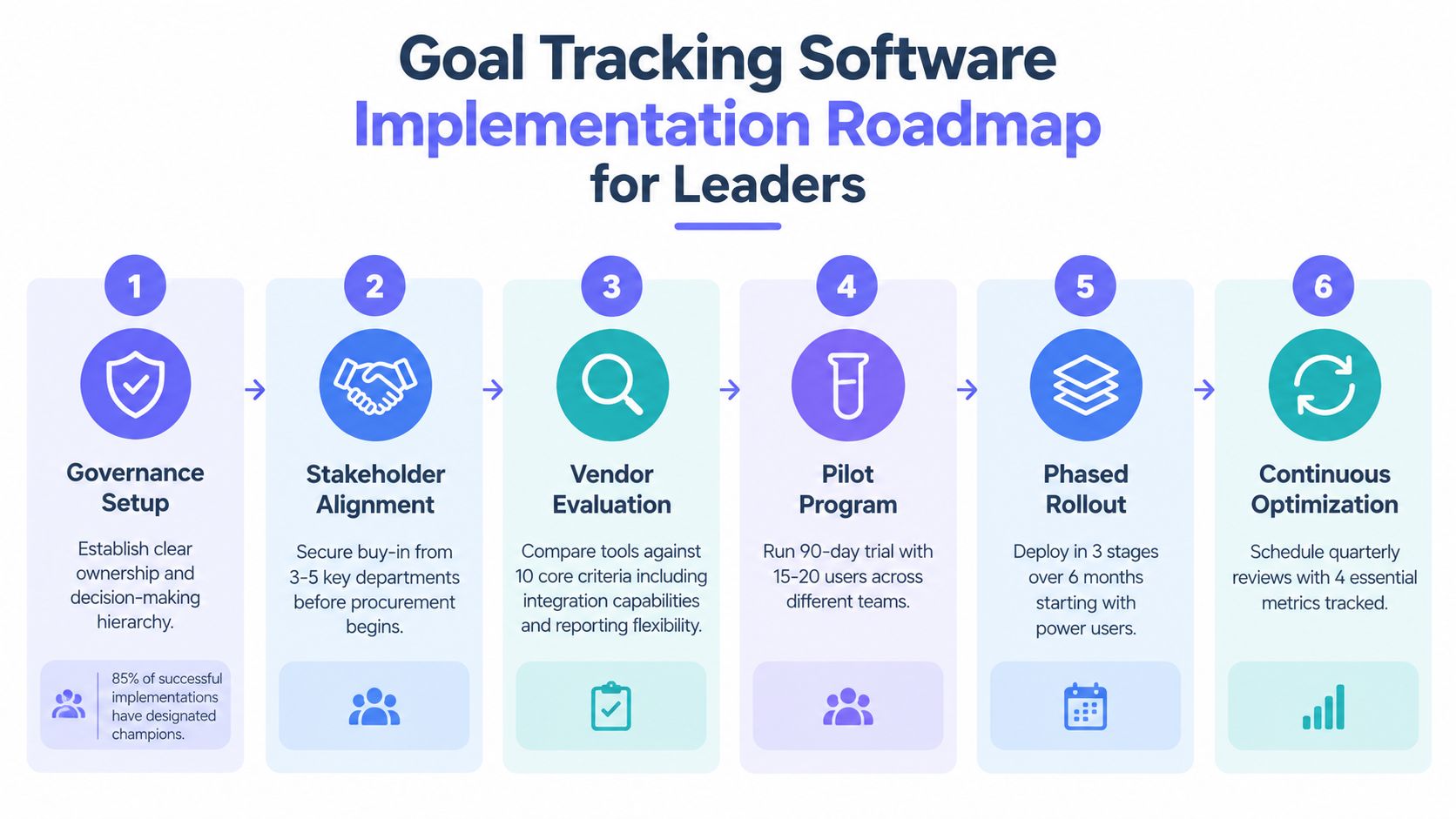
Scale only when the pilot demonstrates a working rhythm. A broad launch can spread bad habits just as efficiently as good ones.
Common Pitfalls and Real-World Rollout Scenarios
A technology scale-up selects a platform with excellent dashboards. Executives can filter by department, view status summaries, and export polished reports. Product and sales teams still plan independently. Marketing changes priorities without updating product dependencies. The dashboard shows the consequences, but it doesn't make the relationships between teams easier to manage.
This is a visibility failure disguised as an analytics success. UK organisational alignment data shows that horizontal misalignment affects 73% of respondents regularly or very often, while diagonal misalignment affects 58% and vertical misalignment affects 46%, according to UK leadership alignment research. A platform that gives each function a better personal view can still leave the organisation poorly aligned.

Scenario one, the dashboard-first scale-up
Symptom: Every team reports healthy progress, but shared launches keep slipping.
Cause: The platform tracks team objectives separately. Owners can update status, but dependencies aren't discussed in a common forum.
Correction: Add shared objectives, dependency reviews, and an escalation rule. Require managers to identify which other teams must act before a result can move. The executive view should show relationships and decisions, not only aggregate status.
Scenario two, the HR-owned programme
An established organisation places OKRs entirely within HR. Employees receive reminders to update goals, and the system links objectives to performance conversations. Operational leaders rarely use the data in their weekly meetings.
The symptom is predictable. Employees treat the platform as an appraisal form. Managers discuss completion of activities instead of changing priorities or removing blockers. The organisation then concludes that OKRs create administration, when the actual problem is that delivery leaders never adopted the operating rhythm.
Move ownership closer to execution. HR and L&D can provide enablement, coaching, and safeguards. Business leaders must own the priorities and use the information to manage delivery.
A goal system fails when the person responsible for the result isn't the person using the information.
Scenario three, the high-growth company that links the cycles
A high-growth business aligns its objective-setting cycle with quarterly business reviews. Teams update progress before the review, managers bring unresolved dependencies, and leaders decide which commitments to stop, continue, or resource differently.
The software isn't doing the leadership work. It is making the work visible at the right time. Owners know when updates are due, managers know which questions to ask, and executives see where intervention is required.
Look for early warning signs
- Green status without evidence: Owners use confidence labels as reassurance rather than as a prompt for discussion.
- Objectives with no trade-offs: Teams add priorities without removing lower-value work.
- Low manager participation: Employees update goals, but managers don't refer to them in one-to-ones or planning meetings.
- Parallel spreadsheets: Leaders request reports outside the platform because the configured views don't answer their questions.
- Constant goal rewriting: Teams change wording to preserve a positive status instead of addressing the underlying delivery issue.
The corrective action is rarely another feature. It is usually a clearer ownership model, a better review question, or a tighter connection between goals and the work managers already control. Further guidance on avoiding these patterns appears in The OKR Hub's overview of common OKR mistakes.
Measuring Whether Your Software Investment Delivers
Software success shouldn't be judged by login activity or the number of objectives created. Those measures can rise while execution remains unchanged. Leaders need evidence that the platform has improved the quality and speed of decisions around important work.
A UK survey of companies with £20m+ turnover found that only 18.4% achieved more than 80% of their aspirational growth goals within three years, while 41.2% failed to reach 60% of their stated targets, according to UK research on operational excellence objectives. That gap gives executives a clear standard. The system must help the organisation deliver more reliably, not merely document ambition.
Use an outcome-based scorecard
Review the rollout against a small set of measures:
- Goal completion quality: Are teams delivering meaningful results, or closing activity items?
- Alignment clarity: Can employees explain how their priorities support current organisational objectives?
- Decision speed: Do leaders identify and resolve risks earlier in the operating cycle?
- Cross-functional coordination: Are dependencies raised before they become missed commitments?
- Manager adoption: Do managers use goal data in reviews, planning, and resource decisions?
- Data reliability: Can leaders trust the information without running a separate reporting process?
Compare the baseline with the position after the first review cycles, then assess whether the improvement persists. Don't reward teams for reporting every goal as healthy. Reward accurate visibility and timely intervention.
A mature system also makes failure more useful. When a goal misses, leaders should be able to see whether the cause was weak prioritisation, insufficient capability, a dependency failure, or a change in strategy. The guide to measuring delivery performance provides a practical basis for building that review discipline.
The best goal tracking software becomes part of management practice. If leaders still rely on separate decks, teams still wait for quarterly reviews, and managers still can't explain which work should stop, the investment hasn't delivered its purpose.
The OKR Hub helps leadership, HR and transformation teams design and implement OKR systems with progress monitoring, structured check-ins, cascading objectives, alignment views, training and hands-on coaching. Visit The OKR Hub to assess whether your current goal tracking approach is improving execution, then build a system that managers can use in the flow of real work.