Only 18.4% of UK companies with turnover above £20 million achieved more than 80% of their aspirational growth goals within three years, while 41.2% failed to achieve 60% or more of their stated targets, according to UK strategy-execution research. The problem isn't a shortage of strategy. Leaders know where they want to go. The failure sits in the operating system that should turn strategic intent into consistent behaviour, decisions and results.
That's why operational excellence objectives need to do more than describe an attractive future. They must change how managers review performance, how teams prioritise work, how functions resolve dependencies and how leaders intervene when delivery slips. OKRs provide the structure, but management discipline determines whether that structure survives contact with daily operations.
Why Most Operational Excellence Objectives Stall
Most operational excellence rollouts stall because a well-written objective never changes daily management behaviour.
“Improve operational efficiency.” “Create a high-performing culture.” “Deliver world-class customer service.” Each statement may support strategy, yet none tells a team which process to change, which behaviour to adopt or what evidence will demonstrate progress. They generate agreement in the planning meeting, then leave managers to interpret the priority for themselves.
The UK execution findings cited above point to a translation failure. The 18.4% success rate shows how rarely strategic ambition becomes sustained delivery, while the 41.2% shortfall shows the cost of losing that connection. In objective wording, the failure appears as broad outcomes with no process owner, operating choice or review evidence.
The objective is rarely the core problem
An operational excellence objective must force a management choice. It should identify the part of the operating model that needs to work better, the outcome that matters and the review rhythm that will keep attention on it.
Vague objectives allow functions to define success independently. Operations may prioritise throughput. Finance may protect cost control. Customer service may preserve response times by passing work to another team. Every function can report progress while the end-to-end experience worsens.
The same rollout pattern follows:
- Strong launch: Leaders introduce OKRs with visible enthusiasm.
- Local interpretation: Teams write objectives around their workload rather than enterprise priorities.
- Weak review: Meetings track activity instead of evidence from process performance.
- Leadership drift: Senior attention moves to another initiative after a few cycles.
- Administrative survival: Teams update status fields without using OKRs to make decisions.
Research on why OKR rollouts fail connects stalled rollouts with this operating failure, not merely poor wording. OKRs become a reporting layer when leaders do not connect them to resource allocation, performance conversations and escalation.
Practical rule: If an objective does not change what a manager reviews every week, it is not an operational objective. It is a slogan.
Effective objectives expose trade-offs. If cycle time must fall, which approval will disappear? If service-level adherence must improve, which handoff needs a named owner? If quality must rise, which leading signal will show that the process is stabilising before customers experience failure?
The answer is fewer, sharper objectives embedded in the management system that controls delivery. Writing better OKRs matters, but changing what leaders inspect, decide and escalate determines whether those objectives survive daily operations.
The Management Capability Gap Behind Poor Execution
Objectives do not execute themselves. Managers do. They set expectations, inspect evidence, coach weak performance, remove blockers and decide which work loses priority. If those behaviours vary by manager, a well-designed operational excellence objective becomes a decorative entry in a dashboard.
Official ONS management-practices data records an overall mean management-practices score of 0.55 on a 0-to-1 scale in 2023 across UK and Great Britain firms. Scores were 0.56 in England, 0.55 in Wales, 0.52 in Scotland and 0.52 in Northern Ireland. The series also links management practice with productivity and shows variation across regions and firm types.
A 250-person scale-up scoring 0.52 could still write excellent objectives and fail to deliver them. If managers review updates only at the end of each quarter, blockers remain hidden, owners wait for decisions and teams optimise locally. Weekly evidence-based reviews would expose those constraints early, giving leaders a chance to act before missed performance becomes normal.
Routines create the performance difference
UK evidence connects structured management practices with better performance. A CIPD summary of UK research reports that, in 2016, the top half of manufacturing businesses by structured management practices had average productivity 38% greater than those in the bottom half.
The same research identifies performance reviews, managing underperformance, training and promotion among the people-management practices most correlated with productivity. Transformation leaders should therefore connect objectives to people processes. An objective cannot influence execution if managers never use it in reviews, coaching or capability decisions.
Build each objective into observable management actions:
- Review performance: Examine process evidence, not confidence or effort.
- Manage underperformance: Address missed commitments while the cause remains visible.
- Build capability: Train managers and teams in the skills the process requires.
- Recognise delivery: Reinforce behaviours that improve the system, not only individual heroics.
- Improve the process: Treat recurring misses as evidence of a broken workflow, unclear decision right or missing capability.
Use the Paradigm International manager accountability guide to define what managers must own, inspect and escalate. “Own the objective” is too vague. “Review the leading indicators every week, remove one documented blocker and escalate unresolved cross-functional issues within the agreed cadence” gives managers observable responsibilities.
A leadership capability framework should assess whether leaders translate priorities, run effective reviews, make trade-offs and hold teams to outcomes without turning accountability into blame.
Operational excellence objectives must force management behaviours. Without that connection, they remain abstract statements attached to a dashboard.
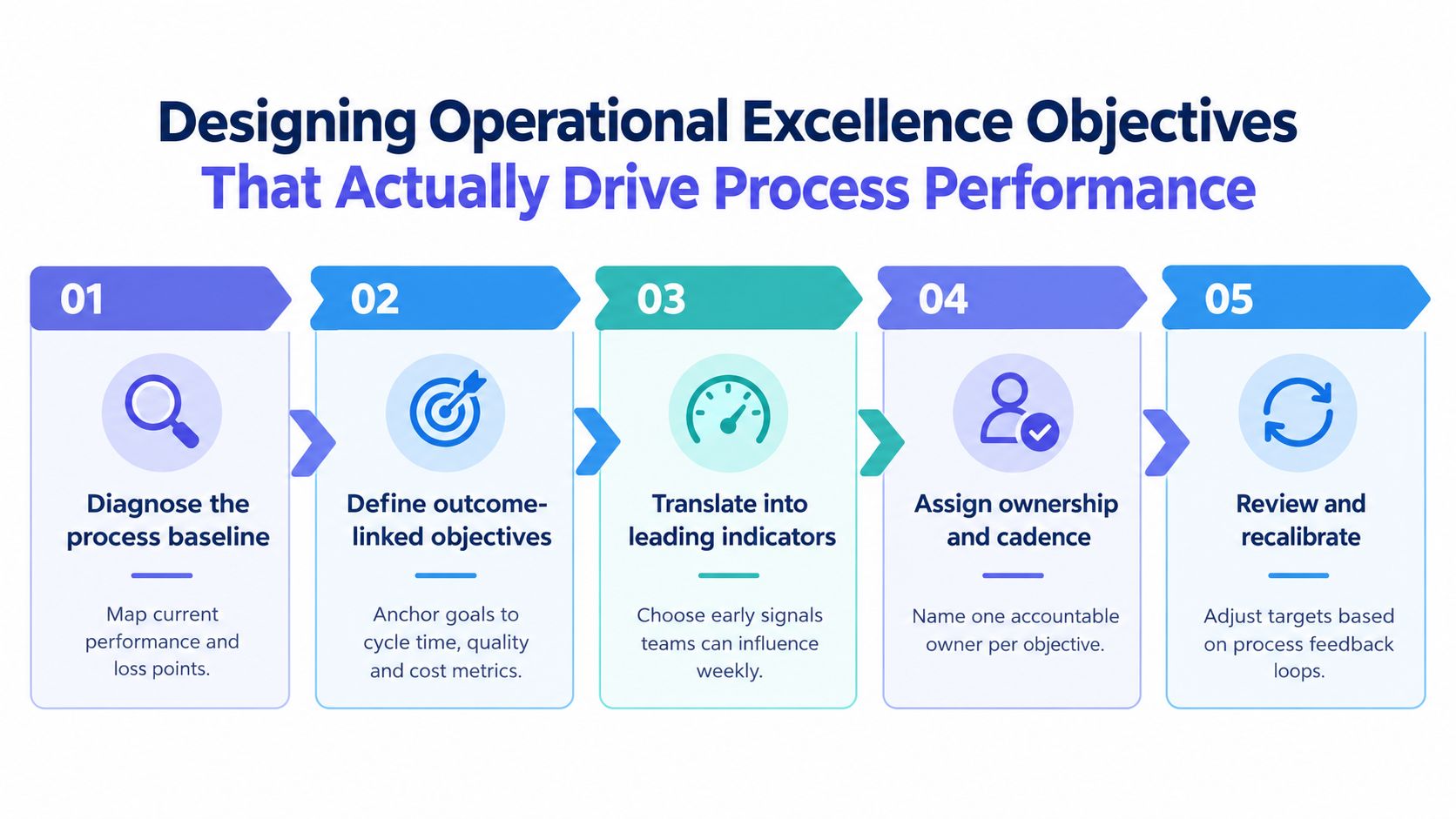
Designing Operational Excellence Objectives That Actually Drive Process Performance
Operational excellence isn't a personality trait or a branding phrase. A UK government Defence Equipment and Support strategy defines it through consistency, reliability and a standardised stakeholder experience. That definition has a practical consequence: objectives should describe process performance, not enthusiasm.
“Become more efficient” is weak. “Stabilise the order-to-delivery process so teams meet agreed service levels consistently” gives leaders a starting point. The key results should then measure the process, such as defects, cycle time, service-level adherence or handoff quality.
Start with the strategic outcome
Begin with the business result, not the department's preferred initiative. If the strategy requires faster customer delivery, the operational objective may concern fulfilment reliability, not the implementation of a new workflow tool. If the strategy requires profitable growth, the process objective may address quote turnaround, onboarding quality or capacity release.
Use this sequence:
- Name the strategic outcome. State what the organisation must achieve for customers, growth, resilience or control.
- Locate the process constraint. Identify where work slows, fails, gets reworked or waits for a decision.
- Write the objective around the outcome. Make it understandable to the people who run the process.
- Choose evidence that proves improvement. Use a small set of process measures rather than a long activity list.
The objective should be qualitative and directional. The key results should show whether the operating condition is changing. Initiatives should explain the work required, but they mustn't masquerade as results.
Build a four-stage cascade
A practical cascade connects four levels without turning strategy into a chain of disconnected targets.
Stage one, strategic intent. The executive team defines the outcome and the trade-offs. They decide whether the priority is speed, reliability, quality, cost, customer experience or a deliberate balance.
Stage two, process performance. Process owners translate that outcome into measures. A service objective might connect to response time and handoff reliability. A quality objective might connect to defect patterns and first-time-right performance.
Stage three, leading indicators. Teams select signals they can influence during the cycle. Waiting time for approvals, unresolved exceptions and adherence to standard work often tell managers more than a lagging quarterly result.
Stage four, governance evidence. Leaders verify adoption through meeting records, decision logs, action closure and visible changes in performance. A published objective doesn't prove that the organisation has adopted it.
Write outcomes that expose ownership
Weak key results describe activity:
- Launch a new dashboard.
- Run process training.
- Hold improvement workshops.
- Complete a system review.
Those initiatives may be necessary, but they don't prove that the process performs better. Stronger key results describe the condition the business needs to see, with a named owner and a review cadence.
Use one accountable owner per objective. Contributors can be numerous, but accountability must be singular. Otherwise, a missed result becomes a debate about dependencies rather than a decision about intervention.
Keep the cascade visible in governance forums. If the objective doesn't appear in the meeting where priorities, capacity and risks are decided, it won't compete successfully with urgent operational noise. For a deeper treatment of measurable goals, use this guide to outcome-based objectives.
Aligning Operational Excellence Across Functions and Leadership Layers
Alignment isn't a communications exercise. It's an operating design problem.
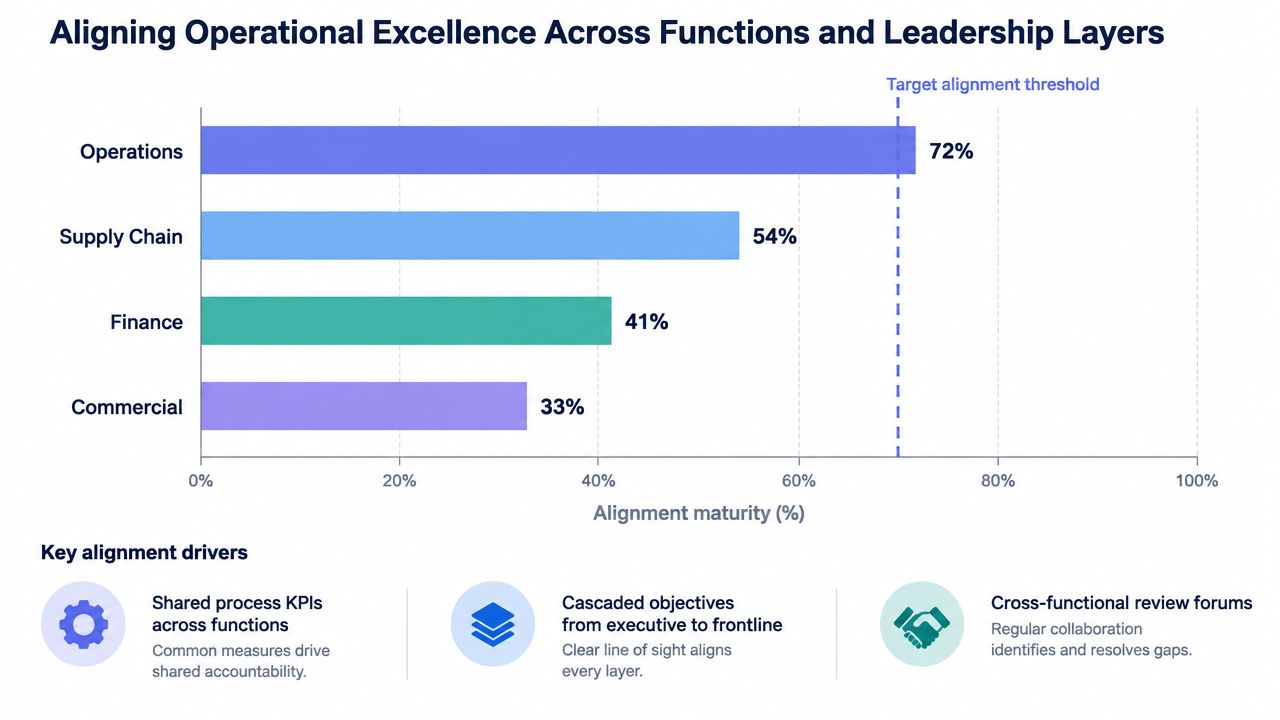
A UK organisational alignment analysis found that horizontal misalignment affected 73% of respondents regularly or very often, while diagonal misalignment affected 58% and vertical misalignment affected 46%, according to UK alignment research. These are different failure points. Horizontal misalignment sits between functions. Diagonal misalignment cuts across teams and management levels. Vertical misalignment separates strategic intent from frontline execution.
A cascade alone won't fix them. Teams need shared measures, shared forums and explicit decision rights.
Fix the horizontal fault line
Consider a customer onboarding process. Sales wants speed and conversion. Risk wants control. Implementation wants complete information. Customer success wants a clean handover. If each function carries a separate objective, the process will optimise locally and frustrate the customer.
Give the end-to-end process a shared objective. Assign each function a contribution, then define the points where decisions must be made together. The review should focus on the full flow, not four departmental scorecards.
A useful cross-functional rhythm includes:
- One process owner: Accountable for the outcome across organisational boundaries.
- Shared process measures: The same definitions and data source for every function.
- Dependency review: A standing discussion of blocked handoffs and unresolved decisions.
- Escalation rules: Clear conditions for moving a problem to the next governance level.
- Decision records: A visible log showing what changed, who decided and when.
Make transparency part of performance
The case for transparency extends beyond efficiency. A 2026 UK business survey found that 73% of respondents want companies to make measurable commitments to ethical and social accountability. Leaders can't credibly promise accountability externally while operating with opaque ownership internally.
Transparency doesn't mean publishing every metric to everyone. It means making the important commitments visible to the people who must deliver them, using definitions they understand and evidence they can challenge.
Operational assets need the same treatment. Plant and facilities leaders, for example, can explore how to cut downtime using predictive maintenance when equipment reliability is a constraint on customer or production outcomes. The point isn't to add another initiative. It's to connect the intervention to the process result and make the dependency visible to every affected function.
Use a deliberate cross-functional alignment approach to expose where objectives conflict. Alignment becomes real when teams can see the same problem, accept the same definition of success and make decisions in the same forum.
Embedding Operational Excellence Into Governance and Review Cycles
An objective becomes operational only when it enters the calendar.
The main execution barrier identified by the March 2025 UK strategy-execution survey was a talent and capability gap, named by 50.4% of respondents, according to the survey findings. The same research identified a talent gap, weak alignment between operations and strategy, and misaligned organisational culture as leading blockers in larger firms.
That combination explains why many OKR programmes look healthy in the platform and weak in the business. People may understand the terminology, but managers don't know how to use the information to challenge assumptions, shift resources or address underperformance.
Replace status reporting with operational review
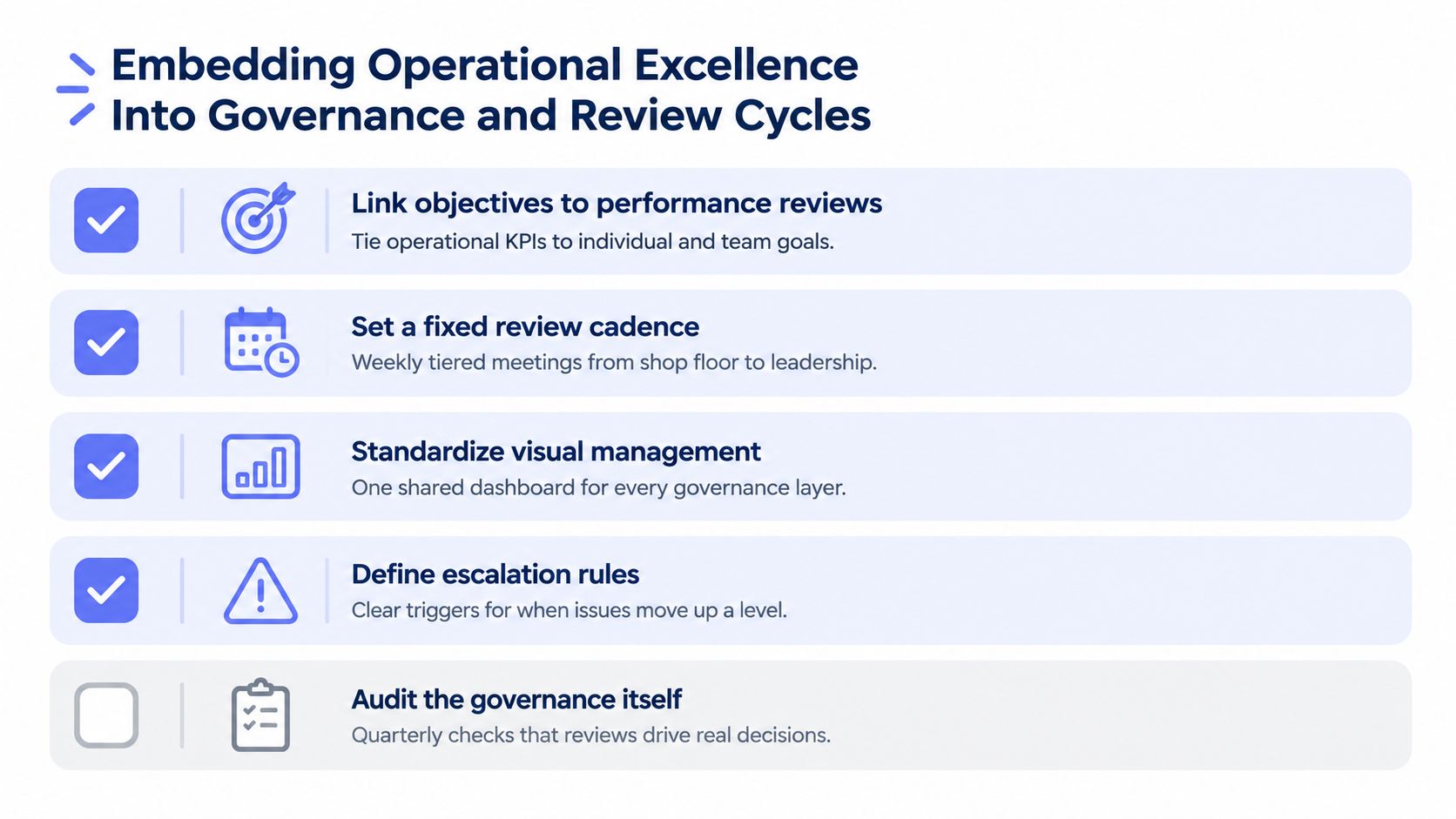
A status meeting asks whether work is on track. An operational review asks what the evidence says, what has changed and what decision is required.
Use a fixed rhythm with distinct purposes:
- Weekly team review: Check leading indicators, surface blockers and confirm the next action.
- Cross-functional review: Resolve dependencies that no single team can remove.
- Leadership review: Reallocate capacity, settle trade-offs and intervene on material risks.
- Cycle review: Assess the result and the quality of the operating system that produced it.
- Retrospective: Improve the objective-setting and review process before the next cycle.
Many organisations get the sequence wrong. They create a dashboard first, then ask managers to use it. Start with the decisions the organisation needs to make, then design the evidence and meeting around those decisions.
Make capability and culture visible
Capability gaps should appear in the objective system as operating risks. If managers can't interpret process data, coach teams or handle difficult trade-offs, training is not a side initiative. It's part of the execution design.
Culture also needs an operational definition. “Collaboration” means little unless leaders can observe whether teams share information, resolve dependencies and accept joint accountability for the customer outcome. “Ownership” means little if managers can avoid a miss by pointing to another function.
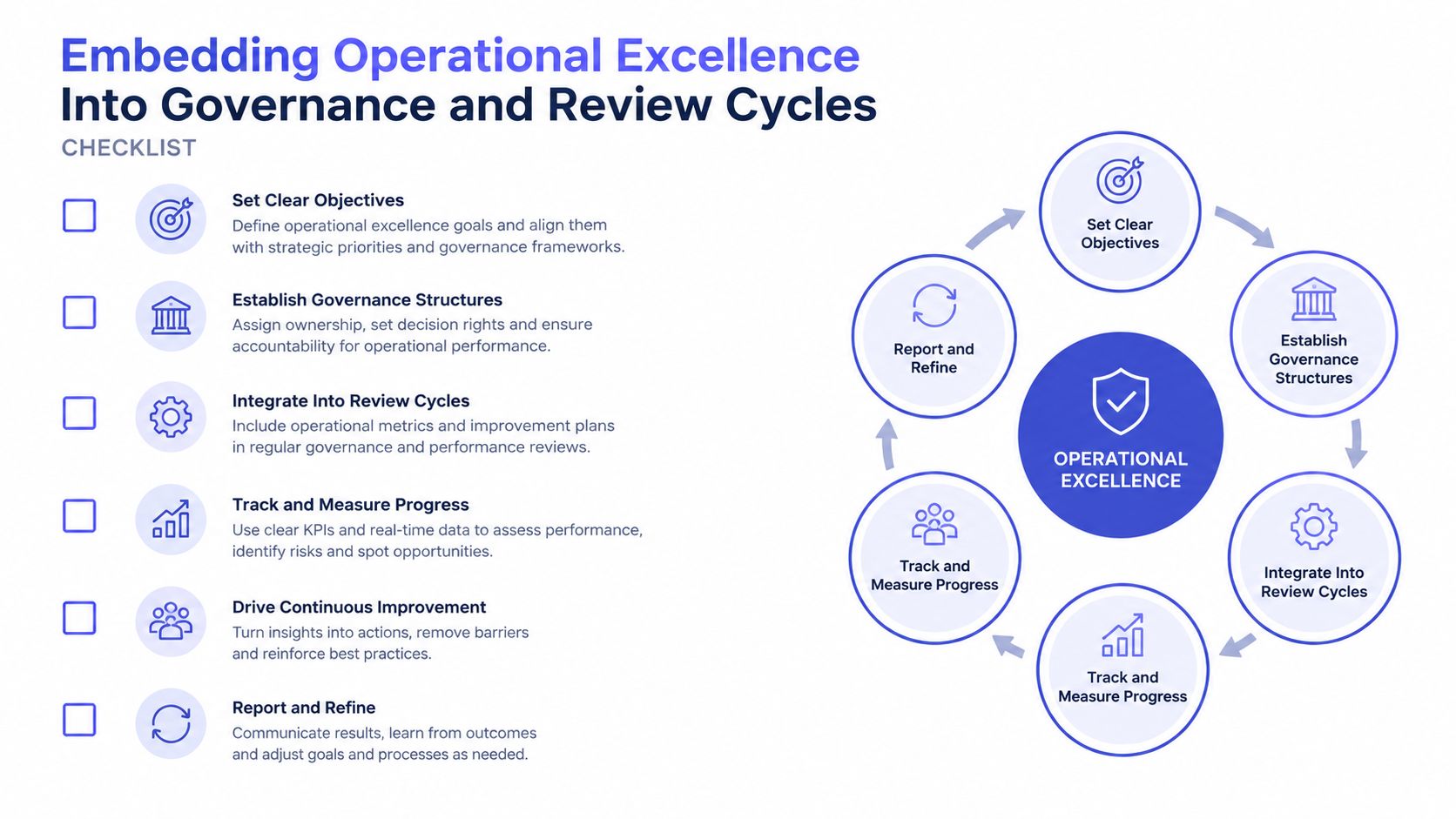
A practical governance checklist asks:
- Who owns the result? One person must be accountable.
- What evidence changes the decision? Define the threshold before the meeting.
- Which dependency needs another function? Name it rather than burying it in commentary.
- What capability is missing? Separate a skills issue from a capacity or process issue.
- What action follows a miss? Replan, escalate, coach, redesign or stop the initiative.
Use governance meeting design for OKRs to keep the cadence focused on decisions. Governance should create movement, not a more elaborate reporting ritual.
The test is simple. After the meeting, can a team say what decision was made, who owns the next action and which evidence will be reviewed next time? If not, the meeting is producing administration rather than accountability.
Real-World Scenarios and Next Steps for Leaders
A national service organisation sets an objective to improve customer reliability. The central team writes a key result about launching a new case-management platform. Regional teams write separate targets for training completion. Leaders celebrate the rollout, but customers still experience inconsistent handoffs because no one owns the process from intake to resolution.
That is an initiative cascade, not an operational excellence cascade.
A stronger design starts with the customer outcome. The process owner maps where cases wait, defines the service experience that must become consistent and gives each function a contribution to the same result. Managers review queue conditions and handoff failures every week. Senior leaders intervene when a policy, capacity constraint or system decision blocks the flow.
Three situations leaders should recognise
The growing scale-up: Founders still resolve exceptions personally. Teams move quickly, but priorities change through private conversations. The first operational objective should establish a visible decision rhythm and clarify which outcomes each leadership team owns.
The established enterprise: Every function has a full OKR set, but no one can explain which objectives depend on one another. The priority is to identify a small number of end-to-end processes, appoint owners and remove conflicting measures.
The transformation programme: The programme office reports milestones, while operational leaders report business-as-usual performance. The fix is to connect transformation initiatives to process key results and make business owners accountable for adoption and realised outcomes.
The diagnostic question: Which meeting would stop happening, which decision would change and which manager would act differently if this objective disappeared?
Start with an evidence-led diagnosis. Review missed commitments, recurring escalations, delayed decisions and measures that teams interpret differently. Then select a small number of process priorities, define ownership and embed them in existing performance and governance routines.
Don't launch another OKR cycle until leaders can answer four questions: what outcome matters, which process constrains it, who owns the result and what evidence will trigger intervention. That discipline turns OKRs from a planning exercise into a management system.
The OKR Hub helps leadership teams diagnose execution gaps, redesign OKRs and embed them into governance, operating rhythms and team delivery through its OKR Focus Flow. Visit The OKR Hub to explore an OKR assessment, implementation support or practical leadership coaching for operational excellence objectives.