The leadership team agrees on the strategy. The board sees a credible growth path. The slide deck is polished, the priorities sound sensible, and every function leaves the planning session apparently committed.
Three weeks later, product is building features sales can't position, marketing is chasing demand that operations can't fulfil, and finance is asking for evidence nobody has time to produce. Decisions wait for another meeting. Two teams solve the same problem. Nobody can explain which work should stop.
That isn't a strategy problem alone. It's a business process alignment problem. Strategy has failed to travel into ownership, decisions, handoffs and weekly work. OKRs can help, but only when they operate as part of an execution system rather than as a quarterly reporting exercise.
Why Business Process Alignment Breaks Execution
A scale-up can have a clear strategic ambition and still execute badly. The chief executive wants expansion into a new market. The product director prioritises platform reliability. Sales wants more custom functionality to close enterprise deals. Customer success wants fewer implementation problems. Each priority is reasonable in isolation. Together, they create a queue of competing work with no agreed decision rule.
The symptoms appear quickly:
- Priorities multiply: Teams treat every leadership request as urgent.
- Decisions slow down: People escalate routine choices because decision rights are unclear.
- Work gets duplicated: Functions create separate analyses, campaigns or solutions.
- Accountability becomes blurred: Several people contribute, but nobody owns the outcome.
- OKRs become activity lists: Teams report tasks completed without proving strategic progress.
UK evidence shows the size of the ambition-to-delivery gap. A 2025 survey of large UK companies found that only 18.4% achieved more than 80% of their aspirational growth goals within three years, while 41.2% failed to achieve 60% or more of their stated targets in the same period, according to UK evidence on growth ambitions and strategy execution. A strong strategy document doesn't close that gap. The operating system does.

Alignment is a chain, not a statement
Effective alignment creates a visible chain:
Strategic choice → measurable outcome → accountable owner → connected process → recurring review → corrective decision.
Break one link and delivery weakens. A leadership team may define a strategic priority, but if no one owns the result, teams optimise locally. A team may own a result, but if the process depends on an unresponsive department, the owner has responsibility without control. An OKR may be measurable, but if nobody reviews it when assumptions change, it becomes historical reporting.
This is why leaders should treat business process alignment as the bridge between intent and execution. The practical role may sit with a chief operating officer, chief of staff or operations lead. Guidance on the command function for startup execution is useful here because it frames execution as coordinated work across priorities, people and operating mechanisms.
The right diagnostic question isn't, “Is our strategy clear?” Ask instead, “Can a team make the right decision on Tuesday morning without waiting for a leadership meeting?” That question exposes the actual operating gaps. It also provides a sharper lens than another strategy workshop, as shown in why strategy execution fails.
Practical rule: If a priority doesn't change ownership, workflow or decision behaviour, it hasn't become operational.
The fix follows a simple sequence. Diagnose where work breaks. Redesign processes around shared outcomes. Embed the new rules into operating rhythms. OKRs provide the language for measurable outcomes, but governance and process design make those outcomes achievable.
How to Diagnose Misalignment Across Teams and Processes
Start with observed behaviour, not opinions about culture. Ask people to walk through a recent piece of work from request to completion. Record where the work waited, who made each decision, what information was missing and which team received the handoff. The gaps are usually visible in the workflow long before they appear in an engagement survey.
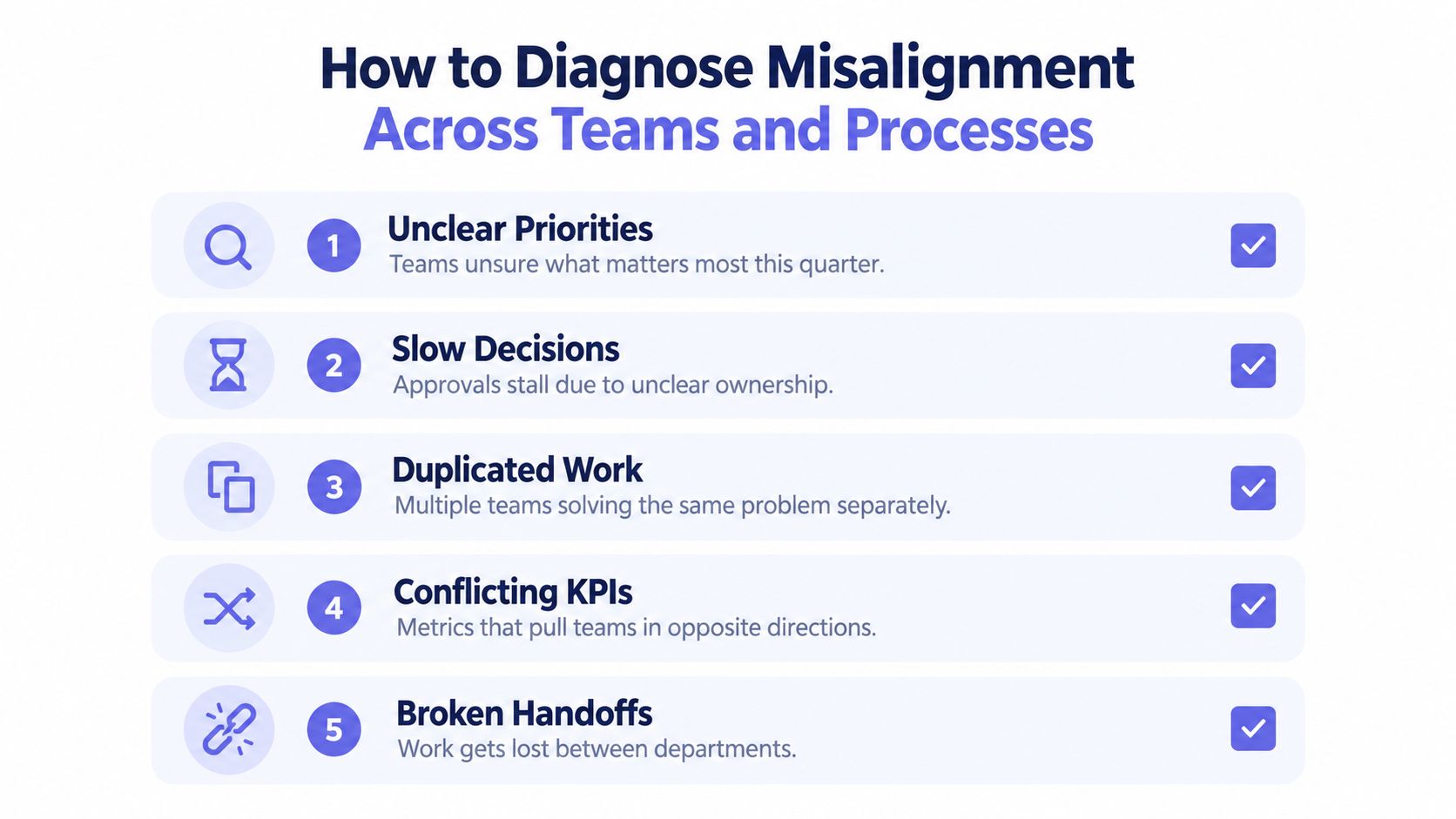
UK worker data illustrates why this approach matters. 53% of UK workers spend up to two hours per day searching for information, 44% say they don't meet objectives because of information gaps, 31% say projects miss deadlines or objectives because of miscommunication or missing details, and 47% say their project teams lack alignment, according to UK workflow productivity data. These are process signals, not merely communication preferences.
Trace the failure through the handoff
Interview the sender and receiver separately. Ask both:
- What does “ready” mean before work moves to the next team?
- Which information must travel with the request?
- Who can reject incomplete work?
- What decision can the receiving team make without escalation?
- How does the sender know the work was accepted?
- What happens when the priority changes?
Different answers indicate a broken operating contract. The remedy may be a clearer intake form, a service-level expectation, a decision owner or a shared definition of completion. It probably isn't another collaboration tool.
Decision latency deserves its own inspection. UK process data says 41% of workers need up to three hours to reach consensus on what work should be done, while 37% leave meetings unsure of the next steps. Review a sample of recent meetings and look for three outputs: a decision, a named owner and a dated next action. If one is missing, the meeting created discussion rather than progress.
Use a short diagnostic scorecard
Keep the assessment simple enough to repeat. Rate each item as clear, partial or unclear:
- Priority line of sight: Can each team explain which strategic outcome its current work supports?
- Ownership coverage: Does every strategic priority have one accountable owner?
- Information flow: Can teams find the inputs required to make routine decisions?
- Decision rights: Do people know who decides, who advises and who executes?
- Handoff quality: Does work arrive with agreed inputs, acceptance criteria and context?
- Consensus speed: Can teams reach a decision without repeated escalation?
- Metric coherence: Do team measures reinforce each other rather than create competing incentives?
Prioritise the item that blocks the most downstream work. A leadership team shouldn't redesign every process at once. It should fix the constraint that creates the greatest queue, rework or escalation load.
For a more structured review, use a performance diagnostics framework to connect workflow symptoms with ownership, capability and execution behaviour. The output should be a small number of testable problems, such as “commercial proposals wait for product approval” or “customer onboarding lacks a single accountable owner”. Those statements are actionable. “Teams aren't aligned” isn't.
Redesigning Processes Around Strategy and OKRs
Process redesign should begin with the value gap, not the software. Define the difference between the organisation's current position and the future state required by the strategy. Then translate that gap into outcomes that teams can influence and leaders can inspect.
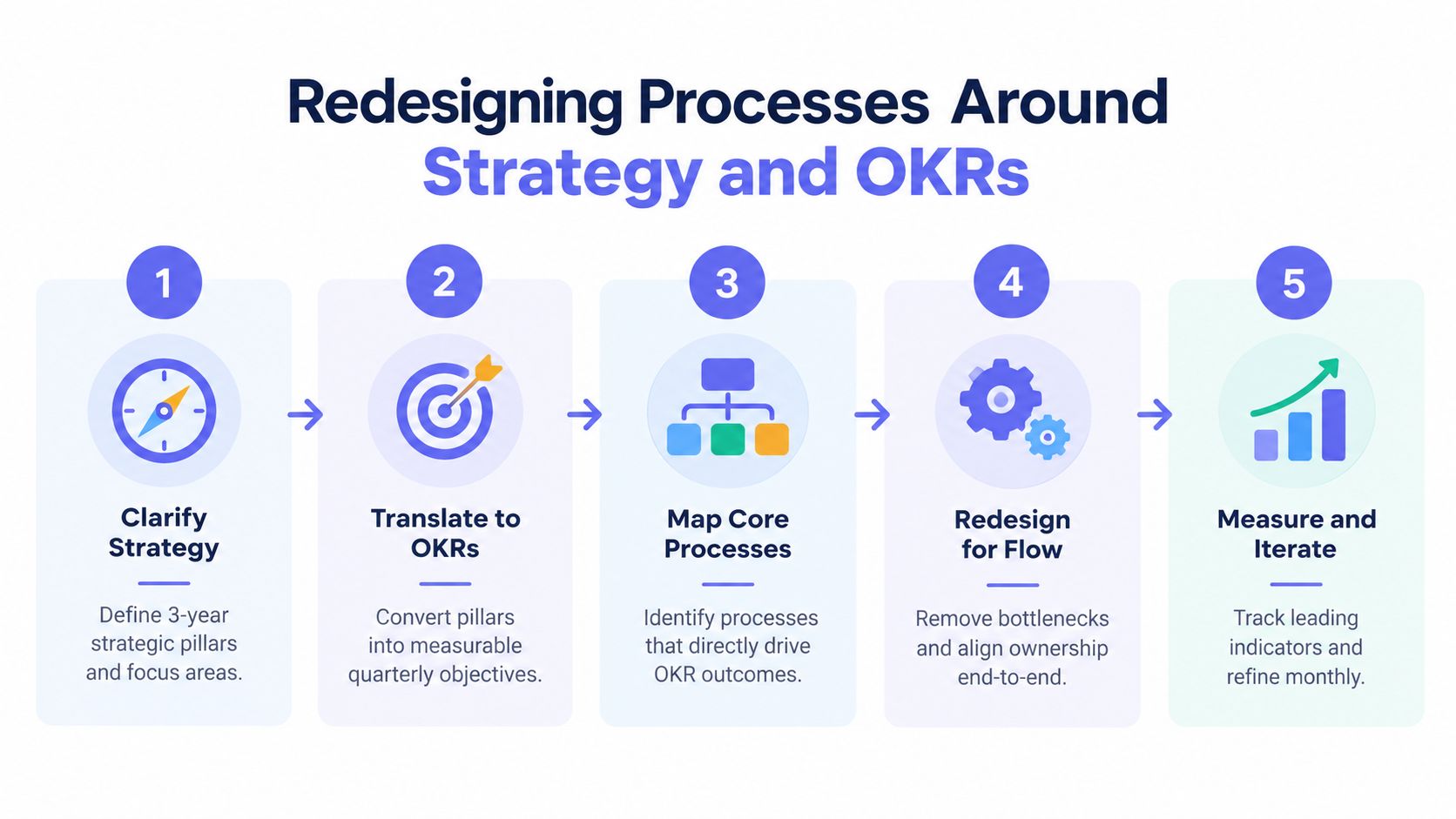
A practical redesign has five moves.
Clarify the strategic choice
State what the organisation will prioritise and what it won't pursue for the planning period. A growth objective without a market, customer or capability choice leaves every function free to interpret it differently.
Translate the choice into outcomes
Convert the strategic pillar into a small set of quarterly objectives and measurable key results. The objective describes the change required. The key result shows whether that change is happening.
Keep the scope tight. A UK small-business OKR guide recommends 1–3 objectives per team or individual, monthly OKR check-ins and a quarterly retrospective, while framing OKRs as a focus tool rather than another layer of administration, as described in this UK guide to using OKRs for teams and individuals. More objectives don't create more alignment. They dilute attention.
Map the process that drives the result
Take one key result and trace the work behind it. If the result concerns successful enterprise onboarding, map sales qualification, solution design, contracting, implementation and customer handover. Identify the point at which information changes hands, then define the minimum input and acceptance condition for each transition.
This exposes a common failure. The team accountable for the outcome often controls only one stage of the process. End-to-end ownership must include the authority to resolve dependencies or force a timely escalation.
Redesign decision rights and flow
Remove approvals that exist only because nobody has defined authority. Assign one decision owner. List the people who provide advice, the teams that execute the decision and the conditions that require escalation.
Do not automate an unclear rule. A workflow tool can route a bad request faster, but it won't decide what “complete” means or resolve conflicting priorities. Fix the rule first, then configure the tool.
Define measurement and iteration
Choose leading indicators that show whether the process is moving, alongside the key result that shows whether the outcome arrived. Review both during the operating cycle. If a handoff repeatedly fails, change the process rather than asking the team to work harder.
The useful distinction is between local efficiency and strategic flow. A department may reduce its own queue while creating more rework for the next team. Business process alignment asks whether the full chain moves towards the shared result. The inputs, processes and outputs model provides a practical way to test that connection without turning process documentation into an end in itself.
Embedding Alignment Into Operating Rhythms and Governance
A redesigned process won't survive if leaders revert to ad hoc requests. Alignment becomes durable when the organisation reviews priorities, dependencies and decisions at predictable points. The rhythm should be light enough to maintain and firm enough to prevent drift.
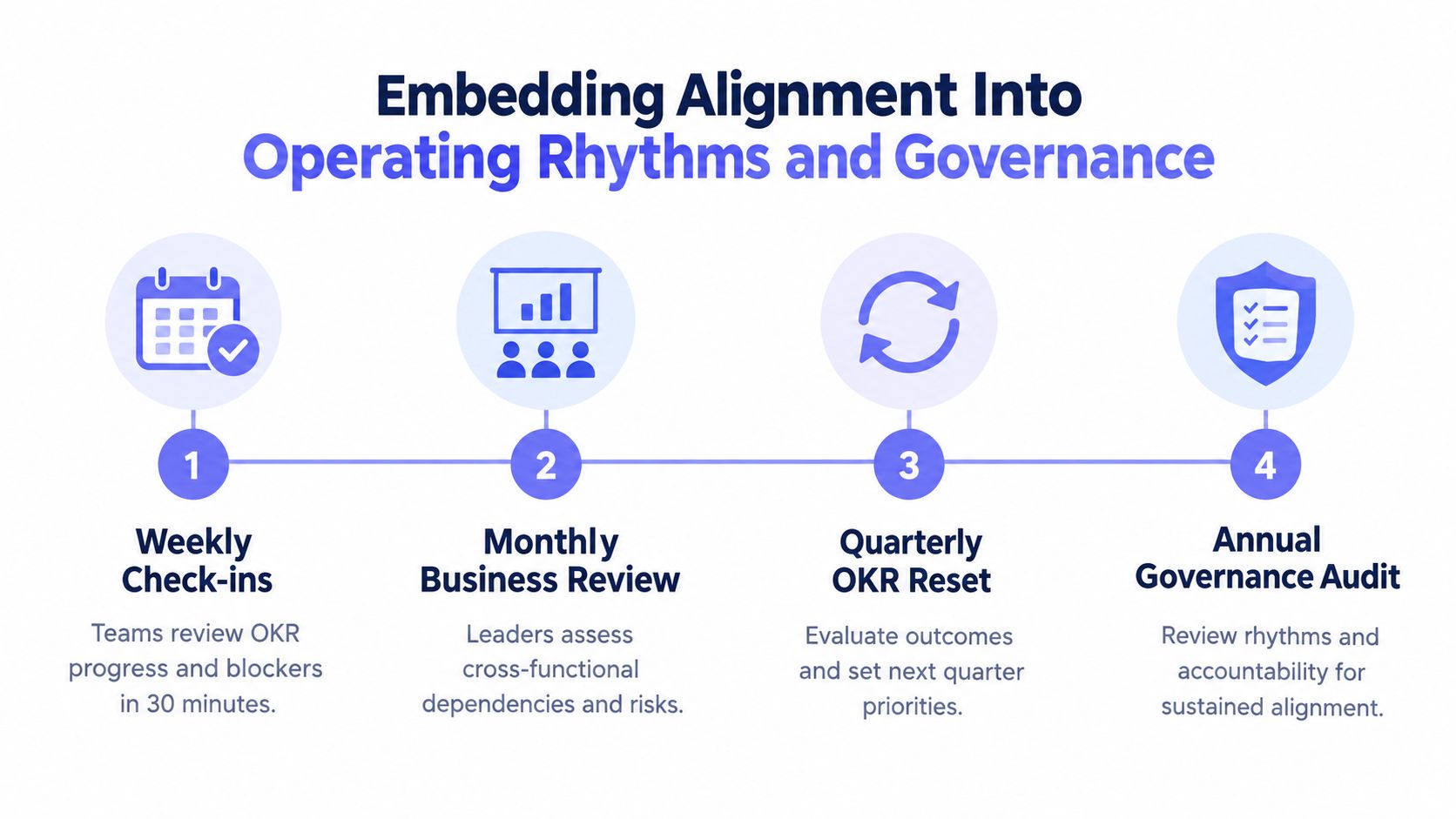
Weekly execution review
Teams should inspect progress against their OKRs, surface blockers and confirm the next decisions. Keep the conversation close to the work. A useful review asks:
- What changed since the last check-in?
- Which result is at risk?
- What dependency is blocking progress?
- Who will resolve it?
- What decision is needed, by whom and by when?
A meeting that only updates a traffic-light dashboard misses the point. The value sits in the decisions and interventions that follow.
Monthly cross-functional review
Leaders examine dependencies that teams can't resolve alone. They should challenge priority conflicts, review resource assumptions and confirm that decisions still hold. If the same issue appears every month, assign an owner to fix the underlying process rather than carrying the issue forward.
Chiefs of Staff and PMO leaders can provide useful coordination here, but they shouldn't become a permanent escalation channel for decisions that belong elsewhere. Their role is to expose patterns, maintain governance and help leadership clarify decision rights. Accountability remains with the business owner.
Quarterly reset
The quarterly retrospective should separate three questions:
- Outcome: Did the key result move?
- System: Did the process support or obstruct delivery?
- Learning: What assumption should change next quarter?
Teams should stop work that no longer supports the strategy. They should also preserve useful practices rather than redesigning everything because one result missed its target. The aim is controlled adaptation, not constant reorganisation.
UK-focused guidance recommends measuring alignment where work happens, not only where strategy is approved. Its checks include line of sight between team OKRs and strategic priorities, ownership coverage for every priority, and decision stability, including leadership reversals that force teams to restart work or wait for escalation, as set out in how to measure strategic alignment.
Use an operating rhythm framework to define the minimum cadence, participants, inputs and outputs. The standard should be consistency, not meeting volume.
Alignment survives when the same priorities shape weekly decisions, monthly trade-offs and quarterly resets.
Measuring What Matters and Proving Alignment Is Working
Leaders often measure alignment through plan completion or the number of teams with published OKRs. Those measures show adoption. They don't prove execution has improved.
Use two layers. Leading measures reveal whether the operating system is functioning now. Lagging measures show whether that behaviour produced the intended business outcome. A team might have excellent ownership coverage but still miss a result because its market assumption was wrong. Measurement should help leaders distinguish execution failure from strategic learning.
Slack's UK State of Work research surveyed 3,000 UK knowledge workers. It found that aligned workers were more than three times as likely as unaligned workers to say they understood company strategy, four times as likely to feel able to make strategic decisions or pursue new opportunities, and more likely to expect revenue growth for their company, according to the UK workforce research source. The practical implication is clear. Alignment should improve understanding and decision confidence, not merely produce cleaner documentation.
| Alignment Check | What Good Looks Like | Signal It Is Working |
|---|---|---|
| Strategic line of sight | Teams can connect current work to a named strategic priority | People explain why work matters without relying on a strategy presentation |
| Ownership coverage | Every priority and key result has one accountable owner | Escalations reach the right decision-maker quickly |
| Decision stability | Leaders change direction only when evidence or strategy changes | Teams don't repeatedly restart work because of reversals |
| Handoff quality | Each transition has defined inputs, acceptance criteria and an owner | Rework and clarification loops decline |
| Dependency visibility | Cross-functional constraints appear in the weekly review | Teams resolve blockers before they become delivery surprises |
| Key result movement | Outcomes are reviewed alongside process indicators | Leaders can tell whether a miss reflects execution or an invalid assumption |
Compare activity with evidence
Activity metrics answer, “Did people do something?” Alignment metrics answer, “Did the right work move the shared result?” Track completed initiatives, but don't mistake completion for value. Pair delivery data with decision time, unresolved dependencies, ownership gaps and key-result movement.
Avoid a single composite alignment score. It creates false precision and encourages teams to optimise the number. A small dashboard with explicit definitions is more useful. Each metric should trigger a management action, such as clarifying authority, removing a dependency or stopping lower-value work.
Retrospectives complete the loop. Ask which process behaviour helped, which created friction and which governance rule needs changing. Then record the decision and check whether it changes the next operating cycle. That is how measurement becomes a control mechanism rather than reporting overhead.
Making Alignment Last and Taking the Next Step
Business process alignment usually deteriorates after a successful planning cycle. A new customer arrives, a senior leader adds a request, a key employee leaves or the market changes. Teams respond locally. The original operating logic weakens one exception at a time.
The answer isn't to freeze the organisation. It is to make exceptions visible and deliberate. Leaders should revisit priorities when assumptions change, assign ownership when responsibilities move and preserve the review cadence even during pressure. Capability matters too. People need to know how to write outcome-based OKRs, manage dependencies, make decisions within their authority and challenge work that no longer supports the strategy.
UK leaders often ask whether alignment is improving execution or merely producing clearer plans. That question is justified. Recent UK strategy-execution research found that only 18.4% of surveyed companies with £20m+ turnover achieved more than 80% of their aspirational growth goals within three years, while 41.2% failed to achieve 60% or more of their stated targets, as reported in UK strategy execution consulting guidance.
Use that concern to set a practical maturity test:
- Early stage: Priorities exist, but ownership and decision rights are inconsistent.
- Developing: Teams use OKRs, yet cross-functional dependencies still rely on personal relationships.
- Embedded: Weekly reviews, monthly governance and quarterly resets consistently change decisions.
- Resilient: The system adapts to new information without losing strategic focus or accountability.
The measure of progress is not the quality of the strategy document. It is whether teams make faster decisions, understand ownership, complete cleaner handoffs and move outcomes that matter. If those behaviours don't change, the organisation has documented alignment without achieving it.
The OKR Hub helps leadership teams diagnose execution gaps, design aligned OKRs, establish decision rights and embed practical operating rhythms through consulting, implementation, training and coaching. Visit The OKR Hub to explore an OKR assessment or discuss the alignment issues slowing delivery in your organisation.