Leadership teams often think OKR adoption fails because people wrote weak goals. That's usually not the issue. The UK's adoption picture shows the bigger pattern. A government review found 56% of businesses were already using at least one of the surveyed technologies, yet adoption remained uneven in practice. The problem wasn't awareness. It was turning scattered use into consistent execution.
That's exactly what happens with OKRs. Leadership agrees the strategy is clear, but teams still chase competing priorities. Dependencies stay hidden until late in the quarter. Progress reports look fine until suddenly they don't. The launch happens. The system doesn't stick.
Good OKR adoption strategies fix operating conditions, not just wording. They change how decisions get made, how trade-offs are exposed, how blockers move, and who owns results. That's why a stronger rollout usually looks less like a communications campaign and more like a management system.
The eight strategies below are organised around the conditions that make OKRs work in practice. Some fix alignment. Some improve ownership. Others tighten visibility, incentives, or learning. You won't need all of them at once. You need the ones that address your current execution bottleneck.
If your organisation is still treating adoption as a launch event, it helps to start with a more practical change management approach that connects rollout to day-to-day behaviour.
1. Cascading OKRs with Alignment Checkpoints
Most OKR cascades fail for a simple reason. Teams write goals that sound connected to strategy, but nobody tests whether they move the company objective. The result is neat-looking alignment on paper and messy execution in reality.
A better model is staged cascading with explicit checkpoints. Company OKRs come first. Business unit OKRs follow. Team OKRs come after that. Each layer has to show how it contributes upward, where it depends on others, and what won't happen unless another team delivers.
Here's the process in a simple visual.
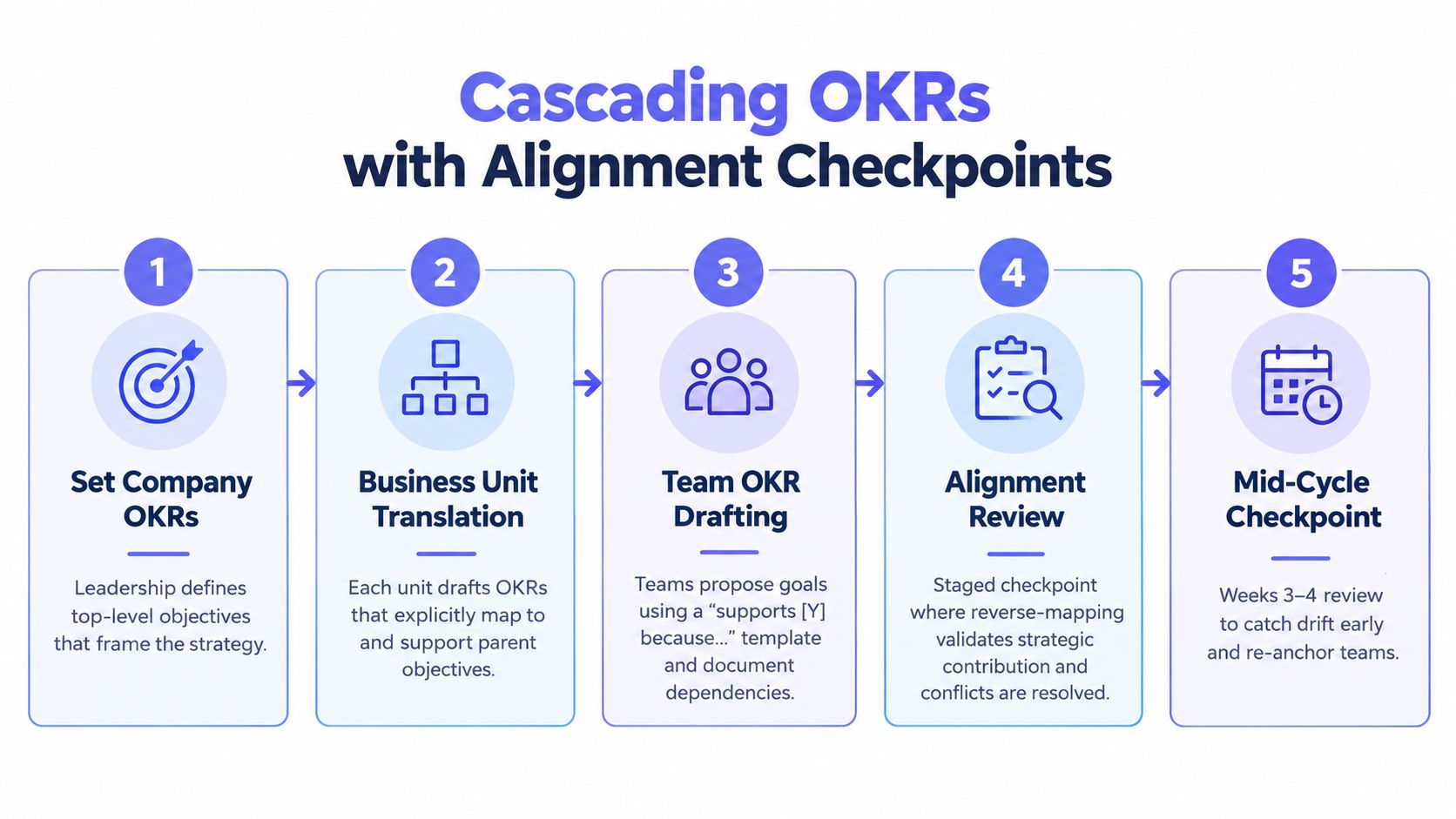
Spotify, Stripe and Adobe each use their own variants of this logic. Squad-level goals feed wider objectives. Contribution maps show how one team supports another. Correlation views surface hidden dependencies before execution starts. The detail differs, but the discipline is the same. Teams don't just submit OKRs. They explain their strategic link.
What to put in the checkpoint
Use one sentence that forces specificity: “Our team OKR supports this company objective because...”. If the sentence is vague, the OKR probably is too. That one line is often enough to expose decorative goals.
A useful support mechanism is a clear cascading communication approach for OKRs that shows teams how to translate strategy without turning the process into a waterfall exercise.
Practical rule: Any team OKR that doesn't map clearly to a company objective should need explicit approval from a senior decision-maker.
A few guardrails make this work:
- Sequence the cascade: Company first, then business units, then teams. Running all levels in parallel creates rework.
- Map dependencies directly: Track who needs what, from whom, and by when.
- Hold a mid-cycle check: Week three or four is early enough to correct misalignment before momentum is lost.
This method adds friction early. That's the point. It's far cheaper than discovering in month two that five teams have been advancing goals no one really needed.
2. Bottom-Up OKR Co-Creation
Top-down OKRs fail at the point of execution. Teams inherit targets they did not shape, then spend the quarter translating, negotiating, or diluting them so the work can get done.
Co-creation solves a different problem than cascading. Cascading checks whether goals connect to strategy. Co-creation tests whether the people doing the work believe the goal is achievable, worth the trade-off, and clear enough to act on. That distinction matters. A perfectly aligned OKR can still be unusable if it ignores capacity, technical debt, customer commitments, or cross-team dependencies.
Atlassian, Buffer and GitLab all use versions of this model. Leadership sets direction and limits. Teams draft the work they believe will move those priorities. Leaders review, challenge, and approve. The value is not democracy. It is better operating judgment before commitments harden.

What usually breaks this process is not lack of enthusiasm. It is vague boundaries.
Give teams a short strategic brief before they draft anything. One page is enough if it includes the current priorities, known constraints, major dependencies, and what success needs to look like this cycle. Without that framing, teams submit either a wishlist or a defensive plan built to survive review.
A healthier proposal process also depends on real staff involvement in execution decisions. If leaders ask teams for input and then override it without explanation, the next round becomes performative.
Instead of a standard checklist section, use a review conversation built around four questions:
- What problem are we trying to move?
- Why is this team the right owner?
- What are we choosing not to do to make room for it?
- What could make this fail halfway through the quarter?
Those questions surface the trade-offs that polished draft OKRs often hide. They also expose a common failure mode. Teams volunteer goals that sound strategic but rely on another function that has not agreed to the work.
Teams rarely object to stretch. They object to commitments that ignore delivery conditions.
Final approval should still sit with a senior leader. The safeguard is transparency. When a proposal is cut, merged, or raised in ambition, record the reason. Over time, those decisions create a reusable standard for what good judgment looks like.
The cost is time up front and a few harder conversations. The payoff is cleaner ownership, fewer mid-quarter resets, and OKRs that survive contact with real operating conditions.
3. OKR-Linked Performance and Compensation
Tie OKRs too tightly to pay and people will protect their score before they protect the business.
That is the central design problem in this section of the operating model. OKRs need enough consequence that leaders and teams take them seriously. They also need enough room for stretch, learning and cross-functional risk-taking. If compensation turns every key result into a personal payout trigger, the system starts producing cautious goals, negotiated baselines and quiet avoidance of hard bets.
The workable middle ground is to use OKRs as evidence in performance discussions, then make pay decisions with judgment. Leaders should look at three things together: outcome quality, difficulty of the objective, and the way the work was carried out. A team that misses an ambitious target because a major dependency failed is different from a team that chose an easy target and hit it cleanly. Compensation design has to preserve that distinction.
This is also why individual OKR payouts usually backfire. They reward local target completion even when the business needs shared execution across product, sales, operations and support. Team-level or company-level weighting creates better pressure. People still care about results, but they have less reason to hoard credit or avoid helping another function.
For leaders reviewing the model, strategic compensation design ideas are useful because they connect incentives to collaboration, risk appetite and long-term priorities rather than simple quarter-end attainment.
A practical review looks like this:
- Check whether high scores are coming from real progress or from low-ambition goal setting.
- Separate the result from the method. Reward strong outcomes, but also examine decision quality, cooperation and risk handling.
- Give managers a formal exception process for disruptions outside the team's control.
- Revisit the plan after each cycle. If nearly every team is fully hitting OKRs, the incentive model is probably teaching caution.
For a more specific take on individual recognition, see rewarding an employee without weakening shared accountability.
The trade-off is obvious. A mixed model is harder to run than a formula. It asks managers to make and defend judgment calls. That extra effort is usually worth it because it protects the operating conditions that make OKRs useful: honest ambition, visible trade-offs, and accountability that improves execution instead of distorting it.
4. Transparent OKR Tracking and Real-Time Progress Visibility
OKRs usually break in the middle of the quarter, not at the review meeting. The review meeting is just when leadership finally sees it.
A tracking system earns its place when it exposes execution risk early enough to change the outcome. Teams need a current view of progress, confidence, dependencies and blockers. Without that, managers are steering from stale status updates, and cross-functional problems sit unresolved until the cycle is nearly over.
The public sector offers a useful warning. The State of Digital Government review reported over £26 billion in annual digital technology spending and nearly 100,000 digital and data professionals, yet 47% of central government and 45% of NHS services still lacked a digital pathway. Spending and staffing were not enough. Gaps stayed hidden in delivery.
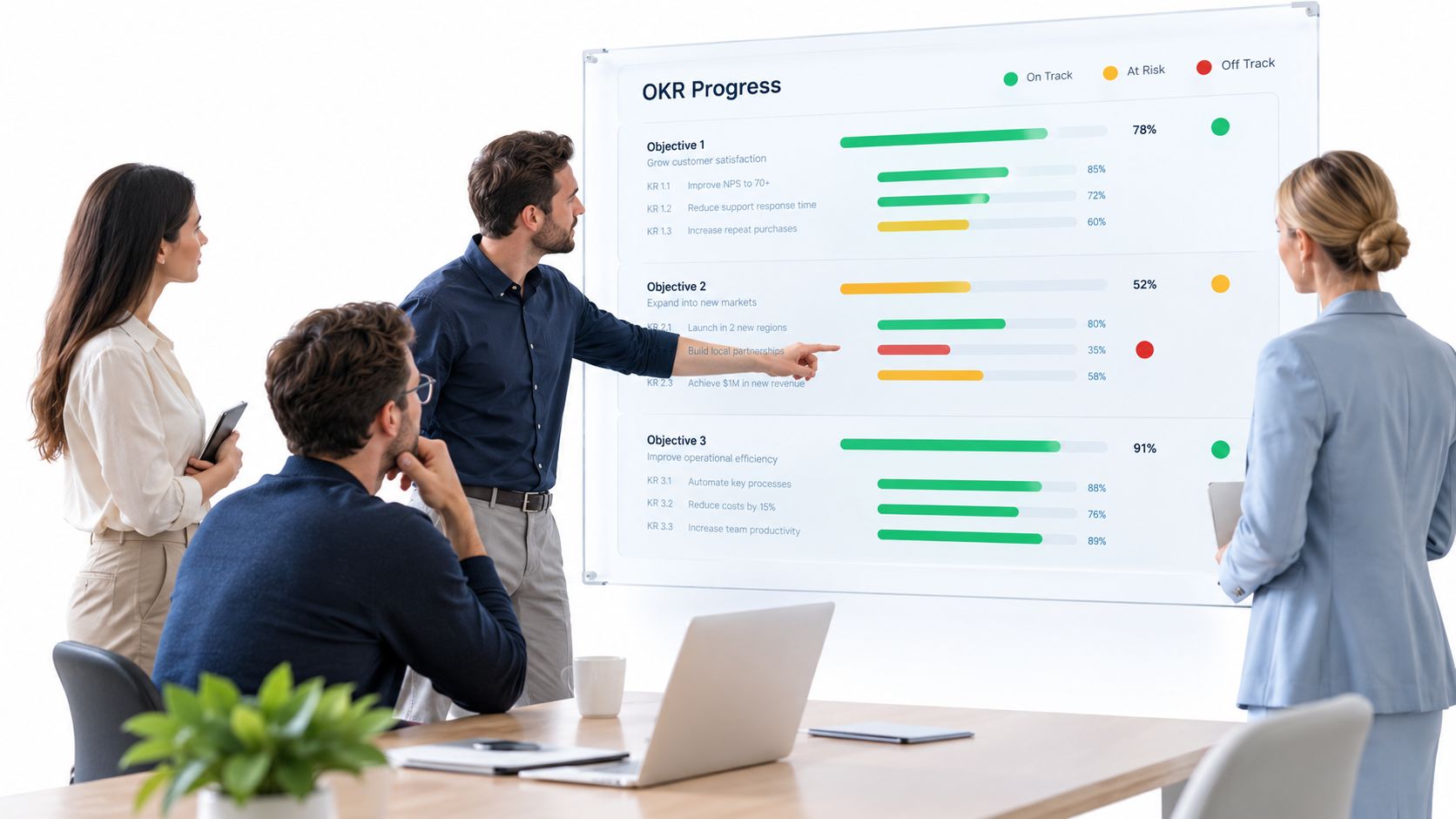
The practical test is simple. If a team misses a key result, could leaders point to the week when confidence dropped, the dependency that slipped, and the decision that should have been made sooner? If not, the organisation is tracking activity, not managing outcomes.
A workable setup stays lean:
- objective and key result
- latest progress update
- current confidence rating
- named owner
- one-line blocker or dependency
- next decision or support needed
For teams building a repeatable OKR tracking system with weekly progress signals and blocker reviews, discipline matters more than dashboard complexity. A simple tool used every week beats a polished dashboard no one trusts.
Two operating choices matter more than the software.
First, set a weekly review rhythm. Monthly reporting is too slow for most execution problems. Product delays, sales capacity gaps, legal review bottlenecks and data issues usually show up gradually. Weekly visibility gives leaders time to reassign work, cut scope, add support or accept the miss early and protect higher-value priorities.
Second, make red status safe to report. Public visibility creates pressure, and that pressure cuts both ways. Used well, it speeds escalation and coordination. Used badly, it teaches teams to keep confidence artificially high until recovery is impossible. Leaders set the tone here. Red should trigger problem-solving, not blame.
One line is often enough to change a meeting: "At risk because analytics dependency moved by two weeks. Need decision on interim metric by Friday."
That level of visibility improves adoption because it turns OKRs into an operating condition, not a quarterly document. People can see who owns what, where execution is slipping, and which trade-offs need management attention. The trade-off is managerial effort. Someone has to read the updates, challenge weak signals, and clear blockers quickly. If leadership will not do that consistently, more visibility just creates reporting overhead.
5. OKR Qualitative Assessment and Outcome Narratives
A scored OKR can still be a bad decision.
Teams sometimes hit every key result by pushing easy work, protecting old assumptions, or chasing a metric that looked useful at planning time and weak by quarter end. The reverse happens too. A team misses the numeric target, but finds a better customer segment, kills a low-value initiative early, or proves that the original goal was built on the wrong premise. If leaders only read the score, they reward output and miss judgment.
That is why mature OKR systems ask for an outcome narrative at the end of each cycle. The point is not extra reporting. The point is to separate three things that often get blurred together: target attainment, business value, and what the organisation should do next.
A good narrative answers practical questions such as:
- What changed for customers, revenue, cost, risk, or speed?
- Which assumptions held up, and which broke during execution?
- Did the team create evidence strong enough to continue, scale, revise, or stop?
- What should change in the next OKR cycle because of this result?
The discipline matters most in conditions where teams are experimenting more than they are learning. Many companies now run growth tests, AI pilots, pricing changes, process automation work, and product bets at the same time. That creates activity. It does not automatically create good portfolio decisions. A short written assessment helps leadership distinguish a useful miss from a wasteful one.
One format works well in practice:
Score. What was the numeric result?
Value. Did the outcome produce low, expected, or high business value?
Evidence. What facts support that judgment?
Interpretation. What changed your view during the cycle?
Decision. Continue, expand, revise, or stop.
Keep it short. Five lines is often enough if the thinking is clear.
The safeguard is review quality. Self-assessment without challenge usually drifts toward generous storytelling. A manager, peer group, or quarterly business review should test the claims, especially when a team argues that a miss was still a success. Ask for evidence. Ask what they would do differently with the same resources. Ask whether another team would reach the same conclusion from the facts.
Numbers show movement. Narratives show whether the movement was worth funding again.
The trade-off is time and managerial attention. Qualitative assessment adds work at the end of the cycle, and weak leaders can turn it into vague reflection with no consequence. Used well, it improves resource allocation, reduces repeated mistakes, and makes the next round of OKRs sharper because teams carry forward lessons instead of just scores.
6. Cross-Functional OKR Teams and Ownership Models
Companies rarely miss a shared outcome because nobody worked hard. They miss it because the work sits in separate functions, with separate incentives, review cadences and definitions of success.
That is the operating condition cross-functional OKR teams address. They put one business outcome under one decision structure, even when delivery depends on Product, Marketing, Sales, Operations or Customer Success at the same time.
Amazon's two-pizza teams, Slack's go-to-market structures and HubSpot's core teams all point to the same lesson. If an outcome crosses functions, ownership has to cross functions too.
A common failure case is customer acquisition. Product improves onboarding completion. Marketing increases lead flow. Sales speeds up follow-up. CAC worsens or conversion stalls because nobody is managing the full system. A cross-functional OKR team gives that system an owner, a working forum and a clear set of trade-offs.

The design choice that matters is simple. Shared outcome does not mean shared accountability in the abstract. It means one named lead owns the OKR, calls decisions when metrics conflict, and escalates blocked dependencies fast. The other functions still own their craft standards and delivery commitments.
Without that structure, teams drift into a familiar pattern. Meetings stay polite, everyone reports activity, and unresolved trade-offs roll into the next week. The OKR turns into a coordination label instead of an execution model.
The Planview summary of UK strategy execution barriers highlights the kind of frictions that make this hard in practice, including investment constraints, skills shortages, cybersecurity concerns and legacy integration problems. Cross-functional OKR teams do not remove those constraints. They expose them earlier, assign them to one accountable group, and force prioritisation before delays spread across the cycle.
Three ownership models tend to work, depending on the operating problem:
Single-threaded owner. One leader owns the shared OKR and pulls in other functions as committed contributors. This works well for a narrow growth, launch or onboarding outcome.
Standing cross-functional squad. The same group stays together across cycles because the dependency pattern is persistent. This fits areas like activation, retention or enterprise implementation, where handoffs are the work.
Temporary mission team. A short-life team forms around one strategic objective, such as entering a segment or fixing a conversion bottleneck, then closes when the outcome is reached or the bet is dropped.
Each model has a trade-off. Single-threaded ownership is fast, but support functions can feel overruled. Standing squads improve continuity, but they can become another layer in the org chart. Temporary teams create focus, but they often struggle if members are still judged mainly by functional priorities.
A practical test helps. If the outcome depends on weekly trade-offs across functions, build a real cross-functional ownership model. If dependency is light and mostly sequential, a normal functional OKR with clear handoffs is usually enough.
Keep the controls tight:
- Name one lead, not three co-owners.
- Set decision rights before the work starts.
- Define which metric wins when local metrics conflict with the shared outcome.
- Review blockers, not full status updates.
- Protect capacity, or the team will remain functional in practice even if the chart says otherwise.
Used well, this model improves speed on decisions that would otherwise bounce between departments. It also makes underperformance easier to diagnose, because leadership can see whether the issue is strategy, resourcing, sequencing or execution discipline, rather than hearing five separate explanations from five separate teams.
7. OKR Retrospectives and Continuous Goal-Setting Evolution
Teams do not get better at OKRs by running more cycles. They get better by changing the conditions that produced weak goals, bad forecasts or avoidable misses.
That is why retrospectives matter. The point is not to re-score the quarter. The point is to decide what the organisation should keep, stop or tighten in the next cycle.
Independent UK strategy-execution research found that more than 50% of business leaders cited talent and capability gaps as a barrier, and only 18.4% of UK businesses achieved more than 80% of their aspirational growth goals within three years. The practical implication is clear. Poor results often come from weak operating habits inside the business, not just bad market conditions.
A useful retrospective examines four failure points.
First, goal design. Teams often write OKRs that mix outputs and outcomes, hide unresolved dependencies or carry too much work for the available capacity. Second, signal quality. Confidence scores, risk flags and status updates need to predict trouble early, not explain it after the fact. Third, decision speed. If blockers sat in review meetings for weeks, the issue was governance, not effort. Fourth, learning transfer. If one team fixes a planning mistake and nobody else changes their approach, the organisation is repeating tuition fees.
A documented continuous improvement cycle for OKRs helps turn those lessons into rule changes, review changes and planning changes.
One format works well in practice: split the discussion into two passes. Spend the first pass on outcome truth. What happened, what moved, what did not. Spend the second on system diagnosis. Which part of the operating model caused the result: target setting, ownership, dependency management, resourcing, review cadence or leadership intervention.
That structure changes the tone. It keeps teams from defending themselves too early, and it gives leadership something more useful than a post-mortem full of vague lessons.
The trade-off is cultural and political. Honest retrospectives expose management errors as often as team errors. Leaders who want clean narratives will get superficial reviews. Leaders who are willing to hear that priorities changed too late, capacity was spread too thin or incentives distorted behaviour will get better OKRs over time.
Measure whether the retrospective changed anything. Did the next cycle contain fewer overlapping priorities, better forecast accuracy, earlier escalation of dependencies or cleaner key results. If not, the meeting was a ritual, not a control mechanism.
8. OKR Portfolio Balancing and Strategic Mix Management
A company can have well-written OKRs and still run the wrong portfolio.
That usually shows up in a familiar pattern. Revenue bets dominate the quarter, while reliability work, capability building, data cleanup and process redesign keep losing headcount. Teams then miss goals for reasons that look operational but started as strategy allocation problems. The issue was not poor execution. Leadership funded too many near-term wins and too little of the work that makes future execution possible.
Good OKR adoption depends on setting operating conditions before teams draft objectives. Portfolio mix is one of those conditions. If leaders want OKRs to work in practice, they need to decide how much capacity goes to growth, how much goes to core performance, and how much goes to enabling work that will not pay back inside the same cycle.
The useful question is simple: what share of this quarter are we willing to spend on each type of outcome?
Some organisations answer that with fixed buckets. Others use a strategic menu that changes by quarter. Either approach can work if the categories are specific enough to force real choices. “Growth” and “foundation” are too soft to govern trade-offs. “Expansion in existing accounts,” “service reliability,” “security remediation,” and “manager capability” are harder to hide behind and easier to resource properly.
A practical test helps. Review the full OKR set and sort each item into a small number of strategic categories. Then compare three views side by side:
- where leadership said capacity should go
- where budget and staffing went
- where team OKRs ended up concentrated
Misalignment is usually obvious. A company that claims resilience is a priority but writes almost every OKR around acquisition has not set a portfolio. It has set a slogan.
If every team can argue that its growth work is the exception, there is no strategic mix. There is only local lobbying.
This approach creates friction, which is the point. Leaders have to say what gets delayed, what gets protected, and what level of underinvestment they are accepting elsewhere. Teams may push back, especially when enabling work reduces visible delivery in the short term. That trade-off is real. So is the cost of avoiding it. Underfunded platform, quality, or capability work usually returns later as missed commitments, slower execution, and emergency reprioritisation.
Measure the portfolio, not just the individual OKRs. Track the share of OKRs and actual capacity by category, then compare planned versus actual allocation at quarter end. Also check whether the mix reduced recurring execution problems: fewer reliability escalations, faster delivery on strategic bets, less mid-quarter scope churn, or better follow-through on technical and operational commitments.
Balanced portfolios do not make OKRs easier. They make leadership choices visible, which is why they improve adoption.
8-Point OKR Adoption Strategy Comparison
| Approach | Implementation Complexity | Resource Requirements | Expected Outcomes | Ideal Use Cases | Key Advantages |
|---|---|---|---|---|---|
| Cascading OKRs with Alignment Checkpoints | High, structured facilitation and decision authority required | Coordination time, alignment templates/tools, leadership involvement | Strong strategic coherence, fewer misaligned team OKRs | Large or scaling organisations with multi-layer structure | Explicit dependency mapping, clear ownership, early misalignment detection |
| Bottom-Up OKR Co-Creation | Medium–High, needs facilitation and clear guardrails | Workshops, L&D/HR support, time for proposals and reviews | Higher ownership, realistic goals, surfaced execution constraints | Organisations seeking engagement and ground-truth input from teams | Increased buy-in, diverse ideas, earlier risk identification |
| OKR-Linked Performance and Compensation | High, compensation design, legal and HR alignment needed | HR + Finance effort, transparent outcome tracking, appeals process | Stronger accountability but risk of conservative goal-setting | Mature OKR cultures aiming to tie incentives to outcomes | Aligns incentives with strategy, reduces subjective evaluations |
| Transparent OKR Tracking and Real-Time Progress Visibility | Medium, tooling plus disciplined cadence required | Dashboards, PMO/ops support, regular updates | Faster course correction, peer accountability, fewer surprises | Fast-moving teams needing dynamic allocation and rapid feedback | Early problem detection, improved transparency, real-time coordination |
| OKR Qualitative Assessment and Outcome Narratives | Medium, requires judgment frameworks and peer review | Time for narratives, reviewer panels, templates/repositories | Richer learning, reduced metric gaming, contextualised impact | Product, research, or strategic work where outcomes are nuanced | Captures actual business impact, builds organisational learning |
| Cross-Functional OKR Teams and Ownership Models | High, cross-team governance and role clarity required | Regular synced meetings, integrated roadmaps, sponsorship | Better end-to-end outcomes, fewer handoffs, aligned metrics | Initiatives that span product, marketing, sales, and operations | Breaks silos, shared accountability, aligned definitions of success |
| OKR Retrospectives and Continuous Goal-Setting Evolution | Medium, facilitation and analytic discipline needed | Retrospective time, tracking of trends, facilitation support | Improved planning accuracy and capability over cycles | Teams committed to improving forecast and execution discipline | Institutionalises learning, reduces repeat mistakes, improves calibration |
| OKR Portfolio Balancing and Strategic Mix Management | Medium–High, leadership consensus and resource modelling | Leadership workshops, resource allocation models, finance input | Balanced investment across strategic buckets, clearer trade-offs | Organisations needing deliberate trade-offs between growth and sustainment | Forces prioritisation, protects foundational work, prevents thrash |
Turn Adoption Into an Operating Discipline
The mistake most organisations make is treating OKR adoption as a design exercise. They spend time on templates, launch decks and wording standards, then wonder why execution still feels slow and fragmented. The challenge is operational. Teams need a system that changes how priorities are set, how trade-offs are reviewed, how blockers are surfaced and how leaders reinforce accountability.
That's why these adoption strategies work best as a sequence, not a menu of disconnected tactics. Start by diagnosing the actual execution problem. If strategy isn't translating into team priorities, fix cascading and alignment checkpoints. If teams comply outwardly but don't really own the goals, use bottom-up co-creation with tighter guardrails. If work goes off course too late, build transparent weekly visibility and blocker escalation. If the same planning mistakes repeat every cycle, strengthen retrospectives and qualitative review.
You don't need every mechanism at once. In fact, trying to implement all of them together usually creates more process than the organisation can absorb. A better approach is to choose the smallest set that addresses the current constraint. Then assign one accountable owner for each mechanism, define how it will operate, and make the expected outcome visible.
The measures should reflect execution quality, not just administrative compliance. Look at alignment quality between company and team OKRs. Track blocker resolution time. Review the quality of outcomes delivered, not only completion scores. Watch whether planning and forecasting improve from one cycle to the next. Those measures tell you whether OKRs are becoming part of the operating system or just another layer of reporting.
Leaders should also expect trade-offs. More transparency can feel uncomfortable. Stronger alignment checkpoints can slow planning at the start. Cross-functional ownership can create tension where siloed teams used to work independently. That friction isn't a sign the system is broken. It's often a sign the execution issues are finally visible.
The practical aim is simple. Build an OKR system that helps leaders make better choices, helps teams focus on the work that matters, and helps the organisation learn faster each cycle. That's what turns adoption into an operating discipline.
If your team is dealing with misalignment, weak accountability or OKRs that have become a tick-box exercise, it can help to explore structured support. The OKR Hub provides practical OKR consulting, implementation, training and coaching for organisations that need to close the gap between strategy and execution.
The OKR Hub helps leadership teams make OKRs work in practice through consulting, implementation, training and coaching grounded in real execution challenges. If you want to improve adoption without adding unnecessary process, visit The OKR Hub to explore practical support for rollout, governance and team-level execution.