The strategy offsite went well. The leadership team agreed the priorities, translated them into OKRs, and briefed the organisation. A few weeks later, delivery has slowed. Product is waiting for commercial input. Operations is working to a different interpretation of the priority. Managers are asking for status updates, but nobody is surfacing the decisions and blockers that matter. The OKRs look tidy. The operating system underneath them is failing.
That's where the manager as a coach becomes more than a people-development idea. Coaching is the management practice that helps teams interpret strategy, make better choices, expose obstacles early, and stay accountable for outcomes. Done properly, it turns OKRs from a quarterly document into a working mechanism for execution.
Why Manager as Coach Is the Missing Link Between Strategy and Delivery
A scale-up can have a clear strategy and still execute badly. The usual symptoms are familiar. Teams write objectives that sound aligned but describe different priorities. Key results become activity lists. One-to-ones turn into project updates. Senior leaders discover delivery risks in a monthly review, when the team has already spent weeks working around them.
The manager's response often makes the problem worse. They provide answers too quickly, redistribute tasks, and ask for more frequent reporting. That creates dependence without improving judgement. People learn to wait for instructions, protect difficult information, and present progress in the most favourable light.
A coaching manager works differently. They use OKRs as a structured conversation about outcomes, choices, evidence, and constraints. They don't ask whether a task is complete. They ask what changed, what the team has learned, which assumption is now doubtful, and what decision would advance progress.
Practical rule: If a manager only reviews the status of an OKR, they're managing the report. If they explore the thinking behind it, they're managing execution.
Consider a product team with a key result focused on improving customer activation. The team reports that engineering work is on schedule. A directive manager accepts the update. A coaching manager asks how the team knows the proposed changes will improve activation, what customer behaviour supports the hypothesis, and which dependency could invalidate the plan. The conversation moves from output tracking to outcome quality.
That distinction matters because strategy becomes deliverable only when managers translate broad intent into local decisions. Teams need help deciding what to stop, where to focus, and when to escalate. They also need enough ownership to adapt without waiting for approval on every detail. Coaching creates that balance, accountability without micromanagement.
UK evidence shows why this capability deserves operational attention. Research cited by ManagerStats on coaching in UK organisations found that 80% of organisations had used or were using coaching, while 95% reported organisational benefits and 96% reported benefits for the individual coached. Yet access was uneven. 85% coached senior managers and directors, compared with 52% providing coaching for non-management staff. Coaching exists, but it often sits at the top of the hierarchy instead of becoming a default management capability.
The implication for OKR adoption is direct. If only some managers can run useful priority conversations, execution quality will vary by team. Some employees will receive clear challenge, practical support, and fast obstacle removal. Others will receive a dashboard review and a request to “push harder”.
Leaders fixing this gap should treat coaching as part of the operating model, not as an optional leadership style. The practical relationship between strategy, alignment, and delivery is explored further in this guide to alignment with strategy.
Diagnosing Where Coaching Breaks Down in Your Operating Model
Most organisations don't have a complete coaching problem. They have an uneven access problem. Coaching may be strong in executive development, inconsistent in middle management, and almost absent for frontline teams. A headline statement such as “we have a coaching culture” doesn't show who gets useful thinking support during real OKR work.
The Institute of Leadership and Management evidence illustrates the design challenge. 80% of companies used coaching, and 95% reported organisational benefits, but 83% said their own managers provided coaching, while 65% hired external coaches. 34% provided no training or support to internal coaches, according to HR Magazine's coverage of the Institute's report. Managers are expected to coach, but many are left to improvise.
Scale also affects access. The same evidence found coaching adoption among 90% of employers with 2,000 or more employees, compared with 68% of organisations with 230 to 500 employees. Smaller scale-ups often need the capability urgently, but lack the formal infrastructure that makes it repeatable.
Map access against execution risk
Start with a simple audit. Don't ask only whether managers have attended coaching training. Ask whether coaching appears in the moments where OKRs fail.
Map each employee segment, function, and manager layer against these questions:
- Access: Who receives regular conversations about outcomes, priorities, and blockers?
- Quality: Do one-to-ones explore judgement and learning, or only task completion?
- Coverage: Which teams have no experienced coach available when an OKR stalls?
- Capability: Which managers struggle to challenge assumptions without taking over?
- Escalation: Can managers remove dependencies, or can they only record them?
- Equity: Do new managers, frontline teams, and underrepresented groups receive the same quality of support as senior talent?
The answers will identify hotspots. A customer support function may have frequent meetings but little coaching. A new leadership layer may have ambitious OKRs but no confidence in setting measurable outcomes. A technical team may understand its work thoroughly but lack help connecting local decisions to the organisation's objective.
Find the failure point, not the training topic
Review a sample of OKRs and meeting notes from different teams. Look for recurring patterns. Objectives may be copied from leadership language without local meaning. Key results may lack an owner or baseline. Risks may appear only at quarter-end. Managers may ask teams to explain missed targets without helping them examine the system that produced the result.
The CIPD benchmark on coaching in UK organisations adds useful context. 71% of UK employers use coaching, and 72% rate it effective, while 53% believe coaching by line managers is the most effective learning and development practice. Yet only 36% place the bulk of delivery on line managers coaching direct reports. Managers also report practical barriers, including coaching being too time-consuming and concern that they don't have all the answers.
The diagnostic conclusion is simple. Don't launch generic training before understanding where coaching access and OKR quality diverge. Fix the manager layer closest to the delivery problem, then build the method into the meetings and decisions that already exist. A practical operating model design approach helps connect capability, governance, and decision rights.
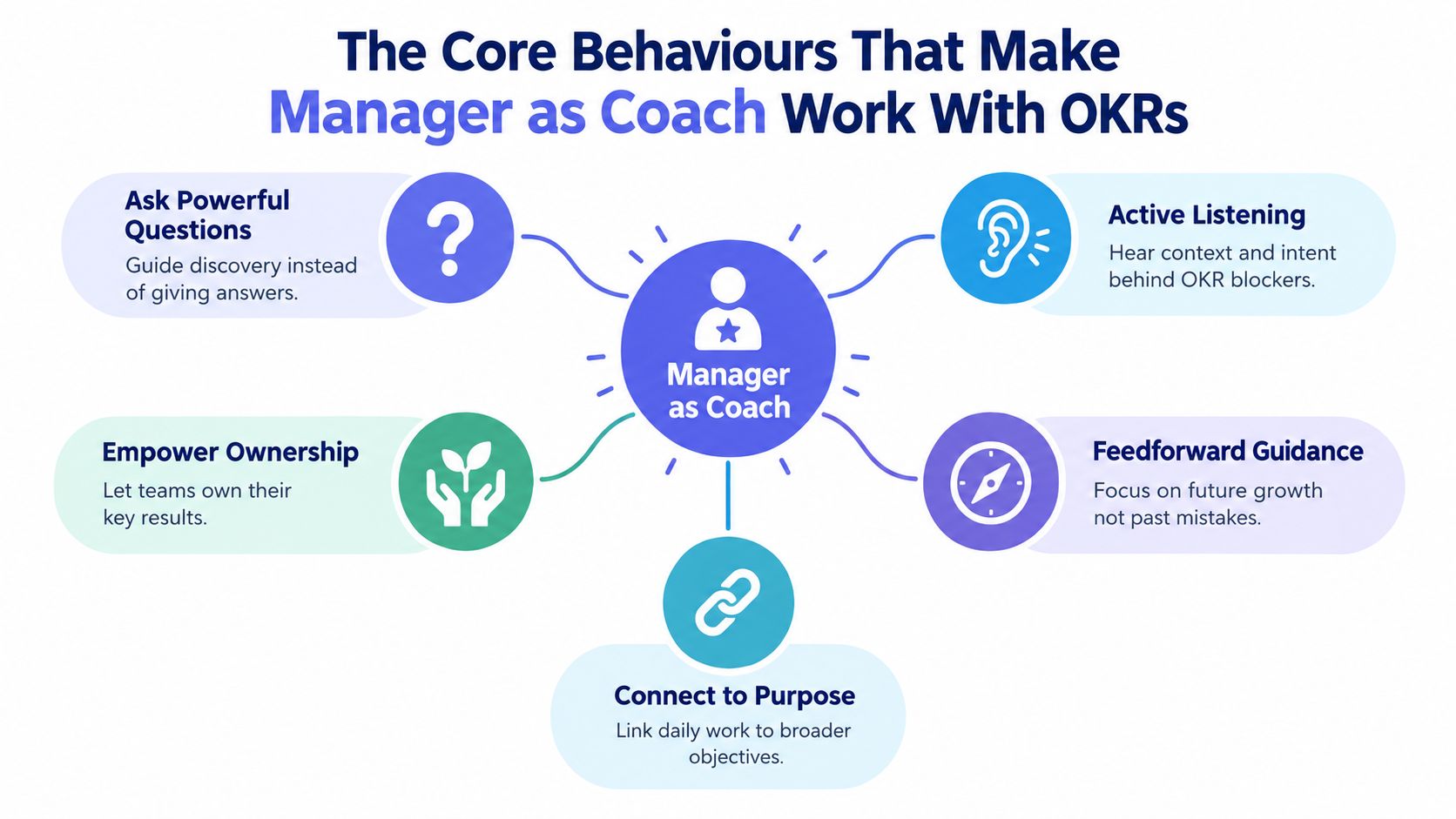
The Core Behaviours That Make Manager as Coach Work With OKRs
Manager-as-coach behaviour should be observable. If it can't be seen in a one-to-one, planning session, or review meeting, it's probably too vague to train.
Ask before telling
The first shift is from giving an immediate answer to improving the team's reasoning. During OKR setting, ask:
- What outcome would prove this objective matters?
- Which customer, operational, or commercial behaviour should change?
- What are we assuming?
- What would make this key result irrelevant?
This doesn't mean managers should withhold expertise. It means they should avoid using expertise as a substitute for team thinking. If a manager sees a weak metric, they can ask the owner to test it before proposing a replacement.
Listen for the blocker underneath the blocker
A stated blocker often describes a symptom. “We're waiting for data” may mean the team doesn't have a decision owner. “Marketing hasn't delivered the campaign” may conceal conflicting priorities. “The target is unrealistic” may reflect unclear scope rather than resistance.
Active listening means reflecting the issue accurately, checking intent, and separating facts from interpretation. The manager might say, “I'm hearing that the dependency is delaying the work, but the larger concern is that nobody has agreed which customer segment comes first. Is that right?”
A useful coaching conversation makes the hidden constraint discussable before it becomes a missed key result.
Contract on the outcome
Coaching without accountability becomes supportive conversation. At the start of a check-in, agree what the discussion needs to produce. That may be a decision, a revised experiment, a dependency owner, or a clear escalation.
A manager can ask, “What do you need to leave this conversation with?” Then they can confirm the commitment: “You'll validate the metric definition with Finance, I'll resolve the access decision, and we'll review the evidence at the next check-in.”
Use feedforward, not a trial
End-of-quarter reflection often becomes a search for fault. A coaching manager turns it into forward-looking learning. Instead of asking why the team failed, ask what it would do differently with the same information available earlier.
The language matters. Replace “Why didn't you spot this?” with “What signal should we monitor next time?” Replace “You need to be more proactive” with “Which decision can you make earlier, and what authority would support it?”
For managers building confidence in collaboration, practical activities such as games that strengthen teamwork can provide a low-risk way to practise listening, problem-solving, and shared decision-making. They're useful only when the learning is connected back to workplace behaviour.
Hold ownership without taking the work back
The final behaviour is disciplined accountability. The manager keeps the owner responsible for the key result while helping remove obstacles. They don't rewrite every plan or become the project manager.
A strong question is, “What will you do next, and what do you need from me?” If the answer reveals a decision beyond the owner's authority, the manager escalates that decision. If it reveals uncertainty the owner can resolve, the manager leaves the ownership where it belongs.
The leadership capability framework should make these behaviours explicit. Otherwise, organisations will assess managers on broad traits such as “develops people” without checking whether their OKR conversations improve judgement and delivery.
Embedding Coaching Into Weekly Rhythms and Governance
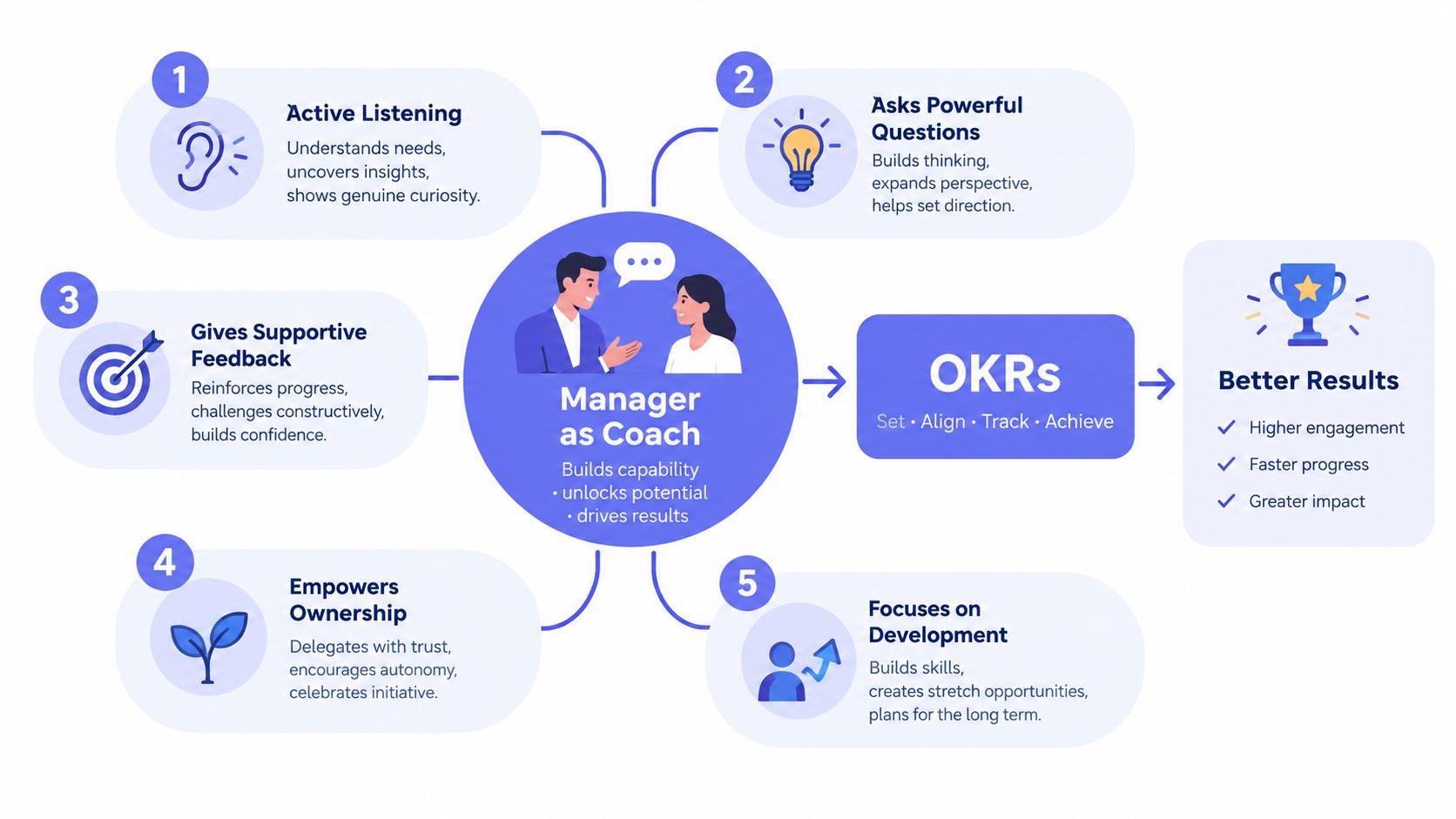
Training won't change execution if the meeting design rewards status reporting. Managers need a repeatable rhythm where every OKR conversation produces better information, faster decisions, or clearer ownership.
A weekly check-in shouldn't ask every person to read out every task. The team should review movement in the key result, identify the most important constraint, and decide what needs attention. The manager's role is to improve the quality of that discussion, not dominate it.
Use a simple sequence:
- Review the outcome signal. What has changed since the previous check-in?
- Interpret the evidence. What does the movement mean, and what remains uncertain?
- Surface the constraint. Which dependency, decision, or capability issue is slowing progress?
- Coach the next move. What options does the owner see?
- Confirm action and escalation. Who will do what, by when, and what requires senior intervention?
That sequence keeps the conversation connected to delivery. It also gives managers permission to coach without adding a separate “coaching meeting”.
Redesign the existing governance
Monthly business reviews should focus on cross-team choices and systemic obstacles. Quarterly retrospectives should examine how the operating system performed, including whether teams had enough clarity, authority, and support to deliver.
The difference is visible in the meeting itself:
| Meeting Type | Traditional Approach | Coaching-Led Approach |
|---|---|---|
| Weekly OKR check-in | Each owner reports activity and explains variance | Owners interpret outcome movement, test assumptions, and agree next actions |
| Monthly business review | Leaders inspect slides and request updates | Leaders resolve dependencies, challenge trade-offs, and clarify decision rights |
| Quarterly retrospective | Teams defend results and list lessons | Teams examine signals, improve the next cycle, and identify support gaps |
Time pressure is a real trade-off. A coaching rhythm may feel slower at first because managers ask questions instead of issuing instructions. But directive speed often creates rework. The better test is not meeting length. It's whether the team makes sound decisions earlier and spends less time correcting avoidable misunderstandings.
Don't add coaching to the calendar. Change what existing meetings are for.
Set escalation rules
Coaching fails when managers ask teams to own problems they're not authorised to solve. Define escalation triggers. A dependency that threatens a committed outcome, a decision that crosses functions, or a material change in strategic assumptions should move to the right governance forum.
Managers should also distinguish between a performance issue and a system issue. If an owner repeatedly misses a commitment, explore both execution behaviour and the conditions around it. The conversation should still end with a clear commitment, but the diagnosis determines whether the response is support, challenge, reprioritisation, or formal intervention.
Teams can use the weekly check-in guidance to standardise this rhythm. The aim isn't uniform wording. It's consistent attention to outcomes, obstacles, and decisions.
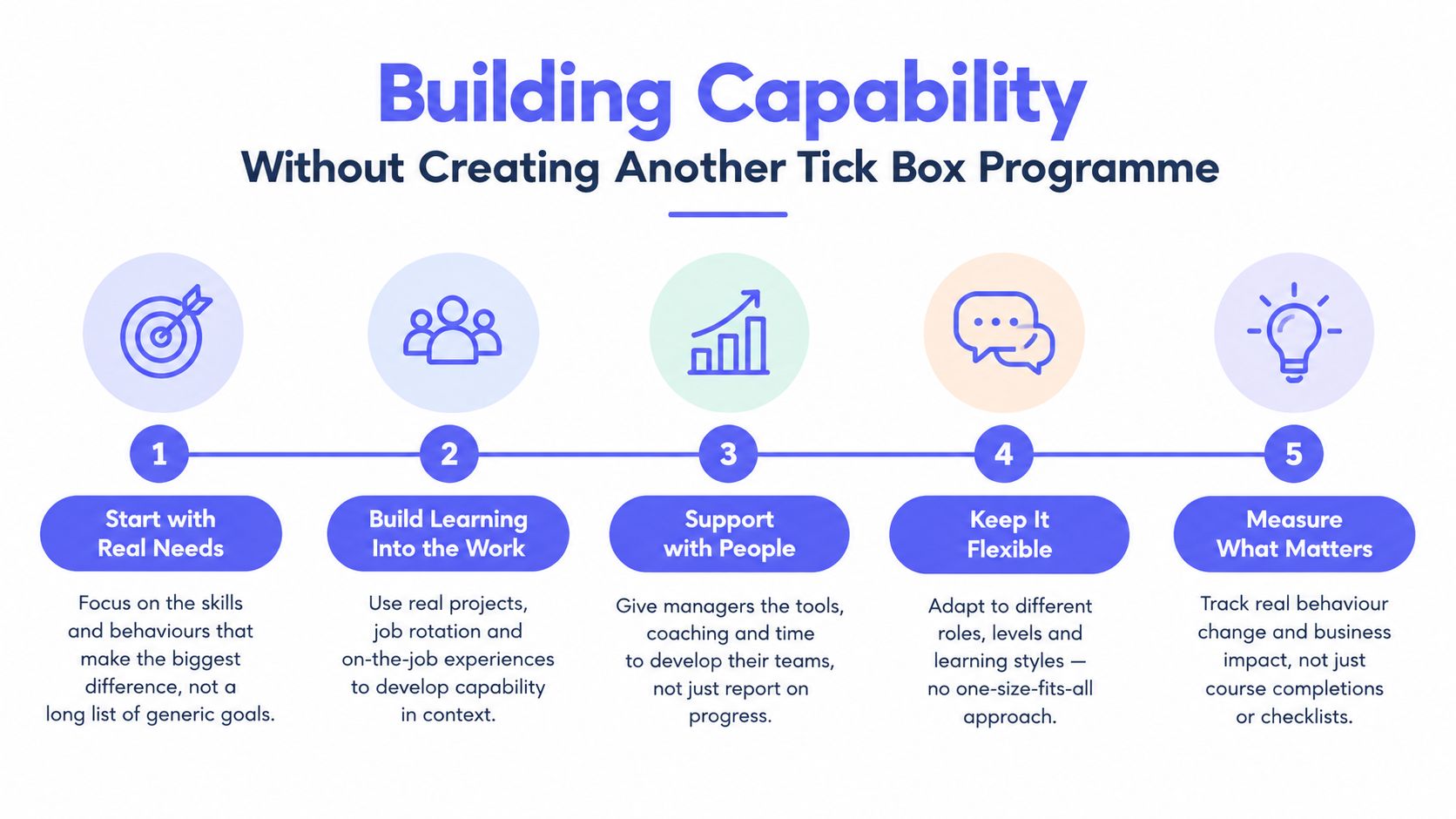
Building Capability Without Creating Another Tick Box Programme
A one-off workshop rarely changes how managers behave under pressure. People may remember the coaching model, then return to asking for task updates when deadlines tighten. Sustainable capability needs practice, observation, feedback, and visible leadership participation.
The rollout should follow the organisation's execution needs. Start by identifying the teams where misalignment and slow decisions are most expensive. Train those managers on the actual OKRs they're responsible for, not fictional scenarios detached from their work.
Use a practical deployment sequence
Diagnose the access gaps, meeting habits, and capability constraints. HR and transformation leaders should combine employee feedback, OKR quality reviews, and observation of real governance meetings.
Design a small set of behaviours and prompts. Avoid a large competency catalogue. Managers need a usable script for opening a check-in, testing assumptions, handling a blocker, and confirming ownership.
Deploy through short skill sprints. A manager might practise one behaviour, use it in a live meeting, and bring the result to a peer coaching circle. An experienced facilitator can observe the conversation and give specific feedback on what helped or hindered ownership.
Sustain through role-modelling and governance. Senior leaders should use the same questions in reviews. Chiefs of Staff and PMO teams should inspect whether meetings produce decisions and escalations, not just complete reporting packs.
Give internal coaches real support
The evidence from the Institute of Leadership and Management shows the risk of leaving internal coaches unsupported. A manager-as-coach model needs protected time, a shared method, access to expert help for difficult situations, and feedback on application.
Don't measure success by attendance. Measure whether managers can demonstrate the behaviour in real OKR moments. Can they challenge a weak key result without rewriting it? Can they help an owner expose a dependency? Can they keep accountability clear when the plan changes?
Senior leaders may also need a different form of support from frontline managers. Resources on coaching types for senior leaders can help distinguish executive reflection, leadership transition, and strategic decision support from the day-to-day coaching required for OKR delivery. The methods overlap, but the operating context doesn't.
A credible capability programme assigns ownership clearly. HR or L&D manages the learning architecture. Transformation or strategy teams connect it to OKRs and governance. Line leaders reinforce the standard. Managers practise in the flow of work. Without all four roles, coaching becomes another initiative that exists in training records but not in management behaviour.
The capability-building programme guidance provides a useful reference point for designing this kind of reinforcement. The core principle is straightforward. Build internal confidence through repeated application, not ceremonial completion.
Measuring What Matters and Sustaining the Change
The wrong measures make manager-as-coach programmes look successful while execution remains slow. Training attendance, completed modules, and self-reported confidence can show participation. They can't prove that teams are making better decisions or delivering more consistently.
Use a balanced measurement set.
Leading indicators should capture the quality of the management system. Track whether teams have clear owners, whether blockers are raised before formal reviews, whether decisions have named owners, and whether employees can explain how their work connects to the current objective. Review a sample of check-in notes for evidence of questions, options, decisions, and follow-through.
Execution indicators should show whether the coaching rhythm improves flow. Monitor the time between raising a blocker and agreeing an action, the age of unresolved dependencies, changes in OKR confidence, and the movement of key results through the cycle. These measures need a consistent definition. Otherwise teams will argue about reporting rather than improving the work.
Outcome indicators should connect to delivery. Look at progress against key results, the quality of quarterly learning, and whether teams can adjust plans without losing strategic focus. Don't treat every missed key result as failure. A team that identifies a weak assumption early may be performing better than a team that reports green until the final week.
UK execution evidence reinforces the need for this discipline. A March 2025 survey of UK companies with turnover above £20 million found that only 18.4% achieved more than 80% of their aspirational growth goals within three years, while 41.2% failed to reach 60% of stated targets. Talent and capability gaps were the top execution barrier for 50.4% of respondents. Coaching won't solve every strategic problem, but it directly addresses the management capability that turns priorities into coordinated action.
The governance test is whether leaders still use coaching behaviours when results are under pressure. Recognition should reward early escalation, sound learning, and effective ownership, not only positive status reports. Quarterly retrospectives should examine which conversations improved delivery and which habits pulled managers back towards command and control.

Good manager-as-coach practice is visible in the work. Teams understand the outcome, owners can explain their choices, blockers appear early, and leaders resolve the decisions only they can make. That's the connection between coaching and OKR delivery. Coaching isn't a softer layer around execution. It's how the organisation improves the quality and speed of execution at the point where strategy becomes daily work.
The OKR Hub helps leadership teams diagnose alignment problems, implement practical OKR systems, and coach managers to focus on outcomes rather than task updates. Visit The OKR Hub to assess your current coaching and OKR maturity, then identify the operating changes needed to improve delivery.