Your strategy deck is polished. The leadership team agreed the priorities. OKRs were set early in the year, owners were named, and everyone left the planning session aligned.
By late spring, delivery has slowed. Decisions sit in functional queues. Teams are escalating the same issues repeatedly. Key results are reported with optimistic confidence ratings, while the underlying workstream is clearly off track. The response is familiar. Book executive coaching, then ask the coach to work on resilience, confidence, or communication.
That response misses the operating problem. Coaching for leaders should change how leaders make decisions, create ownership, challenge weak plans, and follow through on commitments. If those behaviours don't appear in delivery data, the coaching has remained a personal-development activity rather than becoming an execution system.
Why Most Leadership Coaching Programmes Miss the Core Problem
Leadership coaching is now established in UK organisations. An Institute of Leadership survey found that 80% of organisations had used or were using coaching, with a further 9% planning to use it. Adoption reached 90% among organisations with 2,001 or more employees, compared with 81% among organisations with 501 to 2,000 employees and 68% among organisations with 230 to 500 employees. The pattern is clear: larger employers treat coaching as a serious management-development mechanism, not a perk for senior executives. The UK executive coaching and leadership development market evidence provides useful context.
The failure sits in the definition of success. Many programmes measure confidence, reflection, attendance, or 360 feedback while the business continues to face slow decisions, unclear priorities, and missed commitments. A leadership team can report strong coaching experiences while delivery remains unchanged.
A retailer can increase its executive coaching spend and still see quarterly output remain flat if operating behaviour stays the same. Leaders may discuss pressure more effectively, yet delivery will not improve while weekly reviews accept vague updates, priorities have several owners, and escalations lack decision deadlines. Coaching must change the mechanics of execution, not only the leader's interpretation of events.
Two models of coaching
A safe space model gives a leader room to reflect. That supports work on conflict, pressure, and habitual responses. It does not, by itself, create an accountability mechanism or alter the meetings where delivery decisions are made.
An operating system model connects every conversation to live work. The coach, chief of staff, or peer coach uses current OKRs, decision logs, meeting evidence, and delivery metrics to challenge behaviour in context. A practical resource such as this executive communications coaching guide can strengthen the communication dimension, provided communication remains tied to decisions and outcomes.
| Dimension | Safe Space Model | Operating System Model |
|---|---|---|
| Agenda control | The leader brings a topic, often framed around personal pressure | The session starts with the most material execution constraint |
| Accountability mechanism | Reflection and intention | A named owner, measurable action, and due date |
| Evidence base | Self-report, feedback, and discussion | OKRs, leading indicators, decision logs, and observed behaviour |
| Exit criteria | Greater insight or confidence | A changed decision, a removed blocker, or a tested commitment |
The evidence supports deliberate programme design. A systematic review of 110 peer-reviewed executive coaching outcome studies concluded that coaching is generally effective, but delivery matters. The strongest outcomes were associated with internal coaches, while the weakest were linked to coaches using a fixed technique rather than adapting to context and coachee needs. The review also notes that 32 of the 110 studies appeared in journals with impact factors. Keep that source in its designated evidence section rather than duplicating it here.
Set the operating model before choosing the coach. The OKR mindset shift matters only when it changes the weekly decisions, ownership checks, and commitments that move strategy into delivery.
Diagnosing the Execution Gap Before Any Coaching Starts
Don't commission a coaching programme because a leadership survey says communication is weak. First identify where execution breaks. A leadership team can run a useful diagnostic in one meeting if it brings the right evidence and refuses to turn the session into another open-ended discussion.
Run the five-part diagnostic
1. Map the signals. Bring two weeks of weekly business review notes, decision logs, and escalation emails. Tag each item as a strategy issue, an execution issue, or a people issue. This stops the team from treating every symptom as a leadership capability problem. If a missed milestone comes from an unresolved pricing decision, resilience coaching won't fix it.
2. Audit ownership. For every priority in flight, name one accountable leader and the date by which a measurable outcome is due. Don't accept a department as the owner. Don't list a committee. One person must be able to answer what has changed, what is blocked, and what will happen next.
3. Pressure-test cadence. Examine the weekly, monthly, and quarterly rhythms. Do they surface slippage early, or do leaders filter bad news until the next formal review? Look for meetings that record updates but don't force decisions.
4. Compare the feedback triangle. Put three views beside each other: what the leader believes, what the team reports upward, and what the data shows. The gap between those views is often more valuable than another broad competency assessment.
5. Choose the intervention. Match the dominant gap to the modality. Use individual coaching for a repeated leadership behaviour, peer coaching for shared decision habits, team coaching for alignment problems, and operating-rhythm redesign when the process itself rewards delay.
Bring the evidence into a 90-minute diagnostic meeting, rather than allowing the issue to drift for a quarter. Use the performance diagnostics guide to keep the discussion centred on delivery evidence.
Use a focused evidence pack
Bring:
- Current OKRs: Include confidence ratings, key-result movement, and the latest commentary.
- Decision records: Show decisions made, delayed, revisited, or escalated.
- Meeting notes: Mark repeated blockers and actions without closure.
- Escalation messages: Look for recurring dependencies and unclear authority.
- People signals: Include relevant feedback, absence patterns, or conflict themes without breaching confidentiality.
- Metric owners: Identify who can validate each delivery measure.
End the diagnostic with two outputs. First, write the two dominant execution gaps in behavioural language, such as “the commercial director delays pricing decisions until finance validates every exception”. Second, specify the evidence that would prove the behaviour has changed.
The Coaching Session Plan and Scripts That Land
A useful coaching session is short, structured, and attached to a live business problem. The coach doesn't need to fill the time with theory. The leader needs to leave with a better decision and a commitment that other people can see.
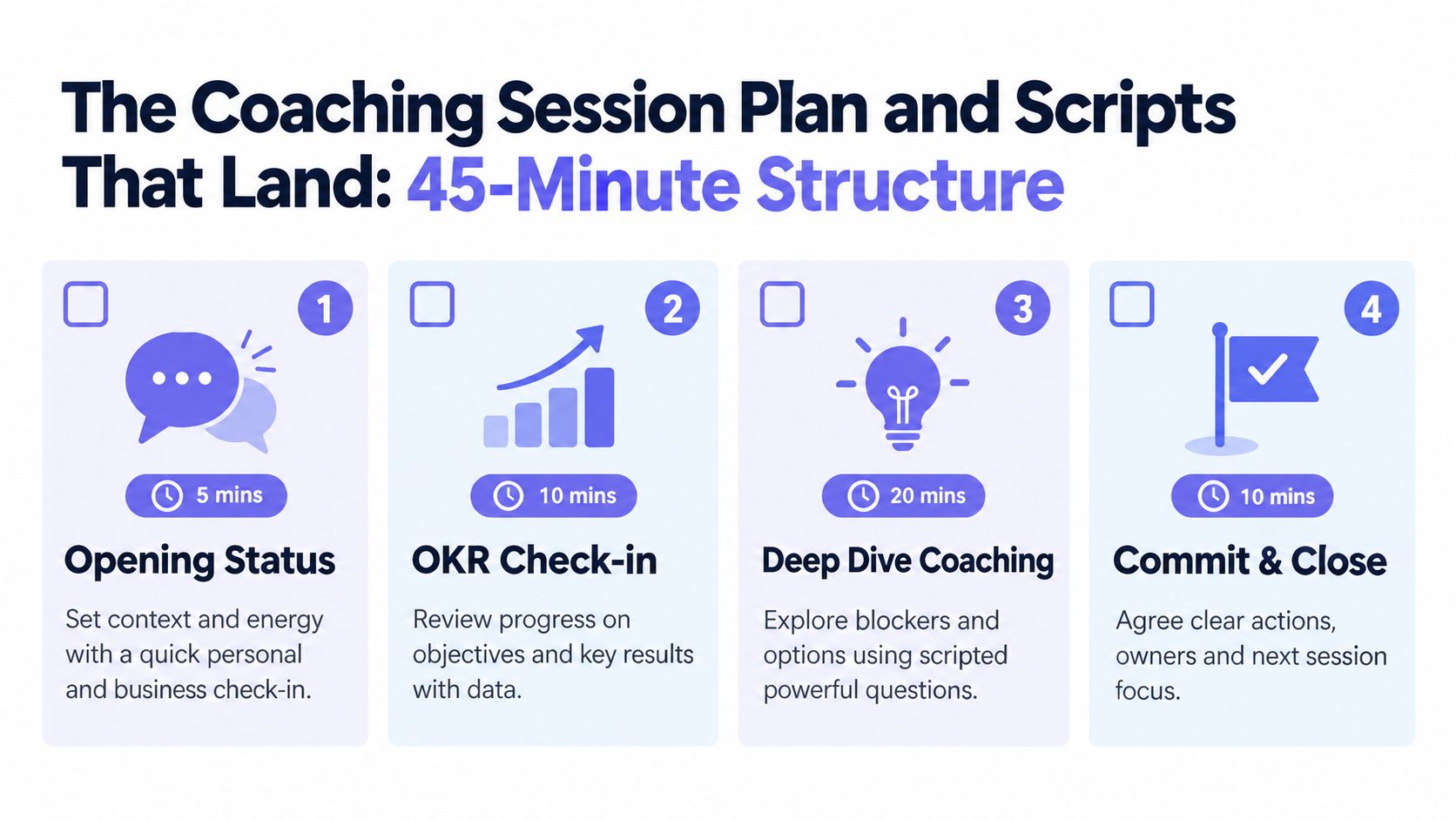
Use this 45-minute structure:
- Opening status, 5 minutes. Ask, “What has changed since we last spoke, personally and in the business?” Keep this brief. The purpose is context, not a long status report.
- OKR check-in, 10 minutes. Review the objective, key results, confidence, and leading indicators. Ask, “What is the leading indicator telling you this week?”
- Deep dive, 20 minutes. Choose one decision or constraint. Ask, “Where are you the constraint, not the team?” Then use, “If this were easy, what would you have done by now?”
- Commit and close, 10 minutes. End with one action, one owner, and one date. Ask, “What is the one thing that must be true in seven days?”
Use the script to expose the real lever
Consider a CFO with a Q3 OKR for cash conversion. The current result is 62 percent against a 75 percent target. The initial diagnosis blames collections. The collections team has a backlog, so the CFO plans to increase review frequency and add escalation points.
The coach doesn't accept the first explanation. “What is the leading indicator telling you this week?” The CFO reviews the data and sees that invoices are being collected once issued, but pricing approvals are delaying invoice creation. “Where are you the constraint, not the team?” exposes the CFO's role in requiring central approval for routine pricing exceptions.
The conversation then turns to action. “If this were easy, what would you have done by now?” The CFO decides to define approval boundaries with the commercial director. “What is the one thing that must be true in seven days?” The answer becomes a written approval rule, with the commercial director as owner and a date for testing it.
Practical rule: No status updates, no therapy, and no theory. Every session ends with a written commitment linked to a live OKR.
The coach, chief of staff, or trained peer needs enough operating context to challenge the explanation, not just listen to it. Facilitation skills training can help internal facilitators ask sharper questions without taking ownership away from the leader.
Embedding Coaching into OKRs, Operating Rhythms and Governance
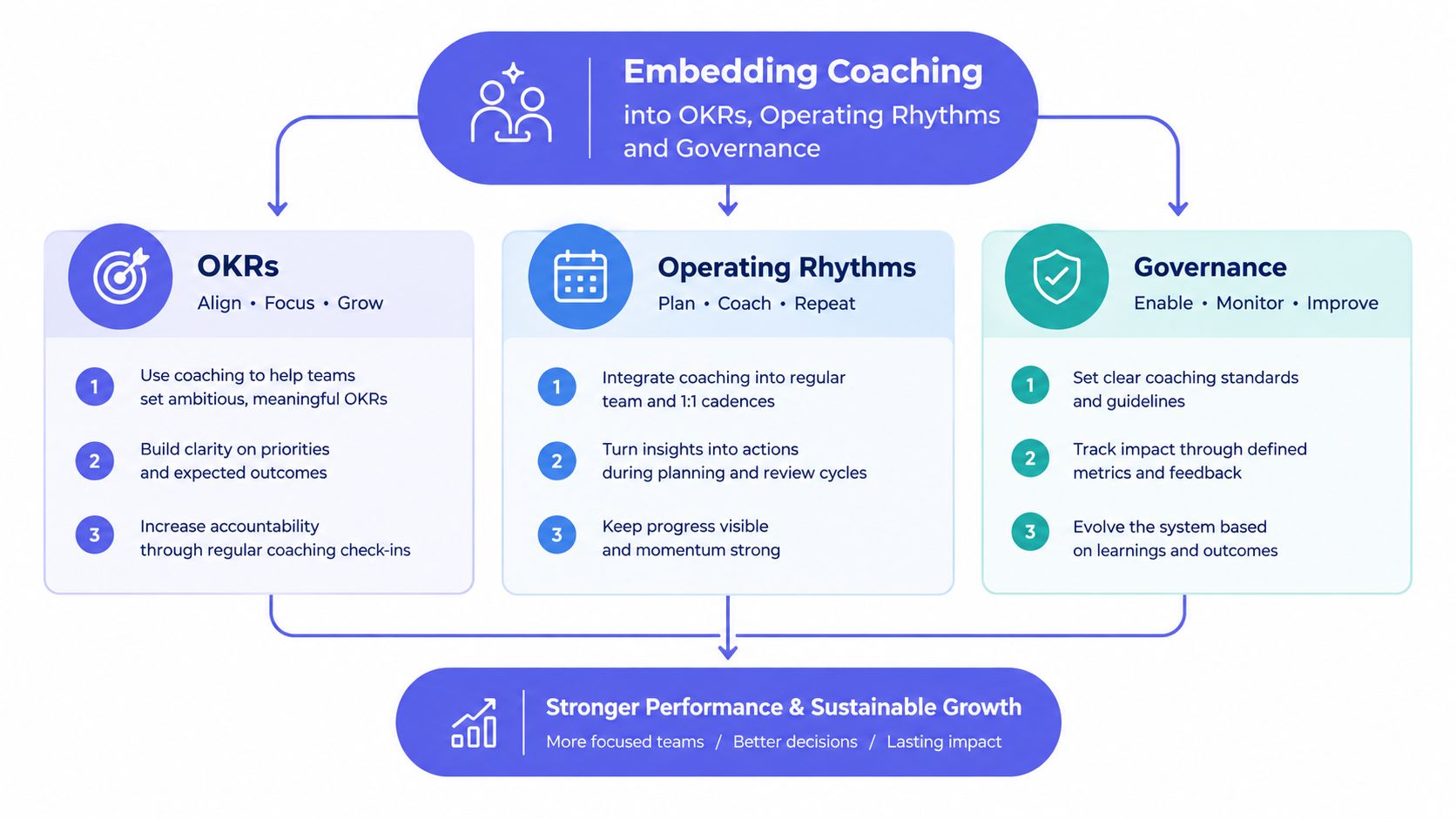
Coaching works best when it sits inside the management system that already runs the organisation. Creating a separate people initiative sends the wrong signal. Leaders attend coaching, then return to meetings that reward vague updates and tolerate unowned work.
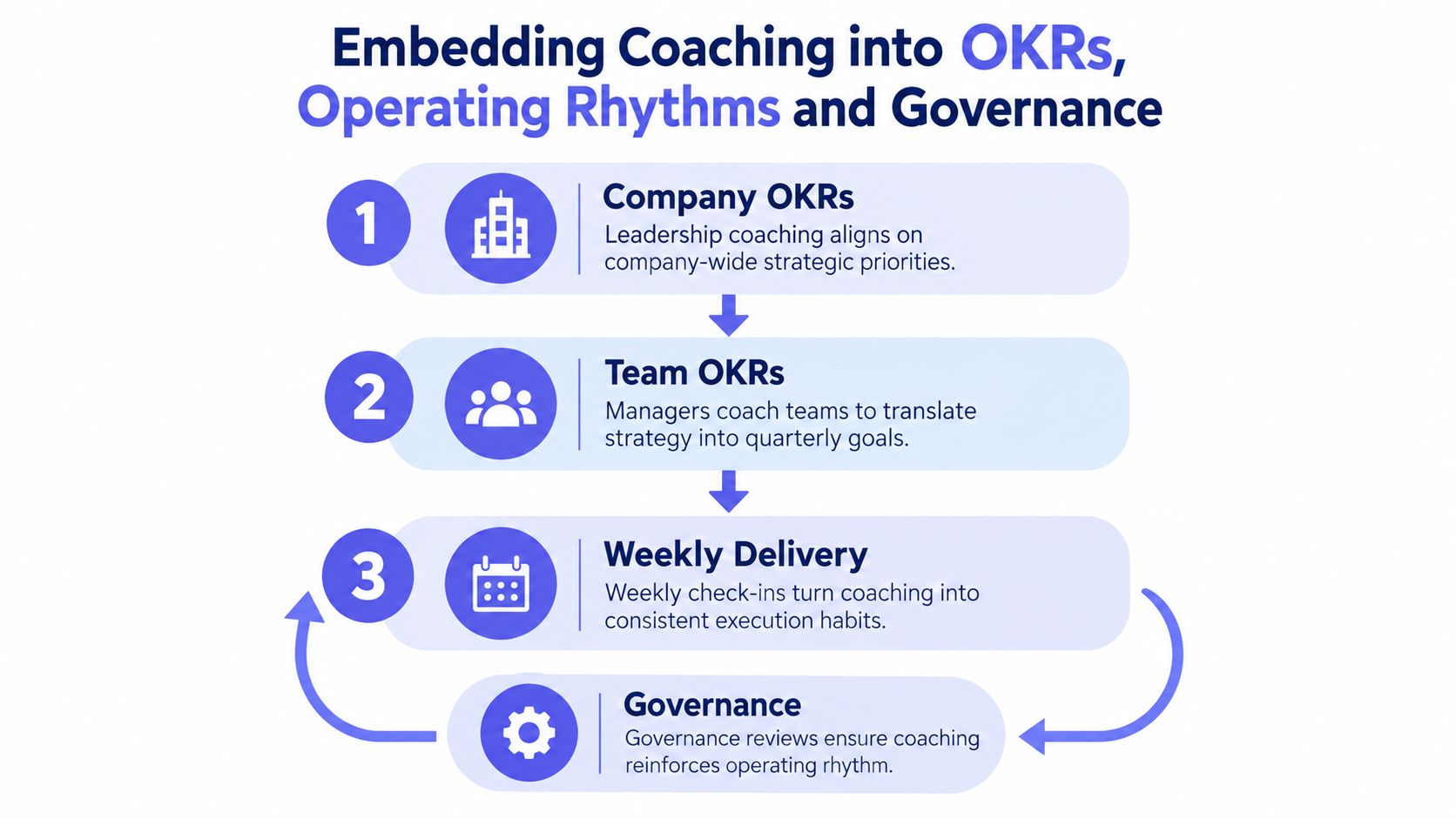
The OKR cascade creates natural coaching moments. Company objectives shape leadership-team one-to-ones. Team objectives provide material for skip-level conversations and weekly business reviews. Key results give stand-ups a factual basis for discussing progress, blockers, and trade-offs.
Place questions inside existing cadences
At a monthly leadership offsite, coach the team on the few decisions that could change the quarter. Don't use the time to reread every objective. In the quarterly board pack, include the material risks, confidence changes, and ownership gaps that require governance attention.
The weekly executive stand-up should answer three questions. What moved? What didn't move? What decision is needed, from whom, and by when? The monthly performance cycle can then examine whether leaders are changing the behaviours that created recurring delays.
A simple coaching log should live in the same system as the OKRs. Lattice, WorkBoard, or a shared Notion workspace can hold the commitment, owner, date, observed behaviour, and evidence. Review the log monthly, then read it back at the quarterly review. Keep it factual. Don't turn private coaching content into a performance file.
Example of the governance loop
A product leader reports a Q3 confidence rating of 0.3 on a strategic launch objective. The usual response is encouragement or a request for a recovery plan. The coaching conversation asks which assumption has failed, what evidence would change the rating, and who owns the next decision.
The leader identifies an unresolved dependency on legal review. The revised plan names the legal director as the owner of a decision, sets a date for resolution, and changes the sequence of work so the team can progress on unaffected components. The confidence rating matters, but the governance value comes from converting a vague warning into a visible plan.
Coaching belongs where leaders decide, review, and allocate work. If it exists outside those moments, it will struggle to change execution.
Use an operating rhythm designed around delivery to make the coaching conversation part of normal management rather than an additional meeting.
Measuring Whether Coaching for Leaders Is Actually Working
A leader reports high confidence in a strategic launch, yet decisions remain slow, risks surface late, and the related work misses its dates. That is not coaching impact. Measure whether leadership behaviour changes execution.
Self-reported confidence provides context, not proof. Track decision quality, commitment closure, early risk visibility, and progress against the objectives attached to the coaching work. The UK leadership coaching research summary identifies decision quality, confidence, conflict handling, and execution alignment as useful measurement domains. Use those domains to define observable behaviours, rather than relying on attendance or satisfaction scores.
Keep the measurement set small. Give each leader one leading indicator and one lagging indicator. Review both during the monthly one-to-one, then agree what behaviour must change before the next review.
| Cadence | Leading Indicator | Lagging Indicator | Owner |
|---|---|---|---|
| Weekly | Decision velocity on the leader's priority work | On-time completion of the related key result | Leader and chief of staff |
| Weekly | Action closure rate from leadership meetings | Delivery of the strategic initiative by its committed date | Initiative owner |
| Monthly | Ratio of problem statements to solution proposals | Engagement movement within the coached team | People leader |
| Monthly | Evidence that risks are raised before escalation | Senior-leader retention on the relevant workstream | Executive sponsor |
| Quarterly | Quality of trade-off decisions recorded in governance | Revenue or margin movement on coached workstreams | Functional leader and finance partner |
Do not claim that coaching caused every commercial result. Make attribution more credible by recording the baseline behaviour, the coaching intervention, the subsequent change, and the business outcome. The UK research base shows that results depend partly on how coaching is delivered, so test whether the coach, method, and operating context fit the leader's problem.
Use delivery performance measures that connect activity to outcomes to connect behavioural changes with delivery evidence. Stop or redesign the programme when behaviour does not change, even if participants report that they enjoyed the sessions.
Common Failure Modes and How to Design Coaching That Holds
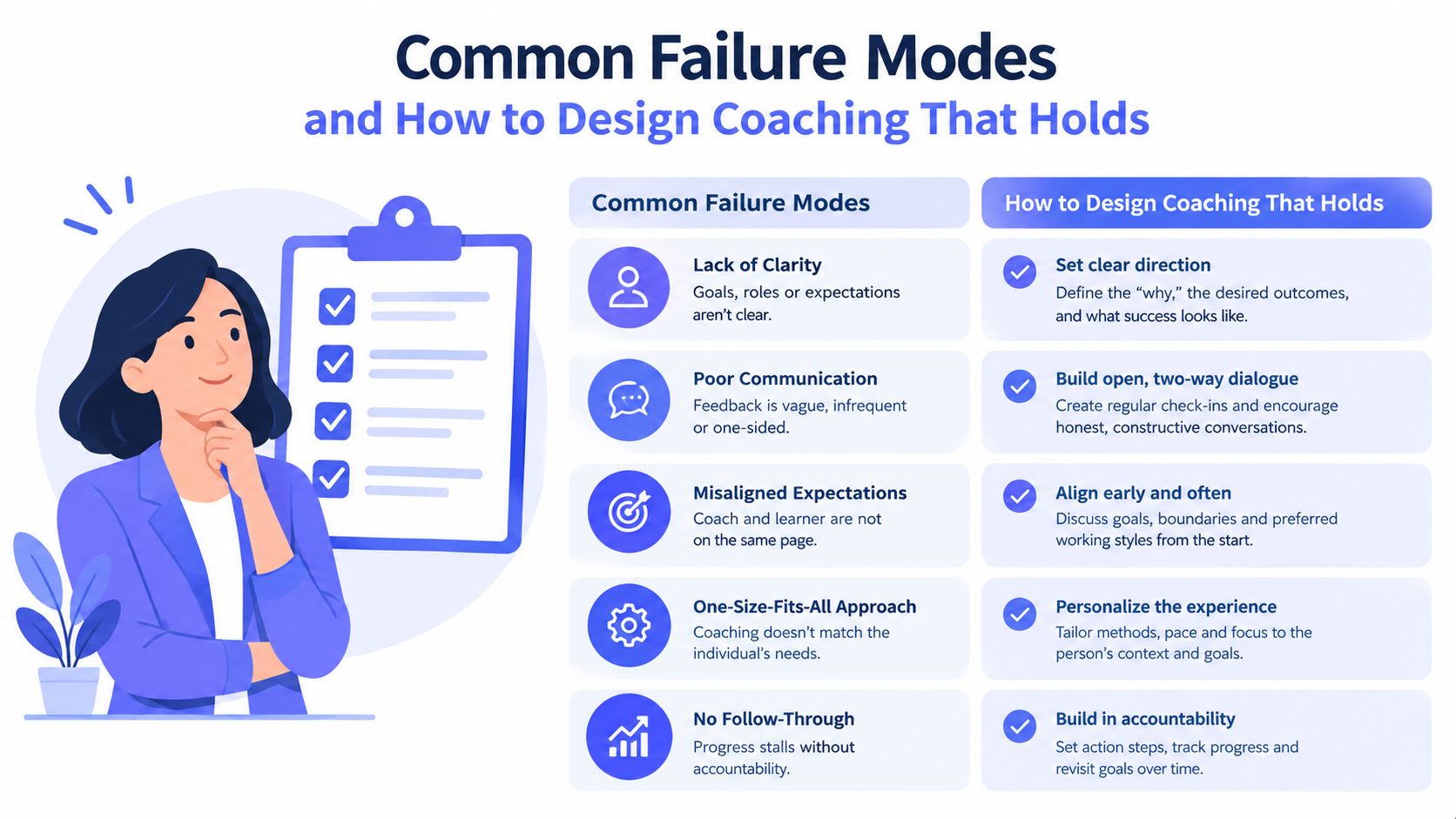
The same design errors appear across UK scale-ups and established enterprises. They aren't failures of coach charisma. They're failures of architecture.
Five predictable breakdowns
Coaching is reserved for senior hires. The symptom is a small group of executives receiving support while the managers translating strategy into daily work get none. The root cause is hierarchy-based allocation. The design move is to allocate coaching by execution need, including leaders who own critical dependencies or recurring delivery failures.
There is no link to delivery metrics. Leaders discuss difficult conversations, confidence, and influence, but nobody connects the work to an objective or key result. The root cause is a people programme operating separately from business governance. Attach each coaching goal to a visible behaviour and a relevant delivery measure.
The coach lacks operating context. A coach asks strong questions but doesn't understand the approval process, decision rights, or commercial constraint behind the issue. The leader leaves with insight but no practical move. Give the coach access to the operating model, current priorities, and agreed boundaries around confidentiality.
Confidentiality becomes a shield. The coach protects the leader's privacy, correctly, but the sponsor receives no evidence of progress. Define the reporting boundary before the engagement starts. Share themes, commitments, and agreed outcome measures, not private disclosures.
The programme arrives as an offsite burst. A powerful workshop creates energy, then weekly routines return to normal. The cause is reinforcement failure. Put coaching questions into the weekly review and revisit commitments in the next session.
The Ridler Report evidence shows how mainstream internal and external coaching have become in UK organisations. It reports that 72% of organisations surveyed expected to increase coaching spend in the next two years, while 75% expected growth in internal coaching. It also reports that 39% of coaching hours were 1:1 internal coaching and 42% were 1:1 external coaching. The implication is clear. Organisations need a system that combines internal operating knowledge with external challenge.
Specify the architecture, not a personality
Put these requirements in the brief:
- Named sponsor: The CEO or executive sponsor owns the mandate.
- Clear purpose: Define the execution behaviour that must change.
- Metric stack: Select leading and lagging indicators before sessions begin.
- Embedded practitioner: Use an internal coach, chief of staff, or peer coach where operating context matters.
- Monthly governance: Review themes, commitments, and evidence without breaching confidentiality.
- Quarterly decisions: Continue, redesign, scale, or stop based on observed change.
- Long enough horizon: Use a 12-month horizon with quarterly check-ins when the behaviour affects multiple operating cycles.
Coaching architecture beats coaching charisma. A brilliant coach cannot compensate for an absent sponsor, unclear ownership, or a leadership team that never changes its meeting habits.
Your First 30 Days and the Next Step to Make It Real
Start small, but use live work. Don't launch a company-wide coaching programme before you know which behaviours are holding back delivery.
Week one
Run the execution-gap diagnostic in the next leadership meeting. Bring the OKRs, decision logs, business review notes, and escalation evidence. Capture recurring themes in behavioural language, then identify where the team's view differs from the data.
Week two
Select two priority gaps. Name the coach, chief of staff, or internal practitioner who will lead the work. Set the session cadence, agree the confidentiality boundary, and choose one leading and one lagging indicator for each coached leader.
Week three
Pilot one structured coaching session against one live OKR. Use the 45-minute plan: opening status, OKR check-in, deep dive, and commitment. Test the questions directly. If the leader can't name the constraint, the decision, the owner, and the date, the session hasn't done its job.
Week four
Review the leading indicators. Did decisions move faster? Did actions close? Did the leader surface risk earlier? Compare those observations with the relevant lagging measure, then decide whether to scale, redesign, or stop.
This approach is deliberately practical. It doesn't require a new leadership philosophy. It requires leaders to connect conversations to work, make ownership visible, and use governance to reinforce the behaviour they expect from everyone else.
If your leadership team recognises the symptoms above, book a 45-minute execution-coaching diagnostic. You'll leave with a map of the dominant execution gaps, two priority behaviours to coach, a recommended session cadence, and a measurement starting point for the next operating cycle.
The OKR Hub helps UK leadership teams connect coaching with strategic alignment, OKR conversations, operating rhythms, and accountable delivery. Visit The OKR Hub to explore OKR consulting, leadership training, and hands-on coaching for execution problems that won't be solved by better intentions alone.