Your leadership team leaves an annual strategy session with clear priorities. Three weeks later, product is working from one interpretation, finance is protecting another, and delivery teams are carrying urgent requests that nobody formally approved. The strategy hasn't changed. The operating system around it has.
That is where iterative planning earns its place. It isn't a recurring meeting, a shorter budget cycle, or an excuse to rewrite objectives whenever delivery gets difficult. It's a deliberately designed loop that connects strategic intent, evidence from execution, resource decisions, and team commitments.
The UK provides useful evidence that planning works better as a controlled cycle than as a one-off event. Central government Estimates move through advance funding, Main Estimates, and later Supplementary Estimates, while departments operate within the same financial year under annuality. The UK Parliament guide to the Estimates process describes a repeated annual sequence of forecasting, approval, revision, and re-approval. HM Treasury's framework also describes annual Strategic Plan revisions and Spending Reviews every two years, with a minimum three-year planning horizon, as set out in the UK government planning and performance framework.
The lesson for business leaders is straightforward. Iteration only improves execution when the organisation knows who decides, what evidence matters, and when priorities can change.
Why Strategy Stalls Between Slides and Delivery
Most leadership teams don't fail at setting strategy. They fail at carrying it into the decisions people make every week.
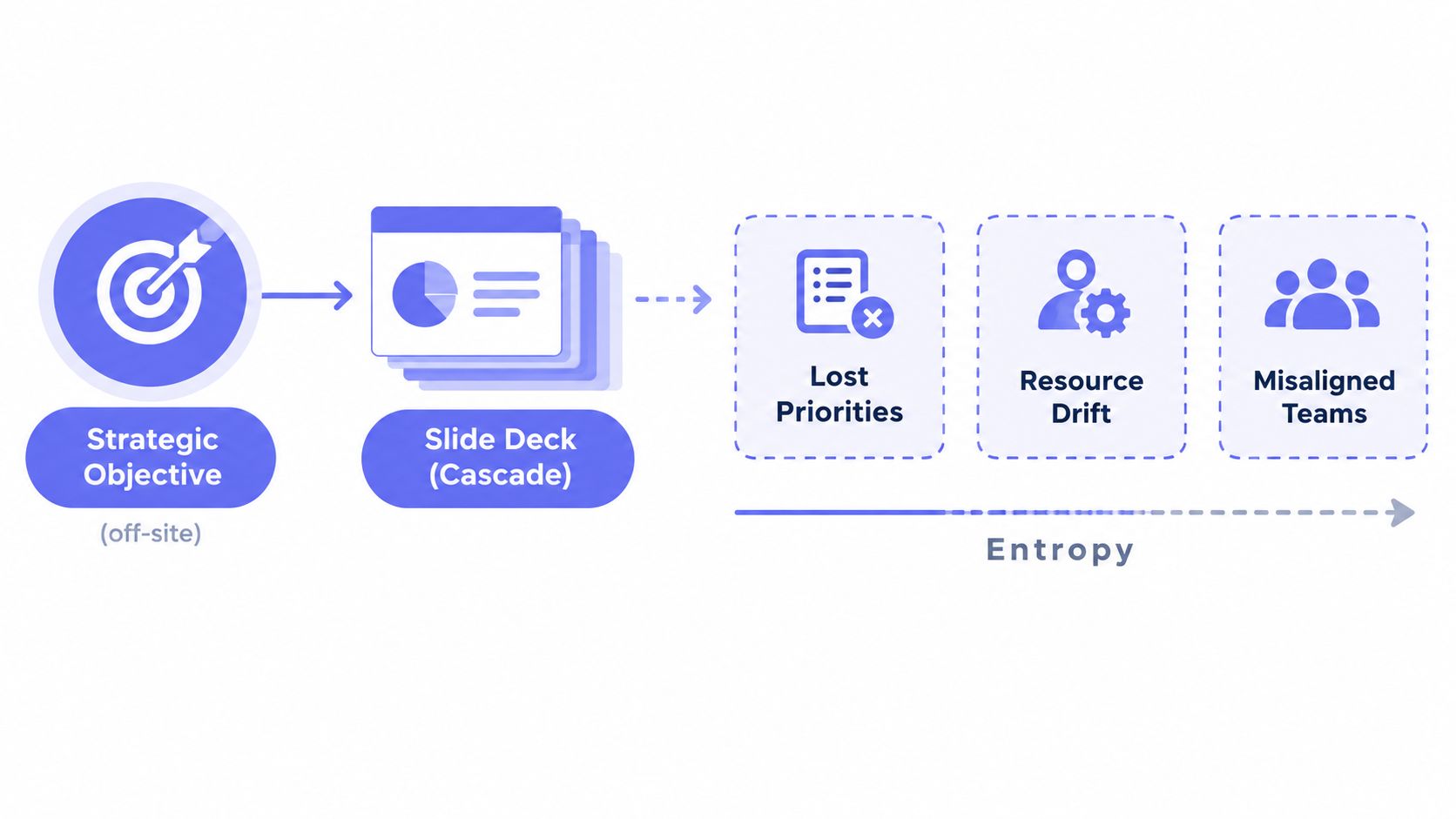
The pattern is familiar. Executives agree on a growth priority during an off-site. The strategy team turns it into a polished deck. Business units translate it into local objectives. Product, sales, operations, and technology then interpret those objectives through their own constraints. By the time work reaches delivery teams, the original bet has become a collection of loosely related activities.
A UK-focused strategy execution source puts the problem plainly, stating that 61% of UK strategies fail because planning is disconnected from operational execution, while only 33% of UK mid-market firms track delivery systematically. Those figures appear in The OKR Hub's strategic execution framework. The important point isn't the percentages alone. It's the mechanism behind them. A strategy can be clear at the top and still fail because no operating loop converts it into trade-offs, ownership, and visible evidence.
Iteration is a decision discipline
Calling for another quarterly planning session won't solve this. Iterative planning is not “do the same plan again later”. It compresses the distance between learning and action.
A delivery team discovers that a proposed feature won't influence the intended customer outcome. A regulatory dependency changes the launch path. Sales sees a recurring objection that invalidates an assumption in the original plan. These aren't interruptions to planning. They're evidence that should influence the next decision.
The operating system needs four connected elements:
- Strategic intent: A small number of measurable bets that define what matters.
- Decision rights: Named people who can approve scope, accept trade-offs, or stop work.
- Delivery evidence: Current signals that show whether teams are moving towards the intended outcome.
- Review cadence: A defined rhythm for turning evidence into changed priorities or continued commitment.
Without those connections, OKRs become reporting language. Teams update confidence scores, attend review meetings, and continue doing the work they had already planned.
Practical rule: If OKR signals never change a resource, scope, or sequencing decision, your planning cycle is decorative.
Leaders should diagnose the gap between slide and ship structurally. Ask who can change a priority mid-cycle. Ask which evidence triggers that change. Ask where the decision is recorded. If the answer is “it depends” or “we discuss it in several forums”, the problem isn't motivation. The organisation hasn't designed the loop. The execution gap analysis from The OKR Hub provides a useful lens for making that gap visible.
Choosing the Right Planning Cadence and Scope
Cadence should match decision latency, organisational stage, and the time it takes for useful evidence to appear. A quarterly cycle can work well for one business and create dangerous delay in another.
Start by separating the cycles that leaders often bundle together. Strategic direction may need a longer horizon. Portfolio choices may need regular adjustment. Team delivery may operate through much shorter work loops. Forcing all three into one calendar creates either excessive administration or insufficient control.
A practical approach is to choose a primary cycle, then layer shorter decision points around it:
- Set the strategic bet. Define the outcome leadership is willing to fund and protect.
- Choose the portfolio scope. Decide which themes or initiatives directly support that bet.
- Limit team commitments. Give teams a focused set of outcomes rather than a full inventory of activity.
- Specify the reset window. State when leaders can change scope and what evidence they need.
- Close the cycle. Review results, record learning, and make the next set of choices.
UK public-sector planning offers a useful structural analogy. Central government combines fixed financial-year boundaries with advance funding, formal Estimates, later revisions, and recurring performance review. Local planning policy also requires the next local plan to begin no later than five years after adoption, while allowing earlier preparation when circumstances change significantly. The National Planning Policy Framework demonstrates the principle clearly: retain a formal rhythm, but don't confuse a maximum interval with a reason to wait.
Match the cycle to the operating context
| Organisation Stage | Primary Cycle | Scope Tier | Forced Decision Type |
|---|---|---|---|
| Early-stage scale-up | Short strategic bet cycle | One company bet and a small team set | Continue, stop, or reshape the bet |
| Mid-stage organisation | Quarterly plan with monthly resets | Company priorities, portfolio themes, team outcomes | Reallocate capacity when evidence changes |
| Enterprise with long feedback loops | Quarterly cycle aligned to fiscal boundaries | Strategic themes, regulated portfolios, delivery commitments | Approve controlled reprioritisation |
| Cross-functional transformation | Defined programme cycle with weekly dependency checks | Outcome, workstream, dependency | Resolve ownership and unblock delivery |
Don't copy a cadence because an OKR book recommends it. A team making rapid product decisions may need a shorter cycle than a regulated infrastructure programme. The right question is: how long can we wait before a bad assumption becomes expensive?
Scope needs equal discipline. Company-level bets should remain few enough for executives to make real trade-offs. Portfolio themes should map to those bets. Team commitments should describe outcomes the team can influence. The comparison of annual and quarterly OKRs is useful here because it highlights the difference between a strategic horizon and a practical execution window.
Aligning OKRs to the Planning Cycle
A leadership team can leave an OKR workshop with polished objectives, then return to the old funding, prioritisation, and delivery routines. The failure is not the cycle length. It is the missing connection between the scorecard and the decisions that shape work. Put the objective inside the planning system, so Key Results affect what leaders inspect, fund, delay, and stop.
Start with the company-level bet. An objective should name a meaningful direction, not a vague theme. “Improve customer experience” offers little guidance when priorities collide. “Reduce the time customers need to reach value” gives teams a change they can work toward and lets leaders test whether proposed work supports it. Key Results make that change visible.
The mechanics set a useful boundary. McKenna Agile Consultants' UK OKR examples distinguishes qualitative, time-bound Objectives from quantitative, measurable, outcome-oriented Key Results, and recommends supporting each Objective with 2–4 Key Results. Use that structure to prevent Objectives becoming task lists. The team still needs delivery plans, but those plans must serve the result rather than replace it.
Build each key result for a decision
Give every Key Result five fields:
- Owner: One person accountable for the result, rather than a committee.
- Baseline: The starting position and the data source.
- Target: The change required within the cycle.
- Confidence: The owner's current assessment of achievement.
- Decision trigger: The condition that prompts support, scope change, or escalation.
The owner is not necessarily completing every task. Accountability must extend to adoption and realised impact. The OKR Hub's outcomes versus deliverables guidance recommends assigning accountability for adoption and using interim indicators such as activation, usage depth, repeat behaviour, cycle time, error rates, and manager compliance when the final outcome takes months to appear. Set the trigger before pressure builds, so a falling indicator leads to a defined decision rather than another status update.
Use three review layers
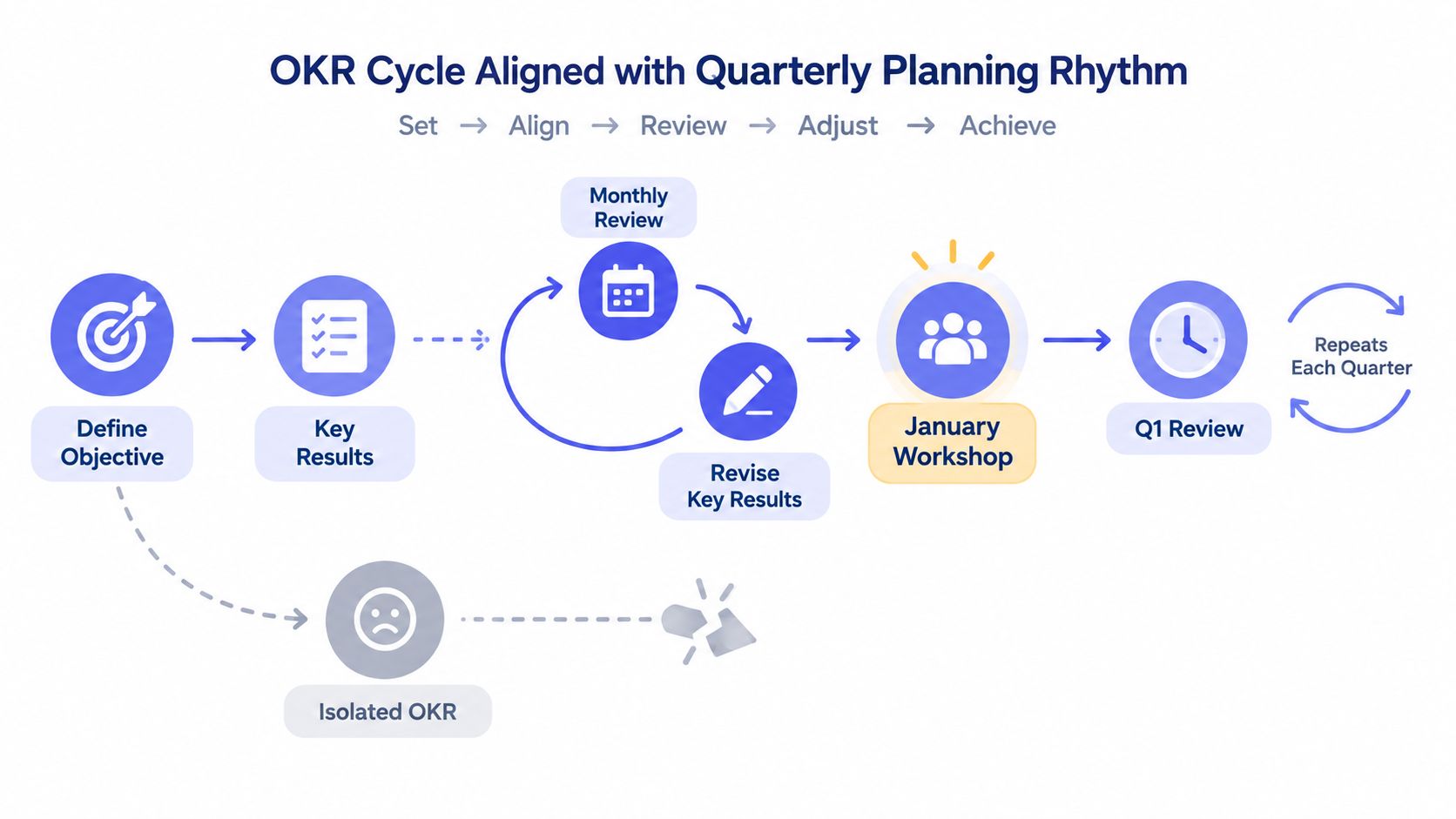
Weekly delivery reviews should handle blockers, dependencies, and near-term commitments. Keep them out of debates about whether the OKR itself is still right.
Monthly strategic reviews should examine confidence changes, evidence quality, risk, and requests to change scope. Use a live scorecard and require a decision or explicit no-change conclusion. A short evidence-based review is more useful than a long narrative presentation.
Quarterly re-planning closes the loop. Leaders review which results landed, which slipped, what assumptions changed, and where resources should move. The next cycle must record those decisions, not copy the previous plan.
Scoring also needs discipline. Solid Growth's OKR guidance describes 3–5 measurable Key Results, weekly tracking, and quarterly grading on a 0–1 scale, where 0 represents no progress and 1 represents full achievement. It identifies 70–80% attainment as a healthy stretch benchmark. Treat that benchmark as a discussion prompt, not a score to manipulate. Consistently high scores may indicate safe targets. Low scores may point to weak capability, poor data, or missing decision support.
The test is direct: does the leadership team make different decisions because of the OKR scorecard? If not, remove the ceremony and redesign the execution system.
Governance and Decision Rules That Hold
Governance isn't a RACI poster pinned to a workspace. It's the wiring that keeps decisions visible when priorities collide.
Every iterative planning cycle should define authority for three recurring decisions:
- Scope addition: Who can approve new work, and what must be removed or delayed to make room?
- Mid-cycle reprioritisation: Who can change sequencing when evidence or risk changes?
- Stalled result escalation: What happens when a Key Result loses confidence or stops moving?
Four roles usually provide enough structure:
- Sponsor: Protects the strategic intent and resolves conflicts above the cycle.
- Cycle owner: Runs the planning rhythm, maintains the scorecard, and controls the decision log.
- Delivery lead: Manages execution detail, dependencies, and team-level trade-offs.
- Reviewer: Challenges evidence, assumptions, and confidence without taking over delivery.
Write the decision rights in plain English. The delivery lead may approve a sequencing trade within agreed scope. The cycle owner may reject an unplanned request or escalate it. The sponsor may approve a material change to the bet. The reviewer can challenge a recommendation but can't redirect the team.
Make trade-offs visible
Broken governance creates private lists. Product keeps its roadmap. Finance maintains a resource view. Engineering tracks technical work. Stakeholders use side conversations to insert urgent requests. Nobody can explain which commitment was displaced.
Healthy governance records each decision in a change log. The entry should state what changed, why it changed, who approved it, which outcome it affects, and what work was dropped or delayed. That record protects teams from revisionist explanations and gives leaders a factual basis for the next review.
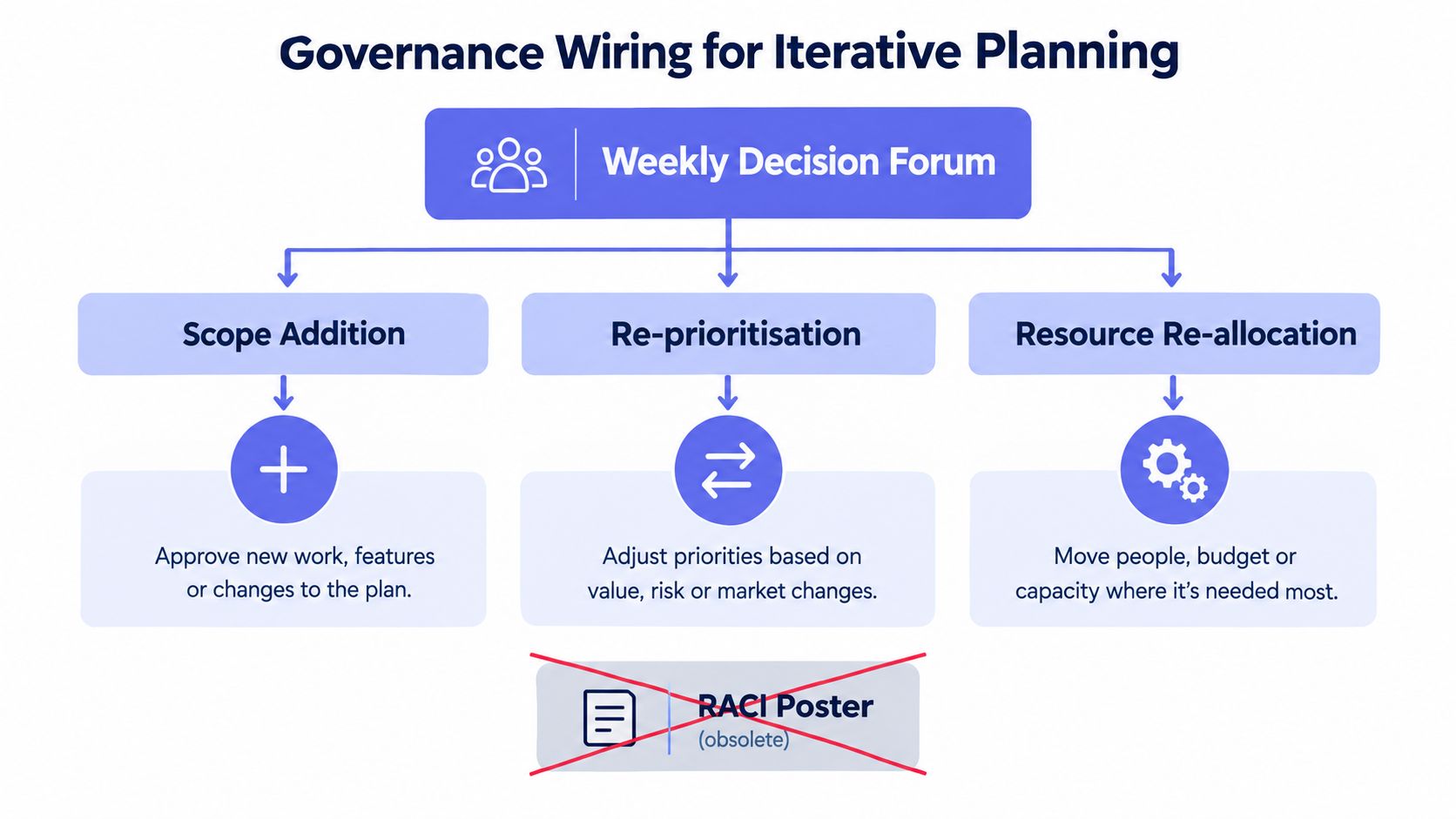
Use one decision forum for changes that affect multiple teams. The decision-making frameworks from The OKR Hub can help leaders define how recommendations move from delivery teams to accountable approvers.
Two rules matter most:
Written trade-off acceptance: Nobody adds material scope without naming what loses capacity or priority.
Single authority per cycle: People can advise, challenge, and provide evidence. One named authority makes the final call.
This isn't bureaucracy. It reduces the time teams lose interpreting contradictory instructions.
Meeting Rhythms and Artefacts That Actually Work
A meeting is useful only when it produces a decision, a resolved risk, or a clear next action. Many organisations have the opposite pattern. Stand-ups, weekly business reviews, steering groups, monthly committees, and quarterly planning sessions accumulate until people spend more time describing work than changing it.
The lean alternative assigns each meeting one output and one artefact. The rhythm should support execution rather than compete with it.
| Meeting | Cadence | Decision Output | Required Artefact |
|---|---|---|---|
| Delivery check | Daily, 15 minutes | Immediate blocker or hand-off | Delivery board |
| Risk and dependency review | Weekly, 30 minutes | Escalation, owner, or mitigation | Risk register |
| Trade-off review | Monthly, 60 minutes | Scope, resource, or sequencing decision | Change log |
| Re-plan | Quarterly, 90 minutes | Next cycle priorities and commitments | OKR scorecard |
Don't mistake more frequent meetings for faster iteration. A daily delivery check should stay close to work. It shouldn't become a miniature leadership review. A monthly trade-off review should examine changes that need authority, not read every team's status aloud.
Keep the artefacts alive
Four artefacts earn their place:
- One-page cycle brief: The bet, intended outcomes, boundaries, owners, and decision rules.
- Live OKR scorecard: Current values, confidence, evidence source, and trend.
- Change log: Approved changes, approvers, reasons, and displaced work.
- Decision log: What was decided, by whom, when, and what the decision excludes.
Everything else needs to justify itself. Status decks often repeat information already available in a delivery board. Multi-tab spreadsheets create competing versions of the truth. Long narrative updates invite passive reading rather than decisions.
The meeting cadence guidance from The OKR Hub supports a practical principle: match the meeting to the decision that must be made. If a forum has no defined decision output, remove it, combine it with another forum, or redesign it.
A useful test is to review the last meeting record. Could a person who wasn't present understand the decision, the owner, the deadline, and the work that changed? If not, the artefact is documenting attendance, not governance.
Designing a Pilot That Proves the Model
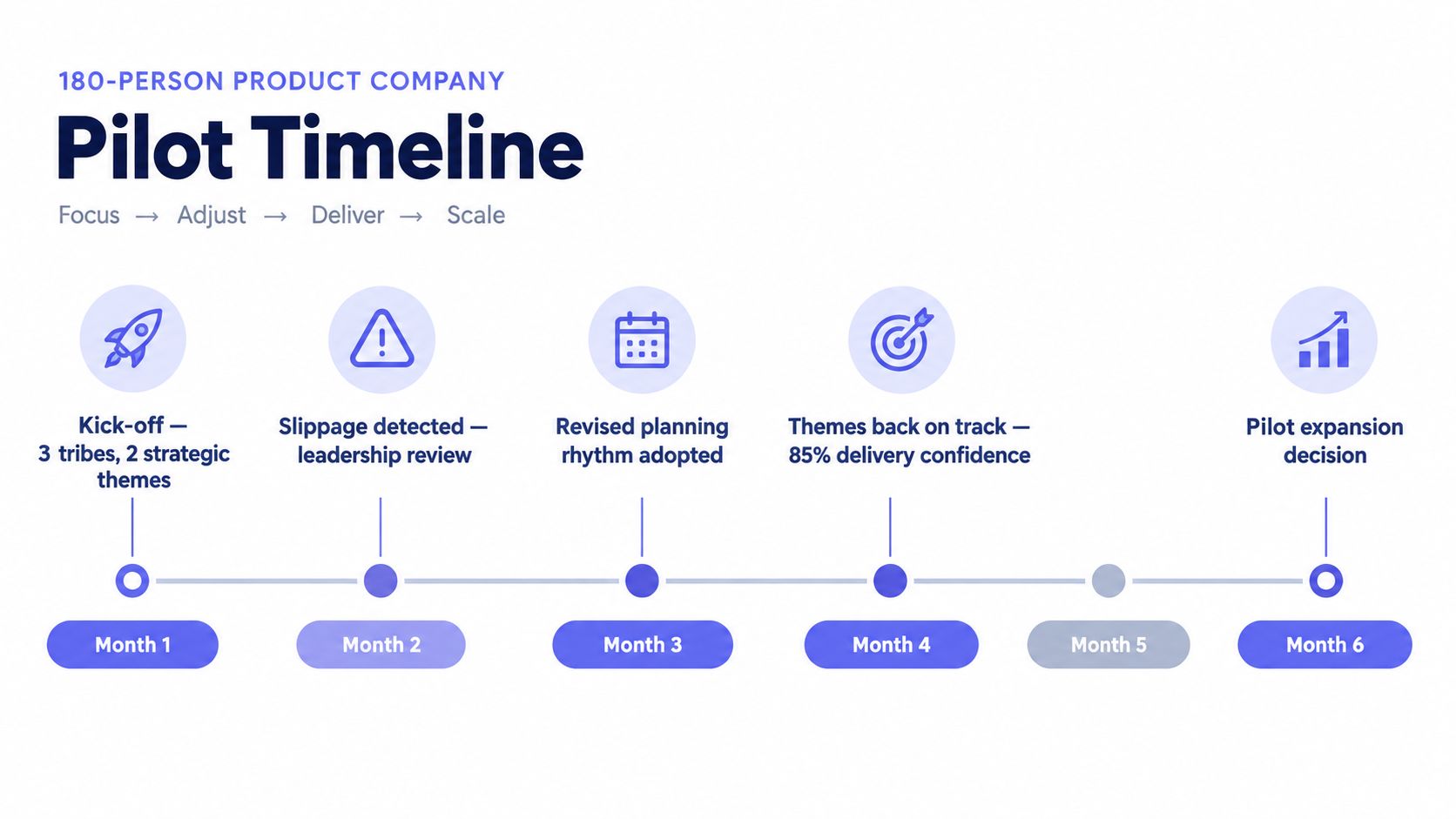
Consider a representative scale-up. It has 180 people, three tribes, two strategic themes that are slipping, and a recently relaunched OKR process that delivery teams don't trust. Leadership wants to roll out a new planning rhythm everywhere.
That would be a mistake.
Start with one tribe. Select the team with a measurable strategic theme, a willing cycle owner, and access to reliable data. Don't choose the most politically visible tribe. Choose the environment where leaders can observe the system directly and where the team can act on the evidence it produces.
A large pilot fails for predictable reasons. Too many stakeholders debate templates. Decision rights remain ambiguous because leaders don't want to exclude anyone. Teams spend time learning the process instead of testing it. When the rollout struggles, nobody knows whether the problem came from the model, the data, or the scale.
Run a four-week test
Week one locks the operating design. The tribe defines its cycle brief, confirms the Objective and Key Results, names the sponsor and cycle owner, and records who can approve scope changes. The team also agrees which data sources count as evidence.
Week two runs the first trade-off review. The cycle owner brings confidence changes, delivery risks, and new requests to one forum. The aim isn't to demonstrate perfect progress. It's to test whether the group can make and record a real trade-off.
Week three tests the risk loop. The delivery lead runs the weekly dependency review. Escalations should move to the person with authority to resolve them. If a risk can't be acted on, the governance design is incomplete.
Week four runs a compressed re-plan. The tribe reviews what changed, which signals proved useful, whether scope moved, and whether the original bet still deserves the same commitment.
Measure the pilot itself, not just the OKRs:
- Cycle adherence: Did the agreed reviews and decisions happen?
- Decision latency: How long did the team wait for an approval or escalation?
- OKR confidence: Did owners update confidence when evidence changed?
- Scope-change volume: How often did new work enter, and was displaced work recorded?
At 30 days, success means the system produces honest information and usable decisions. It doesn't require every Key Result to be on track. In fact, a pilot that reveals a stalled result is more valuable than one that hides problems.
Scale only when three conditions hold. Governance is written. The change log is live. At least one Key Result has been re-scored. The phased implementation approach from The OKR Hub reflects this logic: diagnose the operating problem, design the system, pilot it, then expand based on evidence.
Common Traps and How Leaders Fix Them
Iterative planning breaks when leaders mistake activity for execution. Teams can update OKRs, attend reviews, and maintain a change log while decisions remain slow, authority stays centralised, and delivery teams work from different versions of reality.
| Trap | Signal | Root Cause | Leader Fix |
|---|---|---|---|
| Tick-box OKRs | Scores change, but no decision follows | OKRs are treated as reporting | Link material score changes to resource, scope, or priority decisions |
| Scope drift | New requests enter without displaced work | Approval thresholds and trade-off rules are missing | Require written acceptance and name the approving role |
| Weak leading indicators | Problems surface only near the end of the cycle | Teams track lagging outcomes alone | Add adoption, usage, cycle-time, quality, or compliance signals |
| Decision fatigue | Several forums revisit the same issue | Authority is fragmented | Combine overlapping forums into one decision-focused review |
| Agile rituals without authority change | Teams complete ceremonies but still wait for executives | Leadership cadence remains centralised | Delegate defined scope trades to the delivery owner |
| Private versions of progress | Product, finance, and engineering report different positions | Definitions and evidence ownership are unclear | Establish one scorecard with named evidence owners |
Fix the signal, not the ceremony
A tick-box OKR appears when a team debates whether a result is green or red, then leaves without agreeing what happens next. Change the operating rule. Every material status change must produce a decision, an escalation, or a documented reason to hold course. If none occurs, the review is reporting theatre.
Scope drift requires evidence, not complaints. Inspect the change log. Additions without dropped work show that the organisation is treating capacity as unlimited. Set an approval threshold, record the displaced work, and identify the person who accepts the trade-off.
Weak leading indicators create late surprises. Final outcomes may take months to appear, so teams need nearer-term evidence of whether delivery is creating the required conditions. Track adoption, usage depth, repeat behaviour, cycle time, error rates, or manager compliance. Assign ownership for the result after launch, not only for producing the deliverable. Earlier guidance on separating outcomes from deliverables makes the same practical point.
Leader's test: Ask, “What did this signal make us do?” If the answer is nothing, remove the metric or give it a decision attached to it.
Data quality creates a quieter failure. The UK Planning Data Platform states that its planning application dataset covers 100,627 planning applications, while warning that it is incomplete and “not yet ready for use”. Its roadmap describes work in 3-month cycles, including local authority testing and quality checks to improve accuracy, consistency, and integrity, as reflected in the UK planning application statistics tables. The lesson for planning teams is direct: faster reviews cannot compensate for unreliable evidence. Mark data confidence, name the quality owner, and prevent uncertain figures from presenting false precision.
Decision rights must change with the cadence. A team can attend every stand-up and still wait weeks for executive approval. Give the delivery owner a defined boundary for scope trades, keep strategic changes with the sponsor, and use one cross-functional forum for decisions that exceed the team's authority. That is how iterative planning becomes an execution system rather than a denser meeting calendar.
The OKR Hub helps leadership teams design iterative planning systems that connect OKRs to operating rhythms, governance, and team-level execution. Visit The OKR Hub to explore OKR consulting, implementation, training, and coaching for organisations that need strategy to translate into measurable delivery.