Most advice on leadership training goals is weak. It treats leadership development like a classroom exercise, not a delivery problem. You get tidy learning objectives, a polished slide deck, a completion report, and almost no change in how managers run teams.
That's why training budgets get challenged in board reviews. Leaders aren't asking whether people enjoyed the workshop. They're asking whether priorities got clearer, whether decisions got faster, and whether managers created better follow-through. If your leadership training goals can't answer those questions, they're not serious goals.
Why Leadership Training Goals Usually Miss the Point
Most leadership training goals are written for the learning team, not for the business.
They usually sit in one of three buckets. The first is activity. Run two workshops. Enrol fifty managers. Hit a completion target. The second is learning. Managers will understand coaching. Managers will increase confidence in feedback conversations. The third is behaviour. Managers will run weekly one-to-ones with actions captured and closed. Managers will escalate blocked decisions within an agreed cadence. Only the third type stands up when someone asks what changed on the ground.
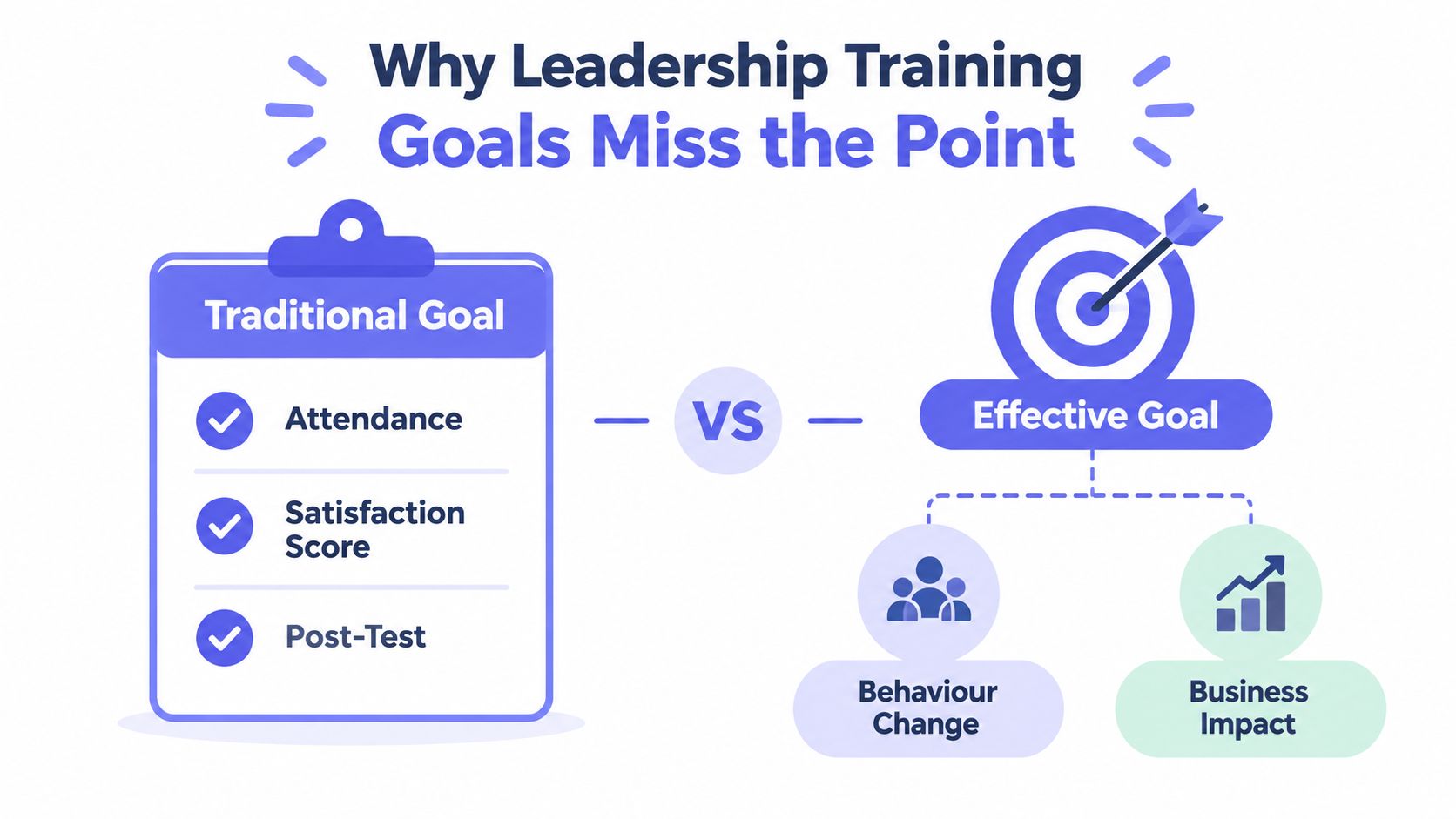
The board doesn't fund learning theatre
Attendance is not progress. Satisfaction is not transfer. A post-course knowledge check is not execution improvement.
That's the core mistake. Organisations write leadership training goals as if the point is to prove content was delivered. It isn't. The point is to change how managers operate when priorities collide, when delivery slips, and when teams need direction.
Practical rule: If a training goal can't be observed in a manager's weekly rhythm, it's probably too vague to matter.
You can see this problem in companies where OKRs already exist but delivery still feels loose. The objectives are there. The dashboards are there. Yet reviews drift, ownership blurs, and decisions stall. Training didn't fail because the content was bad. It failed because it wasn't tied to a change in managerial habit.
A lot of OKR adoption suffers from the same issue. It becomes a reporting layer instead of an operating system. That's exactly how OKRs turn into a tick-box exercise. Leadership training goals often follow the same pattern.
What good goals look like instead
Strong leadership training goals start with execution pressure, not curriculum design.
They ask questions like these:
- Priority clarity: Are managers translating company goals into a smaller set of team priorities?
- Decision speed: Are blocked issues getting resolved inside a defined cadence?
- Accountability: Are one-to-ones, team reviews, and action follow-ups becoming consistent?
- Focus discipline: Are managers stopping low-value work when trade-offs appear?
That shift matters because line management is where strategy gets converted into behaviour. If managers don't run clear cadences, challenge drift, and close actions, strategy stays verbal.
Better leadership training goals don't describe what managers learned. They describe what managers now do, how often they do it, and what that changes for delivery.
The UK Leadership Gap You Are Training Into
The UK context makes this harder, not easier.
A large share of organisations aren't refining strong management capability. They're trying to patch a structural gap. The Chartered Management Institute found that 82% of managers entering management roles had received no formal management and leadership training, 52% held no management and leadership qualifications, and 33% of current managers and leaders had never received formal management and leadership training in its 2023 UK benchmark research.
That's the backdrop for most leadership training goals in the UK. You're often not building advanced leadership depth. You're converting accidental managers into people who can set priorities, run reviews, give feedback, and create accountability.
The spend is real, so the scrutiny is real
UK employers are already putting serious money into training. One UK industry summary says organisations invested approximately £7.5 billion in leadership development in 2023, notes that around 25% of total training investment went to leadership development in 2020, and says demand for leadership training was expected to rise by 8% annually. The same source also cites that in 2024, 59% of UK employers funded or arranged training and 19.6 million employees, or 63% of the workforce, received training in a separate market report, all summarised in this UK leadership development market overview.
If that level of spend exists, vague goals are indefensible.
UK leadership training investment vs. scale at stake
| Metric | UK leadership training figure | Comparable execution loss | Impact |
|---|---|---|---|
| New managers without formal training | 82% | Teams inherit managers who haven't been prepared to run cadence, feedback, or accountability | Basic management inconsistency becomes a delivery problem |
| Current managers without formal training | 33% | Existing leadership layers may still operate without solid management habits | Drift persists even after reorgs and strategy resets |
| Leadership development investment | Approximately £7.5 billion in 2023 | Boards expect visible operational return, not just course completion | Training is treated as a performance lever |
| Workforce receiving training | 19.6 million employees, 63% of workforce | Training is mainstream, so weak transfer is expensive at scale | Goal quality matters as much as programme volume |
A useful response is to stop writing goals from a competency catalogue and start from your operating model. If your managers are meant to drive alignment and follow-through, your goals should reflect that. A solid leadership capability framework helps, but only if those capabilities are translated into observable management routines.
Designing Goals That Move Real Behaviour
The cleanest way to write leadership training goals is to work backwards from strategy.
Start with the business outcome. Then identify the manager behaviour that most directly influences it. Then make that behaviour observable and time-bound. Finally, attach a leading measure that tells you whether the behaviour is happening.
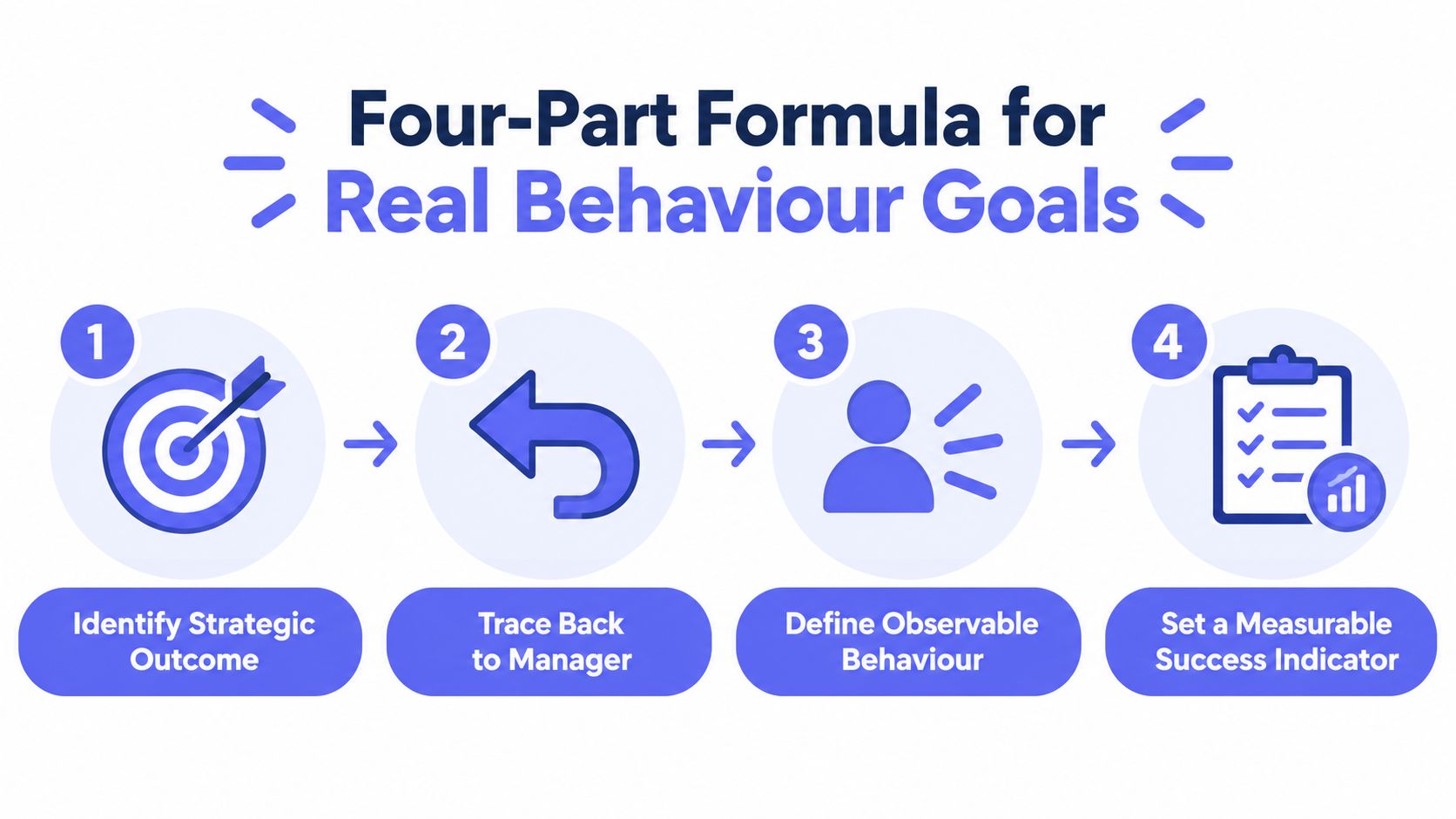
Work backwards from the parent OKR
Most training teams begin with a topic. Coaching. Communication. Resilience. That's backwards.
Begin with the parent objective. For example, a retailer might set an OKR around improving store execution, reducing avoidable loss, and tightening operating discipline. Once that objective is clear, ask which manager behaviour would make the biggest difference. Not in theory. In the weekly running of the business.
That usually leads you to things such as:
- Review cadence: A store manager runs a weekly shrink review with supervisors and logs actions by owner.
- Escalation discipline: Blocked issues are raised within the same trading week, not left to drift.
- Follow-through: Open actions from the previous review are checked before new issues are discussed.
Those are training goals worth funding.
Don't ask whether managers can describe good leadership. Ask whether they now run a better week.
Make the behaviour visible
A useful template is simple:
Following this programme, [manager group] will [observable behaviour] [cadence or trigger], in order to support [strategic outcome], measured by [leading indicator].
That beats vague wording every time.
Here's a weak version:
- Managers will improve coaching capability.
Here's a stronger version:
- Store managers will run a weekly shrink review with named actions and follow-up from the previous week, supporting the team objective of tighter stock control, measured through review completion and action closure trends.
That's specific enough for line leaders to inspect. It also forces training design to match reality. If the goal requires weekly review discipline, the programme should include practice on running that meeting, handling poor data, assigning owners, and closing actions. Not just generic content on leadership style.
If you need a cleaner way to phrase strategic intent before translating it into behaviour, this guide on how to write objectives is useful.
Attach one leading signal
Don't drown the goal in measurement. Add one leading signal that shows the behaviour is happening.
Good examples include:
- Cadence adherence: Are the reviews or one-to-ones taking place?
- Action quality: Are actions specific, owned, and dated?
- Decision turnaround: Are operational issues being resolved faster?
- Closure discipline: Are managers finishing agreed actions before creating new ones?
Teams also need a visible way to track team progress effectively, especially when the training is meant to improve execution rhythm rather than add more reporting.
One note on tools. The OKR Hub works with leadership teams on this exact translation problem, connecting strategy, OKRs, and management cadence so training supports execution rather than sitting beside it.
Three Scenarios Where the Wrong Goal Stalls Delivery
A retail chain launches a leadership programme for store managers. The goal is clean on paper: achieve full workshop attendance across the cohort. The sessions happen. Feedback is decent. Six months later, service problems still show up at store level because managers weren't asked to change anything on shift. No new review rhythm. No tighter handover discipline. No clearer ownership. Attendance happened. Delivery didn't.
The completion trap
A mid-cap technology firm takes a different route. It ties manager development to completion of an emotional intelligence module. Managers finish the e-learning, discuss self-awareness in breakout groups, and rate the experience positively. Yet product and operations still complain that cross-functional delivery is slow. Nobody measured how long decisions sat unresolved. Nobody tightened meeting discipline. Nobody changed escalation habits.
This is common. Leaders choose a respectable topic, but they don't define the operational behaviour that should follow from it.
A training goal that ends at course completion creates paperwork, not better management.
The strategic disconnect
A public sector directorate funds a leadership cohort during a live transformation. The programme covers communication, influence, and personal impact. All sensible topics. The problem is that none of the goals are tied to the directorate's top priority. The cohort finishes just as a transformation deadline is missed. Senior leaders then ask the obvious question: what exactly did this programme help us deliver?
That question should have been answered before launch.
A better design would have linked the programme to behaviours such as faster risk escalation, tighter milestone review, clearer ownership in programme meetings, or stronger manager follow-through between workstreams. Those are leadership training goals with a direct line to execution.
The pattern behind all three
These scenarios look different, but the failure is the same. The organisation funded learning activity without defining the management behaviour that would move delivery.
If your current goals sound polished but don't survive contact with the weekly running of the business, they need rewriting. Many of the same errors show up in common OKR mistakes, especially when teams confuse activity with outcome.
Metrics That Prove Leadership Training Changed Execution
If you want to prove leadership training worked, split your metrics into two groups. Leading indicators show whether managers are using the new behaviour now. Lagging indicators show whether that behaviour is improving execution over time.
Keep the dashboard tight. No more than six metrics. Anything larger usually turns into vanity reporting.
Measure behaviour first
The strongest leading metrics are operational, not psychological.
Use measures such as:
- One-to-one cadence quality: Whether managers hold regular one-to-ones with clear actions and follow-up.
- Issue-to-decision time: How quickly a raised issue is logged, resolved, or escalated.
- Structured coaching use: Whether managers use a consistent approach in development conversations.
- Meeting-to-decision ratio: Whether recurring meetings end with decisions or just discussion.
- Action closure rate: Whether agreed actions are completed within the expected cadence.
These are useful because they can shift quickly. You don't need to wait for annual engagement results to know whether a manager's operating rhythm changed.
Decision test: If the metric can improve while a manager behaves exactly the same way, it's the wrong leading metric.
Then measure downstream delivery
Lagging indicators should connect back to the performance outcomes the training was meant to support.
Leading vs lagging metrics for leadership training goals
| Metric | Type | Cadence | What movement tells you |
|---|---|---|---|
| One-to-one frequency and action follow-up | Leading | 30, 60, 90 days | Whether managers adopted the expected management rhythm |
| Time from issue raised to decision logged | Leading | 30, 60, 90 days | Whether decision speed is improving |
| Use of structured coaching conversations | Leading | 30, 60, 90 days | Whether the skill is being applied, not just understood |
| Meeting-to-decision ratio | Leading | 30, 60, 90 days | Whether teams are converting discussion into action |
| Team OKR progress reliability | Lagging | 60, 90 days and beyond | Whether better management discipline is improving delivery consistency |
| Project milestone hit rate for leadership-owned workstreams | Lagging | 60, 90 days and beyond | Whether the training is affecting execution outcomes |
Use direct-report engagement, regrettable attrition, internal promotion movement, and workstream delivery only where they clearly connect to the target population and context. Otherwise, they become noisy.
Baseline each metric before the cohort starts. Then review movement at 30, 60, and 90 days. If you skip the baseline, every post-programme story becomes subjective. If you wait too long to check, the training disappears into seasonal noise and competing priorities.
A practical delivery performance measurement approach helps here because it forces the same discipline on leadership development that you'd expect in any transformation workstream.
Rollout Conditions That Make Goals Stick
Most leadership training doesn't fail in the room. It fails in the calendar the week after.
UK evidence is blunt on this. A UK government feasibility assessment on evaluating management and leadership training said impact measurement needs workforce records for at least 1,000 trained managers and 1,000 matched controls, with training delivered on average two or more years earlier and at least one year of pre-training data, according to this government evidence review on leadership training evaluation. In other words, proving impact is hard. That's exactly why weak rollout conditions are so expensive.
A separate UK evaluation found limited workplace transfer across management training levels, with no statistically significant aggregate effects across most covered line-management practice domains and satisfaction scores only ranging from 51% to 75% rating the training 8/10 or above, below the 80% quality threshold used by the Cabinet Office, as summarised in this review of whether leadership training really works.
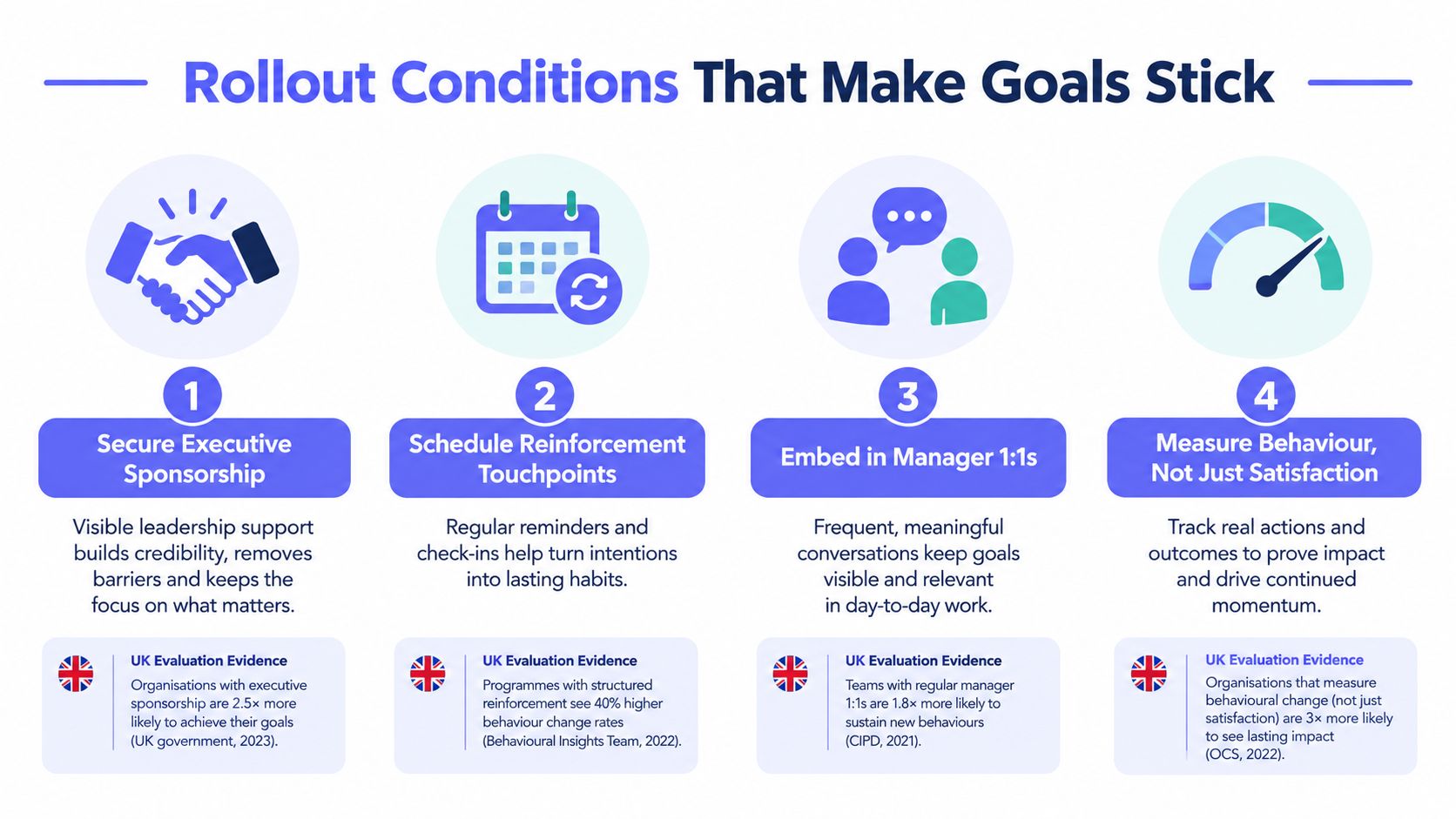
Four conditions matter most
- Executive ownership: A senior executive should own the business goal the programme is meant to support. If ownership sits only with L&D, the programme becomes a service, not a performance intervention.
- Manager commitment before launch: Participants should agree a small set of application goals with their own line manager before the first session. Not afterwards.
- Reinforcement in live cadence: Use peer coaching triads, short application tasks, and regular one-to-ones to keep the behaviour visible between sessions.
- System embedding: Put the expected behaviour into performance conversations, talent reviews, and team operating rhythms. If it only lives in the LMS, it won't survive.
What kills transfer every time
Three conditions reliably crush transfer.
Conflicting priorities. Overloaded cohorts. No protected time to practise.
Training can't compete with an operating model that rewards urgent firefighting and ignores management discipline.
Your Leadership Training Goals Checklist
Leadership training goals should read like a delivery brief, not a learning catalogue.
Start with the business priority. If you can't point to the parent objective or OKR, stop there. Training without a strategic anchor is easy to approve and hard to defend later.
Use this in a planning week
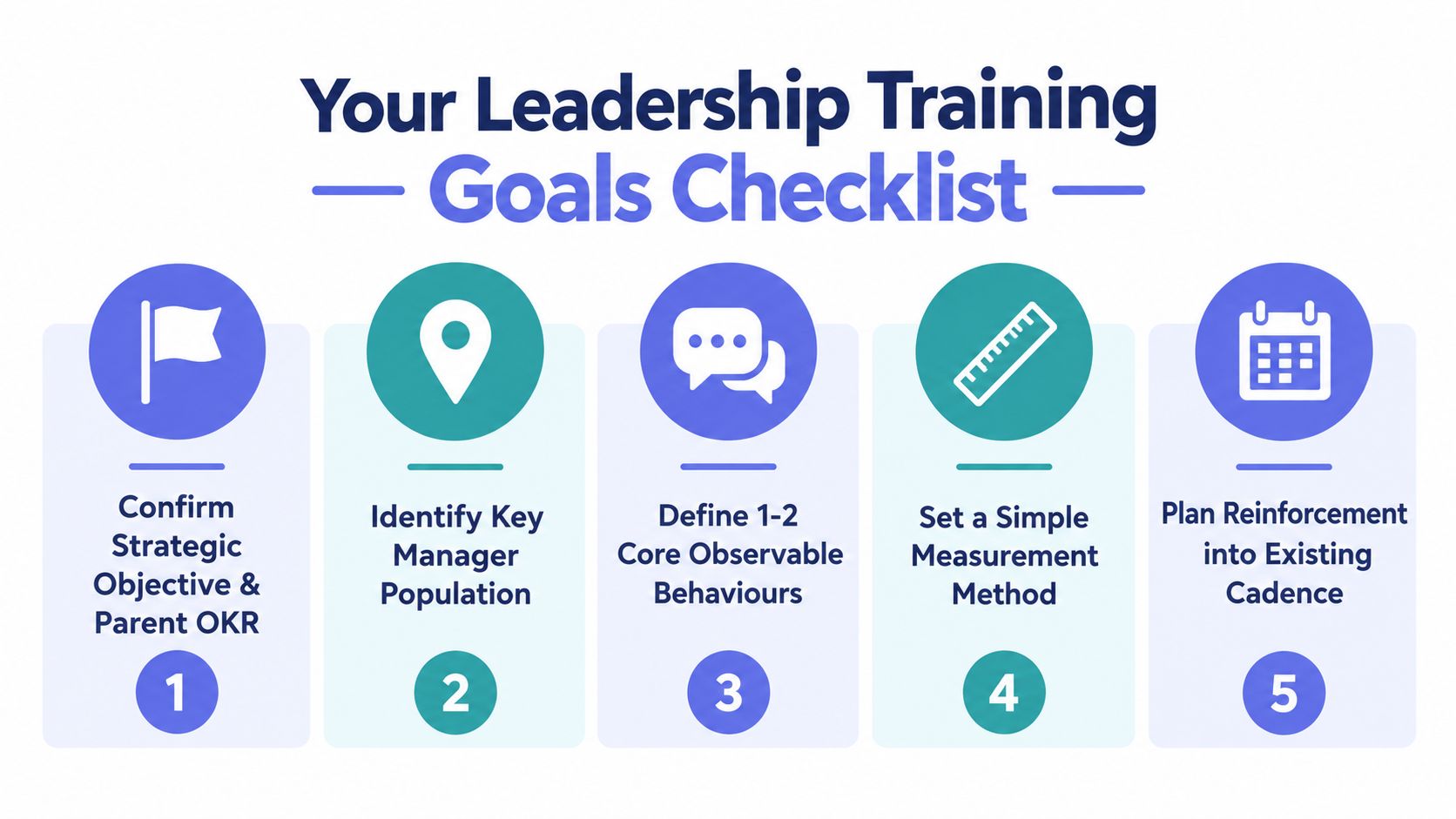
- Confirm the parent objective: Name the strategic priority, the delivery problem behind it, and the team or manager population that most affects it.
- Isolate the few behaviours that matter: Pick two or three manager actions that would noticeably improve execution. Weekly review cadence. Faster escalation. Better action closure. Clearer one-to-ones.
- Write goals with from-to movement: Replace broad capability wording with visible behavioural change. From irregular one-to-ones to weekly one-to-ones with actions recorded and reviewed. From reactive issue handling to same-week escalation and decision logging.
- Attach one leading and one lagging metric: Keep it simple. One measure that proves the behaviour is happening, one that shows whether execution is improving.
- Lock in reinforcement: Name the sponsor, the review cadence, and where the behaviour will be discussed after the programme ends.
Stress-test the wording
Before approval, challenge each goal against three failure patterns:
- Attendance theatre: Would this goal still look successful if managers changed nothing in practice?
- Soft-skill vagueness: Can a line leader observe the behaviour in a normal week?
- Untestable phrasing: Do you have a baseline and a check-in point, or is the goal built on opinion?
One final standard matters. UK government evidence on line management training points to a harder truth: training is more useful when it's targeted, intense, and evaluated through workforce outcomes rather than participant surveys, as set out in this UK government review of line management training effectiveness. That's the benchmark to use.
If you're planning the next budget cycle, map every current leadership training goal against this checklist. If HR or L&D can't show the behavioural shift, the metric, and the reinforcement plan, the goal isn't ready.
If your leadership training goals still read like course outcomes, you're funding activity instead of execution. The OKR Hub helps leadership teams connect strategy, OKRs, and management rhythm so training changes how teams operate. If you're reviewing budgets or redesigning a programme, it's a practical place to start.