Your leadership team has done the offsite. The slide deck is polished. There are five priorities on the final page. Everyone nodded in the room.
Then six weeks pass.
Product is still chasing one set of outcomes. Sales is pushing a different agenda. Finance is asking what got deprioritised to fund any of it. The same trade-offs keep coming back in steering meetings because nobody settled them the first time. The priorities exist on slides, but not in the operating system of the business.
That's the strategic priorities definition problem. Most organisations don't suffer from lack of intent. They suffer from vague priority statements that never became governed constraints.
The Leadership Problem Behind Vague Priorities
I see this pattern constantly. A leadership team leaves an offsite convinced it has alignment because the language is neat and the list is short. Then normal operating pressure returns and the list starts to unravel. Teams interpret the same priority differently. Two executives assume they both own it. Middle managers keep legacy work alive because nobody has explicitly told them what stops.
This isn't a failure of ambition. It's a failure of design.
A strategic priority only becomes real when it constrains choices. If it doesn't change who decides, where money moves, what work slows down, and which forum inspects progress, it's still a slogan. That's why many digital transformation programmes stall after a strong strategy phase. A more grounded model is the CloudCops GmbH consulting approach, which treats transformation as an execution challenge tied to decisions, delivery and operating change, not just planning.
The gap leaders usually miss
The gap is simple. Your priorities exist as words, not as a governed constraint set.
That distinction matters because misalignment is expensive in attention, not just budget. In a UK survey of 102 senior leaders, respondents said more than 30% of their time and energy went into dealing with misalignment, with horizontal misalignment reported regularly or very often by 73%, diagonal by 58%, and vertical by 46% (UK alignment research on implementation of strategy).
A related pattern shows up in why teams drift in the first place. If you're diagnosing why one leadership decision turns into five competing interpretations across functions, this breakdown of why teams are misaligned at work is worth reading.
Most priority lists fail for one reason. They describe importance, but they don't govern behaviour.
Three questions matter. What is a strategic priority, really. How is it different from goals and OKRs. And what makes one operationally real rather than politically convenient.
What Strategic Priorities Actually Mean
A strategic priority is a small set of organisation-wide choices about where you'll focus leadership attention, investment, and execution pressure for a defined period. It isn't a summary of everything that matters. It's a deliberate narrowing of what matters most now.
That means a proper strategic priorities definition must include choice and sacrifice. If the statement doesn't tell people what gets less attention, it isn't a priority. It's a preference.
The cleanest way to separate the layers
Use this rule.
- Strategic priorities are the choices.
- Goals are the outcomes you want from those choices.
- OKRs are the measurement and review layer that shows whether the choices are working.
Leaders blur these layers all the time. They call revenue growth a priority when it's a goal. They call an Objective a strategy when it's really a communication device. They stuff every major initiative into the same bucket and wonder why nobody can tell what takes precedence.
In practice, strategic priorities should be scarce. At company level, three to five is usually the upper limit. If you're trying to carry more than that, one of two things is true. Either you haven't made hard choices, or you're mixing categories that should be managed differently.
What a real priority statement includes
A real priority statement has four things attached to it from day one:
- A defined bet: Where you're concentrating effort.
- A trade-off: What slows, stops, or loses budget because of that choice.
- An owner: One accountable executive, not a committee.
- A time boundary: The period in which this priority governs decisions.
The UK public sector offers a useful reference point here. The UK Statistics Authority formally closed its 2020 to 2025 strategy in October 2025 and introduced new strategic priorities, showing that priorities work best when they are explicit, finite, and tied to governance cycles rather than left as broad aspirations (UK Statistics Authority strategy and business plan).
If your teams struggle to keep organisational knowledge, decision context, and priority logic visible across departments, tools like a unified AI employee platform can help centralise context. But the tool isn't the point. The operating definition comes first.
For a sharper view of how company priorities should connect to team execution, this piece on strategic alignment is a useful companion.
Six Qualities That Make a Priority Real
Most leadership teams can test their current priority list in under an hour. Run each item against six qualities. If two or more are missing, the priority isn't operational.
Named ownership
Every company-level priority needs one executive owner who can be held to account in a formal forum. Not a department. Not a working group. A person.
When this is missing, you hear phrases like “marketing and product are jointly leading this”. That usually means neither can settle cross-functional conflict.
Explicit trade-off
The trade-off has to be written into the priority or its approval note. What gets slowed, stopped, or deprioritised to make room for this.
If that line doesn't exist, teams keep old commitments alive and overload the system.
Practical rule: If a strategic priority doesn't create at least one uncomfortable “no”, it hasn't been defined tightly enough.
Resourcing attached
Ambition without resource is theatre. The priority needs committed budget, headcount, capability allocation, or all three.
Missing resourcing usually shows up as leaders saying the work is “critical” while asking teams to absorb it into existing capacity.
Review cadence
Company priorities need a fixed review rhythm. Quarterly is the realistic minimum for formal priority review, with evidence checked more frequently.
When cadence is absent, the priority gets discussed only when it goes off track or becomes politically noisy.
Evidence, not just outcomes
You need leading indicators, not only lagging commercial or operational results. Waiting for year-end financials is too slow.
If this quality is missing, steering groups spend their time swapping opinions because nobody agreed what early proof looks like.
Deprecation rule
A real priority has a condition under which it gets downgraded, replaced, or killed. This stops zombie priorities surviving long after the business case has evaporated.
When there's no deprecation rule, leaders keep legacy priorities alive because retiring them feels like admitting error.
A useful diagnostic lens
A UK-focused strategy alignment framework scores 12 measurable indicators from 0 to 2, including strategy recall, named accountability, decision authority, trade-off records, governance cadence and outcome focus. In that model, scores below 14 indicate critical misalignment risk, 14 to 22 indicates structural drift, and above 22 indicates a functioning alignment system (UK strategic alignment diagnostic).
That's the right mindset. Treat a priority as a governed constraint set. If you can't score it for ownership, trade-offs and review evidence, it isn't ready.
Strategic Priorities vs Goals vs OKRs
Execution drifts when leaders use three different layers of planning as if they're the same thing. They're not. Each one solves a different problem.
Here's the simplest working distinction.
| Dimension | Strategic Priorities | Goals | OKRs |
|---|---|---|---|
| Purpose | Choose where the organisation will focus and what it will sacrifice | State the outcome leadership wants | Prove progress through measurable objectives and key results |
| Time Horizon | Typically tied to an annual or multi-year governance cycle | Usually annual or linked to a planning period | Usually quarterly, sometimes annual for top-level objectives |
| Number Allowed | Few. Usually three to five at company level | More than priorities, but still selective | Multiple across company, function and team levels |
| Ownership | One executive owner | Senior leader or function owner | Named owner at each level |
| Measurability | Should be testable, but not always phrased as metrics alone | Often outcome-based and measurable | Explicitly measurable by design |
| Failure Mode | Becomes a vague slogan with no trade-offs | Becomes a wish list detached from delivery | Becomes a tick-box reporting exercise |
| Example | Modernise the core service by shifting investment from maintenance-heavy legacy work | Reduce service failure and improve adoption of the new model | Objective to improve service reliability, with key results tied to adoption, cycle time and defect trends |
The short version is this. Priorities choose where to play. Goals state what winning looks like. OKRs prove it's happening.
If your teams still collapse these into one layer, they'll write Objectives that repeat strategic themes and call it alignment. It isn't. This comparison of OKRs vs SMART goals helps clarify where each tool does its best work.
Strategic Priorities in Practice
The definition gets clearer when you watch it operate in real situations. The structure stays the same. The context changes.
Scenario one: Series B scale-up entering a new European market
The strategic priority is simple. Win repeatable entry into one new European market before expanding further.
That forces a trade-off. The company pauses broader multi-market exploration and stops custom product requests that only serve its existing home market. The owner is the Chief Revenue Officer, because the issue is commercial repeatability, not just launch activity.
Resource shift matters here. Leadership moves experienced operators into the target market squad and protects local enablement work from being raided by core business demands. The monthly leading indicator is whether the go-to-market motion is becoming repeatable across the first target customer segments.
Scenario two: Enterprise retailer in a margin-led turnaround
The priority is not “grow profit”. That's too broad. The priority is rebuild margin by simplifying assortment and tightening promotional discipline.
The trade-off is painful. Merchandising loses freedom to chase low-quality volume through discounting. Some local exceptions stop. The owner is the Chief Commercial Officer with finance oversight because margin recovery sits in the commercial engine, not in a spreadsheet.
A turnaround priority is credible only when somebody can name the commercial behaviour that must stop.
Leadership reviews one leading indicator monthly. Are category decisions becoming more disciplined, or are teams slipping back into reactive discounting to hit short-term numbers.
Scenario three: Public-sector organisation modernising a legacy service
Here the strategic priority is improve service quality by modernising the critical service stack and reducing dependence on brittle legacy processes.
This mirrors the public-sector reality that priorities often have to balance service quality, resilience and compliance at once. In the UK's official statistics system, strategic priorities for 2024/25 were made concrete through five priority outcomes, including improved trustworthiness, top-quality statistics on health, population and migration, top-quality statistics on prices, GDP and employment, greater linked data capabilities, and modernised digital infrastructure. The Office for National Statistics sharpened this further in 2025/26 by making the quality of its critical statistics its top priority and explicitly prioritising quality over quantity (UK Statistics Authority annual report and accounts 2024 to 2025).
The trade-off is usually slower progress on lower-value enhancements so critical quality risks get addressed first. The owner is the service executive who controls delivery and can settle cross-functional dependencies. The monthly leading indicator is whether the modernised path is reducing operational friction in the live service.
Translating Priorities Into Measurable Execution
Most leadership teams don't need another planning workshop. They need a conversion method. Take a vague priority statement and force it through six decisions until it becomes executable.
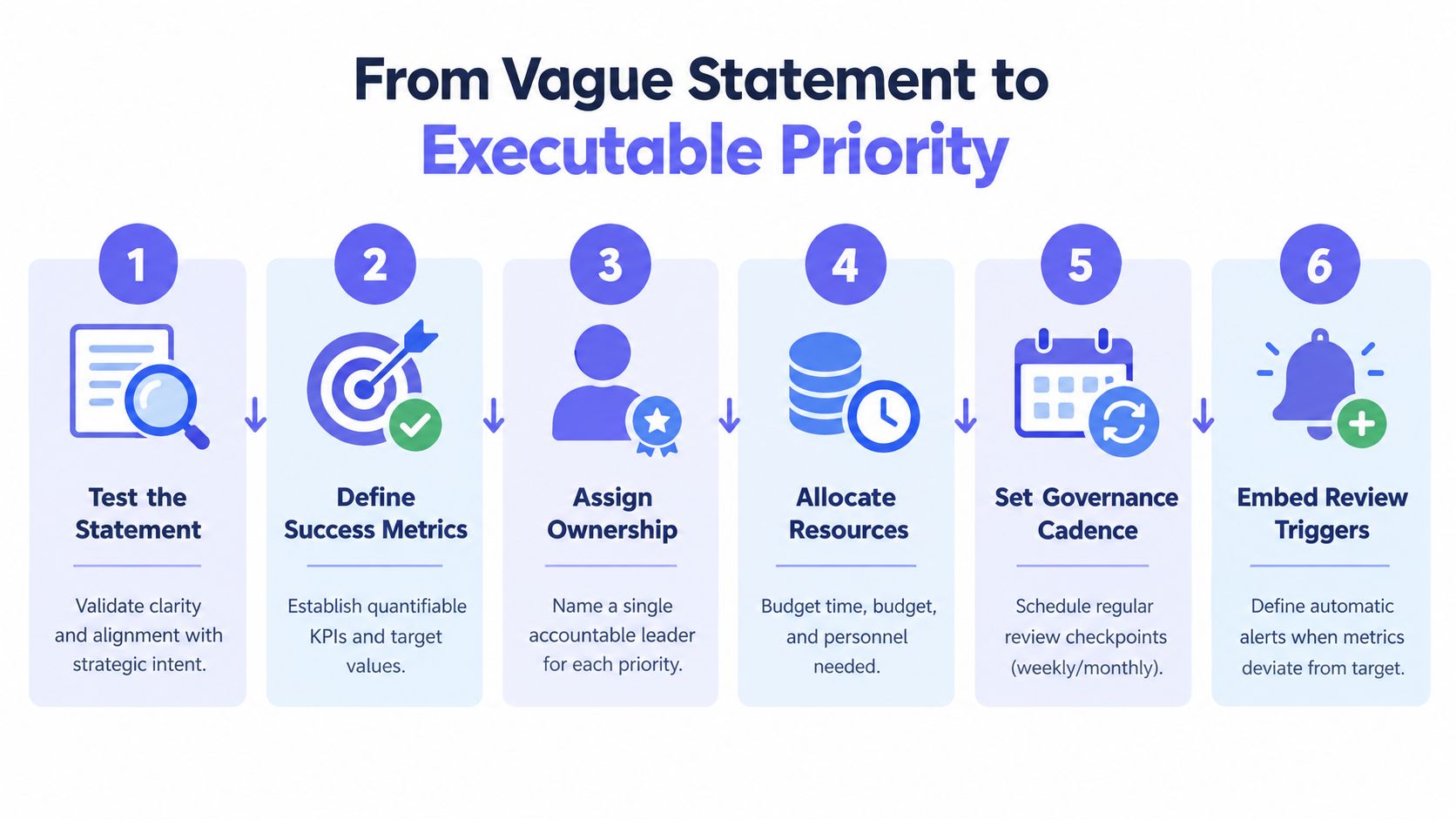
Step one test the statement
Action: Put the draft priority through the six-quality test.
Deliverable: A marked-up statement showing gaps in ownership, trade-offs, resources, evidence, cadence, or deprecation.
Governance check: If the item fails on multiple qualities, it doesn't enter the final company priority set.
Step two name one owner
Action: Assign a single accountable owner at C-level or P&L level.
Deliverable: One named executive in the plan, minutes and review forum.
Governance check: If two executives believe they own it, nobody owns it.
Step three write the trade-off plainly
Action: Add one sentence that states what the organisation will stop, slow, or deprioritise.
Deliverable: A trade-off statement attached to the priority approval.
Governance check: The CFO, COO or Chief of Staff should be able to see the capacity logic immediately.
If a priority can't survive one explicit trade-off sentence, it was never robust enough to guide execution.
Step four move real resources
Action: Reallocate budget, headcount, delivery capacity, or specialist capability.
Deliverable: A resource decision recorded alongside the priority, not buried in a separate operating plan.
Governance check: No funding decision means no live priority.
Step five set the review rhythm
Action: Define quarterly decision reviews and monthly evidence reviews.
Deliverable: Two or three fixed quarterly checkpoints with a standard agenda. Stop, continue, start.
Governance check: If the review is optional or gets bumped for other meetings, the priority is already weakening.
Step six define the kill rule
Action: Write the condition under which the priority will be downgraded, replaced, or retired.
Deliverable: A deprecation trigger linked to evidence, timing, or strategic context.
Governance check: Leaders agree in advance what would make continued investment irrational.
A practical way to support this is to separate cadences cleanly. Strategic priorities get reviewed quarterly. Evidence gets reviewed monthly. Team execution runs week to week through OKRs and delivery rhythms. If you need a sharper method for defining evidence at the outcome level, this guide on how to measure outcomes is a useful reference.
Common Pitfalls and How OKR Hub Addresses Them
Leaders often assume the problem is commitment. Usually it isn't. The problem is weak governance.
The failure patterns that quietly wreck priority setting
One common issue is priority inflation. Eight things are labelled top priorities, which means none of them is. Another is cosmetic OKRs, where teams copy the priority wording into an Objective and never define measurable proof. Then there are unfunded mandates, which leadership declares critical without moving any budget or people.
The other two are just as damaging. Accountability gaps appear when the owner is “the leadership team” or “operations” instead of a named individual. And review-free quarters happen when no one checks whether the priority is producing evidence until it's too late to intervene.
UK strategy-execution research found the persistent failure mode wasn't weak strategy formulation but weak translation into operating priorities. The top barriers reported were talent gaps, weak alignment between operations and strategy, and misaligned organisational culture (UK strategy execution research key findings).
Priority Pitfalls and How OKR Hub Counters Them
| Pitfall | Warning Sign | OKR Hub Counter |
|---|---|---|
| Priority inflation | Leadership keeps adding “one more” strategic item during planning | Planning workflow that caps the active company priority set |
| Cosmetic OKRs | Objectives repeat strategy language but key results don't measure anything useful | Structured objective and key result template that rejects vague wording |
| Unfunded mandates | Teams are told to deliver strategic work with no capacity shift | Resourcing linkage that flags objectives without committed budget or headcount |
| Accountability gaps | Owners are teams, functions or committees | Named-owner field with accountability reporting |
| Review-free quarters | Progress only surfaces when an issue becomes severe | Quarterly check-in cadence with escalation rules |
A structured system matters because governance beats motivation every time. In UK research on knowledge workers, only 16% said teams collaborated effectively across departments, while 52% understood how their work contributed to broader company goals. The same findings showed aligned workers were more than three times as likely to understand company strategy and four times as likely to feel authorised to make strategic decisions or pursue new opportunities (UK State of Work alignment findings).
That's where a platform and consulting model can help if used properly. The OKR Hub applies an OKR-based structure to cap priorities, force measurable key results, assign ownership and embed quarterly review discipline. If your current system can't stop vague priorities entering the plan, it isn't protecting execution. This article on why OKRs fail is useful if you're trying to diagnose whether the issue is your framework or how you're operating it.
What to Do Next as a Leadership Team
Don't launch a new strategy programme. Start smaller and get stricter.
Book a single two-hour priority review. Bring the current company priority list. Cut it to three to five items. Then require each item to have three things before it survives the meeting: a named executive owner, a written trade-off statement, and one explicit funding or capacity decision.
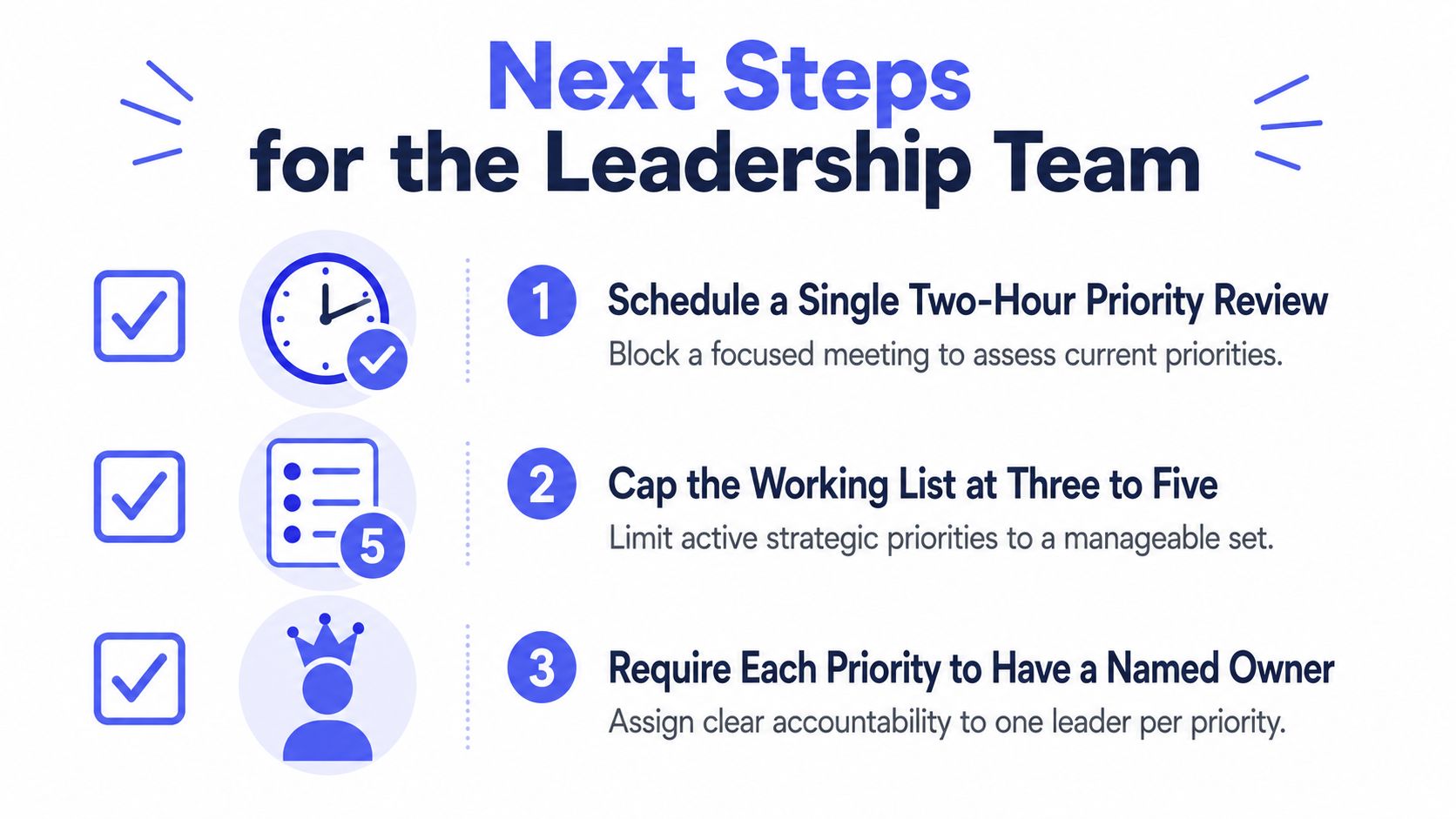
Then put a 90-day review in the calendar before anyone leaves the room. Each owner should leave with the job of drafting two or three measurable key results that will prove the priority is moving.
That's enough to change the quality of execution within one quarter. A smaller, sharper, fully owned set of priorities will outperform a longer, vaguer list every time. The test is simple. Would your leadership team still defend those priorities publicly when asked what you chose not to do.
If your priorities are clear in principle but weak in execution, The OKR Hub helps leadership teams turn them into owned, measurable commitments with proper review cadence. We work with scale-ups and enterprise organisations to fix misalignment, weak accountability and slow delivery by making OKRs operate as an execution system, not a reporting ritual.