The strategy offsite went well. Leaders agreed on three or four bets, teams left with clear objectives, and the roadmap looked credible. Eighteen months later, delivery is scattered across product work, regulatory requests, customer escalations, reporting, hiring, technical debt and “quick” executive asks. Everyone is busy. Few people can explain what should stop.
That is the core priority problem. Organisations rarely fail because they can't rank a list. They fail because they can't protect decisions when capacity tightens, trade-offs appear and operational work arrives without an owner. A priority management system must therefore govern what gets attention, what waits, who decides and when priorities are allowed to change.
Why Most Priorities Never Reach Delivery
The assumption that better planning produces better execution is wrong. A leadership team can write a coherent strategy and still leave delivery leads to negotiate priorities through meetings, messages and escalation chains. The result is predictable. New work enters faster than old work leaves, dependencies remain implicit, and teams keep several commitments alive because nobody has the authority to close one.
UK evidence shows that priority-setting has long been more complicated than a single standard method. Research covering all 152 Primary Care Trusts in England found a mix of formal and informal processes, a useful historical marker for the shift from ad hoc decisions towards explicit rules, evidence and governance (the Nuffield Trust research on setting priorities). The lesson applies well beyond healthcare. Priority-setting becomes a management capability when leaders must rank initiatives, allocate scarce resources and explain trade-offs consistently.
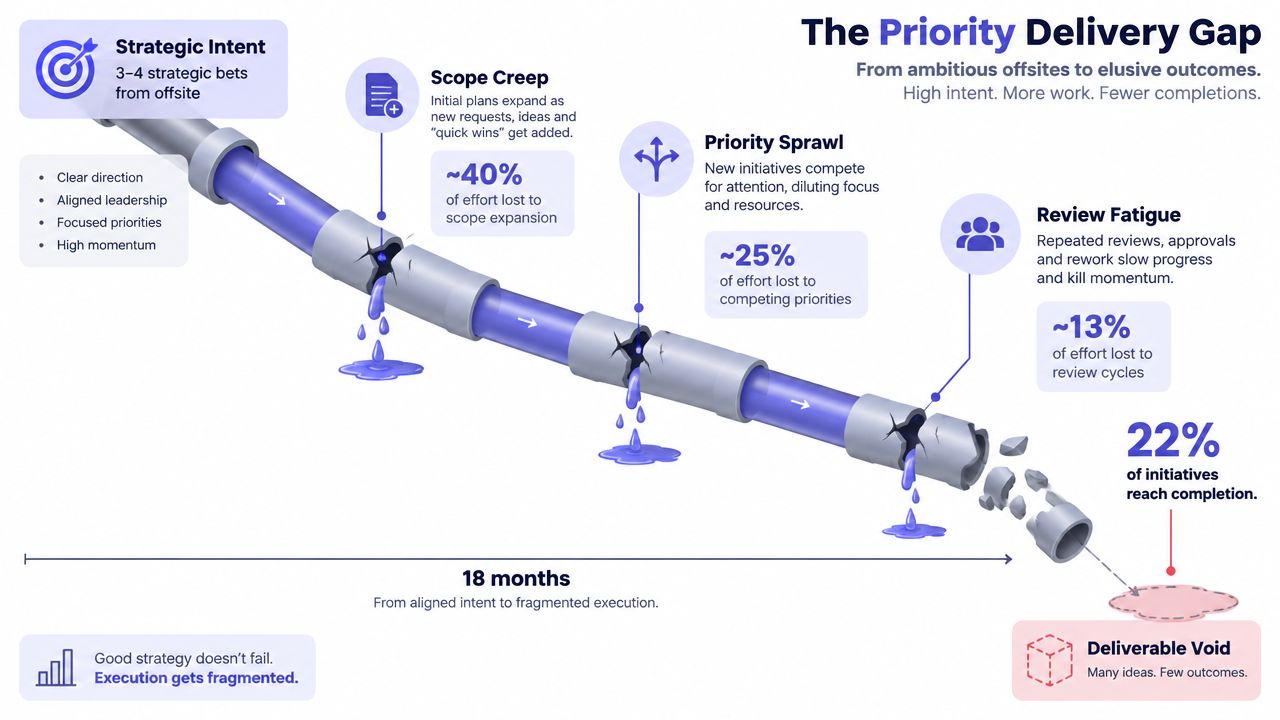
Four silent failures usually sit between strategic intent and delivery:
- Ambiguous ownership: Teams know an initiative matters, but nobody owns the final call when objectives conflict.
- Hidden BAU load: Support, approvals, incidents, compliance and stakeholder management consume capacity without appearing in the strategic plan.
- Weak deprioritisation: Leaders add work but rarely remove it, so the roadmap becomes a record of ambition rather than a delivery commitment.
- Absent escalation routes: Teams surface blockers but don't know which forum can resolve them or reallocate people.
The UK National Audit Office makes the same operational point in different terms. Departments need to set the relative importance of competing objectives and understand the levers available to use scarce resources well (NAO guidance on government performance management). A priority list without decision rights is only a wish list.
Practical rule: Every new priority should identify the work it displaces, the owner who approves that trade-off and the next review point.
The system needs governance, cadence and tooling together. A backlog tool can show sequence. OKRs can show outcomes. Neither can decide what the organisation is willing to stop. The operating model has to do that.
For a useful contrast between strategic intent and delivery behaviour, see why strategy execution fails. The important question isn't whether the strategy is clear. It's whether the organisation can keep making difficult choices after the offsite ends.
Five Diagnostic Checks for a Broken Priority System
Don't start by buying software or rewriting every objective. Spend one week gathering evidence from the work already in motion. These five checks expose whether the problem sits in capacity, ownership, communication or review discipline.
Check the load before judging the teams
1. Compare active priorities with planned capacity. Ask each team to list active strategic priorities, mandatory operational work and unplanned commitments. Compare that list with the capacity leaders committed, not an idealised view of available time. If a team is carrying materially more work than its plan can support, the response isn't motivational pressure. Reduce the active set, reserve capacity for unavoidable operational demand and record what has been deferred.
2. Trace the last ten escalated decisions. Pull the decision log, meeting notes and relevant messages. For each escalation, record the date, issue, decision, participants, decision owner and time taken. The key finding is often not that decisions are slow. It's that no one had a named right to make them, so the issue travelled through management layers until someone senior intervened.
Check whether the organisation can say no
3. Review roadmap movement across the last quarter. Count net-new items added and compare them with items explicitly deprioritised, stopped or moved to a waiting state. A roadmap that only grows has no trade-off mechanism. Require each addition to name a removal, owner and reason. A simple deprioritisation log creates evidence of the choices leaders are making instead of letting old commitments vanish without a trace.
4. Interview middle managers without prompts. Ask them to name the organisation's current strategic priorities, explain their team's contribution and identify the work they'd stop if capacity tightened. Compare answers across functions. Horizontal, diagonal and vertical misalignment have been reported frequently in UK organisational analysis, affecting 73%, 58% and 46% of respondents respectively (the UK alignment analysis reported by FM Magazine). The diagnostic implication is direct. If managers translate priorities differently, cascade quality is already failing.
5. Inspect the review cadence. Look at calendars and agendas, not policy documents. Working teams need a regular forum to review in-flight priorities, blockers and capacity. Executives need a portfolio view that tests dependencies and approves trade-offs. If meetings only report progress, they aren't priority reviews. Add explicit questions: what changed, what is at risk, what stops and who decides?
A diagnostic should end with action, not a colourful scorecard. Use the findings to select one value stream, define its decision rights and remove a small number of competing commitments. The performance diagnostics guidance can help structure that review, but the evidence must come from your own work system.
Governance and Decision Rights That Hold Priorities Steady
Priority governance fails when forums exist without authority. A monthly portfolio meeting that can discuss problems but can't move people, stop initiatives or change scope is governance theatre. Leaders should define decision rights before they define meeting formats.
Use three tiers. The executive committee owns strategic direction and the most consequential changes. A delivery board or PMO owns portfolio trade-offs within that direction. Delivery leads own execution choices inside an approved boundary. This separation prevents executives from micromanaging delivery while stopping teams from making strategic changes without mandate.
| Tier | Owners | Decision Scope | Escalation Trigger | Cadence |
|---|---|---|---|---|
| Strategic | Executive committee | Strategic bets, material investment, major scope changes and accepted risk | Direction, investment or risk changes beyond the approved mandate | Quarterly, with urgent exceptions |
| Portfolio | Delivery board or PMO | Capacity allocation, sequencing, dependencies and cross-team trade-offs | Scope, budget or timeline variance beyond agreed tolerance | Monthly |
| Execution | Delivery leads | Day-to-day sequencing, delivery choices and local blockers | A dependency, risk or variance exceeds delegated authority | Weekly |
The table only works if the escalation triggers are explicit. “This feels urgent” isn't a trigger. Define thresholds around scope, budget, timeline, risk and dependency impact. The exact thresholds should reflect your organisation, but the principle is fixed: escalation must be based on a visible change to the delivery contract.
Give every forum a decision artefact
The executive committee needs a short trade-off memo. It should state the decision required, options considered, impact on strategic outcomes, capacity consequence and recommendation. The portfolio forum needs a capacity heatmap and dependency view. Delivery teams need a decision log with the owner, date, rationale and follow-up.
Review cadence should reinforce those artefacts:
- Weekly: Review in-flight priorities, leading indicators, blockers and newly discovered constraints.
- Monthly: Rebalance the portfolio against capacity, dependencies and outcome progress.
- Quarterly: Reset strategic themes and explicitly remove work that no longer earns its place.
The UK Statistics Authority's 2026 system priorities describe tiering by expected user impact and a “waiting room” approach, where work enters delivery only when it is ready, resourced and clearly defined (the UK Statistics Authority's system priorities). That is a useful design pattern for overloaded organisations. Not every valid idea belongs in active delivery.
Decision rights should also appear in the tools people use. Link each priority to an owner, outcome, dependencies, current status and next decision date. For a broader view of how to assign authority under pressure, use decision-making frameworks as a reference point. The test is practical: can the forum change the work, or can it only describe the problem?
Choosing the Right Prioritisation Framework
A framework doesn't make a trade-off for you. It gives the trade-off a repeatable shape. Choose it after assessing three tensions: urgency versus impact, benefit versus effort, and strategic fit versus execution capacity.
The wrong framework creates false confidence. A spreadsheet can make subjective assumptions look precise. A workshop can create consensus without creating accountability. Match the method to the decision and the governance cadence that will enforce it.
| Framework | Best For | Core Strength | Failure Mode | Scale-Up Fit | Enterprise Fit |
|---|---|---|---|---|---|
| Eisenhower Matrix | Fast triage of urgent work | Simple separation of urgency and importance | Ignores effort, dependencies and portfolio capacity | Useful for local triage | Weak as a portfolio method |
| RICE | Product and growth backlogs with usable evidence | Balances reach, impact, confidence and effort | Stalls when scores aren't calibrated | Strong for focused product teams | Useful where data governance is mature |
| MoSCoW | Time-boxed releases and stakeholder alignment | Makes inclusion and exclusion visible | “Must have” becomes political and oversized | Strong for a small release scope | Useful with firm governance |
| WSJF | Sequencing work by economic flow and delay | Connects cost of delay with job size | Requires disciplined estimates and cadence | Can be heavy for an early scale-up | Strong in structured portfolios |
Use the method your governance can enforce
The Eisenhower Matrix works when a team needs to clear an inbox or incident queue. It breaks down when several teams compete for shared engineering, legal or commercial capacity because it doesn't show dependencies or delivery effort.
RICE is stronger for product teams comparing hypotheses. It can expose low-confidence ideas, but only if reach, impact and effort have shared definitions. Without calibration, the calculation hides disagreement inside a score.
MoSCoW is fast and useful before a release. Its weakness is political inflation. If every stakeholder labels their request a must-have, the method has stopped working.
WSJF suits larger enterprises that can sustain economic analysis, sequencing and regular portfolio reviews. It isn't a badge of maturity. If the organisation can't maintain the estimates or enforce the cadence, it adds administrative weight without improving choices.
Pilot one framework for one quarter in one value stream. Record the decisions it supports, the disputes it surfaces and the work it helps stop. Then standardise only what teams can use consistently. The guidance on prioritising with OKRs is useful when the framework needs to connect directly to outcome ownership.
The best framework isn't the most sophisticated one. It's the one leaders will use when saying no becomes uncomfortable.
Embedding OKRs Into the Operating Rhythm
OKRs fail when they sit in a slide deck while the priority system lives in project trackers, inboxes and executive conversations. The fix isn't to write more ambitious objectives. It is to connect strategic themes, team outcomes, review forums and trade-off records into one operating rhythm.
Start with quarterly themes. Translate the annual strategy into a small number of battlegrounds that describe where leadership attention must go now. Turn each theme into team-level objectives, then define key results that show an outcome rather than a list of tasks. Assign one accountable owner to each result, even when several teams contribute.
The priority pipeline should feed the OKR cascade:
- Themes become objectives. A quarterly theme gives teams a shared direction without forcing identical goals across functions.
- Top priorities become key results. The result captures the measurable change that matters, while initiatives describe the work supporting it.
- Dependencies become review topics. Teams bring blocked outcomes to the forum with a decision request, not just a status update.
- Deprioritised work becomes visible. Log what waits, why it waits and when it will be reconsidered. Otherwise it will return through a side conversation.
Build the rhythm around existing decisions
Weekly team check-ins should track leading indicators, confidence, blockers and changes in capacity. Monthly business reviews should challenge whether the work still deserves attention and whether dependencies are being resolved. Quarterly retrospectives should assess outcomes, learnings and the priorities that should stop. The annual strategy refresh should validate direction, not merely roll last year's objectives forward.
Keep the number of objectives per team below five. More than that usually signals that leadership hasn't made the underlying choices. A new key result requires an explicit trade-off. It cannot be added because a senior stakeholder asked nicely or because the team found spare time in one sprint.
The UK CEO evidence supports this focus on clarity and friction removal. In a 2026 UK CEO survey, 33% questioned whether they had the right leadership team in place, while 33% said unnecessary bureaucracy and internal politics hampered agility (the UK CEO survey data). OKRs won't repair weak leadership on their own. They can, however, make ownership, conflict and competing commitments visible in the forums where leaders must act.
The operating rhythm guidance is relevant here because adoption depends on connecting objectives to the meetings people already attend. If the rhythm doesn't change, the behaviour won't either.
A Phased Rollout Plan Leaders Can Actually Follow
A priority management system should enter the organisation through a controlled value stream, not a company-wide announcement. Launching governance, tools, OKRs and training together creates compliance work before leaders have proved that the system improves a real decision. Roll out the operating system in waves, with each wave testing trade-offs, escalation and review discipline.
Wave one is a six-week pilot
Choose one product or service team and one executive sponsor. During the pilot:
- Run the five diagnostic checks.
- Select one prioritisation framework.
- Define decision rights for one value stream.
- Establish weekly priority reviews.
- Create a decision log and deprioritisation log.
- Keep the existing project tracker.
The sponsor must attend enough reviews to make real trade-offs. Every new commitment should identify the work it displaces, the person authorised to approve that change and the forum that records it. Week six should produce evidence of decisions made, work stopped, unresolved escalations and changes in team focus.
Keep the experiment contained. Do not redesign the organisation chart, migrate tools or introduce a new enterprise metric during this wave.
Wave two expands the decision model
Over the next eight weeks, extend governance to two adjacent teams. Introduce quarterly themes and connect team OKRs to the selected value stream. Standardise the minimum toolset, ideally a shared OKR platform connected to the project tracker teams already use. A lightweight setup fits better than a heavyweight professional services automation tool while the operating model is still being tested.
Replace training decks with shadowing. Managers should observe a live review, prepare a trade-off memo and make a decision with coaching. The objective is practical judgement: stopping, sequencing and escalating work when capacity or strategy changes.
Wave three embeds the rhythm
Use the final wave to codify the cadence, retire legacy prioritisation rituals and establish success criteria. Keep the system small enough to operate without a specialist team. Leaders should now see whether priority changes are explicit, owners understand their mandates and teams can explain which work they are not doing.
Do not add metrics during expansion or migrate tooling mid-pilot. Keep unrelated organisation design issues outside the rollout. The OKR Hub offers consulting, implementation, training and coaching for teams embedding OKRs into governance and execution rhythms.
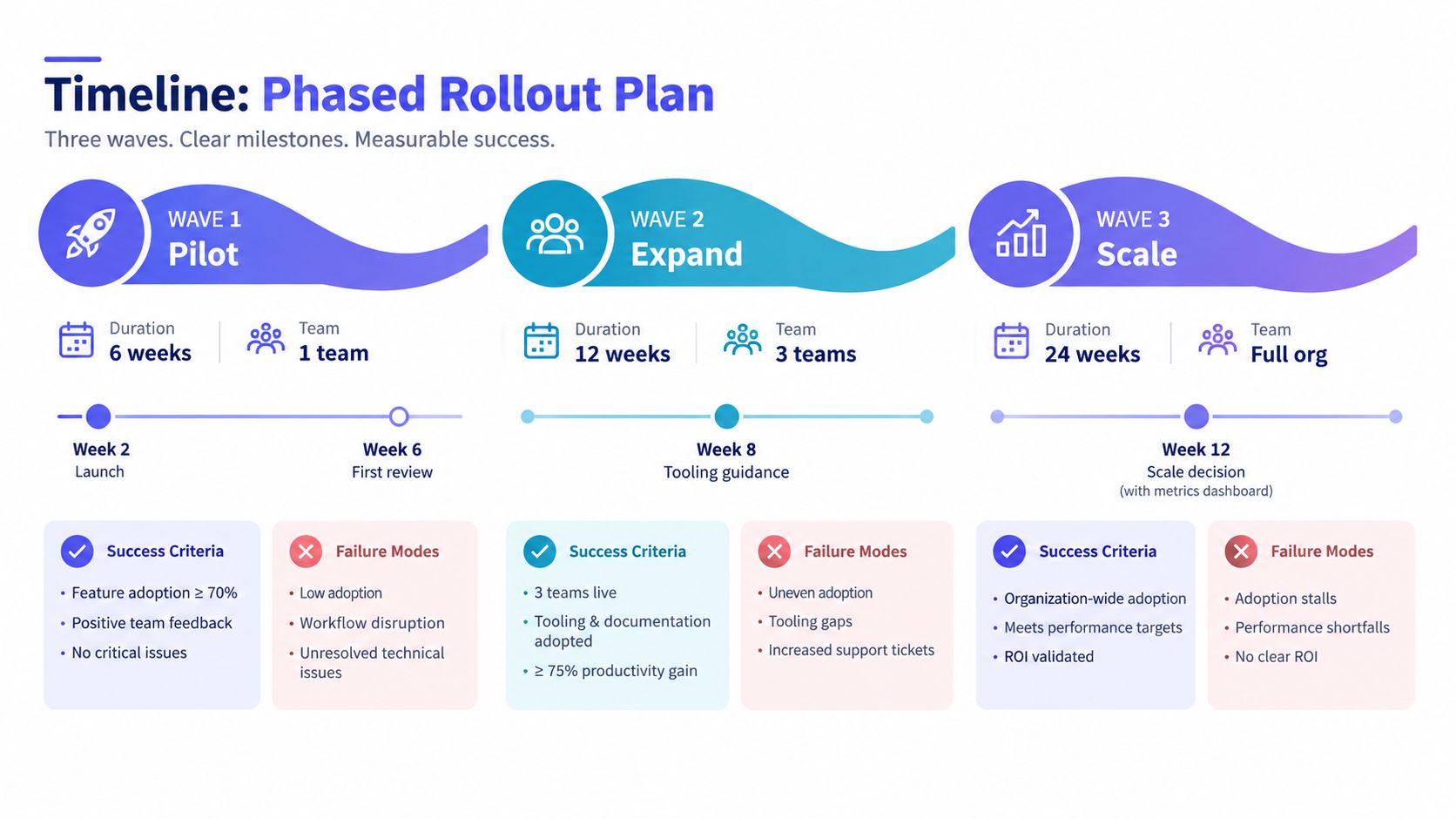
Scale only when the pilot produces better decisions, clearer trade-offs and explicit resource shifts, not merely higher tool usage. A system that creates more updates without changing what receives capacity has failed its purpose.
Common Failure Modes and Measurable Success Criteria
A leadership team can follow the process and still undermine it through everyday behaviour. The most common failure is silent priority drift. A customer request arrives, an executive adds a project and a compliance task appears, but nothing is removed. The team keeps its original commitments on paper and absorbs the new work in practice.
Hidden BAU creates a similar distortion. Support queues, incidents, reporting, approvals and stakeholder management often sit outside the strategic backlog, so leaders overestimate the capacity available for transformation. Weak decision ownership makes the problem worse because nobody wants to kill an initiative associated with a senior sponsor.
| Failure Mode | Practical Fix | Measurable Success Signal |
|---|---|---|
| Silent priority drift | Require every new priority to name the work it displaces and add the decision to a deprioritisation log | The backlog shows explicit additions, removals and owners |
| Hidden BAU disguised as strategy | Separate operational load from strategic initiatives and review both against capacity | The ratio of strategic to operational work is visible and discussed |
| Weak decision ownership | Assign decision rights by tier and name an accountable owner for every trade-off | Escalations reach the correct forum without repeated referral |
| Progress-only reviews | Add questions about scope, risk, capacity and work that should stop | Review time produces decisions, not only status updates |
| Metric overload | Keep a small outcome set and define each measure before collection begins | Leaders spend less time debating definitions and more time acting |
Success needs more than completed projects. Track the ratio of strategic to operational work in the backlog, the percentage of priorities completing within target cycle time, the time spent in review versus re-planning and the number of explicit trade-off decisions logged each quarter. These indicators show whether the system is shaping capacity or merely decorating a to-do list.
The execution gap is visible in UK business data. Among 250 UK companies with turnover above £20 million, only 18.4% said they achieved more than 80% of their aspirational growth goals within three years, while 41.2% failed to reach 60% of their stated targets (the UK strategy execution analysis). The implication is clear. Strategy needs a disciplined mechanism for choosing, sequencing and reviewing outcomes until they land in delivery.
Capability matters too. A UK project delivery survey linked increased confidence among business leaders to high-quality leadership at 22%, professional development at 19% and recruiting qualified or certified project professionals at 18% (the UK project delivery confidence survey). Build manager capability alongside the system. For teams refining their measurement approach, these strong KPI framework tips offer useful guidance on defining measures that support decisions rather than generate reporting noise.
A priority management system is working when leaders can answer four questions quickly: what matters now, what is consuming capacity, what has stopped and who can change the decision. If those answers remain unclear, the organisation doesn't need another workshop. It needs fewer active priorities, stronger decision rights and a review rhythm with authority to act.
The OKR Hub helps leadership, transformation, PMO and People teams connect priorities to OKRs, governance and team-level execution through consulting, implementation, training and coaching. Visit The OKR Hub to assess where your priority system is breaking and identify the next practical intervention.