Most advice about choosing a goal setting framework starts in the wrong place. Leaders compare SMART goals, OKRs and the Balanced Scorecard, then assume the winning methodology will solve weak execution. It won't. A new vocabulary can't repair unclear ownership, conflicting priorities or meetings where nobody reviews progress.
The useful question isn't, “Which framework should we adopt?” It's, “What management system will make important work visible, reviewable and accountable?” The framework matters, but the operating rhythm around it matters more. Strategy creates direction. Governance turns that direction into decisions, actions and measurable outcomes.
Why Goal Setting Frameworks Fail in Practice
Leadership teams often blame the framework when delivery stalls. They say the OKRs were too ambitious, the SMART goals too rigid, or the scorecard too complicated. Those criticisms can be fair. More often, the organisation has not created the management conditions in which any goal system can work.
UK performance-management evidence shows the gap. A CIPD-cited employee survey found that only 28% of employees had systematic performance management, meaning objectives were set, monitored, feedback was provided and missed objectives carried accountability. 48% had at least a basic level, where specific job objectives were set but the wider management rhythm was absent (CIPD research on the impact of performance management).
That gap separates documentation from execution. Organisations can write targets quickly. Fewer maintain the follow-up, coaching and decision-making routines that keep those targets active after the planning cycle ends.
Strategy can be clear while execution remains weak
A leadership team may agree on a growth strategy, communicate three priorities and publish an annual plan. Delivery can still break down inside the organisation. Product, sales, operations and finance interpret the priorities differently. Teams protect local targets, while dependencies remain invisible until a milestone is missed.
Planview's UK strategy execution research found that only 18.4% of large companies achieved more than 80% of their aspirational growth goals within three years, while 41.2% failed to achieve even 60% of their targets. The same research identified talent and capability gaps as the main delivery barrier for 50.4% of decision-makers (Planview's UK strategy execution research).
These findings indicate an execution-capacity problem rather than a goal-writing problem. A framework can expose constraints, but it cannot compensate for missing skills, overloaded teams or unresolved trade-offs. Leaders must decide which work will stop when capacity is already committed.
Practical rule: Do not introduce new goal terminology until you know who reviews progress, who resolves conflicts and who can change the plan.
Replace the framework debate with an operating-system diagnosis
Before choosing a methodology, inspect the management system around it:
- Ownership: Does every strategic goal have one accountable leader, or is responsibility spread across a committee?
- Cadence: Do teams review progress often enough to intervene before a miss becomes inevitable?
- Visibility: Can leaders see dependencies and stalled work without requesting separate reports?
- Decision rights: Can someone stop lower-value work when a priority changes?
- Learning: Do reviews examine assumptions and capability gaps, or merely record red, amber and green statuses?
A goal setting framework fails when leaders treat it as an annual appraisal exercise. The analysis of why OKRs fail directs attention to adoption, leadership behaviour and execution conditions rather than the labels attached to objectives.
The same operating discipline applies to project delivery. Teams can use tactics from Tutorial AI when projects suffer from unclear scope, weak coordination or late escalation. Goal systems and project systems fail for similar reasons when ownership, intervention points and decision authority remain undefined.
A mature framework is not the one with the most polished templates. It is the one embedded in regular conversations about priorities, capacity, evidence and decisions. That operating system closes the gap between approved intent and delivered value.
Comparing the Major Goal Setting Frameworks
Frameworks solve different management problems. Treating them as interchangeable creates unnecessary friction. A leadership team should select based on the type of work, the level of coordination required and the behaviour it wants reviews to produce.
OKRs work well when the organisation needs to translate strategic change into focused outcomes. An Objective gives teams a clear direction, while Key Results define evidence of progress. Initiatives describe the work that may influence those results. This structure helps leadership teams expose cross-functional dependencies and force choices about what won't receive attention.
The trade-off is that OKRs can become theatrical. Teams write ambitious objectives, attach weak activity measures and then defend their status in a quarterly ritual. OKRs are also a poor substitute for operational controls. A support team that must maintain reliable service, or a finance team that must complete recurring processes, may need service measures and controls rather than inspirational outcomes.
SMART goals are valuable for making an individual or team commitment precise. They help clarify what will be delivered, how success will be measured and when the work should be complete. Their weakness appears when every goal is assigned to one person and optimised locally. A sales target can be specific and measurable while still encouraging behaviour that creates problems for onboarding, customer success or margin.
The Balanced Scorecard gives leaders a broader view. It can connect financial outcomes with customer experience, internal processes, and organisational capability. That makes it useful for enterprise planning and board-level discussions. Its risk is weight. If every function adds measures without retiring old ones, the scorecard becomes a reporting burden that describes the business without helping managers choose their next action.
| Framework | Best Suited For | Primary Risk | Review Cadence |
|---|---|---|---|
| OKRs | Strategic change, transformation, product and growth priorities | Aspirational objectives, weak Key Results and ritualised reviews | Regular progress reviews with formal cycle resets |
| SMART goals | Clearly bounded responsibilities and repeatable delivery | Individual optimisation and limited cross-functional alignment | Agreed checkpoints linked to the work |
| Balanced Scorecard | Enterprise performance and strategic perspective | Excessive measures and reporting overhead | Management reviews linked to planning and performance cycles |
The practical comparison in OKRs versus SMART goals is helpful for boards deciding whether they need a better goal format or a more connected execution system.
Use combinations deliberately
These frameworks don't need to compete. An enterprise might use a Balanced Scorecard to maintain strategic balance, OKRs to drive a transformation priority and SMART commitments for defined delivery responsibilities. The mistake is allowing each layer to create separate priorities, terminology and reporting meetings.
A useful design principle is simple: use the lightest framework that creates the required clarity and coordination. Add governance where work crosses boundaries. Don't add administration merely because the organisation wants a more polished-looking system.
Matching the Framework to Your Execution Context
A framework rarely fails because its label is wrong. It fails because leaders apply the same operating logic to work with different levels of uncertainty, dependency and decision speed. Start by separating repeatable delivery, complex change and enterprise direction, then set the degree of structure and review each type of work can support.
For repeatable operational work, define specific objectives and measurable service expectations. Payroll, regulatory reporting and fulfilment teams benefit from clear standards, named ownership and predictable review points. The work follows known steps and established cues, so tighter goals can focus attention without limiting useful discovery.
Complex work needs specificity about the outcome, while leaving the route open to revision. Product discovery, transformation, market entry and innovation involve interdependent decisions and unfamiliar information. A fixed target can push a team to optimise the wrong activity or suppress learning that challenges the original plan. Leaders must decide which assumptions are stable enough to measure and which require regular testing.
CIPD evidence distinguishes these contexts. Specific, challenging goals tend to improve performance for relatively straightforward work, but they do not operate the same way for complex tasks involving unfamiliar cues, interdependent steps or new knowledge. In those settings, frequent feedback helps keep decisions aligned with what the team is learning (CIPD evidence on goal-setting and performance).
Segment the organisation before you standardise it
Before imposing one template, map each team against three questions:
- How predictable is the work? Stable work can support tighter measures. Exploratory work needs room to revise assumptions.
- How dependent is delivery on other teams? High dependency calls for shared outcomes, visible blockers and joint reviews.
- How quickly does new information change the plan? Rapid change requires shorter feedback loops and explicit learning checkpoints.
An organisation might use OKRs for a product team entering a new market, but measure more than features released. Outcome measures tied to customer behaviour, adoption or commercial validation show whether the strategy is working. Review the underlying assumptions at agreed points. A programme manager responsible for a defined implementation milestone may use a SMART goal, provided the milestone remains connected to the outcome it supports.
A performance management framework can provide the people-management context, including expectations, feedback and accountability. It should not force every role into one goal structure.
The strongest design combines a shared strategic layer with differentiated team-level mechanics. Everyone needs to understand the priority, ownership and evidence of success. Teams need enough discretion to select the work and measures that fit their operating context. That choice, supported by consistent review rules, closes more execution gaps than standardising every document.
Designing the Governance Layer for Real Execution
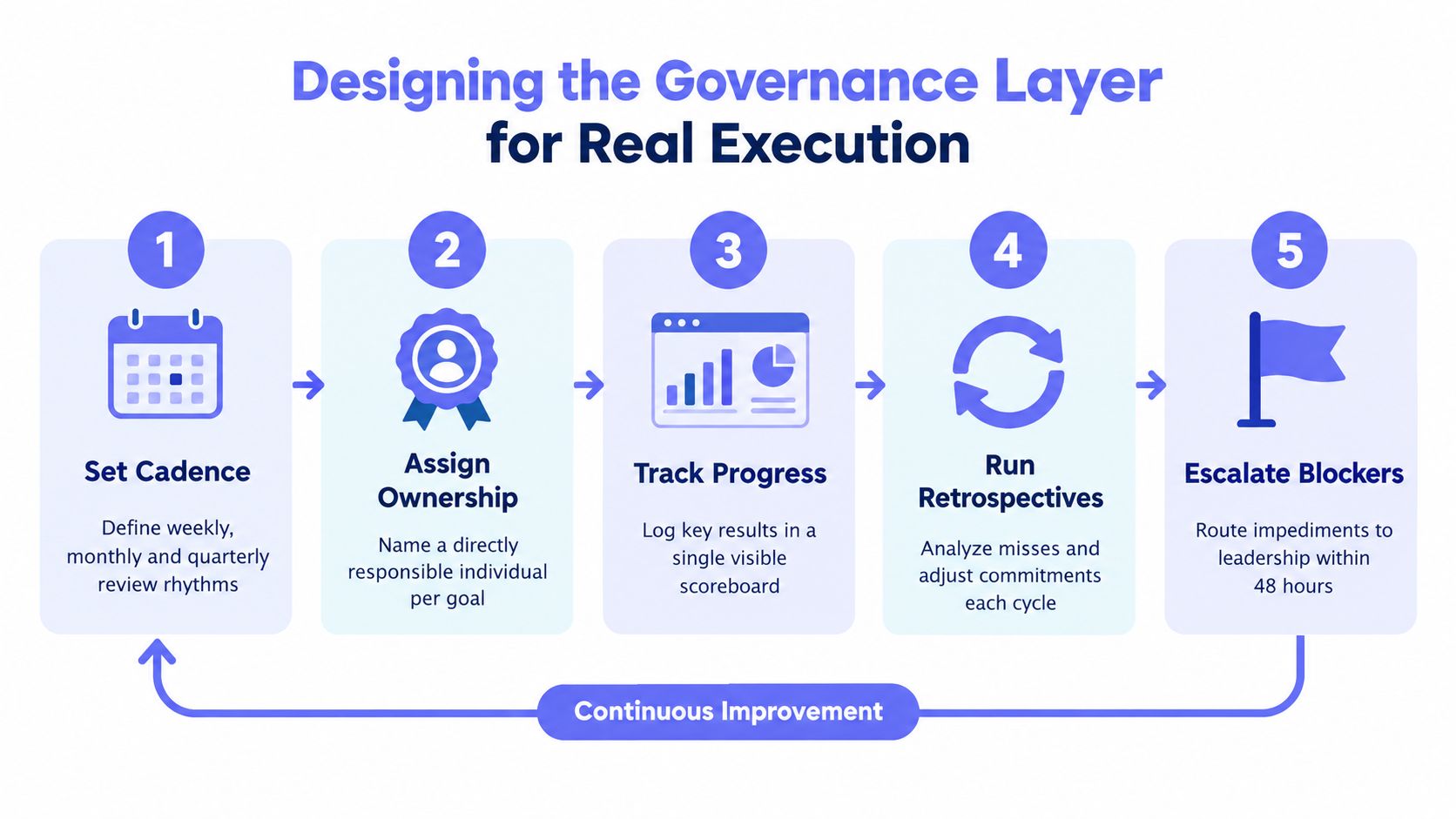
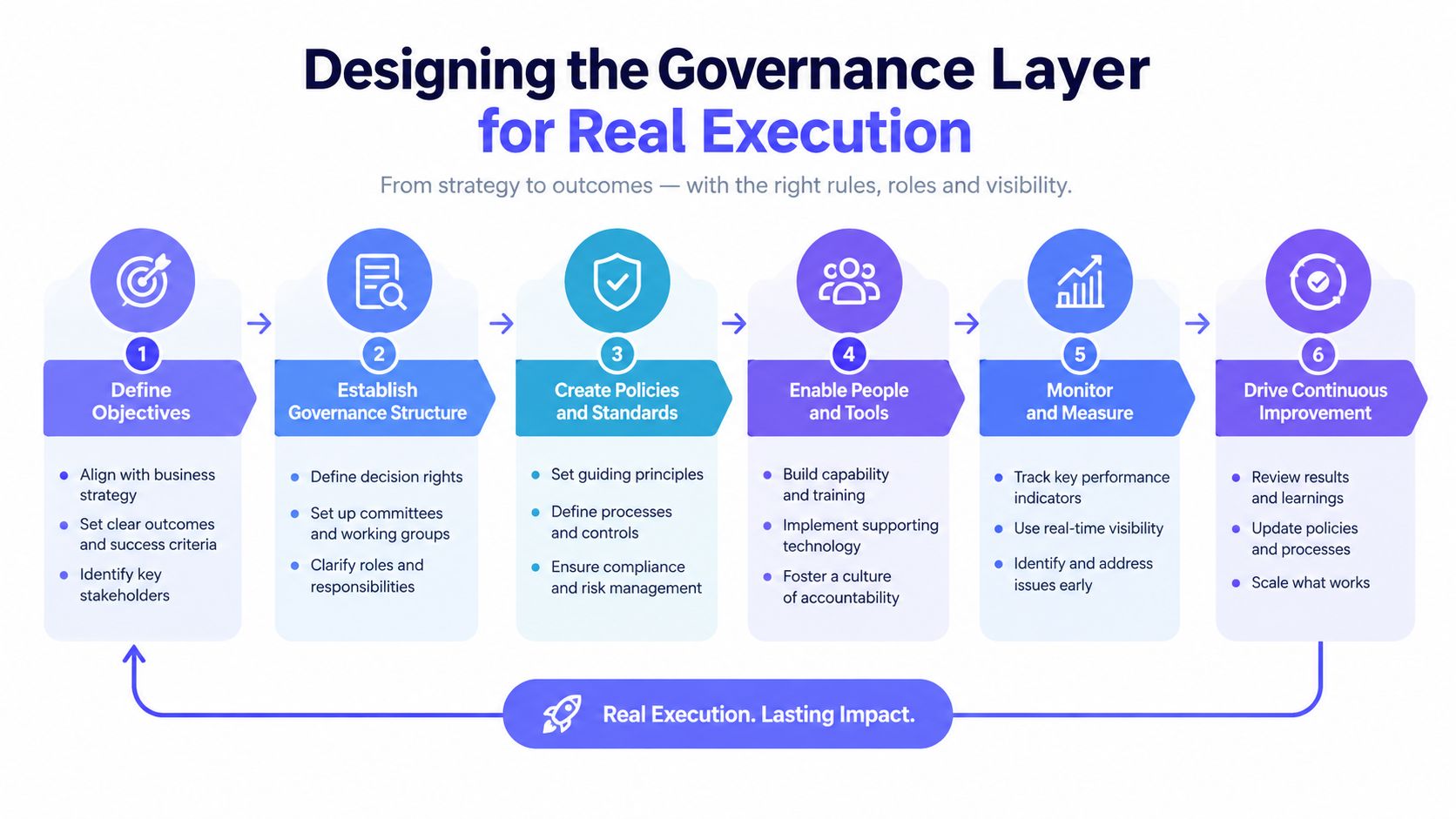
A goal rarely fails because the wording is unclear. It fails because nobody has agreed who can act, what evidence counts, when decisions happen, or what follows when delivery falls behind. Governance turns a goal from a statement into a management instrument by answering five operational questions: who owns the outcome, what evidence matters, when progress is reviewed, what happens when delivery slips, and which decisions require escalation.
The UK government's planning and performance framework provides a useful model. Departments set Strategic Plans around priority outcomes, Spending Reviews allocate funding against those priorities, and Annual Reports and Resource Accounts report progress and results after the financial year.
Private organisations can apply the same logic without adopting public-sector terminology. Strategy defines the outcomes. Resource allocation reflects those choices. Reviews test progress against evidence rather than confirming that activity took place. Leaders should also document decision rights and escalation routes, which are often left implicit in otherwise detailed governance frameworks.
Build the rhythm into existing management meetings
Avoid creating a parallel bureaucracy when the organisation already has useful forums. Add goal review to meetings where leaders make resource, risk and delivery decisions. The review should produce a decision, an owner or a specific intervention, not another status update.
A workable rhythm might include:
- Weekly team reviews: Confirm movement, surface blockers and decide the next action.
- Monthly leadership reviews: Examine cross-functional dependencies, capacity and changes in assumptions.
- Quarterly resets: Decide what to continue, stop, re-scope or resource differently.
- Retrospectives: Examine why delivery moved or stalled, then change the system rather than assigning blame.
The cadence should match the speed and risk of the work. Volatile customer demand may require faster intervention than a stable internal process. Consistency matters more than a universally correct schedule. If nobody knows when a goal will be reviewed, urgent work will displace it.
The GOV.UK service standard sets a related discipline. Teams must define success, identify metrics that show whether the service solves the right problem, collect performance data across online and offline channels, and publish mandatory KPIs for central government services (the service standard for defining success and publishing performance data).
Finance leaders can use governance insights for finance leaders when connecting strategic commitments to funding, controls and decision rights. An unfunded priority is usually a communication exercise, not an executable commitment.
Put four items on one scoreboard:
- The outcome being pursued.
- The current evidence and trend.
- The directly responsible owner.
- The decision or support required from leadership.
A review that only asks whether a team is on track creates status theatre. Ask what changed, what the team learned, which dependency is blocking progress, and what leadership must decide.
Fixing Common Framework Failures in Scale-Ups
Scale-ups rarely fail because they lack ambition. They fail because ambition expands faster than management discipline. A founder's direct visibility disappears, new departments create competing priorities and managers inherit targets without the authority or capability to deliver them.
The first failure is an objective that describes intent rather than an outcome. “Become the market leader in our category” may express strategic direction, but it doesn't tell a team what evidence would demonstrate progress. Rewrite it around a meaningful change in customer, commercial or operational performance, then identify the few measures that would prove the change.
The second failure is a Key Result that measures activity. More campaigns, meetings or releases may be useful inputs, but they don't prove that the organisation created value. Keep activity measures as lead indicators where they have a clear relationship with the outcome. Don't present them as the outcome itself.
Treat trust as a design condition
Goal commitment depends on how people experience the process. A UK study of 54 managers in a financial-services organisation found that participation in goal-setting increased commitment, with the effect mediated by procedural fairness and interpersonal trust (the UK government financial-services study source).
That finding has practical implications. If leaders impose targets without explaining trade-offs, teams may protect themselves by setting safe measures, hiding risk or treating the system as a compliance exercise. Co-creation doesn't mean every team chooses its own ambition. It means people can challenge assumptions, identify dependencies and understand how the commitment was reached.
Use the following fixes when a rollout starts to deteriorate:
- Aspirational objectives: Define the observable change and the strategic reason it matters.
- Weak measures: Remove vanity metrics and test whether each Key Result would change a leadership decision.
- Too many priorities: Make trade-offs explicit. If everything remains important, capacity has not been allocated.
- Bureaucratic reviews: Replace presentation-heavy meetings with decisions, blocker removal and learning.
- Fear-driven targets: Separate strategic goal conversations from pay and performance-rating mechanics where possible, so teams can discuss risk openly.
- Stale commitments: Recalibrate when evidence or market conditions change, while recording why the change was made.
The objective system should increase candour, not punish it. A missed target can reveal a flawed assumption, missing capability or blocked dependency. Leaders waste the value of the framework when they treat every miss as an individual failure.
Transitioning Your Team to a New Framework
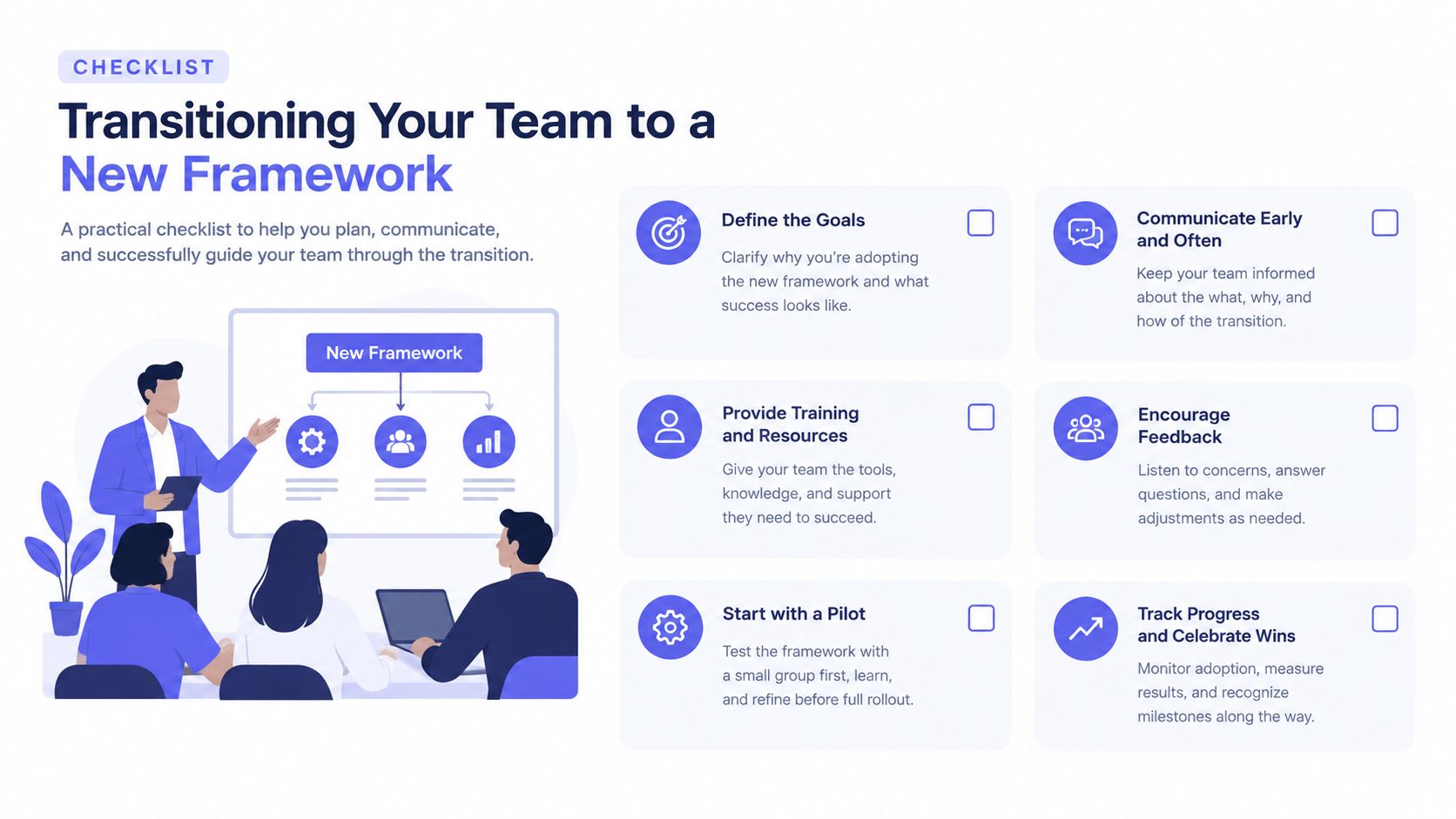
A transition fails when leaders launch templates before they explain the problem. Teams need to know what the current system is costing them. Show the duplicated priorities, late escalations, conflicting measures or decisions that keep returning to the executive team.
Start with leadership alignment. Agree on the small set of enterprise outcomes that will anchor the first cycle. Define what leaders will stop doing, because a new framework won't work if old reporting demands remain untouched.
Pilot the behaviours, not just the templates
Choose a team with a real coordination problem and a leader willing to work differently. Use the pilot to test how objectives are shaped, how Key Results are evidenced, how reviews handle misses and how blockers reach senior decision-makers.
Train managers to coach rather than inspect. A manager should ask:
- What outcome are you trying to change?
- What evidence would show movement?
- Which assumption is most uncertain?
- What support or decision do you need?
- What should we stop doing to protect this priority?
Expect friction in the first cycles. People will confuse outputs with outcomes, copy old targets into new fields and ask whether a goal is a promise or a forecast. Answer those questions through live examples and manager practice, not a longer policy document.
Don't hide the early productivity dip. Teams are learning a new rhythm, and leaders are learning to make trade-offs more visibly. Protect the transition by reducing parallel reporting, publishing decisions and sharing what the pilot changed. Internal credibility grows when employees can see that feedback altered the system.
Scale only after the organisation has learned which parts need standardisation and which parts should remain flexible. A common review language is useful. Identical goals for every team are not.
Measuring the Impact of Your Goal Setting System
A goal-setting framework can look healthy while value still leaks through weak decisions, delayed escalation, and unexamined priorities. Measure the operating system around the framework, not employee familiarity with its terminology.
Set a baseline for the gap between current performance and the desired future state. Then identify leading indicators that should move before the final outcome. Track whether teams review goals, bring evidence, resolve blockers through timely decisions, and change priorities when capacity shifts. These measures show whether governance is changing execution or merely adding reporting.
Earlier CIPD evidence associated systematic performance management with stronger objective achievement. Treat that finding as a management prompt, not proof that any framework creates results. Examine whether leaders provide clear decisions, managers hold useful reviews, and teams can connect activity to measurable outcomes.
Use the impact measurement guidance to separate progress from reporting noise. The monitoring and metrics guide offers a practical reference for selecting evidence and reviewing operational signals.
After each cycle, audit the system. Did goals change decisions, expose dependencies, clarify accountability, or stop low-value work? If not, revise the governance layer before replacing the framework. A new template rarely fixes unclear ownership or slow escalation.
The OKR Hub helps leadership teams diagnose execution gaps, design an OKR system, support implementation, and build adoption through training and coaching. Visit The OKR Hub to assess goal-setting maturity and connect strategy with delivery.