The leadership team leaves a three-day programme energised. Everyone rates it highly. A month later, priorities still conflict, decisions sit in functional queues, and the company misses another quarterly target. The training wasn't necessarily poor. The organisation expected a classroom event to repair an operating system it hadn't changed.
That distinction matters. Leadership training effectiveness isn't demonstrated by attendance, confidence, or a polished feedback form. It shows up when managers make better decisions, hold clearer conversations, run stronger operating rhythms, and help teams deliver the outcomes leadership has committed to.
UK evidence supports the business case, but it also exposes the measurement problem. The Chartered Management Institute's evidence on management and leadership development reports average increases of 23% in organisational performance and 32% in employee engagement and productivity among organisations investing in these programmes. The relevant question for a leadership team isn't whether training can work. It's whether your programme changes behaviour in the conditions where delivery takes place.
Why Most Leadership Training Does Not Change Delivery
A mid-market UK firm sends its senior managers to an off-site programme. The sessions cover feedback, delegation, strategic thinking, and communication. Participants score the experience 4.6 out of 5. The L&D report calls the intervention a success.
The next two quarterly targets are missed. Product leaders still prioritise different customer segments. Sales escalations bypass agreed decision rights. Managers discuss accountability in the workshop, then return to weekly meetings where nobody owns the unresolved actions.
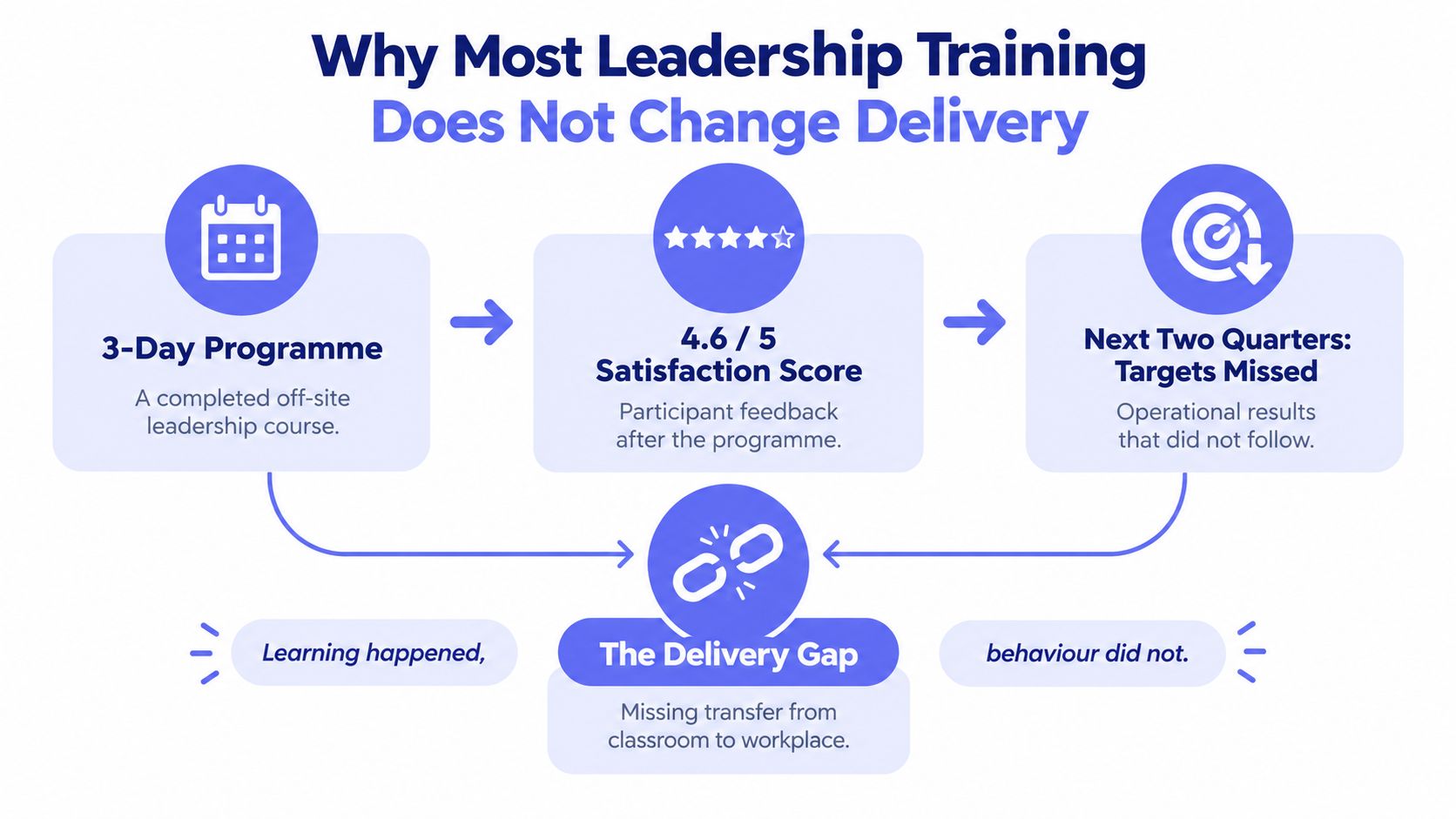
The problem is the delivery gap. Training was bolted onto the organisation instead of being wired into its goals, governance, and routines. The leadership bench was treated as separate from the OKR system, quarterly reviews, and team rituals that determine what people do each week.
Four failure modes
- Skills are taught in isolation. A manager learns a feedback model, but no current performance conversation requires them to use it. The skill remains theoretical.
- Reinforcement stops at the classroom door. Nobody observes the new behaviour, gives feedback, or protects time for practice. Managers revert to familiar habits under delivery pressure.
- The line of sight is missing. Participants can't explain which priority, decision, or business outcome the training should improve. Without that connection, capability becomes an HR activity rather than a management lever.
- L&D measures attendance instead of change. Completion rates and satisfaction scores are easy to report. Behaviour adoption and business contribution require operational data, manager involvement, and honest interpretation.
The OKR Hub's capability-building guidance treats development as part of the execution system. That means each programme needs an input-to-output logic. What capability is changing? Which operating behaviour should follow? Which team or company result should move if the behaviour sticks?
Practical rule: If training can't be connected to a decision, conversation, or ritual that changes on Monday, it isn't yet connected to delivery.
The UK evidence base makes the same point from a different angle. A UK Government evidence review of effective management training concluded that management skills programmes are usually effective in improving management practices and organisational productivity, although design and evaluation vary. The gain comes from transfer into management practice, not from exposure to content.
Frameworks Worth Using and Where They Fall Short
A leadership team can complete a polished evaluation and still learn very little about delivery. Kirkpatrick helps prevent that by separating reaction, learning, behaviour, and results. Its value is the sequence of questions. The weakness appears when an organisation stops at reaction and treats a positive survey as evidence of change.
The ROI Methodology adds financial discipline. It aims to isolate programme impact, assign monetary value to benefits, and compare that value with programme costs. That approach suits expensive or strategically important interventions. It becomes misleading when training effects cannot be separated from hiring, workload, leadership changes, market conditions, or process design.
| Framework | Focus | Typical Metrics | UK Evidence Strength | Main Weakness |
|---|---|---|---|---|
| Kirkpatrick | Reaction, learning, behaviour, results | Feedback, assessment, observation, business outcomes | Strong as an evaluation scaffold | Suggests a cleaner path from learning to results than organisations usually experience |
| ROI Methodology | Isolated impact and financial return | Benefit value, costs, ROI calculation | Useful selectively where data and assumptions hold up under scrutiny | Can overstate certainty and understate system effects |
| UK Evidence Base | Management practice, productivity, transfer, context | Practice quality, productivity, workforce data, interviews, observations | Strongest when multiple data sources are combined | Attribution remains difficult in live organisations |
Capability models add a practical bridge between a framework and daily management. The OKR Hub's leadership capability framework shows how to connect capability definitions to the behaviours these frameworks try to measure. A useful model names observable actions, such as setting priorities, recording decisions, giving feedback, or escalating risks.
The UK evidence on leadership development from CIPD describes a moderate positive effect overall, while noting that economic return is unclear and effects differ across participants and settings. Evaluation frameworks should therefore support disciplined judgement. They should not create confidence that the evidence cannot support.
Prioritise behaviour before finance
Level 3 is the practical centre of the assessment. It asks whether managers changed what they do at work. Look for structured one-to-ones, faster escalation, clearer prioritisation, better decision records, and consistent quarterly reviews.
Level 4 tests whether those changes contributed to delivery outcomes. The UK Government feasibility assessment for evaluating management and leadership training recommends mapping the programme, building a theory of change, using pre and post participant surveys, and adding interviews and observations. Where feasible, teams can also use team surveys and administrative data. The assessment warns that post-only satisfaction surveys cannot show whether managers learned or changed their practice.
Use Kirkpatrick to structure the questions. Use ROI techniques when the investment and available data justify them. Add contribution analysis to state what the programme plausibly influenced and what remains uncertain. Leadership training effectiveness improves when evaluation is honest enough to change a delivery decision.
A Five-Step Measurement Plan You Can Run This Quarter
A credible measurement plan doesn't require a large analytics function. It requires a clear causal chain, a small number of observable behaviours, and collection points agreed before the programme begins.
Step one, map the programme
Record the cohort, business context, delivery format, facilitators, time commitment, direct cost, and intended outcomes. Don't describe the programme as “improving leadership”. Name the capability, such as prioritisation, feedback, delegation, or decision-making.
Then write the expected chain:
- Input: managers receive targeted practice and coaching.
- Capability: managers can apply the skill in a live situation.
- Behaviour: managers use the skill in a recurring operating ritual.
- Team effect: teams experience clearer priorities or faster decisions.
- Business outcome: an agreed OKR or operational measure improves.
Step two, build the theory of change
List the assumptions. Managers must have authority to act. Their line managers must reinforce the behaviour. Workload must leave room for practice. External factors, such as restructuring or a major client loss, must be visible in the interpretation.
The OKR Hub's delivery-performance measurement guidance is useful here because it keeps measurement close to execution rather than treating it as a separate reporting exercise.
Step three, define indicators across four levels
Use one meaningful measure at each level, with at least one Level 3 behaviour measure and one Level 4 outcome measure for every cohort.
- Level 1: Did participants find the content relevant?
- Level 2: Can they demonstrate the skill in a simulation or assessment?
- Level 3: Are they using the behaviour in live work?
- Level 4: Is the linked team or business outcome moving?
Step four, collect evidence at three checkpoints
Set the baseline before delivery. Repeat collection 30 days after the programme, then again 90 days after. Combine surveys with observations, OKR data, workforce records, and short interviews. A single data source rarely explains transfer.
Step five, set targets and confidence
A practical dashboard can contain three panels:
- Leading indicators: practice adoption, one-to-one quality, decision throughput.
- Lagging indicators: team OKR delivery rate, engagement scores, regrettable attrition.
- Confidence rating: red, amber, or green for whether training is causing the change or merely correlating with it.
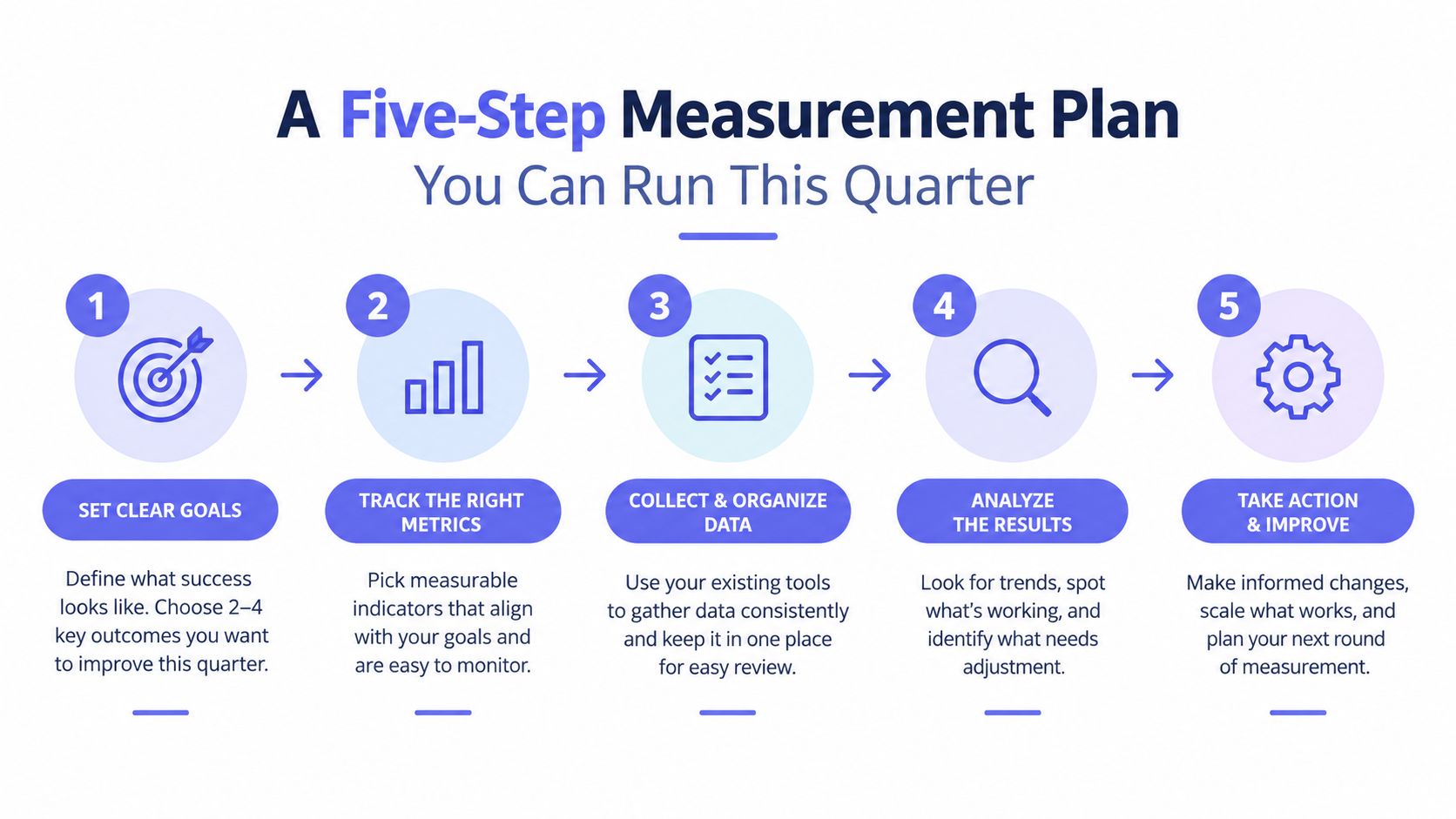
Consider 12 first-line managers in a UK professional services firm. The programme targets weekly prioritisation conversations and clearer delegation. Before training, the firm records existing one-to-one quality, overdue decisions, team OKR progress, and engagement data. At 30 days, the leadership team checks whether the conversations and delegation behaviours are visible. At 90 days, it compares the behaviour evidence with delivery movement and documents other factors that may have influenced the result.
That is enough to make a funding decision. Expand the programme if behaviour and outcomes move with credible supporting evidence. Redesign it if learning is strong but application is weak. Stop it if neither changes.
Linking Training to OKRs and Real Delivery Outcomes
Training becomes operational when it has a place in the OKR conversation. The first distinction is between a learning Objective and a delivery Objective.
A learning Objective describes the capability shift. For example, “Managers run structured weekly one-to-ones with direct reports.” A delivery Objective describes the business result that the capability should support, such as stronger retention, better engagement, or faster decisions.
A cohort of ten people managers might use the following mapping:
| Training Objective | Team-Level KR | Leadership KR | Observable Behaviour | Data Source |
|---|---|---|---|---|
| Managers run structured weekly one-to-ones with direct reports | Improve retention in participating teams | Improve engagement scores across the manager cohort | Managers use a consistent agenda, record actions, and close actions in the next meeting | Calendar records, short direct-report pulse, manager observation |
| Managers make clearer priority trade-offs | Increase the proportion of committed team work completed on time | Improve confidence in cross-functional prioritisation | Managers document decisions, owners, and rejected alternatives | Decision log, operating review, OKR tracker |
The exact measures depend on the organisation. The principle doesn't. Every training module should answer one question: what decision, conversation, or ritual changes on Monday?
That change should be observable in an operating review within 30 days. If it isn't, the programme has a transfer problem, a measurement problem, or a design problem.
Avoid renamed deliverables
A common OKR failure is to rename existing work as a Key Result. “Complete leadership training” is an activity. “Attend all coaching sessions” is an activity. Neither proves that managers changed how they lead.
A stronger KR makes failure visible. If managers don't hold structured one-to-ones, direct reports should be able to report that. If decisions remain slow, the decision log should show it. If engagement doesn't move, leadership must examine whether the target behaviour was sufficient, whether managers had the authority to act, or whether the training was aimed at the wrong constraint.
The OKR Hub's employee development planning guidance supports this connection between individual development and organisational execution. Training investment becomes defensible when leaders can trace it from capability, to behaviour, to a result they already own.
Choosing Formats That Match Your Leaders and Stage
There is no universally effective format. The right choice depends on who is learning, what behaviour must change, and how quickly the organisation needs to see application.
| Format | Evidence of Behaviour Change | Cost per Head (Relative) | Best for |
|---|---|---|---|
| Classroom workshop | Useful for shared language, weaker when left without practice | Low to medium | Leadership alignment and common frameworks |
| Executive coaching | Strong potential for individual transfer and accountability | High | Experienced leaders with specific blind spots |
| Cohort programme | Supports peer challenge, repetition, and shared context | Medium | Managers facing similar operating problems |
| On-the-job action learning | Closest connection to live delivery and observable behaviour | Medium to high | Teams that need application rather than theory |
Classroom workshops still have a role. They can align a leadership team around decision rights, feedback standards, or the mechanics of an OKR cycle. They fail when leaders treat shared vocabulary as changed practice.
Coaching works differently. A coach can challenge a leader's interpretation of a conflict, rehearse a difficult conversation, and return to the outcome later. The trade-off is scale and cost. Coaching is rarely the sensible default for every manager.
Match the format to experience
New managers need repetition. Give them coached practice, realistic scenarios, feedback, and low-stakes opportunities to use the skill. A first-time manager usually needs help with the mechanics of a one-to-one, delegation, escalation, and expectation-setting.
Experienced leaders need relevance. Short peer-led sessions, live case clinics, and coaching can surface habits that a basic workshop won't reach. A 2026 UK evaluation of leadership programmes found that content was effective overall, but some experienced learners considered parts of it too basic, as reported in the evaluation of completed leadership programmes.
The practical default is blended delivery, but blending isn't automatically integration. A workshop on Monday, a disconnected coaching block next month, and a survey at the end will reproduce the same transfer problem unless all components target the same behaviours and feed into the same operating reviews.
Use peer learning for leadership development when leaders can bring live delivery problems into the room. The value lies in applying the method to current work, not collecting another model.
What to Measure Instead of Happy Sheets
A post-session satisfaction survey captures a participant's view of the vendor, room, facilitator, or content. It does not show whether a manager learned the skill, used it under pressure, or improved team delivery. A well-rated session can still produce no change in how decisions are made, commitments are followed up, or performance issues are handled.
The weaknesses are predictable. Participants may give polite answers, engaged people may be more likely to complete the form, and a positive reaction can coexist with unchanged behaviour. Treat the survey as a service check, not proof of leadership training effectiveness.
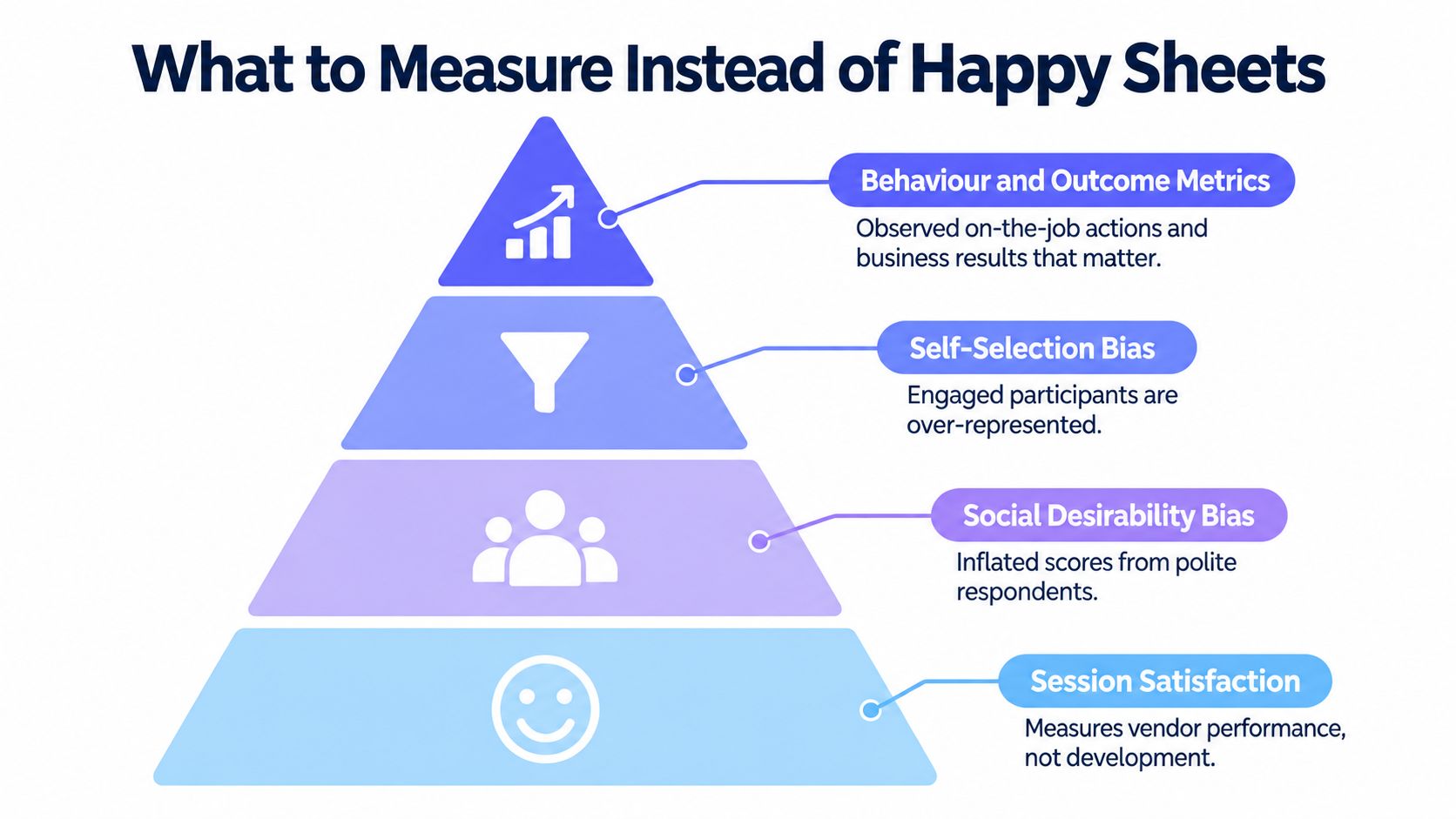
As noted earlier, the UK Government feasibility guidance on workforce-record evaluation shows why post-only satisfaction surveys cannot establish learning or changed practice. The practical response is to measure the behaviour and delivery outcomes that follow training.
A better measurement hierarchy
- Level 1, weekly pulse: Did the manager hold the targeted one-to-one or feedback conversation?
- Level 2, observation: Did direct reports and peers see the behaviour, using a short rubric?
- Level 3, team delivery: Did retention, decision cycle time, or project completion move in teams connected to the training objective?
- Level 4, business contribution: Did the relevant outcome move relative to a comparable control team, where that comparison is feasible?
UK evidence discussions measure individual confidence and immediate learning more often than organisational outcomes. That imbalance leaves long-term impact uncertain. It also explains why training evaluations can look positive while delivery problems remain unchanged.
Start with a small operating measure. Ask managers and direct reports two weekly questions: did the target behaviour occur, and did it help the team? Review the answers alongside examples, observation notes, and delivery data in a quarterly behaviour audit.
Better evidence is often smaller evidence. Two consistent behaviour questions, backed by operating data, can tell leaders more than a long satisfaction form completed once.
Training rarely explains every movement in an OKR or delivery metric. Judge contribution rather than claiming sole causation. If behaviour improves but delivery does not, inspect the surrounding system. Conflicting priorities, weak governance, or limited authority may still prevent managers from applying what they learned.
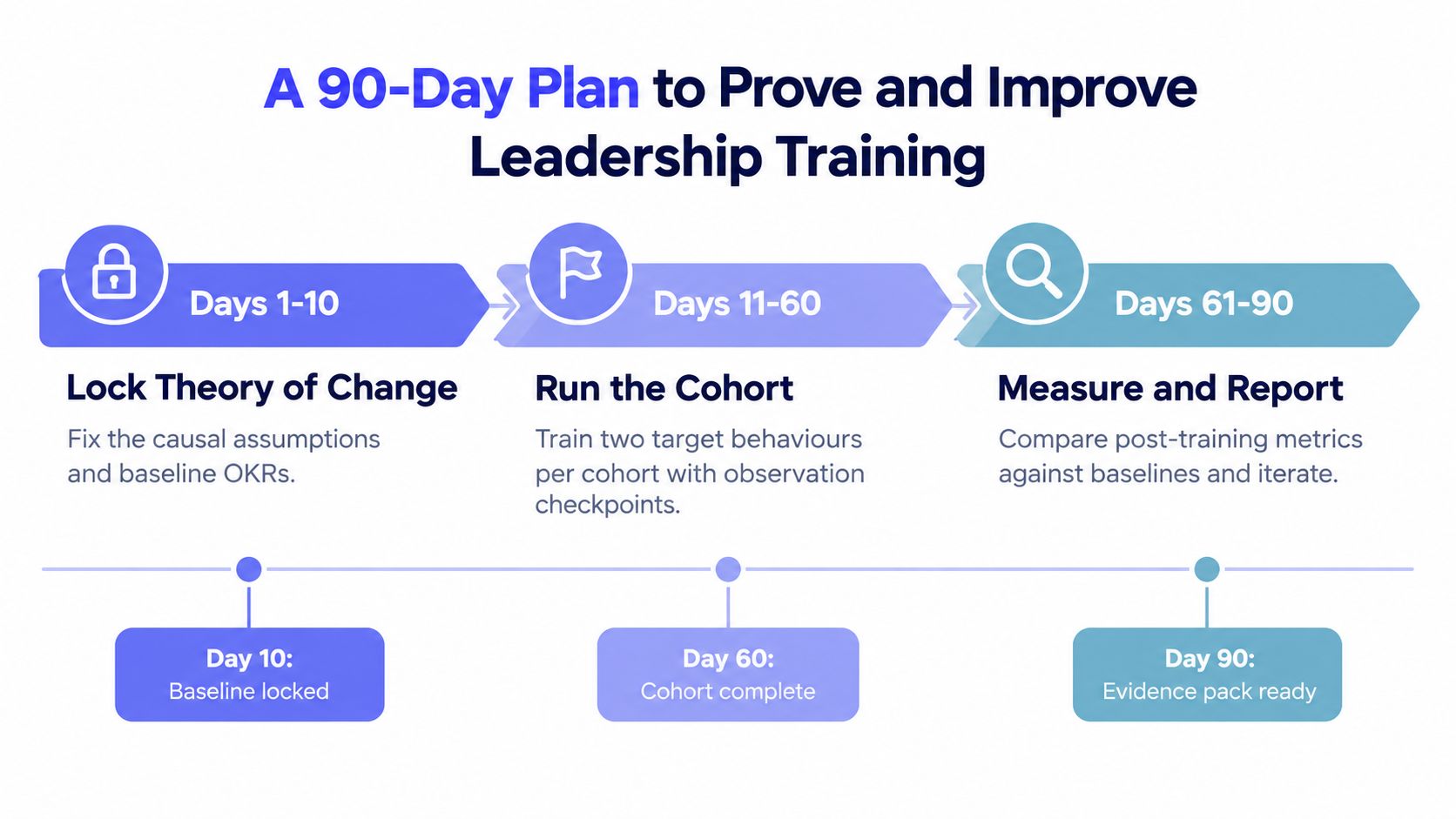
A 90-Day Plan to Prove and Improve Leadership Training
A leadership team can test whether training changes delivery within one quarter. The test needs an owner, a finance partner to check assumptions, and line managers who will reinforce the target behaviours in live work.
Days 1 to 10, lock the logic
Define the theory of change and agree the baseline OKRs. Select the two behaviours each cohort must shift. Write the measures before delivery starts, including evidence that could disprove the programme's value.
Avoid vague outcomes such as “better leadership presence”. Choose observable actions, including closing delegated actions, documenting decisions, or running structured one-to-ones. Identify comparable teams if a control comparison is feasible, and record the limits of that comparison.
Days 11 to 40, connect delivery to rehearsal
Run training alongside current work. Managers should practise the target behaviours in existing meetings, customer situations, performance conversations, and quarterly planning. Line managers observe application, give feedback, and reinforce the routine rather than leaving transfer to the participant.
At the 30-day checkpoint, capture leading indicators. Are managers using the new routine? Do direct reports notice a difference? Are decisions, commitments, and escalations recorded more clearly? Keep the review focused on evidence that can be checked in normal operating records.
Days 41 to 70, test transfer
Use short pulse surveys and calibrated 360-degree observations. Assess only the behaviours selected at the start. Generic confidence questions add noise and make it harder to see whether the behaviour has changed.
Compare people who received reinforcement with those who did not, where the groups are sufficiently comparable. Weak transfer may reflect the operating environment rather than the course content. Managers may lack time, authority, feedback, or consequences for returning to old habits. Record those constraints instead of labelling every gap a training failure.
Days 71 to 90, reconcile evidence and decide
Compare behaviour change with movement in the relevant OKRs. Prepare a conservative Level 4 ROI estimate using the assumptions Finance applies to other investments. State what was measured, what was inferred, and what remains uncertain. Training rarely explains every change in an OKR, so report contribution rather than claiming sole causation.
Then make a clear decision:
- Keep: elements that produced observable behaviour and supported delivery.
- Kill: activities with no credible transfer or outcome signal.
- Expand: components that work for a defined cohort and operating context.
- Redesign: content that participants understand but do not apply.
Watch three pitfalls. Measuring before delivery has stabilised creates noise. Treating poor transfer as a course failure can hide a manager-reinforcement failure. Reporting only favourable cohorts makes the programme look stronger and removes the evidence needed for correction.
UK evidence supports disciplined investment, not automatic expansion. CMI reports that high-performing organisations spend 36% more per manager each year on management and leadership development than low-performing organisations, spending £1,738 per manager compared with £1,275, with an average of £1,414 across organisations, as detailed in its Good Management report. The Productivity Institute's analysis links a 20% increase in spending per staff member trained with a 2% productivity gain overall and a 3.6% gain for managers. It also warns that expanding coverage without increasing training intensity can harm productivity when fewer than one in five staff are trained each year, according to the Productivity Institute's analysis of training intensity.
Run the plan with one cohort, two behaviours, and the OKRs those behaviours should influence. Use the findings to decide whether to invest further, change the reinforcement system, or stop paying for activity that does not improve delivery.
The OKR Hub helps leadership teams connect leadership training to strategic alignment, cascading OKRs, and effective OKR conversations through consulting, implementation, training, and hands-on coaching. Visit The OKR Hub to assess where capability is blocking execution and build a practical measurement and operating plan.