A leadership team leaves a coaching workshop energised. Managers promise to delegate better, challenge weak assumptions, and hold clearer conversations. Three weeks later, priorities still conflict, decisions still wait for escalation, and teams are still measuring activity instead of delivery.
That pattern is common because leadership coaching training is often treated as a learning event rather than an execution intervention. Good coaching can improve judgement and behaviour, but it can't compensate for unclear priorities, broken governance, or accountability that disappears between meetings.
The practical question isn't whether leaders need coaching. It's whether the organisation has an operating rhythm that gives new behaviours somewhere to work.
Why Most Leadership Coaching Training Fails Before It Begins
Prestigious programmes can produce thoughtful leaders and disappointing results. Participants learn powerful questions, practise active listening, and leave with a clearer view of their leadership style. Then they return to a system that rewards firefighting, changes priorities without explanation, and gives nobody a reliable way to review commitments.
The coaching wasn't necessarily poor. The design was incomplete.
Coaching without structural reinforcement becomes expensive conversation. A leader may learn to ask a team member, “What outcome are you trying to create?” But if the team has no agreed objective, no owner, and no review cadence, the question generates insight without changing delivery.

Skills don't repair a broken system
Organisations often diagnose a system problem as an individual capability problem. A product team misses a launch because marketing, engineering, and sales work to different assumptions. The response is to send managers to a communication course. The actual need is shared priorities, explicit dependencies, and a decision process that exposes disagreement early.
The same mistake appears in management development. A newly promoted manager receives coaching on feedback, delegation, and conflict. Yet their own manager still changes priorities privately, senior leaders bypass agreed forums, and performance conversations focus on effort rather than outcomes. The new skills are being asked to overcome contradictory signals.
UK evidence makes the risk clear. In a 2023 leadership development report, 84% of HR decision-makers reported barriers to providing leadership learning and development, with lack of time for leaders at 50% and financial constraints at 34% among the biggest obstacles, as reported in the UK leadership development report. Almost a quarter of employers provided no learning and development to new leaders, while only 25% refreshed leaders' skills at least annually, according to the same source.
That isn't an argument against coaching. It's an argument for designing it around the conditions leaders face.
Start with diagnosis, not delivery
Before commissioning sessions, identify where execution breaks:
- Decision quality: Which decisions remain unclear, duplicated, or trapped with senior leaders?
- Priority discipline: Can teams explain the few outcomes that matter and how their work contributes?
- Accountability flow: What happens when an owner misses a commitment or a dependency fails?
- Leadership behaviour: Which observable behaviours make the problem worse?
A capability diagnostic should distinguish between a leader who lacks a skill and a leader who operates inside a system that makes the skill difficult to use. The distinction protects the programme from becoming a polished response to the wrong problem.
The UK's coaching qualification history supports this principle. Coaching capability became more credible when it was standardised, assessed, and embedded in a recognised pathway through the UK Coaching Certificate, rather than left as an informal add-on, as described in research on the UK Coaching Certificate and coach education. Leadership coaching training should follow the same logic. Define capability, assess it, practise it, and embed it in the work.
For organisations building a digital programme, practical guidance on how to create a coaching program online can help with delivery design. But the platform won't solve an absent operating rhythm.
Even a well-designed programme can become a tick-box exercise if leaders aren't required to apply the learning to live priorities, decisions, and commitments.
Practical rule: Don't approve a coaching curriculum until you can name the execution behaviour it must change and the operating forum where that change will be observed.
The Three Types of Misalignment That Coaching Alone Cannot Fix
Leaders often describe execution problems as low motivation, weak ownership, or poor communication. Those explanations can be convenient, but they're frequently too personal. A team may be working hard and still move slowly because the organisation sends conflicting signals.
Research on UK organisations identified three recurring forms of misalignment. Horizontal misalignment affected 73% of respondents regularly or very often, while diagonal misalignment affected 58% and vertical misalignment affected 46%, according to UK organisational alignment research.
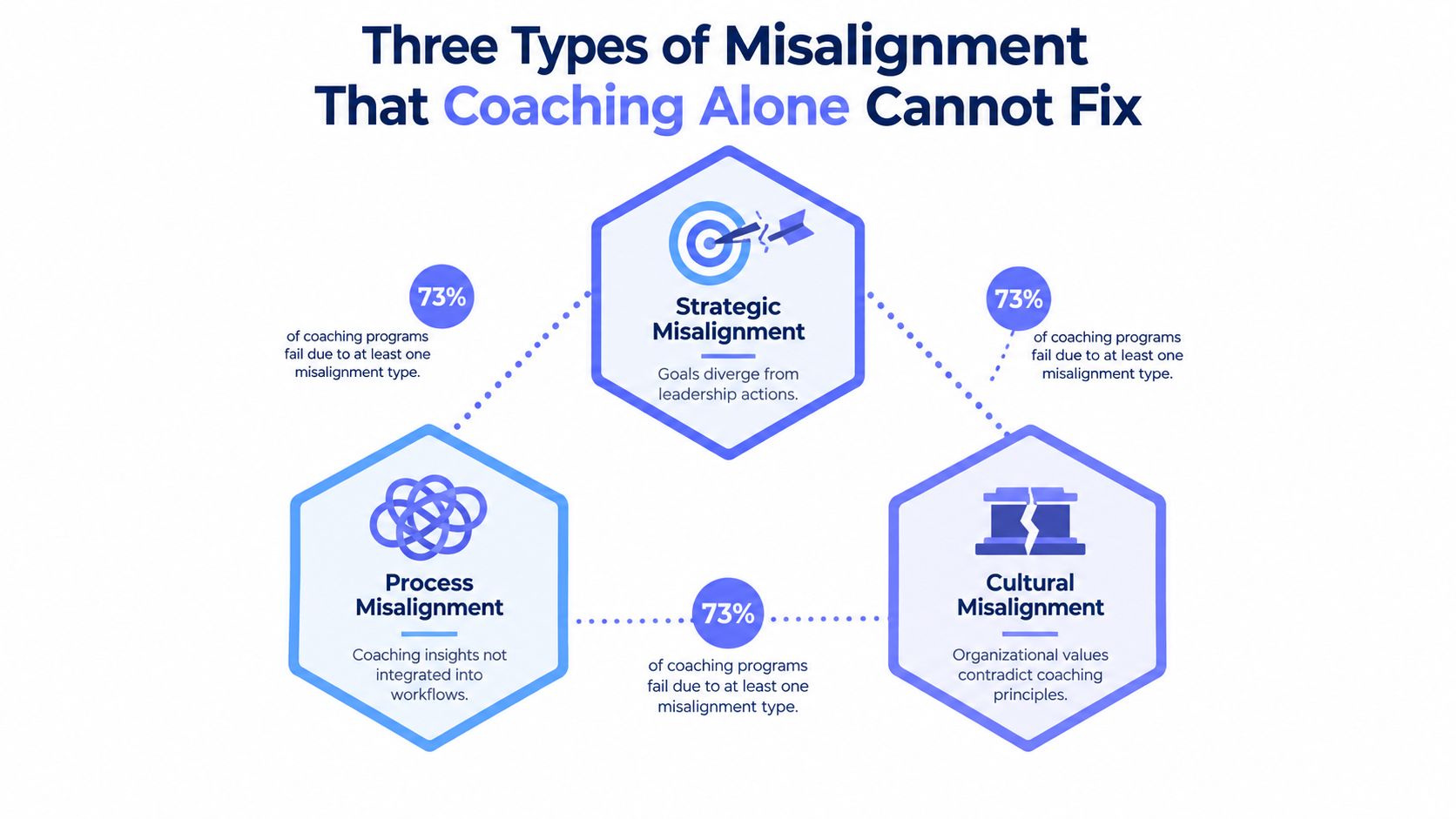
Horizontal misalignment
This sits between functions or peer teams. Sales commits to a date that delivery hasn't validated. Product optimises adoption while operations is measured on cost control. Finance asks for predictability while commercial leaders reward exceptions.
Coaching can help leaders listen better and negotiate more constructively. It can't decide which outcome takes priority. Without a shared objective and visible trade-offs, every function can behave rationally while the organisation moves in circles.
An OKR-based operating rhythm gives peer leaders a common conversation. They can test whether their objectives support the same strategic outcome, identify dependencies, and agree what won't be pursued. The value comes from making conflicts visible before they become delivery failures.
Diagonal misalignment
Diagonal misalignment appears when people receive different instructions from managers who sit in different parts of the organisation. A frontline team might hear that speed matters from one leader and risk reduction matters from another. Both messages can sound reasonable. Together, they create hesitation and defensive prioritisation.
Leadership coaching training needs to teach leaders to align before they coach. A manager who asks excellent questions but gives inconsistent direction still creates confusion. Coaching conversations should include explicit checks:
- What outcome are we jointly accountable for?
- Which decision belongs to this team?
- Which constraint is fixed, and which can be challenged?
- What will we review, and when?
The analysis of why teams are misaligned at work is useful because it shifts attention from individual blame to coordination design.
Vertical misalignment
Vertical misalignment is the gap between strategic intent and operational reality. Executives describe growth, resilience, or customer value. Teams receive a long list of initiatives and no practical method for deciding what matters this week.
Coaching alone can't close that gap. Leaders need to translate strategy into objectives, define meaningful results, and review progress with enough discipline to adjust course. The coach then helps leaders improve the conversations around those commitments, rather than substituting for the commitments themselves.
The diagnostic order matters:
| Question | What it reveals |
|---|---|
| Are peer teams pursuing compatible outcomes? | Horizontal conflict |
| Do managers give consistent signals? | Diagonal conflict |
| Can teams connect daily work to strategy? | Vertical conflict |
The data doesn't prove that every coaching failure comes from one of these categories. It does show why a generic programme is a weak starting point. Diagnose the alignment failure first. Then decide whether the answer is coaching, operating design, or both.
Designing Leadership Coaching Training Around Capability Diagnostics
The difference between a programme that changes behaviour and one that produces invoices is the precision of the diagnosis. Leaders at different stages face different execution problems, so a single curriculum usually creates broad awareness rather than useful capability.
A newly promoted manager may need to set expectations, delegate work, and run effective one-to-ones. A director may already do those things well but struggle to align several functions around a scaling decision. Treating both as the same learner wastes time and makes measurement vague.
Phase one, segment by role maturity
Start with a capability diagnostic that combines self-assessment, manager input, observed behaviour, and evidence from current objectives. Avoid asking only whether a leader feels confident. Confidence can coexist with weak prioritisation or poor follow-through.
Segment learners by the work they must lead:
- New managers: expectation-setting, delegation, feedback, and basic accountability.
- Established managers: prioritisation across teams, performance conversations, and dependency management.
- Senior leaders: strategic translation, trade-offs, cross-functional alignment, and decision velocity.
- Executive teams: shared ownership, governance, and consistent signals across the organisation.
The segments aren't permanent labels. They create a starting hypothesis that the diagnostic can test.
Phase two, map capability to execution gaps
Next, connect the leadership behaviour to a live business problem. A vague objective such as “become a better communicator” isn't useful. A stronger formulation might be, “Reduce repeated escalation by clarifying decision rights in the weekly product review.”
Use questions that force specificity:
- Where does work stall?
- Which conversations are avoided?
- What commitment is repeatedly missed?
- Which team or function experiences the consequence?
- What would a better behaviour look like in a real meeting?
- Which OKR review or planning forum will reveal progress?
The performance diagnostics guidance provides a useful reference point for separating symptoms from underlying execution constraints.
Phase three, define outcomes before sessions begin
Write two kinds of outcomes. Behaviour outcomes describe what the leader will do differently. Delivery outcomes describe what the team should experience as a result.
For example:
| Behaviour outcome | Delivery outcome |
|---|---|
| Ask owners to state the result, measure, and next decision | Teams leave reviews with clearer commitments |
| Challenge competing priorities in planning | Fewer unresolved dependencies |
| Close each coaching conversation with an owner and date | More consistent follow-through |
Don't promise an outcome the programme can't influence. Coaching can't guarantee revenue, product adoption, or a funding result. It can improve the quality of decisions, clarity of ownership, and consistency of review. Those are meaningful leading indicators when tracked rigorously.
Phase four, design around the OKR Focus Flow
The OKR Focus Flow provides a practical sequence for leadership coaching training:
- Diagnose: Identify the alignment, capability, and governance problem.
- Design: Choose the coaching behaviours and operating changes required.
- Deploy: Apply them in planning, check-ins, reviews, and decision forums.
- Build capability: Equip managers and internal champions to sustain the practice.
A coaching session might therefore begin with a real objective that has lost momentum. The leader explores assumptions, identifies the missing decision, rehearses the conversation with the accountable owner, and carries the action into the next OKR check-in. The session has a clear transfer point.
This design also clarifies the coach's role. The coach develops judgement and behaviour. The leadership system supplies the context, data, and accountability. Neither can replace the other.
The test isn't whether participants enjoyed the programme. It's whether the next operating conversation is clearer, faster, and more accountable.
Session-Based Coaching Versus Embedded Operating Rhythms
A leader leaves a coaching session with a useful technique, then returns to meetings that reward the old behaviour. No one asks where the technique applies, which decision it should improve, or what evidence will show progress. Coaching without an operating rhythm becomes an expensive conversation.
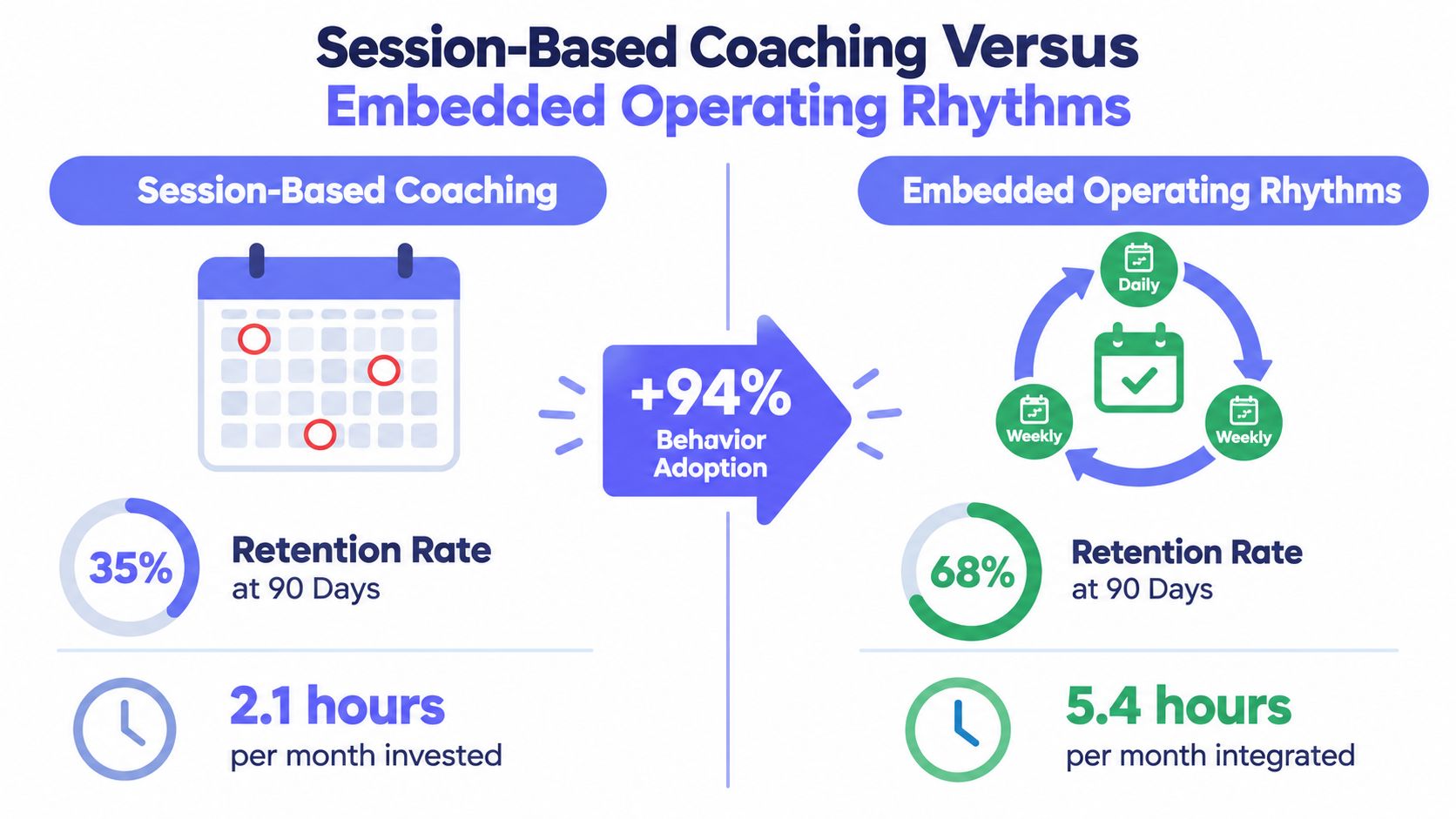
Session-based coaching treats development as a series of appointments. A leader attends, reflects, practises a technique, and leaves with an action. That format can help with a defined personal issue, but it rarely creates consistent behaviour across planning, delivery, and review.
Embedded coaching connects development to the forums where leaders already work: weekly check-ins, OKR reviews, quarterly planning, and cross-functional dependency discussions. Learning is tested inside the work rather than added beside it. The coach can observe the decision context, while the leader has a clear opportunity to apply and review the behaviour.
The event model
The event model is easy to procure and report. Attendance is visible, completion is simple to record, and participants often value the protected time to think. Those signals say little about whether leadership behaviour changes after the session.
The weaknesses usually appear later:
- No transfer point: The leader does not know where to apply the technique.
- No manager reinforcement: The participant's manager never asks about the agreed behaviour.
- No shared language: Each leader interprets the training differently.
- No evidence loop: The organisation measures attendance instead of changed delivery.
A thoughtful session can therefore remain disconnected from execution. The organisation has paid for reflection but has not created a mechanism that makes the learning durable.
The embedded model
An embedded model ties each coaching interaction to a live operating cycle. Before a session, the leader brings an objective, dependency, or difficult conversation. During the session, they examine assumptions and rehearse a response. Afterward, they apply the behaviour in a defined forum and review what happened.
A practical rhythm might look like this:
| Moment | Coaching application |
|---|---|
| Before the weekly review | Identify the decision or commitment that needs attention |
| During the review | Use questions that clarify outcome, owner, evidence, and next action |
| After the review | Record the behaviour used and the response it produced |
| At the next check-in | Examine progress, obstacles, and whether escalation is needed |
The operating rhythm guidance explains how recurring forums give leaders repeated opportunities to practise, receive feedback, and correct course. The forum supplies repetition. Coaching supplies examination and rehearsal.
Reported coaching improvements ranged from 3% to 97%, while poorly executed coaching was associated with negative effects for 57% of coachees and 17% of organisations, according to the UK coaching outcomes case material. That spread makes implementation discipline more important than choosing a fashionable coaching format.
Make follow-through part of the programme
Require each participant to define the work application before leaving a session. Their manager should know the behaviour being practised, without breaching coaching confidentiality, and ask about application during the normal management cadence.
Review impact at 30, 60, and 90 days, as recommended in the verified UK coaching guidance. Track whether leaders set clearer outcomes, resolve dependencies earlier, and close commitments more reliably. If the programme does not change those conversations, it has not changed the operating system.
Embedding OKRs Into Leadership Coaching Training Outcomes
A leadership coaching programme can produce thoughtful conversations and still fail to improve delivery. The failure usually appears after the session, when nobody has agreed what will change, who owns it, or when progress will be reviewed. OKRs give coaching a visible work object. Instead of discussing leadership in the abstract, the coach and leader examine how the leader sets an objective, assigns ownership, handles trade-offs, responds to evidence, and keeps the team aligned when progress slows.
That makes coaching practical. It also stops coaching language becoming a substitute for management. A supportive conversation still needs a defined outcome, a decision, and a follow-through mechanism. Without those elements, coaching becomes expensive conversation rather than a change in operating behaviour.

Coach the objective before the behaviour
Many execution problems start with an unusable objective. It may describe activity, combine several competing outcomes, or give the team no basis for choosing between priorities. Coaching should test the objective before focusing on the leader's communication style.
Ask:
- What business outcome will this objective change?
- Why does it matter now?
- What must be true for it to succeed?
- Which team owns the result?
- Which decisions sit outside that team's authority?
- What evidence will show meaningful progress?
The coach does not need to become an OKR editor. The purpose is to give the leader a disciplined method for checking whether the team has a direction it can act on and review.
The same test applies to key results. A leader may claim ownership while assigning only tasks. Coaching should expose the difference between completing work and changing an outcome. If a key result cannot inform a decision, it is unlikely to support accountability.
The practical trade-off is speed versus clarity. A team can write an objective quickly, but correcting an ambiguous objective later consumes more time and creates avoidable conflict. Spending coaching time on the outcome at the start usually prevents that rework.
Use coaching questions inside OKR governance
A leader can use a short set of questions during weekly reviews:
- What changed since the last review?
- What evidence supports the current confidence level?
- What obstacle needs a decision rather than more effort?
- Who owns the next action?
- What will we stop, defer, or escalate?
These questions reinforce listening, curiosity, challenge, and shared problem-solving while keeping the discussion connected to delivery. They also create a repeatable structure that participants can practise between coaching sessions.
A manager who says, “Tell me what you need,” may sound supportive while leaving the team to formulate an unbounded request. A stronger question is, “Which decision or dependency is preventing progress, and what support would remove it?” That wording narrows the issue without taking ownership away from the team.
The review must produce a visible next step. If participants leave with insight but no owner, decision, or review point, the coaching has not transferred into the operating rhythm.
Separate accountability from blame
Accountability works when people know what they own and have a fair chance to influence it. Blame appears when leaders use OKR reviews to punish variance without examining assumptions, dependencies, or changing conditions.
Leadership coaching training should help managers distinguish three situations:
- Execution failure: The owner had clarity and capacity but did not follow through.
- System failure: Dependencies, decision rights, or resources blocked delivery.
- Learning failure: The team discovered new evidence and failed to adapt the plan.
Each situation calls for a different response. Execution failure may require a direct performance conversation. System failure requires an operating change. Learning failure requires stronger review discipline. Treating all three as motivation problems teaches people to hide risk instead of surfacing it.
According to a 2024 analysis by the Office for National Statistics management practices survey, the official dataset covering 2016 to 2023 recorded an overall mean UK and Great Britain score of 0.57 and a median of 0.61 on a 0-to-1 scale, as reported in the UK strategy execution analysis. The benchmark points to room for stronger management discipline, particularly in the routines that turn coaching into consistent execution.
Measure transfer, not attendance
A leadership coaching training dashboard should combine behavioural and delivery measures. The categories need to match the operating problem, but useful measures include:
- Alignment: Whether teams connect objectives to strategic priorities.
- Ownership: Whether each key result has a clear accountable leader.
- Decision speed: How quickly unresolved issues reach the right forum.
- Dependency health: Whether cross-functional blockers are surfaced early.
- Review quality: Whether conversations produce decisions and next actions.
- Capability transfer: Whether managers use coaching practices without external support.
Attendance shows participation. It does not show changed management behaviour. Review the quality of conversations, the speed of decisions, and the reliability of commitments instead.
Avoid claiming that coaching caused every movement in business performance. Use a practical chain of evidence. A leader changes how they run an OKR review. The team identifies a dependency earlier. Accountable owners agree a decision. Delivery becomes more predictable. That is a credible execution story because each link can be observed.
A UK national charity case found that 83% of participants said their work performance improved after coaching, and all participants said coaching helped them resolve issues that might otherwise have affected performance, according to the Strengths-based coaching case study. The transferable lesson is not to copy the programme blindly. Give participants explicit accountability, role clarity, and a plan for applying the practice in normal work.
Build the manager as a coach
The manager does not need to become a professional coach. They do need to improve everyday conversations by listening before prescribing, asking questions that reveal assumptions, challenging vague commitments, and closing with a clear owner and review point.
The guidance on the manager as a coach is useful when organisations want coaching capability to spread through normal management practice. The approach works best when leaders model it. If executives demand clarity from teams but leave their own priorities unclear, the behaviour will not travel.
The wider business case is execution. UK strategy research found that only 18.4% of businesses achieved more than 80% of their aspirational growth goals within three years, according to UK strategy execution research. The same source reports that 61% of strategies fail because of disconnects between planning and operational execution, while only 33% of UK mid-market firms track delivery systematically. These figures make the coaching question direct. If leaders cannot connect strategy to weekly decisions, better interpersonal technique will not be enough.
The OKR Hub offers OKR consulting, implementation, leadership and team training, and hands-on coaching through its OKR Focus Flow. The approach helps teams diagnose execution issues, design the required system, deploy it, and build internal capability. To assess whether leadership coaching is changing delivery, visit The OKR Hub and review the next step for your organisation.