The most popular advice on leadership team coaching is wrong. It treats the leadership team as a collection of executives who each need better communication, confidence, or delegation. That approach produces thoughtful individuals and the same slow decisions.
If the team already understands the strategy but delivery remains inconsistent, the problem probably isn't a lack of personal insight. It sits in the operating system: who decides, which priorities win, how disagreement is handled, and what happens when commitments slip. Leadership team coaching should change that system.
UK organisations have used coaching at scale for more than a decade. The Institute of Leadership reported that 80% of organisations surveyed already had or were using coaching, while another 9% were planning to. Yet only just over half made coaching available to all staff, and 85% aimed it at managers and directors, with the strongest use in middle management and senior leadership. The market doesn't need more awareness of coaching. It needs better access, stronger consistency, and interventions that improve collective execution. (Institute of Leadership coaching research)
Why Leadership Team Coaching Is Not Individual Coaching Scaled Up
Buying six executive coaches and placing them around a leadership team isn't team coaching. It's an individual development programme with a group of participants.
One-to-one coaching can improve a leader's self-awareness, communication, delegation, or resilience. Those gains matter. But they won't resolve a team that avoids difficult trade-offs, makes decisions in private, or leaves ownership ambiguous. Each executive may become more effective while the group continues to duplicate work, protect functional interests, and postpone enterprise-level choices.
The leadership team is the unit that owns execution. Its members decide which initiatives receive attention, how resources move between functions, and what the organisation treats as urgent. If those decisions remain slow or contradictory, personal development hasn't addressed the constraint.
The team has its own behaviour
A leadership team is a system with shared rituals, informal power, decision rights, and recurring patterns of avoidance. Those patterns won't necessarily appear in individual coaching conversations. A chief product officer may say they need clearer priorities. The chief financial officer may say the issue is weak commercial discipline. The chief operating officer may describe a capacity problem. In the leadership meeting, the same people may agree with everything and resolve nothing.
This is why a coach must observe the team doing real work. The relevant evidence sits in the meeting where a product launch is challenged, a hiring request is deferred, or a customer commitment conflicts with an internal priority.
Practical rule: If the leadership team is the bottleneck, coach the team where the bottleneck appears.
The intervention should expose how the team makes decisions, not just how each member experiences the team. It should test whether the group can disagree in the room, decide in the room, and leave aligned enough to defend the decision outside it.
That doesn't make individual coaching irrelevant. A leader may need focused support to challenge a peer, stop rescuing a direct report, or handle conflict without retreating. But that personal work should serve a team-level outcome. The objective isn't six improved executives. It's a leadership team that can turn strategy into coordinated action.
The distinction is similar to the difference between managing and coaching explored in this practical guide for managers who coach. The relationship matters, but so does the context in which behaviour must change. For a leadership team, that context is the operating cadence.
The Execution Problems UK Leadership Teams Actually Face
Most UK leadership teams don't fail because the strategy is incomprehensible. They fail because the approved strategy doesn't survive contact with competing priorities, functional incentives, and unresolved decisions.
A typical team may contain six to ten strong functional leaders. Each person is capable, experienced, and accountable for a department. The trouble starts when functional loyalty beats enterprise ownership. Sales protects a forecast. Product protects a roadmap. Finance protects a cost position. Operations protects capacity. Everyone is rational, and the company still drifts.
UK evidence shows why this remains a serious problem. One leadership teams report found that only 40% of leaders rated their company's leadership quality as high, a decline of 17% over two years. Only 23% of employees said they were confident in leaders' ability to handle changing workforce needs, while just 37% of leadership development professionals reported behaviour change from their programmes. (UK leadership capability evidence)
The message is clear. Training content isn't the same as changed behaviour. A workshop can produce agreement on paper. It won't necessarily change how leaders handle a live resource conflict on a Tuesday morning.
Symptoms that point to a system problem
Growth performance shows the same pattern. In a March 2025 survey of 250 UK companies with turnover of £20m or more, only 18.4% achieved more than 80% of their aspirational growth goals within three years, while 41.2% missed 60% or more of their targets. Talent and capability gaps were the biggest barrier for 50.4% of respondents, alongside weak alignment between operations and strategy and misaligned culture. (UK strategy and execution findings)
That isn't proof that coaching alone will fix growth. It does show why coaching must reach beyond personal mindset. If the leadership team doesn't convert strategy into ownership, sequencing, and trade-offs, the business will keep blaming the market for decisions it never made internally.
| Visible Execution Symptom | Underlying Leadership Team Dynamic |
|---|---|
| Strategy is understood but nobody owns the outcome | The team has discussed the plan without assigning enterprise-level accountability |
| Decisions stall between functions | Decision rights are unclear, or leaders are waiting for consensus that won't arrive |
| Quarterly reviews re-litigate old choices | The team is reporting activity instead of testing assumptions and making decisions |
| OKRs produce polished slides but little behaviour change | Objectives aren't connected to resource choices, meeting agendas, or consequences |
| Revenue misses get blamed on market conditions | Leaders haven't separated external factors from weak sequencing and priority drift |
| Committees consume time without binding decisions | Meetings lack a clear decision owner, evidence threshold, and closure rule |
Misalignment is widespread across relationship types. A UK organisational alignment analysis reported that horizontal misalignment affected 73% of respondents regularly or very often, diagonal misalignment affected 58%, and vertical misalignment affected 46%. (UK organisational alignment analysis)
Horizontal misalignment creates duplicated work and handoff friction. Vertical misalignment means leaders believe one thing while teams deliver another. Diagonal misalignment exposes dependencies that no single function can resolve. Leadership team coaching must therefore examine the full route from executive decision to operational interpretation, not just the quality of the senior meeting.
For a broader diagnosis of the patterns that cause plans to stall, see why strategy execution fails. The key question isn't whether the team has a strategy. It's whether the team has built a system that makes the strategy executable.
A Four-Stage Framework for Coaching the Leadership Team
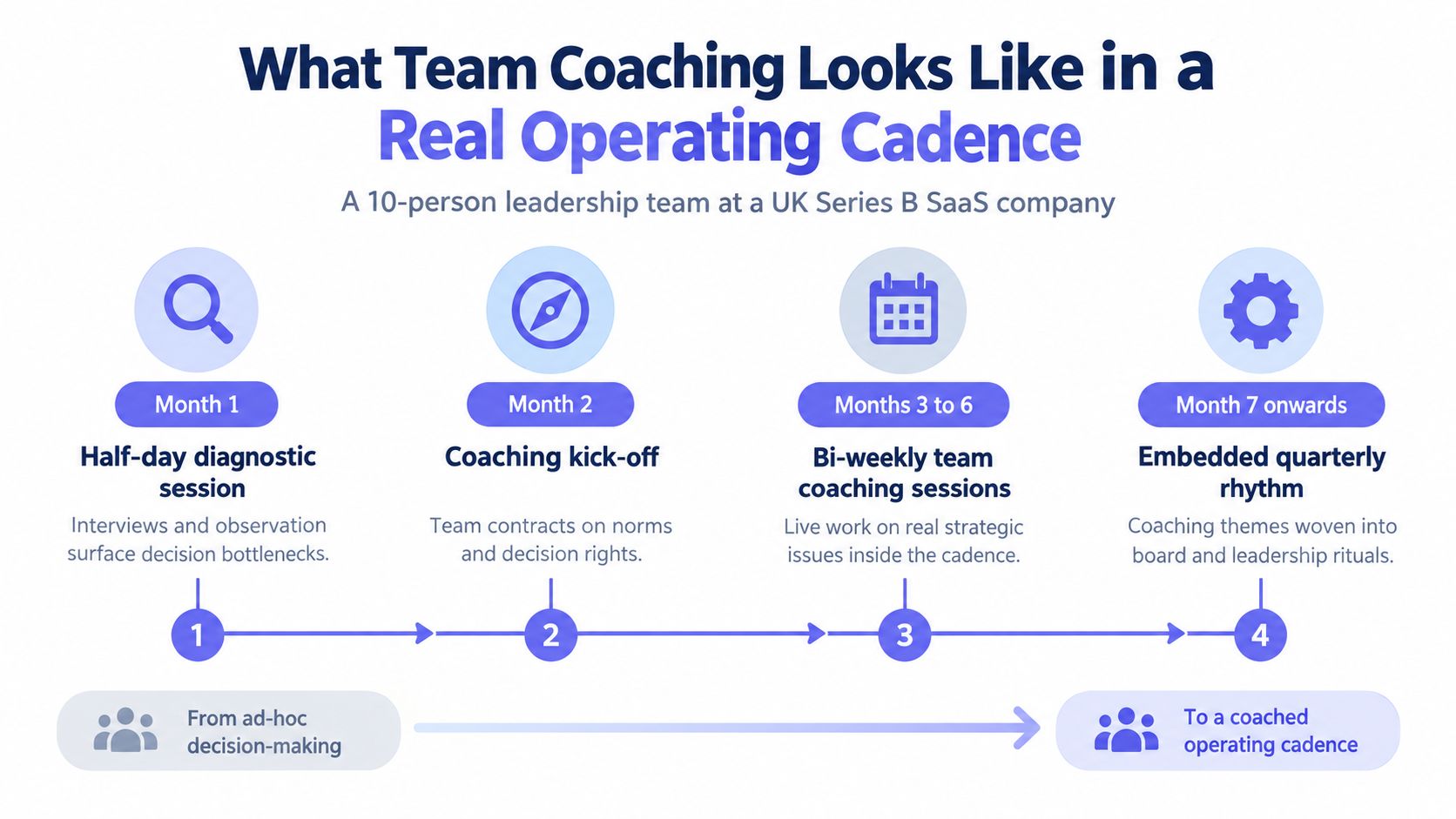
A useful engagement follows four stages: diagnose, contract, coach the team as a system, and embed into governance. Skip the first stage and the coach works from assumptions. Skip the last and the team returns to its old habits when the engagement ends.
Diagnose the operating system
Start with evidence, not a personality profile. Interview team members, observe leadership meetings, inspect decision logs, and review the route from strategic objectives to team commitments.
Assess seven failure modes:
- Strategy clarity: Can each leader state the few outcomes that matter and explain what won't be prioritised?
- Decision rights: Does the team know who recommends, decides, and executes?
- Conflict tolerance: Can leaders challenge an assumption without turning disagreement into politics?
- Accountability: Does one person own each outcome, or does the team hide behind collective responsibility?
- Cadence: Do meetings create decisions and follow-through, or merely circulate updates?
- Talent: Does the team have the capability and capacity to deliver its commitments?
- External orientation: Are leaders responding to customers, competitors, and market signals, or mainly negotiating internally?
The output should be a diagnostic report with observed patterns, not labels.
Contract for team-level change
The contract defines what the engagement will change. Agree the outcomes, the meetings in scope, the decision rights under review, and the behaviours each member will practise.
A strong contract says, for example, that the team will reduce unresolved cross-functional decisions, use one ranking method for quarterly priorities, and challenge priority conflicts in the room. It also states how the coach handles confidentiality and what information can be shared with the sponsor.
The main artefacts are a team charter, an agreed set of behavioural commitments, and a clear coaching scope.
Coach the team as a system
Use live strategic work. The coach should facilitate a real pricing decision, hiring trade-off, product sequencing issue, or customer commitment. Abstract exercises allow leaders to perform. Real choices reveal how the team behaves.
The coach names avoidance, tests assumptions, surfaces competing interpretations, and asks who has authority to decide. They also watch what happens after the meeting, when unresolved disagreements reappear in side conversations.
Facilitation notes should record observed behaviour, decisions made, open dependencies, and the next experiment. The team should leave with practice, not inspiration.
Embed into governance
The final stage rewires the forums that keep the business moving. Change the operating committee agenda, quarterly business review, board pack, and performance conversations so the new behaviours are required by the work itself.
The expected artefacts include a revised governance pack, updated agendas, decision rules, and a recurring review of team commitments. Coaching then becomes part of the operating rhythm rather than an event that sits outside it.
What Team Coaching Looks Like in a Real Operating Cadence
Consider a ten-person leadership team at a UK Series B SaaS company. The strategy is credible. The team wants growth, stronger retention, and more disciplined product delivery. Yet decisions move through ad-hoc conversations, functions rank their own priorities, and the weekly operating meeting becomes a sequence of updates.
The engagement starts with a half-day diagnostic session. Before the session, each leader ranks the proposed business priorities and identifies the commitment they would drop if capacity became constrained. The coach compares the responses, then uses the gaps to expose assumptions that would otherwise remain polite and hidden.
The session doesn't ask, “How can we communicate better?” It asks sharper questions:
- Which decision has been waiting longest, and why?
- Who can decide it without another meeting?
- Which objective depends on another function's work?
- What are we pretending is a priority because we haven't agreed what to stop?
- Where do we leave the room aligned but explain a different decision afterwards?
The coach then observes the weekly 90-minute operating meeting. They notice that the chief revenue officer raises a customer exception, the product leader defers it to roadmap planning, and the chief operating officer records it as a dependency. Nobody decides whether the exception changes the quarter's priorities.
In the next monthly half-day coaching session, the team works on that pattern. The coach asks the group to rank the issue against the agreed objectives, identify the decision owner, and state the trade-off in front of the team. The point isn't to make the meeting more comfortable. It's to make the decision visible and binding.
The coach may shadow another working session and feed observations back into the next team discussion. They might note that leaders challenge proposals but don't challenge priority assumptions, or that the CEO closes debates too early. Those observations become material for practice.
The difference from group personal development is obvious. Nobody is taking turns discussing their leadership style while the operating system stays untouched. The team is rehearsing new decision behaviour inside the cadence where execution happens.
A practical operating rhythm for leadership teams should make priorities, dependencies, decisions, and escalation visible every week. Coaching gives the team a way to improve that rhythm while using it.
Aligning the Leadership Team on OKRs and Priorities
Alignment doesn't come from asking whether everyone agrees. Leaders often agree with the wording and disagree with the consequences. Use a process that forces those consequences into the room.
Start before the meeting
Send a short pre-read with the proposed objectives, draft key results, major dependencies, and known capacity constraints. Ask every leader to:
- Rank the objectives.
- Identify the objective they would drop.
- Name the dependency most likely to block delivery.
- State the assumption behind their ranking.
- Nominate one accountable owner for each proposed OKR.
Don't collect comments only. Require a ranking. Ranking creates a useful disagreement surface before hierarchy and group dynamics influence the discussion.
Use the live meeting to force trade-offs
Begin by collating the rankings. Show where the team converges and where it diverges. Then run a structured drop and add exercise. Each leader must propose one priority to remove and one outcome to strengthen.
Use prompts that make silence visible:
- Which objective would you defend if you could keep only one?
- What are we agreeing to because it sounds reasonable?
- Which dependency has no named owner?
- If this objective succeeds, what must another function stop doing?
- Are we debating evidence, authority, or preference?
- What would change our view before the next review?
When two functions need the same quarter, don't let the conflict become a negotiation between departmental budgets. Test the causal chain. Which outcome contributes more directly to the enterprise objective? Which dependency must happen first? What evidence would justify sequencing one before the other?
Leave with operating artefacts
The meeting should produce three things:
- A one-page OKR set: Objectives are concise, key results are measurable, and each OKR has one accountable owner.
- A visible dependency map: The team can see which commitments rely on another function, decision, or capability.
- A conflict-resolution protocol: Leaders know how to handle a priority collision mid-quarter without reopening the entire strategy.
A good OKR alignment session doesn't eliminate disagreement. It turns disagreement into explicit choices that leaders can explain and defend. Teams wanting a facilitated version can use a structured goal alignment workshop rather than leaving the work to whoever speaks first.
Embedding New Behaviours Into Governance and Reviews
Coaching gains disappear when the organisation's governance rewards the old behaviour. If the board pack still celebrates activity, the quarterly review still accepts vague ownership, and performance conversations still focus only on individual ratings, the team will revert.
Change the forums first. The leadership team should maintain three simple norms: challenge in the room, decide in the room, leave aligned. That doesn't mean artificial consensus. It means leaders can disagree openly, record the decision, and represent it consistently afterwards.
Replace activity reporting with decision quality
A board pack should show OKR progress, material risks, unresolved dependencies, and decisions required. It shouldn't force executives to hide behind a long list of completed tasks.
The quarterly business review should test whether the strategy's assumptions still hold. It should ask what changed, which key results are off track, what decision is required, and what the team will stop or sequence differently. Performance templates should reinforce team-level commitments, not reward leaders for protecting local metrics at the expense of enterprise outcomes.
| Governance forum | Before coaching | After coaching |
|---|---|---|
| Board meeting | Activity updates and late escalation | OKR progress, assumptions, dependencies, and decisions |
| Quarterly business review | Functional reports and retrospective debate | Strategic choices, trade-offs, and corrective action |
| Operating committee | Open issues without clear closure | Named decision owners and explicit deadlines |
| Performance conversation | Individual effort and functional targets | Behaviour, cross-functional commitments, and outcome ownership |
Teams can use a broader Vision governance framework as a reference when reviewing decision structures, accountability, and oversight. The framework is useful as a prompt, but the leadership team still needs to adapt governance to its own decision volume and operating model.
Run a lightweight self-audit each quarter. Ask whether decisions are being made at the right level, whether unresolved dependencies are shrinking, whether leaders are reopening closed choices, and whether teams can describe the same priorities in consistent language. Record the answers and choose one regression to address.
The coach should eventually leave. The governance system should make the new behaviour easier to repeat. For practical guidance on redesigning forums, see governance meetings that drive decisions.
Signals It Is Working and What to Do Next
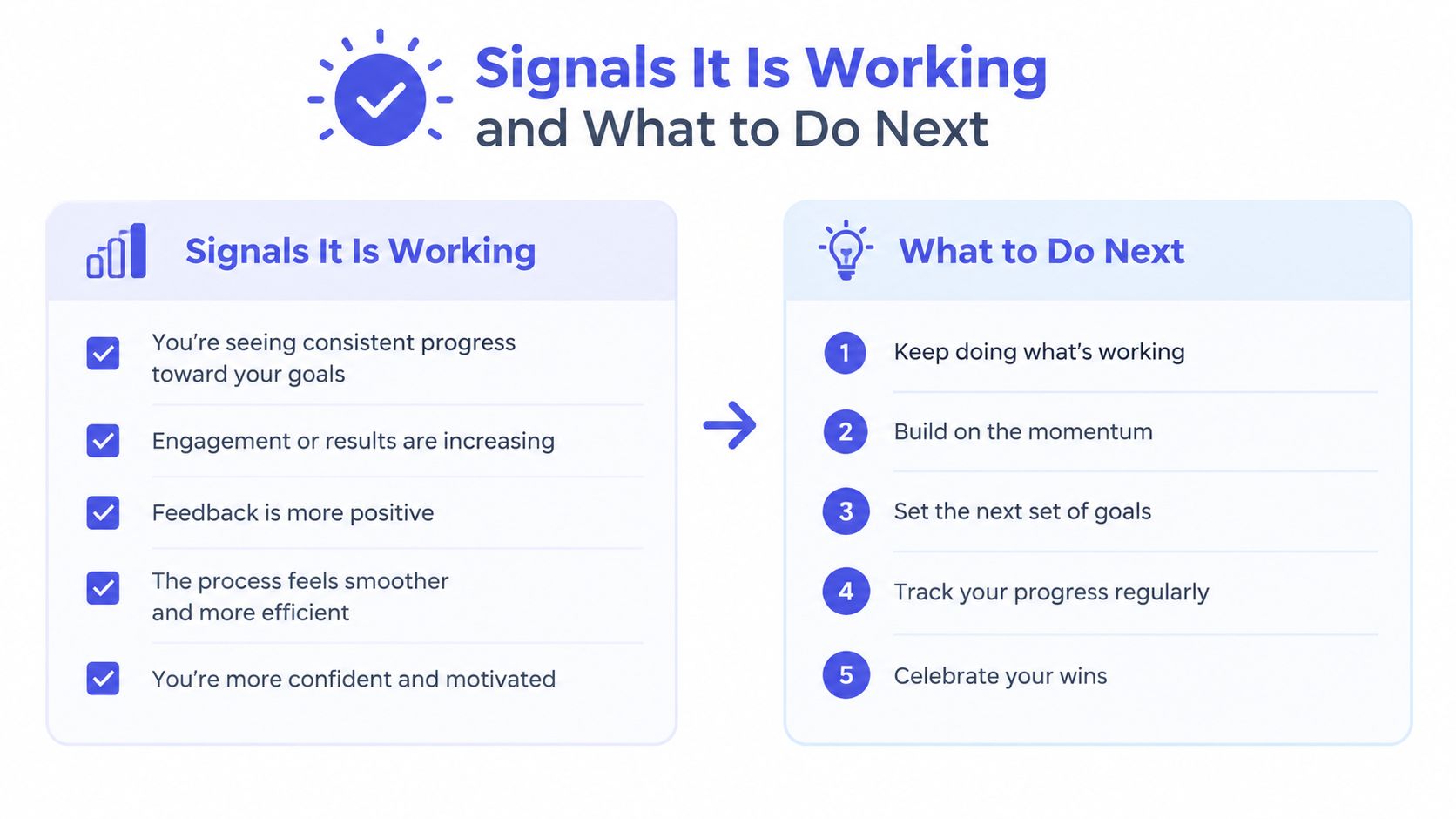
Don't wait for annual performance results to judge leadership team coaching. Lagging outcomes matter, but they arrive too late to guide the next decision. Leading signals show whether the team is changing its operating behaviour now.
Look for leaders challenging assumptions in the meeting instead of in private. Watch whether the team closes decisions without requiring another approval loop. Check whether owners can explain the outcome they own, the dependencies they need, and the trade-off they accepted.
Use this short diagnostic during the current quarter:
- Meetings still end with open questions: The team may lack decision rights. Revisit who recommends, decides, and executes, then test the rule on one live issue.
- OKR confidence varies sharply between functions: The objective may be clear but the causal chain isn't. Map dependencies and ask each owner what would make delivery credible.
- Leaders agree in the room but communicate different priorities afterwards: The team has an alignment problem, not a messaging problem. Record the decision, the rationale, and the non-priorities.
- Cross-functional friction keeps returning: The governance forum may be treating symptoms. Coach the team through one recurring dependency and assign a permanent escalation route.
- The same leader closes every debate: The team may have a power or psychological safety issue. Contract how challenge works and make the decision owner speak last.
- Quarterly reviews report progress without changing choices: The review has become a status ritual. Add explicit questions about assumptions, trade-offs, and stop decisions.
The first action should be narrow. Choose one operating rhythm or governance change that the team can protect after the engagement. A weekly decision review is often more useful than another broad leadership session because it creates repeated evidence of changed behaviour.
Coaches also need an operating model for their own visibility. A resource such as social media for coaches may help with external communication, but it won't replace disciplined observation, contracting, and measurement inside the client team. The work succeeds when the coach's insights become the team's habits.
Review the diagnostic after the next cycle. If decision speed improves but cross-functional friction remains, focus the next intervention on dependency ownership. If meetings improve but outcomes don't, inspect whether the OKRs are connected to resource choices and governance.
The OKR Hub helps scale-ups and enterprise teams diagnose execution gaps, align leadership teams on priorities, and embed OKRs into operating rhythms and governance through its OKR Focus Flow. Visit The OKR Hub to explore leadership team coaching, facilitated OKR alignment, and a practical diagnostic for testing where your strategy-to-execution system is breaking.