Only 18.4% of UK companies with turnover of £20m or more achieved more than 80% of their aspirational growth goals within three years, according to a March 2025 study of 250 businesses (Strategy Management). That result changes the leadership goal setting conversation. The central problem isn't usually a lack of ambition or strategic ideas. It's the operating system between the boardroom decision and the work people do each day.
Goals fail when they stay at the level of intent. Teams hear that growth, customer value, efficiency, or innovation matters, but they don't know which trade-offs to make, who owns the outcome, or how progress will be reviewed. OKRs work when they connect strategic choices to decisions, dependencies, and regular management action. They fail when leaders treat them as quarterly paperwork.
The Gap Between Strategy and Delivery
The research explains where growth plans break down: talent and capability gaps were the biggest barrier for 50.4% of respondents, alongside weak alignment between operations and strategy and a misaligned culture. The same study found that 41.2% of companies failed to reach 60% of their target within three years (FM Magazine). These findings shift leadership goal setting from writing better ambitions to managing the conditions required to deliver them.
The pattern is familiar in scale-ups. Executives agree on a priority, then each function converts it into a local plan. Product adjusts the roadmap, sales increases pipeline activity, operations protects service levels, and finance monitors the forecast. Each response can appear sensible while the combined effort misses the intended business outcome.
Alignment research shows why agreement in the leadership meeting is insufficient. Horizontal misalignment affected 73% of respondents regularly or very often, while diagonal misalignment affected 58% and vertical misalignment affected 46% (The OKR Hub alignment research). Departments, management layers, and delivery teams can therefore pull in different directions even after senior leaders have agreed on the strategy.

Strategy needs an execution architecture
A strategy becomes executable when people can answer five questions without escalating routine decisions:
- What matters most: Which outcome takes priority when resources conflict?
- What changes: Which customer, commercial, operational, or organisational result must improve?
- Who owns it: Which leader is accountable for the outcome, rather than a list of tasks?
- What depends on it: Which teams must coordinate for delivery to work?
- How will we know: Which leading indicators show whether progress remains on track?
OKRs give leaders a practical structure for these answers. The objective states the direction. Key results provide evidence of change. The review and governance rhythm keeps both connected to decisions, dependencies, and operating reality.
Treating OKRs as a replacement for strategy creates another administrative layer. Used properly, they make strategic choices visible enough to manage. Leaders can use this guide to close the execution gap, then choose the alignment and governance changes required in the next planning cycle.
Designing Strategic Objectives That Drive Action
A strategic objective should state what must become true, not what leaders intend to do. “Improve the customer experience” points in a direction. “Make onboarding easier for new enterprise customers” is more useful, but it still leaves investment, sequencing, and trade-offs open to interpretation. A leadership objective earns its place when different leaders make consistent decisions from the same wording.
Start with the business constraint. Identify what is blocking the organisation's growth ambition: low conversion, slow implementation, weak retention, limited delivery capacity, or fragmented ownership. That constraint gives the objective a commercial and operational context, rather than turning it into a general statement of intent.
Build the objective around an outcome
Use this design sequence:
- Name the strategic shift. State the change the organisation needs, such as making enterprise onboarding predictable or increasing the value created by existing customers.
- Define the affected stakeholder. Specify whether the outcome concerns customers, employees, partners, shareholders, or the operating model.
- Set the decision horizon. A time boundary helps leaders decide what belongs in the current cycle and what should wait.
- Choose evidence of success. Select measures that show the outcome changing, not measures that merely record activity.
- Test the trade-off. State what the organisation will stop, delay, or fund differently to make the objective credible.
The distinction between outputs and outcomes keeps activity from being mistaken for progress. Launching a feature is an output. Improving activation through that feature is an outcome. Hiring a team is an output. Removing a capability constraint that blocks delivery is an outcome. Outputs still matter, but they do not prove that strategy is working.
Use leading indicators without losing the result
A leadership team needs a small set of measures that show movement before the final business result appears. For an objective focused on predictable onboarding, leading indicators could include completion of critical hand-offs, adoption of a standard implementation path, or accounts with a confirmed owner. The final result might concern customer time to value or retention, depending on the strategic choice.
Avoid turning every activity into a key result. A long list creates the appearance of control while making priority decisions harder. A focused group of outcome-based measures forces leaders to discuss what matters when indicators move in different directions.
Leaders can use the guide to writing objectives as a practical quality check. The stronger test is operational: if two leaders would sequence investment differently after reading the objective, it is still too vague. Can a team use the objective to make a better decision this week?
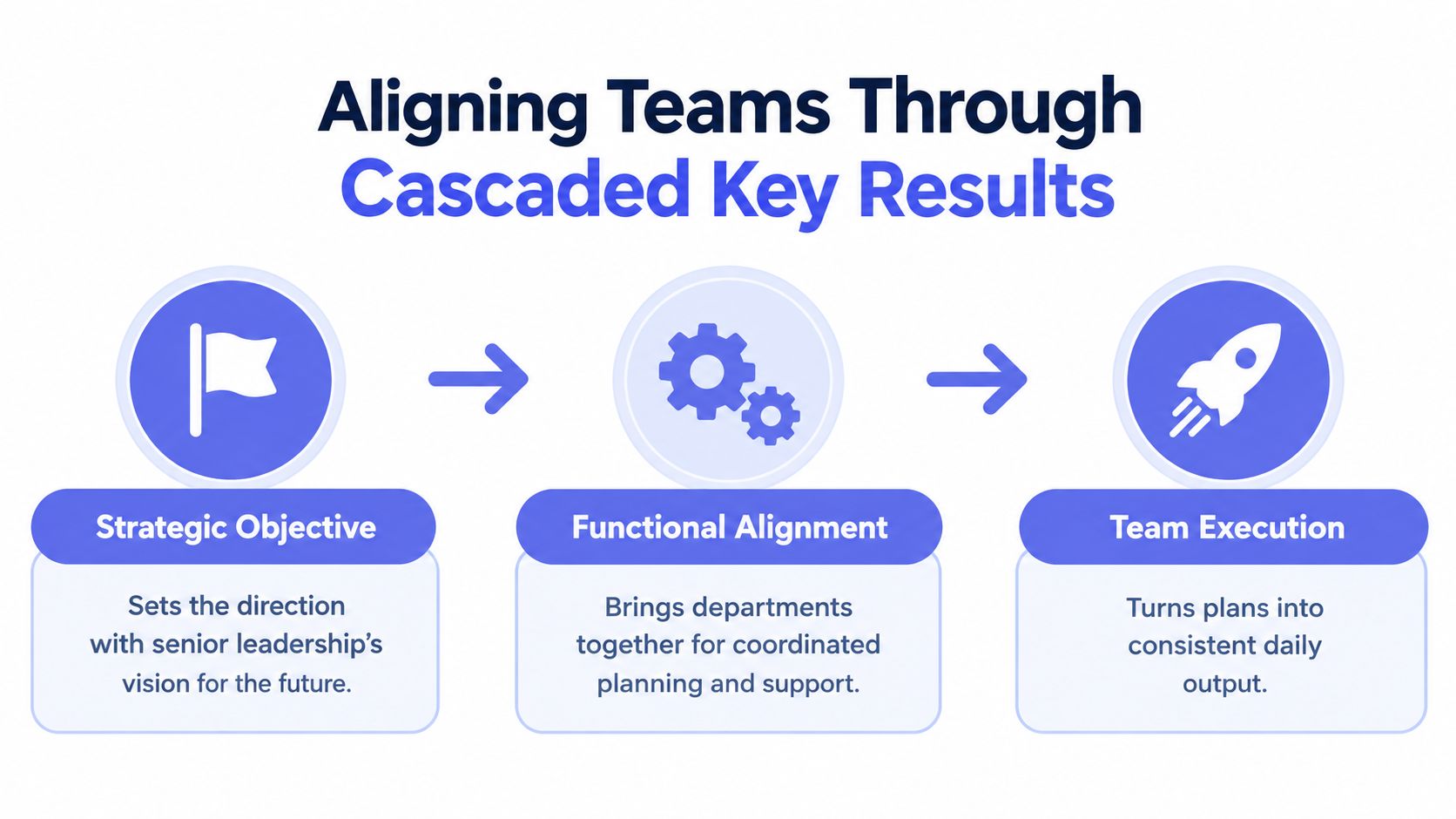
Aligning Teams Through Cascaded Key Results
A senior objective creates alignment only when dependent teams can state what they own, what they need, and how their result contributes to the enterprise outcome. Leadership goal setting therefore requires vertical clarity, linking enterprise priorities to functions and teams, plus horizontal coordination, connecting the groups responsible for delivery.
Consider an objective to make enterprise onboarding faster and more reliable. Sales may own the quality of information captured during hand-off. Product may remove avoidable configuration steps. Professional Services may improve implementation predictability, while Customer Success supports adoption after launch. Each contribution matters, but no single team can deliver the enterprise result alone.
Cascade through contribution, not translation
A weak cascade copies corporate language into every department. A stronger one asks each team to define the result it can influence and the dependency it creates for another group.
| Level | Management question | Typical output |
|---|---|---|
| Enterprise | What strategic outcome must change? | A focused set of company objectives |
| Function | What must this function deliver or enable? | Functional key results and dependencies |
| Team | What measurable result can this team influence? | Team-level key results |
| Individual | What decision or contribution does this person own? | Clear responsibilities within the team plan |
This structure should expose missing links, not create administrative layers. If a team cannot explain how its work supports the objective, leaders may have defined the objective too broadly. The cascade may also have skipped a dependency that sits between the executive priority and the team's work.
Make dependencies explicit
Peer leaders should resolve dependencies before teams finalise their key results. Ask:
- Which result depends on another function?
- What input must arrive, and by when?
- Who can resolve a conflict?
- Which team carries the risk if the dependency slips?
- What decision will the group make if capacity becomes constrained?
Horizontal misalignment can stall execution even when every team has a reasonable objective. Product and Sales may agree that growth matters while disagreeing about which customer segment receives investment. Operations may commit to service reliability without accounting for demand created by a commercial campaign. Shared vocabulary does not resolve these conflicts. Leaders need an agreed decision rule and a clear owner for escalation.
For teams changing workflows and tooling, resources on making ownership and hand-offs visible in monday.com can complement the goal system. The tool is secondary. The operating requirement is visibility: teams must be able to see who owns each hand-off, what is blocked, and when another group must act.
Use “cascade” to describe line of sight, not a purely top-down process. Teams should challenge measures they cannot influence and identify work missing from the executive plan. The OKR cascade framework can help leaders connect objectives while preserving local judgement.
Practical rule: Every key result needs one accountable owner, a named dependency map, and a clear escalation path.
Establishing a Review Cadence and Governance Rhythm
Annual reviews arrive after many useful decisions have already passed. A working goal system asks throughout the cycle: what have we learned, what is blocked, and what needs to change now? The point is governance, not more meetings. Leaders need a rhythm that keeps strategic intent connected to decisions after the quarterly review ends.
Match each review to the decision it supports. Weekly conversations address delivery risks and immediate blockers. Monthly reviews examine trends, cross-functional dependencies, and resource choices. A quarterly leadership review tests whether the objective still reflects the strategy and whether progress justifies continued investment.
Compare the two operating models
| Set-and-forget model | Continuous management model |
|---|---|
| Goals are agreed, filed, and revisited late | Goals stay visible in normal management conversations |
| Teams report activity after the fact | Owners discuss evidence, risks, and next decisions |
| Problems surface during formal reviews | Blockers are escalated while leaders can still act |
| Measures become a scorecard | Measures support prioritisation and learning |
| Failure feels personal and sudden | Variance becomes a prompt for intervention |
Continuous management does not mean changing targets whenever delivery becomes difficult. That would weaken accountability. It means separating three conditions: a genuine change in context, a flawed assumption, and weak execution. Leaders can then adapt the plan without rewriting history or hiding poor delivery.
Give each meeting a job
A weekly check-in should stay close to execution. Owners report movement, confidence, and the one blocker that requires help. A monthly retrospective examines recurring patterns, such as hand-off failures or dependencies that keep slipping. The quarterly session makes strategic choices, including whether to continue, stop, or redirect work.
Keep performance evaluation out of every operational check-in. Separate the development conversation from the pay conversation, or owners will hedge their status reports. People surface risks earlier when the meeting is designed for improvement rather than judgement.
A governance record should contain only information that can trigger action:
- Current position: What evidence supports the latest status?
- Confidence: Does the owner still expect the result to be achievable?
- Blocker: What is preventing progress?
- Decision: Which leader must decide, and by when?
- Next movement: What will change before the next review?
The review rhythm also protects strategy from operational noise. Leaders can test whether an urgent request represents a real priority or merely a loud interruption. They can see when a target needs a decision, when an assumption needs testing, and when an owner needs support. That turns goal tracking into a management system that keeps execution connected to strategy.
Avoiding Common Misalignment Traps
Many organisations operate a goal system that looks disciplined from the outside. Objectives sit in a platform, dashboards display status colours, and quarterly presentations include every team. Yet the system can remain disconnected from daily decisions. The test is simple: can leaders point to a choice, resource allocation, or stopped activity that changed because of the goals?
The first trap is activity disguised as progress. Teams report workshops completed, features released, campaigns launched, or hires made. Those outputs may be necessary, but they do not show whether the strategic problem has improved. If the objective concerns customer retention, leaders must connect delivery to customer behaviour or value rather than treating volume as the result.
The second trap is the loose target. UK workplace evidence shows how quickly accountability becomes vague. In a 2018 survey of 3,000 employees, only 21% said their manager set specific goals, while 38% said they had never been set specific goals or targets and 41% described their targets as “loose” (FE News). A goal system cannot govern execution when people interpret the expected result differently.
Test the system for false confidence
Ask leaders to inspect these signals:
- Vanity measures: Does the dashboard celebrate activity without showing customer, commercial, or operational impact?
- Unowned outcomes: Does a key result have several contributors but no person accountable for the result?
- Conflicting incentives: Does one team gain credit for behaviour that creates a problem for another?
- Silent dependencies: Do teams discover critical hand-offs only after delivery slips?
- Status theatre: Do meetings review colours rather than make decisions?
- Goal volume: Have leaders created so many priorities that no one knows which one wins?
Agreement without commitment presents the greatest risk. Everyone says a goal matters, but nobody can explain what they will stop doing, which trade-off they will make, or what support they need. That gap usually appears after the quarterly review, when competing requests reach teams with no agreed decision rule.
Manager quality determines whether goals become real
Leadership goal setting continues after the executive team publishes its OKRs. Managers translate intent into daily choices, explain why priorities matter, challenge weak measures, and address drifting commitments. Loughborough's summary reports that managers account for 70% of the variance in employee engagement, poor management costs UK business £84 billion every year, and objective-setting can increase employee goal achievement by as much as 30% (Loughborough University).
Manager capability therefore functions as an execution control. A manager who avoids difficult priority conversations preserves ambiguity. A manager who waits until the end of the cycle finds problems after the available options have narrowed.
The same summary reports average productivity gains of over 56% in organisations introducing appraisal or management-by-objectives systems with high senior-management commitment, compared with just over 6% where that commitment was lacking. The framework alone produces nothing. Leaders create the conditions through specificity, follow-through, resources, and visible decisions.
Review these common OKR mistakes to identify recurring failure modes, then check whether meetings, incentives, and leadership decisions reinforce the behaviour the goals require.

Embedding Goal Setting Into Your Operating System
OKRs create value only when they change how leaders run the organisation. They should influence planning, prioritisation, resource allocation, risk escalation, and performance conversations. If the only change is a new template, the company has added administration without improving execution.
An effective operating model connects three layers: strategy defines the outcomes worth pursuing, governance creates the decisions and review rhythm that protect those outcomes, and team execution turns them into coordinated work. Weakness in any layer creates a gap between strategic intent and delivery.
Start with leadership behaviour
Executives need to demonstrate the discipline they expect from others. Limit priorities, name owners, expose trade-offs, and review evidence instead of accepting reassuring narratives. Change course openly when assumptions fail, while keeping genuine performance problems distinct from legitimate strategy changes.
Use a practical adoption sequence:
- Diagnose the execution gap. Examine strategy recall, line of sight, named accountability, decision authority, governance cadence, and outcome focus. A UK alignment diagnostic scores 12 items from 0 to 2. Scores under 14 indicate critical misalignment risk, scores from 14 to 22 suggest structural drift, and scores above 22 signal a functioning alignment system (The OKR Hub alignment diagnostic).
- Choose leadership outcomes. Set a focused group of objectives that reflects the organisation's actual constraints and growth choices.
- Map contribution and dependency. Work across functions before teams finalise their key results. This exposes handoffs that team-level planning often misses.
- Install the meetings. Put weekly tracking, monthly learning, and quarterly decisions into existing calendars.
- Build manager capability. Train managers to run useful goal conversations, challenge weak measures, and escalate blockers.
- Improve the system each cycle. Remove redundant measures, clarify ownership, and change governance where decisions remain slow.
Treat adoption as capability building
The first cycle will expose design problems. Objectives may be too broad, measures may track activity rather than outcomes, and owners may lack the authority or resources to deliver. Treat these findings as inputs for the next cycle, not as evidence that the method has failed.
The operating system improves when leaders connect goals to the meetings where the business already makes decisions. Use the operating rhythm guidance to coordinate reviews with existing forums instead of creating a parallel calendar that people eventually ignore.
The OKR Hub is one option for leadership teams that need support diagnosing alignment, designing OKRs, training managers, and embedding the system through its OKR Focus Flow. Its work suits organisations with clear strategy but inconsistent, misaligned, or slow delivery.
Leadership commitment determines whether the system affects execution. Clear objectives provide direction. Consistent review, ownership, and intervention turn that direction into decisions and measurable progress. The test is whether leaders use goals when priorities collide.
The OKR Hub helps scale-ups and enterprise teams diagnose execution gaps, design practical OKRs, train leaders and managers, and establish operating rhythms through its OKR Focus Flow. If delivery remains inconsistent or slow, visit The OKR Hub to explore a guided assessment and identify the next practical step.