
Most leadership teams don't need another explanation of the three Ps. They need to stop using the phrase as if it describes one agreed operating model.
In practice, leaders use it to mean different things: Purpose, People and Process; Product, Process and People; People, Planet and Profit; or People, Process and Platform. Those models can all sound sensible in an offsite. Only one is built to close the gap between strategy and delivery.
That gap is expensive. UK productivity grew at roughly 2% a year before the 2007–08 financial crisis, but had the earlier trajectory continued, productivity would have been approximately 26% higher in 2022, according to Parliamentary analysis of Office for National Statistics data. More activity clearly isn't the same as better execution.
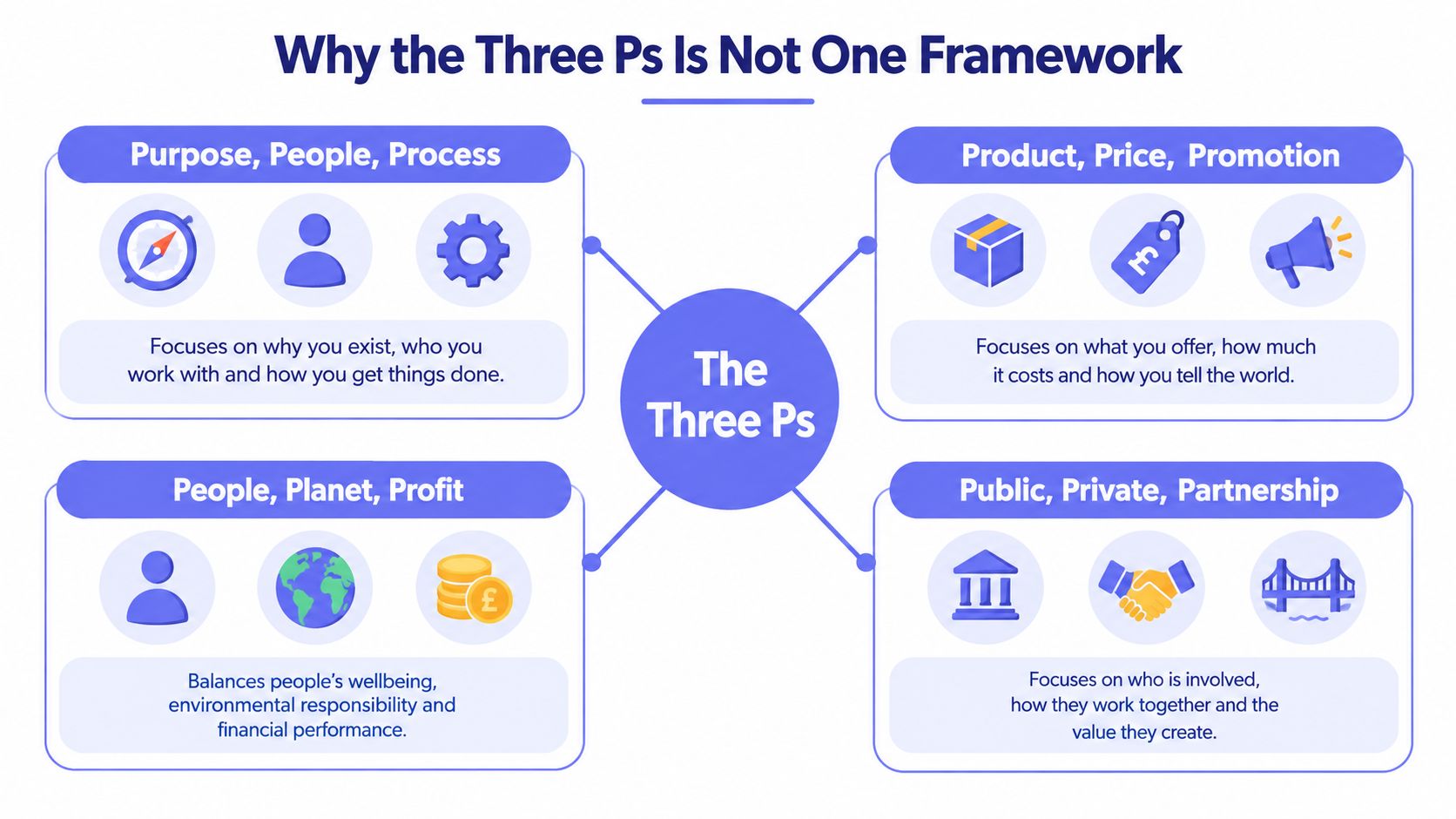
Why the Three Ps Is Not One Framework
The popular advice assumes that “the three Ps” is a single framework with a settled meaning. It isn't. It's a label reused across strategy, marketing, sustainability, organisational design and public policy.
The four versions leaders most often encounter are:
- Purpose, People and Process, an execution model.
- Product, Process and People, an operating or service-delivery taxonomy.
- People, Planet and Profit, a sustainability and stakeholder model.
- People, Process and Platform, a transformation model linking capability, ways of working and technology.
Those aren't interchangeable. They answer different questions. A leadership team that confuses them can spend a quarter debating terminology while its actual delivery problem remains untouched.
What each version is really for
Purpose, People and Process asks whether the organisation knows what matters, has the capability and authority to act, and uses a repeatable rhythm to convert work into outcomes.
Product, Process and People usually helps teams understand how an offering is created and delivered. It's useful for diagnosing operational friction, but it doesn't automatically set strategic priorities or create accountability for business outcomes.
People, Planet and Profit frames the relationship between social, environmental and commercial value. It can improve decision quality, but only when leaders translate each ambition into owned measures and explicit trade-offs.
People, Process and Platform is a transformation lens. It reminds leaders that technology depends on capable people and workable processes. It doesn't, by itself, decide which outcomes deserve attention first.
A useful comparison is the difference between a coaching philosophy and a delivery system. Resources such as Coachful's coaching model overview show how named models can organise conversations and development. That doesn't mean a coaching model will fix a leadership team's weak prioritisation.
Framework-shopping is often a symptom. When leaders keep searching for the perfect three-P definition, they may be avoiding a harder question: which outcomes must change, who owns them, and what will happen when progress stalls?
Start with that question. Then use a practical goal-setting framework to connect strategy to a limited set of measurable commitments.
Comparing the Four Three-P Models
The right model depends on the problem in front of you. A sustainability leader needs a different lens from a chief operating officer dealing with broken handoffs. A product director may need to redesign the operating flow, while a chief executive needs to align the organisation around a few outcomes.
The mistake is treating every model as if it has equal execution value.
| Model | Sets priorities | Assigns owners | Measures outcomes | Builds review cadence |
|---|---|---|---|---|
| Purpose, People and Process | Strong | Strong | Strong | Strong |
| Product, Process and People | Partial | Partial | Partial | Weak |
| People, Planet and Profit | Partial | Weak unless designed explicitly | Partial | Weak unless governed |
| People, Process and Platform | Partial | Partial | Partial | Partial |
Purpose, People and Process
This is the strongest choice when the problem is misalignment, slow execution or unclear accountability. Purpose filters competing work. People defines capability, decision rights and ownership. Process creates the cadence that exposes progress and forces decisions.
It doesn't solve everything automatically. Leaders still need to define outcomes, select measures and remove work that no longer matters. But the model contains the ingredients of delivery.
Product, Process and People
This version is useful when an organisation needs to understand how value moves from idea to customer. It can reveal defects, unnecessary steps, poor handoffs and capability gaps.
It becomes weak at the strategic level. A team may improve the process for producing the wrong product, or optimise delivery without knowing which customer or commercial outcome matters most. It describes the operating chain, but it doesn't necessarily govern the portfolio.
People, Planet and Profit
This framework is valuable because leaders should not treat sustainability as a decorative statement. UK CEO data reports that only 38% use data and impact measurement to communicate sustainability outcomes, while just 29% quantify sustainability risks or opportunities in financial terms, according to KPMG's UK CEO Outlook.
That evidence points to a governance problem. Without measures, owners and trade-off rules, the three Ps become three ambitions competing for attention.
People, Process and Platform
This model is useful for digital transformation. The ONS found that 88% of firms in the top decile of management-practice scores had adopted at least one advanced technology, compared with 51% in the bottom decile in 2023. The ONS analysis of management practices and technology adoption supports a blunt conclusion: a platform won't rescue unclear ownership or weak management routines.
Use this model to sequence transformation. Don't use it as a substitute for prioritisation.
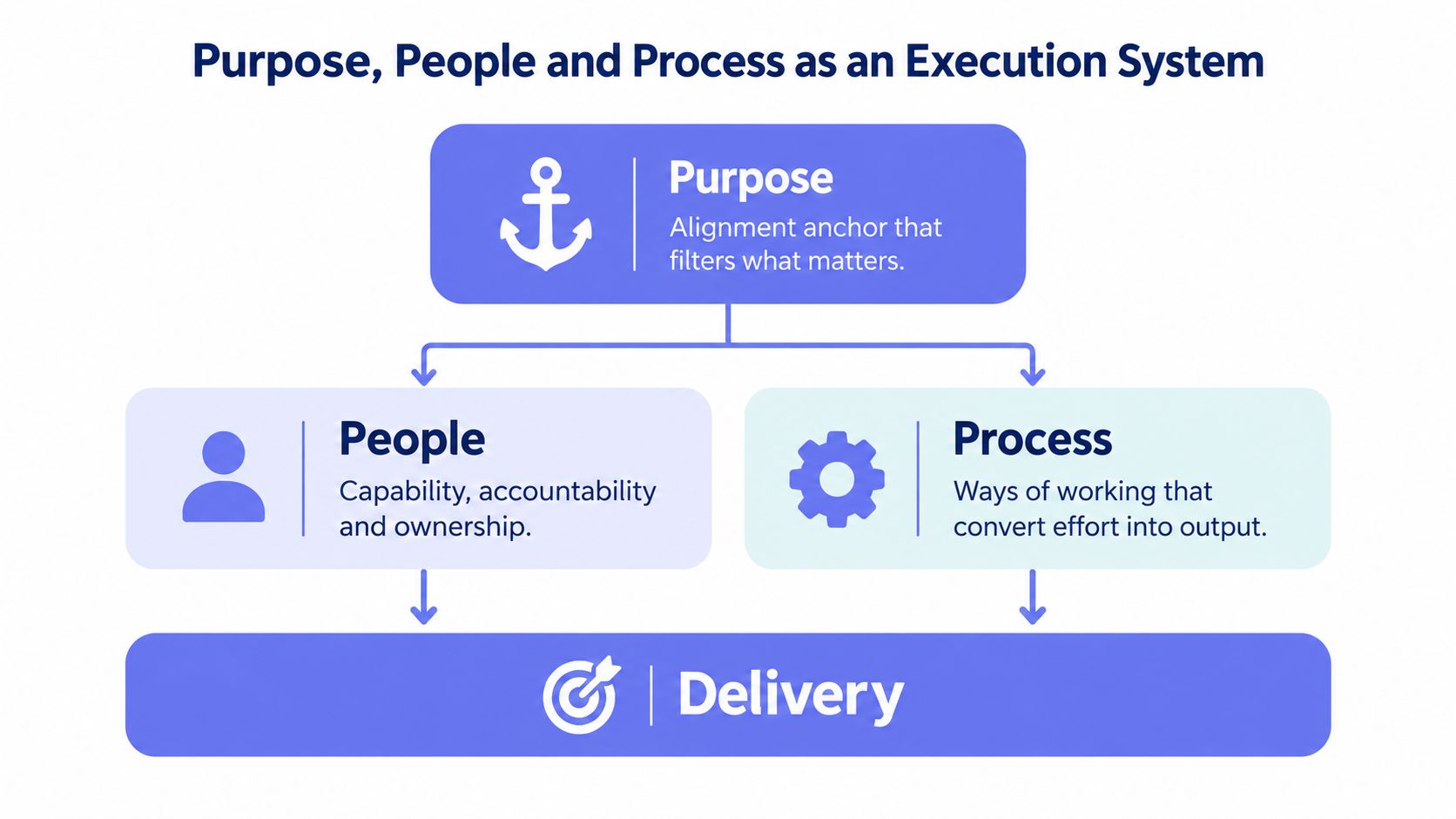
Purpose, People and Process as an Execution System
Purpose is the filter. It tells leaders which work deserves funding, attention and protection when resources are tight. Without it, every function can defend its own priorities, and the organisation ends up with a long list of reasonable initiatives that cannot all be delivered.
People turn intent into decisions. This means more than having talented employees. Each priority needs a named owner, clear decision rights and enough capacity to act. If everyone is responsible, nobody is accountable when a dependency fails.
Process turns effort into repeatable progress. A process isn't a document stored in a shared drive. It is the meeting rhythm, review discipline, escalation route and decision habit that keeps work moving.
Why the three Ps must be sequenced
Purpose without People creates inspirational slides with no delivery owner. People without Process creates capable individuals working through inconsistent priorities and informal escalation. Process without Purpose creates efficient activity that may not improve the business.
The sequence matters:
- Clarify Purpose. State the strategic outcomes that matter now and what won't receive attention.
- Configure People. Assign ownership, decision rights and the capabilities required.
- Install Process. Set the review cadence, evidence standards and escalation rules.
- Measure Delivery. Track outcomes and leading indicators, not just completed tasks.
OKRs are the connective layer. A strong Objective makes Purpose legible to teams. Key Results give People a shared definition of progress. The review cycle makes Process visible through regular decisions, not retrospective storytelling.
This is why I don't treat OKRs as a goal-writing exercise. They should change what teams discuss, stop and fund. A leadership team that writes excellent Key Results but keeps every existing initiative hasn't changed its operating system.
Make the process executable
The practical test is whether someone outside the leadership meeting can explain what happens next. Who updates the measure? Who reviews it? What triggers escalation? Which decision follows a red result?
For teams documenting repeatable work, an SOP documentation blueprint for SaaS can provide useful structure. The document matters only when it supports a live operating habit.
The four dimensions of execution offer a useful way to pressure-test the system. Purpose, People and Process should reinforce one another, not sit in separate transformation workstreams.
Practical rule: If a priority has no owner, no measure and no review date, it isn't a priority. It is a preference.
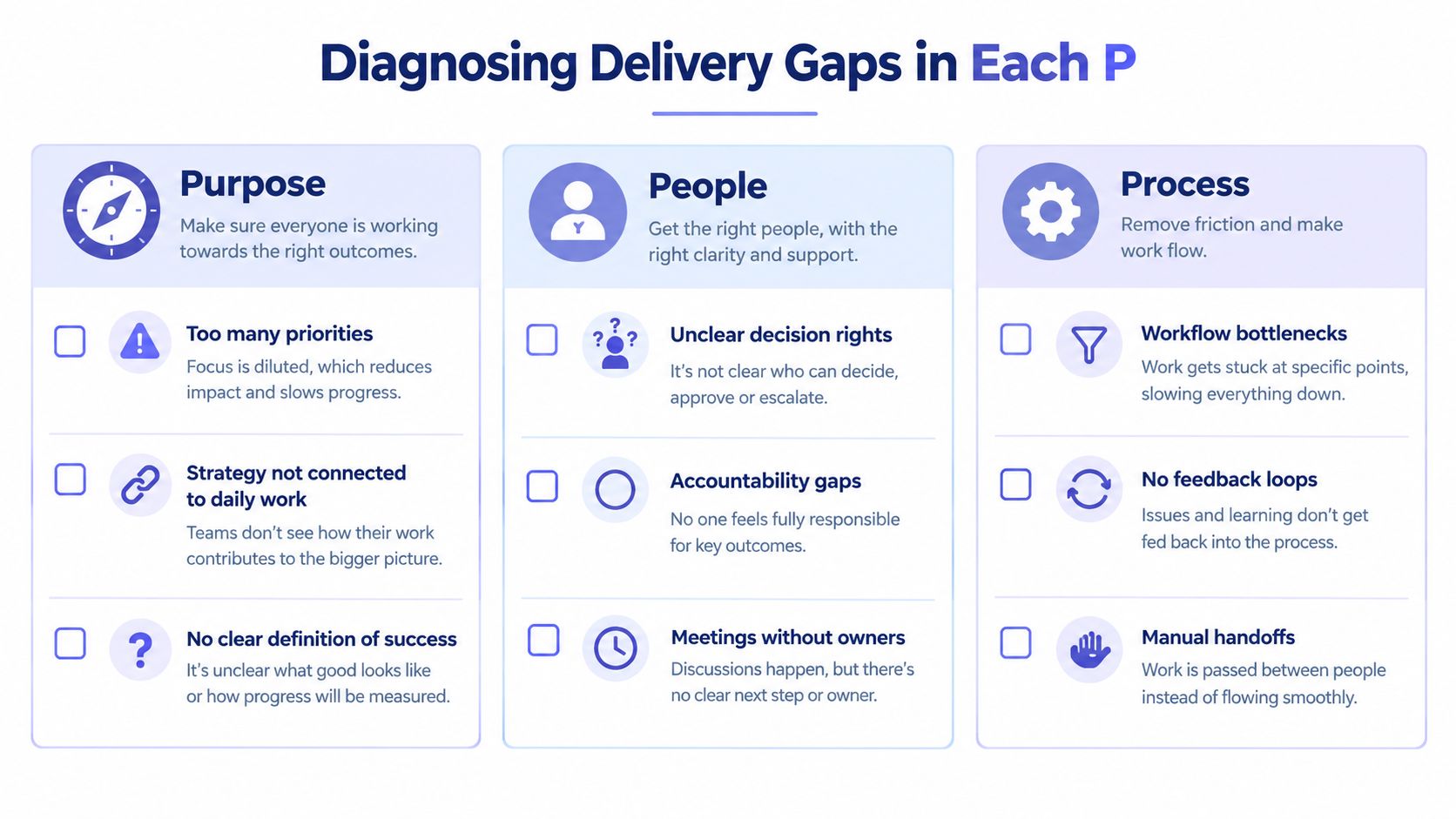
Diagnosing Delivery Gaps in Each P
You can diagnose most three-P failures in a single leadership meeting. Don't start with a new platform or a rewritten strategy. Look at the evidence already visible in the organisation.
Purpose failures
Purpose is breaking when the organisation has too many priorities, teams can't connect strategy to daily work, or leaders use different definitions of success.
Run three checks:
- Priority check: Ask every executive to name the organisation's most important outcomes without looking at a slide. Compare the answers.
- Line-of-sight check: Ask a team leader which current work directly supports those outcomes. Notice how much work has no clear connection.
- Success check: Take a live initiative and ask what evidence would show that it is working. If the answer is a list of activities, the outcome is undefined.
UK productivity evidence makes this more than a planning annoyance. Parliamentary analysis found that the economy increasingly relied on more hours worked rather than producing more output per hour after the financial crisis. Leaders should therefore challenge activity that doesn't improve value delivered.
People failures
People is breaking when decision rights are unclear, accountability disappears between meetings, or capable employees spend their energy navigating friction.
Ask:
- Decision check: Identify a recent delayed decision. Who had authority to make it? If the answer requires several names, the decision right is probably unclear.
- Ownership check: Select one underperforming Key Result. Ask who owns the outcome, not who has tasks connected to it.
- Capacity check: Ask what work the owner will stop to create room for the priority.
The capacity question deserves direct attention. The CIPD Good Work Index found that only 28% of employees in its North of England sample said they were always or often full of energy at work, unchanged from the previous year and below the 33% recorded in 2019, as reported in the CIPD's North of England Good Work Index. Adding another objective to an exhausted team isn't ambition. It's poor portfolio management.
Process failures
Process is breaking when meetings produce updates but no decisions, dashboards aren't trusted, handoffs create queues, or teams discover problems only at the end of a quarter.
Use a simple test:
- Pick one stalled priority.
- Trace its last three review points.
- Record what information was available, what decision was made and who followed up.
- Identify the point where the work became invisible.
The performance diagnostics approach helps turn those observations into a structured intervention. The aim isn't to create more reporting. It's to make the existing work legible enough for leaders to act.
Two Leadership Teams, Two Different Outcomes
The first leadership team has a clear strategy deck. It contains growth priorities, customer commitments and an operating plan. Every function supports the direction in principle.
The trouble starts after the offsite. Sales launches several campaigns. Product starts multiple improvements. Operations takes on urgent requests from every executive. The weekly meeting becomes a tour of updates. Nobody can say which outcome has slipped because the team measures activity, not progress.
At quarter-end, leaders blame dependencies and capacity. The same initiatives roll forward. Accountability evaporates because no one agreed what would stop when a higher-priority demand arrived.
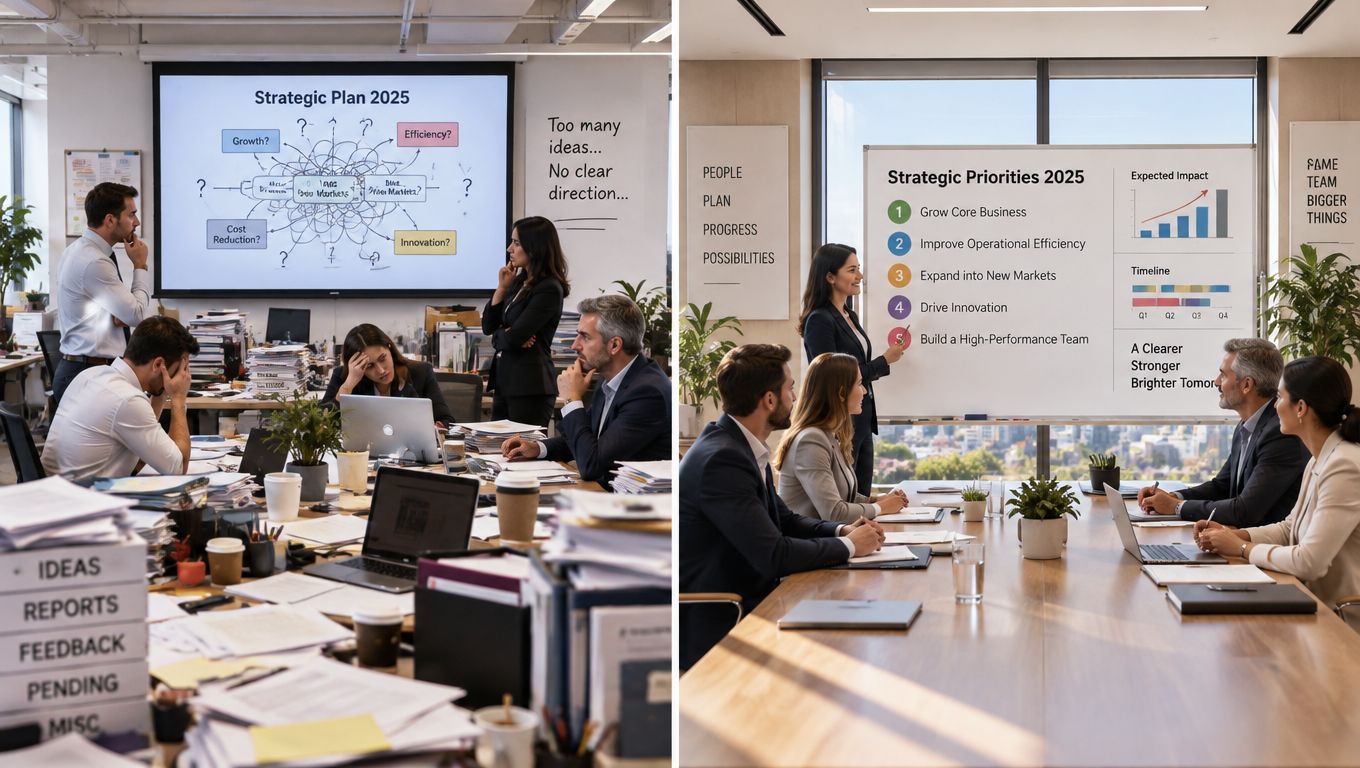
The second team makes a different choice. It selects a small number of outcomes for the quarter, assigns one accountable owner to each, and identifies the leading indicators that should move before the final result appears.
The weekly meeting doesn't ask every department for a status report. It asks three questions:
- What changed in the evidence?
- What is blocking progress?
- What decision or intervention is required?
The team also revisits priorities during the quarter. If a new demand matters more, leaders make the trade-off visible and remove something else. That behaviour matters more than the wording of the OKRs.
The difference under pressure
When a major customer issue appears, the first team adds meetings and asks people to work harder. The second team checks the agreed outcomes, assigns the response to an owner and decides which existing commitment changes.
Senior leaders sometimes try to repair the first pattern with an offsite designed around trust, communication or team building for senior teams. Those interventions can help relationships. They won't replace ownership and review discipline.
Leadership coaching can reinforce the right behaviours, especially when executives avoid difficult trade-offs. A focused leadership team coaching approach becomes useful when the team is willing to change how it makes decisions, not just how it talks about them.
Running OKR Focus Flow to Fix the Three Ps
A quarter is long enough to install a working execution rhythm if leaders resist the urge to redesign everything. I use the OKR Focus Flow as a sequence: diagnose, design, deploy and develop.
Diagnose before writing objectives
Start by identifying which P is failing.
- If teams disagree on what matters, diagnose Purpose.
- If decisions stall or ownership is blurred, diagnose People.
- If work disappears between meetings, diagnose Process.
- If all three symptoms appear, start with Purpose and People before introducing more tooling.
Review live work, not hypothetical examples. Select a stalled priority, trace its ownership and inspect the evidence used in leadership meetings. The output should be a short list of failure points, not a long maturity assessment.
Design the smallest workable system
Choose a limited set of outcomes for the quarter. For each one, define:
- One accountable owner.
- A measurable Key Result.
- A leading indicator.
- The decisions and dependencies that could block progress.
- The work that will stop or reduce to create capacity.
Don't give every function a separate objective to create balance. That produces administrative completeness and strategic confusion.
Deploy into the operating rhythm
Set a weekly progress review with a fixed agenda. Discuss movement in the measures, risks, decisions and interventions. Keep task detail in the team workflow. The leadership meeting should focus on outcomes and trade-offs.
Make escalation explicit. A red result should trigger a hypothesis and an action, not a defensive explanation. If the same blocker appears repeatedly, the owner needs a decision from someone with authority.
Hybrid working makes this discipline more important. Evidence submitted to Parliament found that 75% of 2,018 UK employers had hybrid working in place, while 38% said increased home or hybrid working had improved productivity or efficiency and 13% said it had reduced it, according to the parliamentary evidence on hybrid working. Distributed teams need reliable coordination. They don't need more status theatre.
Develop internal capability
By the end of the quarter, leaders should be able to run the system without external support. Train owners to update evidence, managers to challenge assumptions and executives to make trade-offs.
The OKR Focus Flow is most useful when it builds those habits into the organisation. The objective isn't a completed implementation. It's a leadership team that can see weak execution early and respond before the quarter is lost.
Treating the Three Ps as One System
The value of the three Ps isn't finding the cleverest combination of words. It is treating Purpose, People and Process as a reinforcing system.
Test every priority against four questions:
- Does it have one named owner?
- Does it have a measurable leading indicator?
- Is there a documented escalation path?
- Is there a review cadence that turns information into action?
If the answer is no, fix the operating condition before asking teams for more effort. UK management-practice data found that the average ONS score was 0.55 on a 0-to-1 scale, and firms below the median were four times more likely to use little or no analysis for business decisions, according to the ONS bulletin on management practices. Better execution starts with better management routines.
I help leadership teams turn strategy into owned, measurable delivery by diagnosing where Purpose, People or Process is breaking, then installing an operating rhythm that teams can run themselves. If your organisation is busy but not moving, book a conversation.