
In 2022, 70.9% of UK workers were employed by firms below the overall labour productivity mean, while workers at the 90th percentile produced 3.59 times as much output as workers at the median. The difference isn't effort alone. It's execution design.
That gap should change how leaders talk about strategy. Most organisations don't fail because executives chose an impossible destination. They fail because priorities get diluted, decisions stall, capabilities don't match the plan, and nobody has a reliable mechanism for correcting course.
I've watched strong strategies die in implementation rooms. The documents were polished. The town halls were energetic. The objectives sounded ambitious. Then teams returned to competing priorities, unclear ownership, overloaded roadmaps, and meetings that reported activity instead of confronting slippage.
The four dimensions of execution provide a better diagnostic: strategic clarity and alignment, prioritisation and portfolio control, capability and capacity, and governance and cadence. Treat them as an operating system, not a checklist. If one is broken, better-written OKRs won't rescue the strategy.
Why Most Strategies Fail Before They Start
The UK productivity figures expose an uncomfortable truth. In 2022, 70.9% of UK workers were employed by firms whose labour productivity was below the overall mean, and workers in businesses at the 90th percentile produced 3.59 times as much output as workers in firms at the median. The 90th-to-median ratio was unchanged from the previous year, so this wasn't a temporary dip or an isolated bad quarter. It points to persistent differences in how firms turn effort into results. The Office for National Statistics productivity analysis gives leaders a useful starting point: execution is a measurable management discipline.
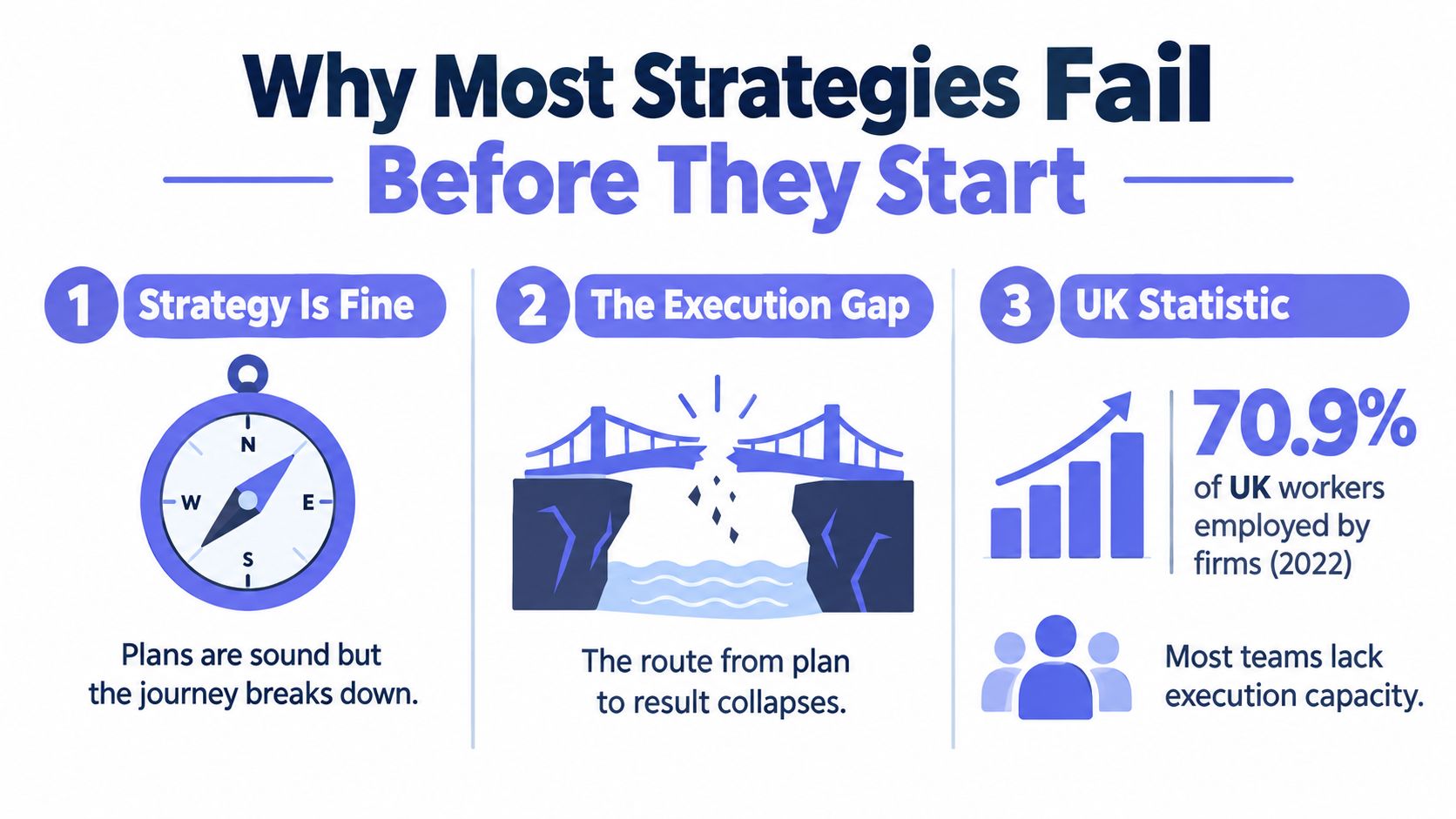
I don't accept the usual explanation that people just need more motivation. Motivation matters, but it can't compensate for a system that sends three functions towards different outcomes. A product leader may be measured on adoption, sales on bookings, operations on cost, and finance on predictability. Each team can work hard while the enterprise moves sideways.
The execution gap is structural
The four dimensions expose where the system breaks:
- Strategic clarity and alignment: People understand the outcome, the contribution expected from their function, and the decisions they can make.
- Prioritisation and portfolio control: Leaders concentrate scarce money, talent, and attention on the work that matters most, while explicitly stopping lower-value work.
- Capability and capacity: Teams have the skills, workflows, decision rights, and available capacity needed to deliver the plan.
- Governance and cadence: Leaders inspect evidence, resolve constraints, and change course before missed outcomes become permanent.
A strategy can be directionally right and still produce poor results when these dimensions are weak. That's why I recommend reading this guide on leading through uncertainty alongside any strategy review. Fear and uncertainty often make leaders tighten control in the wrong places, delay difficult decisions, and confuse more reporting with better execution.
Practical rule: Stop asking whether teams are committed to the strategy. Ask which operating mechanism currently prevents delivery.
Start with a blunt diagnostic. Can every major outcome be traced to an accountable owner? Can leaders identify the work that has been deliberately excluded? Can teams explain which dependency is blocking progress? Do review meetings trigger decisions, or merely collect status updates?
If the answer is no, rewriting the strategy won't solve the problem. The more useful question is why strategy execution fails, then fixing the specific mechanism responsible.
Dimension One Strategic Clarity and Alignment
Strategic clarity isn't a mission statement. It isn't agreement in a leadership off-site. It exists when people can connect an enterprise outcome to the resources, capabilities, dependencies, and decisions required to produce it.
The Productivity Institute makes this point through its research on digital investment. Productivity gains from digital investment depend on alignment across business models, processes, incentives, decision rights, and the organisational chain. Its research programme on firms shows why buying technology rarely creates value by itself. If processes stay unchanged, incentives reward old behaviour, and decision rights remain unclear, the organisation adds activity without improving the result.
Turn alignment into a visible map
I use a simple test with leadership teams. Select a small number of strategic outcomes and create a one-page map for each. The map should show:
- The outcome: What business result must change?
- The accountable executive: Who owns the result, not merely a workstream?
- The contributing functions: Which teams must change behaviour or provide capability?
- The leading indicators: What evidence will show movement before the final outcome arrives?
- The unresolved decisions: Which choices, dependencies, or trade-offs could block delivery?
Review the map monthly. Don't turn it into a presentation exercise. Use it to expose conflicting priorities, missing capability, and decisions that have been sitting in limbo.
This is particularly important when marketing promises demand that production can't fulfil, or when operations optimises efficiency while commercial teams need flexibility. Leaders working through the relationship between supply and demand may find this perspective on aligning production and marketing useful because alignment must connect functions that experience the same business outcome from different angles.
Cascading goals isn't alignment
A common failure starts with a sensible enterprise objective. Each function then writes locally coherent goals. Finance protects margin. Product increases usage. Sales expands pipeline. Customer service reduces handling time. The objectives look professional, but the incentives and dependencies pull in different directions.
Alignment exists only when each commitment has an explicit contribution path to the enterprise result. A team shouldn't have to guess whether its work matters or which constraint takes precedence when priorities collide.
Clarity test: If an accountable owner can't explain the contribution path, the organisation has written goals, not created alignment.
Use OKRs to make that path visible. An objective should state the strategic outcome. Key results should show measurable movement towards it. The leadership team must also define what happens when two functions need the same scarce capability or when a local target conflicts with enterprise value.
For a deeper diagnostic, understand strategic alignment as an operating discipline, not a communications campaign. Clarity is the first dimension because every later decision depends on aiming at the right result.
Dimension Two Prioritisation and Portfolio Control
Alignment is useless when everything remains a priority. I call this portfolio blindness. Leaders approve initiatives one at a time, each with a plausible business case, then act surprised when the combined portfolio exceeds available capacity.
The UK infrastructure record shows the cost of that behaviour. Between 2015 and 2024, only 59% of planned UK infrastructure spending materialised, leaving a £163 billion shortfall. On the Transpennine Route Upgrade, delayed decisions about scope changes led to approximately £190 million being spent on work that was ultimately not used. The evidence is set out in this analysis of UK project delivery.
That isn't a problem of enthusiasm. It is a portfolio-control failure. Work continued while the decision that should have redirected it remained unresolved.
Every priority needs an exclusion
A credible priority answers four questions:
- What outcome receives protected capacity?
- Which initiatives contribute directly to it?
- What work will stop, slow, or remain unfunded?
- Who can approve a change when new information appears?
Most leadership teams answer only the first two. They publish a long list of commitments and call it focus. The list becomes a political compromise, not a delivery instrument.
A founder deciding between product reliability, market expansion, and hiring faces the same problem as a large infrastructure portfolio. Strategic resource allocation for startups is useful here because constrained organisations can't hide poor choices behind layers of governance. They feel every misplaced pound and every diverted person.
Use OKRs to make trade-offs explicit
An OKR system should force the portfolio conversation into the open. Link funded initiatives to measurable outcomes. When an initiative has no clear contribution, challenge it. When two initiatives depend on the same team, expose the conflict before both plans claim the capacity.
I recommend a portfolio review that asks:
- Which outcome has the greatest strategic consequence?
- Which work is consuming capacity without moving a key result?
- Which dependency needs an executive decision?
- What should stop if a new commitment is approved?
Leaders must be willing to kill attractive projects. A project can have a capable sponsor, enthusiastic users, and sound technical work yet still be the wrong use of capacity now.
Portfolio rule: No new priority enters the system without naming the work it displaces.
Prioritising with OKRs means converting strategy into explicit choices, not adding another layer of labels to an already overloaded plan. If the OKRs don't create a meaningful “no”, they aren't controlling the portfolio.
Dimension Three Capability and Capacity
Execution capacity isn't the same as AI adoption. A new tool can increase output, but it can also increase hand-offs, review work, decision load, and confusion.
UK evidence makes the risk difficult to ignore. 44% of UK employees using AI reported heavier workloads and 45% said their roles had become more complex, while 77% of AI-using businesses reported that less than half their staff use the technology. These figures come from the UK government's AI adoption research.
That combination creates a dangerous illusion. Leaders see a tool in use and assume the operating model has improved. Employees may experience the opposite. A small group uses AI intensively, colleagues receive new outputs to check, managers create additional controls, and nobody redesigns the workflow from beginning to end.

Separate tool adoption from operating-model adoption
When a leadership team introduces AI, automation, or a new platform, I ask questions that most implementation plans omit:
- Cycle time: Does the work reach a decision or customer faster?
- Hand-offs: Has anyone removed a transfer between functions?
- Rework: Are errors, duplicate tasks, and revisions falling?
- Decision latency: Can the authorised person decide without unnecessary escalation?
- Workload: Has the new capability reduced work, or redistributed it invisibly?
Usage is not proof of execution improvement. A team can use ChatGPT, Microsoft Copilot, Salesforce, Jira, or a workflow platform every day and still deliver slowly if the underlying approval chain remains intact.
Capacity is a leadership choice
Leaders often describe capacity as if it were a fixed fact. It isn't. Capacity changes when priorities change, when decision rights move closer to the work, when redundant approvals disappear, and when teams stop maintaining initiatives that no longer matter.
Capability also includes management skill. A team may possess the technical expertise but lack the ability to prioritise, escalate, or make trade-offs across functions. Training alone won't fix that. People need authority, usable processes, and time protected for the work that matters.
Capacity test: If a new capability creates more work before it removes work, treat it as an operating-model change, not a productivity win.
For each major capability investment, assign an owner for the process change. Define the baseline, identify the constraint, and inspect whether the intervention changed throughput or decision speed. If nobody owns that verification, the organisation is measuring adoption theatre.
Dimension Four Governance and Cadence
Leaders often treat governance as administration. That mistake kills execution. Governance is the mechanism that converts a stated priority into repeated decisions, visible evidence, and timely intervention.
The ONS reported an overall UK management-practice mean score of 0.57 in 2023 on a 0-to-1 scale. Its evidence covers practices such as continuous improvement and the use of key performance indicators. A 0.1-point increase in management-practice scores was associated with a 9.6% increase in productivity. The ONS management-practices analysis supports a point many leaders still resist: management routines are a performance lever, not bureaucratic overhead.
Build a control loop
A quarterly planning event can't manage a fast-moving execution system. It creates commitments, then leaves teams alone with the consequences. By the time leaders review the final result, the constraint may have existed for months.
A working control loop does six things:
- Define the intended outcome.
- Measure leading and lagging indicators.
- Compare actual performance with the target.
- Identify the constraint.
- Decide an intervention.
- Check whether the intervention changed the result.
The review must distinguish outcome variance from activity variance. Customer adoption below target is an outcome signal. Completed development tickets are an activity signal. More tickets don't prove that customers adopted the product.
Set a rhythm people can use
I recommend three layers of operating cadence:
- Weekly team checks: Review progress, blockers, confidence, and immediate trade-offs.
- Monthly cross-functional reviews: Resolve dependencies, shift resources, and assign decisions.
- Quarterly reprioritisation: Reassess the portfolio using evidence, not political momentum.
Each meeting needs a decision owner. Each corrective action needs a named person and a date. A dashboard that shows red without triggering action is decoration.
Governance principle: Don't ask teams to report a problem unless the meeting has the authority and discipline to resolve it.
Operating rhythms should also protect time for improvement work. UK public-sector evidence has noted that day-to-day workload can make administrative and improvement activity difficult to reserve. Leaders who fill every calendar with delivery work leave no space to improve the system producing that work.
Operating rhythm is where accountability becomes behaviour. Without a predictable cadence, OKRs become a static document. With one, they become evidence for decisions.
Applying the OKR Focus Flow Diagnostic
Most organisations respond to execution problems by running another OKR workshop. That's like painting the ceiling while the roof is leaking. The first task isn't better wording. It's identifying which part of the operating system is failing.
I use the OKR Focus Flow as a diagnostic sequence. Start with the four dimensions, then test each one against observable evidence.
Start with the constraint
Ask the leadership team to answer these questions without preparing a presentation:
- Clarity: Can people state the enterprise outcomes and explain how their work contributes?
- Prioritisation: Which active initiatives would stop if capacity became tighter?
- Capability: What workflow, skill, or decision right prevents the next result?
- Cadence: When will leaders see slippage, and what action will the evidence trigger?
The weakest answer identifies the likely constraint. Don't fix all four dimensions at once. That creates another transformation portfolio with too many moving parts.
If clarity is weak, reduce the number of outcomes and map contribution paths. If prioritisation is weak, freeze new commitments and run a portfolio decision. If capability is weak, redesign the workflow and assign ownership for the change. If cadence is weak, establish a review rhythm with decision rights before asking teams to write new OKRs.
Apply a targeted intervention
A leadership team with too many objectives may need to simplify its OKR set. A product and sales organisation with recurring conflict may need explicit dependency rules and a weekly trade-off meeting. A business introducing AI may need to measure rework, workload, and decision latency before declaring a productivity gain.
The intervention should change behaviour, not just documentation. If a new template produces the same meetings, the same unresolved dependencies, and the same delayed decisions, nothing important has changed.
Use the OKR Focus Flow to structure the diagnosis and sequence the work. The point isn't to make every objective elegant. The point is to create a system where leaders can see what matters, decide what gets capacity, identify who owns the constraint, and intervene while there is still time to recover.
Make the system self-correcting
A healthy execution system produces uncomfortable evidence early. Teams surface missed assumptions. Executives make trade-offs in public. Owners escalate constraints before deadlines become emergencies. Review meetings change resource allocation instead of merely recording variance.
That's the standard I use. Better-written OKRs are useful only when they support better decisions. The true measure of progress is whether the organisation can repeatedly convert strategic intent into changed work and verified outcomes.
I help leadership teams diagnose the structural causes of slow, misaligned execution, then connect strategy to priorities, ownership, capability, and operating cadence. If your strategy is clear but delivery remains inconsistent, book a conversation.