Most leaders don't have a strategy problem. They have a weekly execution problem. The strategy is approved, communicated, and placed in a presentation. Then priorities compete, decisions wait for senior meetings, teams optimise locally, and nobody can explain why an important commitment slipped.
The popular advice is to communicate the vision more clearly, build a stronger culture, or motivate people to take ownership. Those actions can help, but they rarely fix the mechanical disconnect between strategic intent and the way work is managed. Organisational effectiveness consulting done properly redesigns the operating rhythm, not just the message.
The Real Reason Strategy Fails in Execution
Poor execution is often blamed on capability. A leadership team sees missed targets and concludes that people need more training, more urgency, or better resilience. That diagnosis is convenient because it places the problem inside individuals. It also avoids the harder question: what does the organisation currently make difficult, slow, or ambiguous?
The UK strategy execution research summary for 2025 offers a sobering benchmark. Only 18.4% of companies achieved more than 80% of their aspirational growth goals within three years, while 63% were pursuing aspirational growth. Just 46% had a clearly measurable value gap, which means many organisations were trying to grow without a sufficiently precise view of what was preventing delivery. The same research found that 69% of high-performing companies treated strategy execution as a core discipline. (2025 UK strategy execution research summary)
That pattern points to an operating failure, not only a motivation failure. Leaders set priorities, but don't define the decisions, measures, owners, and review points that should carry those priorities into the frontline. Teams then create their own interpretations. Product protects the roadmap. Sales protects the quarter. Operations protects stability. Each function can look reasonable while the organisation moves slowly.
Where the operating rhythm breaks
The breakdown usually appears in a few predictable places:
- Priorities: There are too many active initiatives, so teams treat everything as urgent.
- Ownership: A senior sponsor is named, but nobody owns the result at the level where the work happens.
- Decisions: Teams escalate routine trade-offs because decision rights were never made explicit.
- Reviews: Leadership meetings discuss activity and status, rather than outcomes, constraints, and corrective action.
- Learning: Risks surface late because people associate bad news with blame.
A useful diagnostic is to trace one strategic goal through a normal week. Who discusses it? Which team changes its work because of it? What measure shows progress? Which meeting reviews the measure? If the answer is unclear, the strategy hasn't reached the operating system.
Practical rule: If a strategic priority doesn't change what people discuss, decide, stop, or measure each week, it remains an aspiration.
External support can help because entrenched habits are difficult to challenge from inside the hierarchy. A neutral practitioner can map the gaps between executive intent, portfolio choices, team commitments, and management routines. The analysis in why strategy execution fails is useful for leaders who want to examine those failure points before choosing an intervention. For teams also considering the role of automation, the devPulse automation bridge insights provide a helpful perspective on connecting strategic priorities with digital process execution.
The objective isn't to make people work harder. It's to make delivery measurable, owned, and reviewable without requiring heroic intervention from the executive team.
What Organisational Effectiveness Consulting Actually Does
Organisational effectiveness consulting is often confused with facilitation, leadership training, or a strategy offsite. Those services have a place, but they don't automatically change how an organisation allocates resources or makes decisions. A polished workshop can create agreement for a day while the same conflicting incentives return on Monday morning.
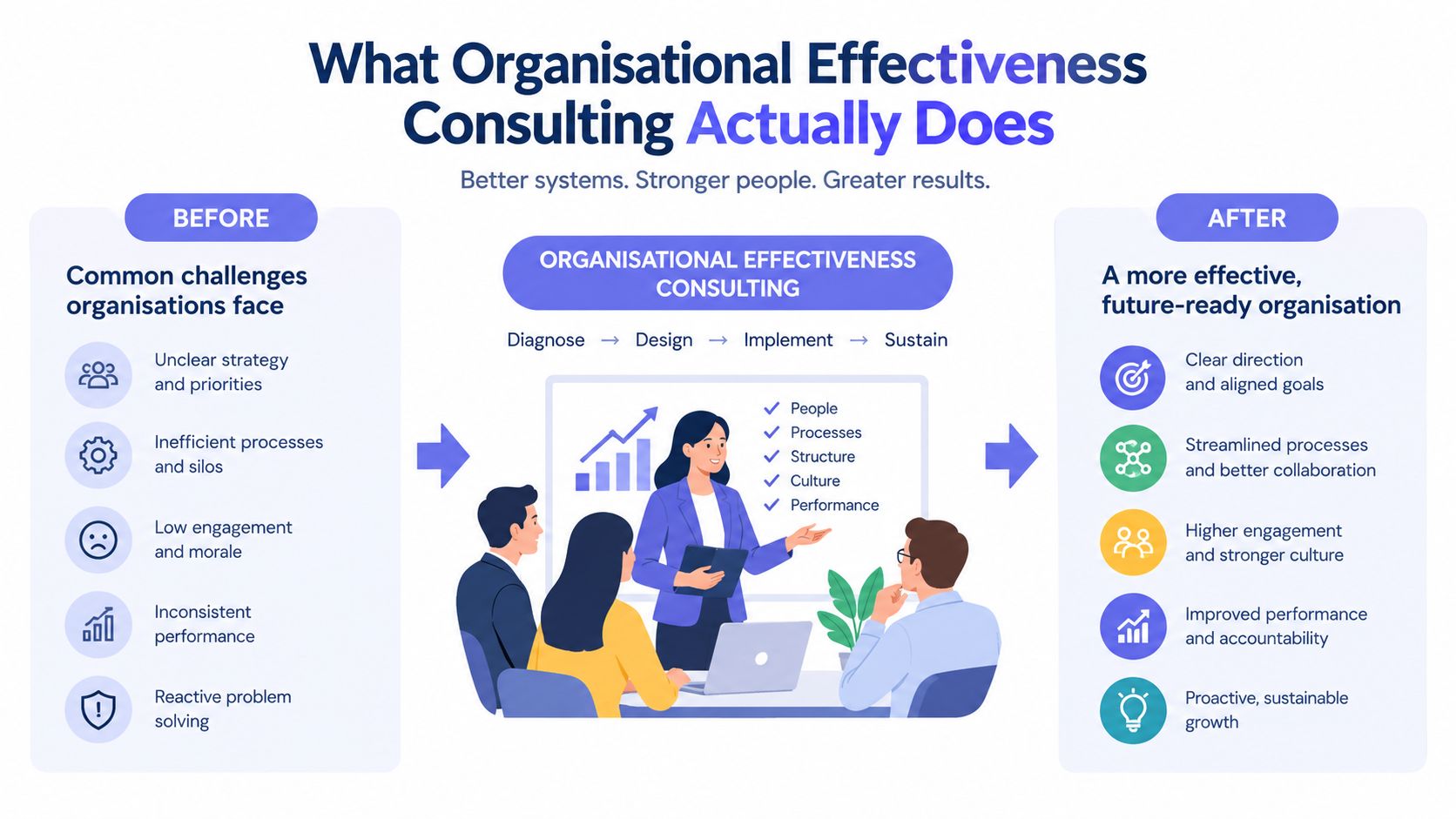
The practical work starts with the organisation as a system. The consultant examines how strategy is translated into plans, how plans become team commitments, how managers review progress, and how leaders respond when delivery falls behind. The output should be more than a report. It should include operating choices that people can use in real management situations.
The work beneath the jargon
A serious engagement normally combines four activities:
- Diagnosis: Interviews, working sessions, document review, and observation reveal where priorities, processes, and accountability diverge.
- Design: Leaders define the planning architecture, governance forums, decision rights, measures, and escalation routes needed for the business.
- Implementation: The new system is used in live meetings and active initiatives, rather than left as a recommendation.
- Capability transfer: Internal leaders learn to run the process, challenge weak commitments, and improve the system without permanent external support.
This is why training alone rarely solves execution problems. A manager can learn how to give better feedback, but still lack authority to resolve cross-functional dependencies. A team can learn project management, but still work against five competing executive priorities. An organisation can install a dashboard, but still fail to agree what the measures mean.
The difference between advisory and implementation is visible in the engagement design. A report-led consultant asks stakeholders for information, analyses it, and presents findings. A practitioner stays close enough to observe the next planning cycle, redesign the meeting, coach the chair, and test whether the new decisions produce different work.
What leaders should expect to receive
A credible scope should identify concrete outputs such as:
- A map of strategic priorities and their owners.
- A clear view of duplicated, conflicting, or unowned work.
- A decision and governance model that specifies which forum handles which issue.
- A management cadence for weekly, monthly, and quarterly reviews.
- Measures that show outcomes, not just completed tasks.
- Coaching and documentation that allow internal teams to sustain the approach.
The strategy execution consulting guidance is relevant here because it treats execution as an operating design challenge. The best engagements leave the organisation with stronger internal judgement. If every meaningful decision still requires the consultant, the intervention has created dependency rather than effectiveness.
Diagnosing the Execution Gap
Don't begin with an OKR template. Begin with evidence about where execution is failing. Most organisations already have enough plans, dashboards, and meeting invitations. The missing ingredient is often a disciplined diagnosis that separates a direction problem from a capacity problem or a governance problem.
Start at the top. Ask each executive to state the organisation's most important priorities without consulting the strategy document. Compare the answers. Differences matter, especially when every leader believes their own function is aligned. Then ask what the organisation will stop doing to create capacity. A priority without a trade-off is usually just an addition to the workload.
A practical diagnostic sequence
First, test strategic clarity. Can leaders describe the intended outcome in operational terms? “Become more customer-centric” won't guide a product decision. A useful outcome should help a team choose between competing actions and identify evidence of progress.
Next, trace the work. Select a small number of strategic commitments and follow them through annual planning, portfolio reviews, team plans, one-to-ones, and delivery meetings. Look for translation errors. The executive goal may be growth, while teams are measured on utilisation, activity, or local efficiency.
Then, inspect accountability. For each important result, identify the person who can influence it, the decisions they control, and the dependencies they need resolved. If the named owner can only report on progress but cannot change the conditions affecting the result, accountability is performative.
Finally, examine the management climate. Ask how quickly teams raise risks, what happens when a forecast changes, and whether managers distinguish a missed assumption from careless execution. People won't provide early warnings if leaders punish transparency. A safe environment doesn't remove accountability. It makes accountability earlier and more useful.
The performance diagnostics approach can help structure this review around evidence rather than anecdote. Use interviews to understand behaviour, but validate what people say against calendars, decision logs, planning documents, resource allocations, and actual review conversations.
Separate symptoms from causes
A stalled project may reflect unclear scope, but it may also reveal unresolved executive conflict. A team that misses commitments may be overloaded, or it may be waiting for a decision from another function. A dashboard with poor data may indicate weak ownership rather than a technology issue.
Create a simple cause map:
- Direction gap: People disagree about the outcome or its priority.
- Design gap: The organisation's structure, process, or governance creates friction.
- Capacity gap: Teams have more committed work than available attention.
- Capability gap: People lack the skills or experience required for the work.
- Behaviour gap: Leaders tolerate avoidance, late escalation, or repeated exceptions.
The diagnostic should end with a small number of root causes and a clear intervention hypothesis. If the findings produce a long catalogue of concerns, the team hasn't prioritised the problem. Effective consulting narrows attention to the few changes most likely to alter weekly behaviour.
Using OKRs to Engineer Accountability
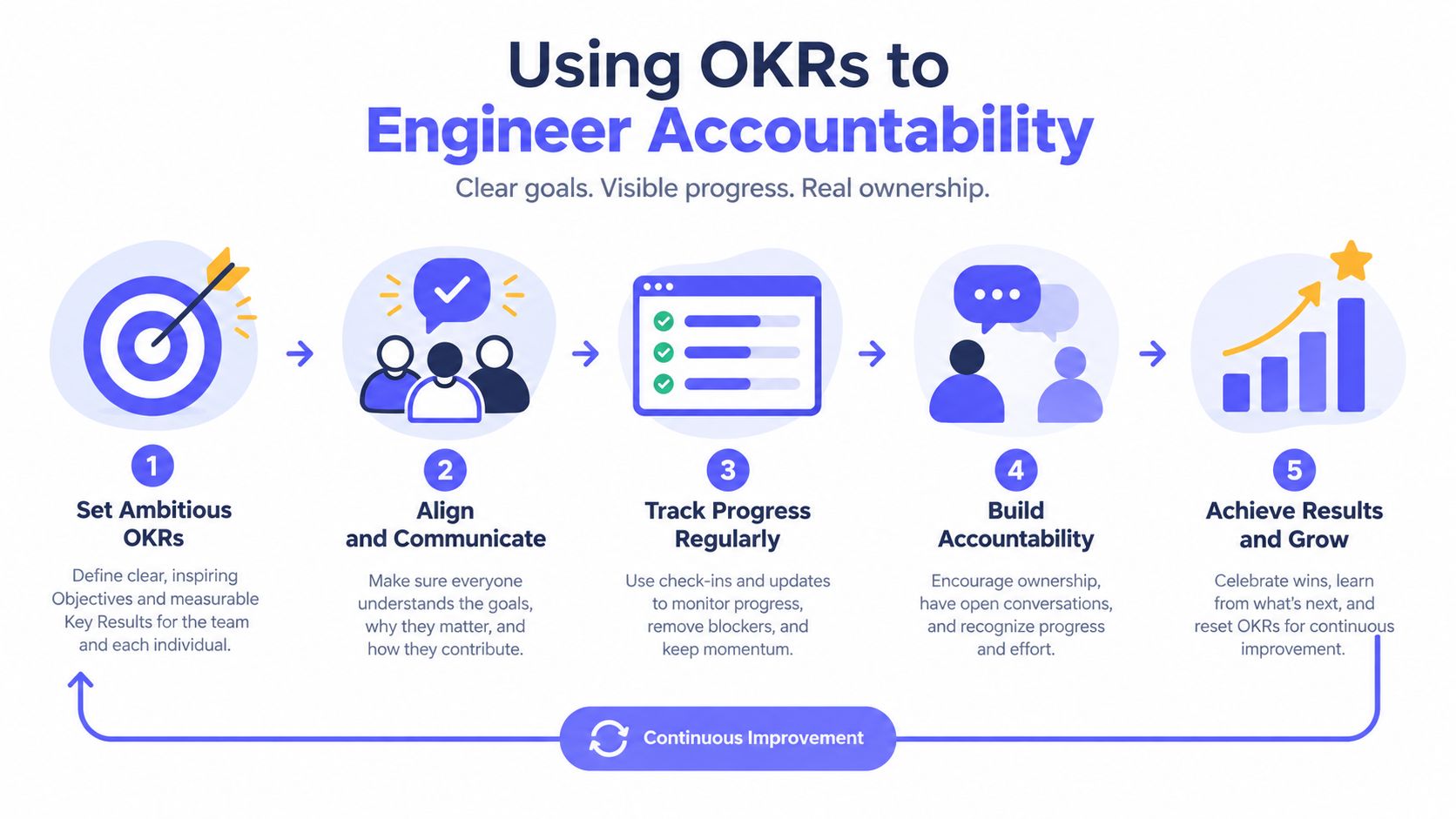
OKRs are commonly introduced as a goal-setting exercise. Teams write objectives, add key results, upload them to a platform, and wait for alignment to appear. It doesn't. OKRs create accountability only when they change prioritisation, resource decisions, and review behaviour.
An effective OKR system forces leaders to make choices that strategy documents often avoid. Which outcome matters most this cycle? What evidence would prove progress? Which work must stop? Which dependencies require an executive decision? Those questions create productive tension because they expose the cost of trying to do everything.
Design the system around decisions
Start with a limited set of company outcomes. Then translate them into team-level contributions without creating a rigid cascade where every lower-level result is merely a smaller copy of the executive goal. Teams should understand their contribution and retain enough autonomy to decide how to deliver it.
A strong OKR has three characteristics:
- The objective expresses a meaningful change, not a list of activities.
- The key results show evidence of that change, rather than recording effort.
- The owner has influence over the result, with visible support for dependencies outside their control.
For example, “launch the new onboarding workflow” describes an activity. A stronger formulation would focus on the customer or operational outcome the workflow is intended to produce. The exact measure depends on the business, but the test is consistent: could the team complete the activity while failing to create the intended value? If yes, the activity shouldn't be the key result.
Build the cadence before the software
The weekly review is where OKRs become operational. Each owner should report what changed, what is at risk, and what decision or support is required. The meeting shouldn't become a round-robin status update. It should expose constraints early enough for leaders to act.
A practical cadence includes:
- Weekly team review: Check movement, confidence, risks, and dependencies.
- Cross-functional review: Resolve conflicts that no single team can fix.
- Leadership review: Reallocate attention, funding, or authority when assumptions change.
- Quarterly reflection: Assess outcomes, learn from misses, and decide what continues.
Use the OKR accountability framework to sharpen the connection between ownership and review. Accountability isn't achieved by assigning a name to every metric. It requires a clear expectation that owners will surface reality, leaders will make decisions, and teams will adjust work when evidence changes.
The strongest OKR systems make avoidance visible. They don't make failure impossible.
Keep performance evaluation separate from experimental target-setting where appropriate. If every ambitious OKR affects compensation directly, people will protect their score rather than expose uncertainty. That doesn't mean OKRs should be soft. It means leaders should distinguish commitment, learning, and controllable delivery when interpreting results.
The final test is behavioural. After implementation, do leaders cancel low-value work faster? Do teams escalate dependencies earlier? Do quarterly conversations focus on outcomes rather than presentation quality? If not, the organisation has created an OKR administration process, not an execution engine.
Choosing the Right Consulting Partner
The consulting model you choose will shape the result. A strategy firm can bring useful analysis. A specialist facilitator can improve alignment in a difficult meeting. An implementation partner can help redesign governance and embed new routines. Problems arise when leaders hire one model while expecting another.
The first question isn't “Have you implemented OKRs before?” It's “What will you change when the organisation's current habits conflict with the framework?” Ask for a clear description of the diagnostic process, the leadership involvement required, and the behaviours the engagement is designed to change.
Compare the engagement models
| Model Type | Focus Area | Long-Term Outcome |
|---|---|---|
| Advisory report | Analysis, recommendations, and future-state design | Leaders receive direction, but internal teams must translate it into practice |
| Workshop-led intervention | Alignment sessions, training, and facilitated planning | Shared language may improve, but operating habits can remain unchanged |
| Embedded implementation | Live planning, governance redesign, coaching, and review support | New routines are tested in real work and adapted before handover |
| Capability-transfer partnership | Implementation combined with internal coaching and ownership | Internal leaders can run, inspect, and improve the system independently |
A low-cost workshop can be the right choice when the problem is narrow and the leadership team already has strong execution discipline. It's the wrong choice when priorities conflict, decisions are slow, and managers lack a shared operating rhythm. Conversely, a long embedded engagement can waste money if the organisation hasn't agreed what problem it needs to solve.
The history of consulting expenditure in the English NHS reinforces the need for discipline. A University of Bristol review found a statistically significant positive relationship between consulting expenditure and organisational inefficiency across a four-year dataset of acute care hospital trusts. On average, every £100,000 spent on management consultants was associated with a drop of around 0.1 points in the Research Capability Index and an increase of roughly £880 in total costs, while higher spending wasn't statistically associated with efficiency gains. (University of Bristol review of management consulting in the English NHS)
Questions worth asking before appointment
- What will you measure before changing anything? Look for baseline evidence, not broad promises.
- Who will do the work? Senior consultants should be involved in diagnosis and implementation, not only sales.
- How will capability transfer happen? Ask who will chair reviews, coach managers, and maintain the system after handover.
- What happens when leaders disagree? The partner should have a method for resolving priority and ownership conflicts.
- What will you stop doing? A credible plan addresses capacity, not just process.
- How will we know the engagement is complete? The exit criteria should describe internal competence and operating behaviour.
Cost matters, but dependency costs more. The practical discussion in OKR consulting cost can help leaders assess fees against scope, intensity, and the capability they expect to retain.
Real-World Transformation in Scale-Ups
Consider a representative scale-up that has moved beyond founder-led coordination. Product, sales, customer success, and operations all agree that growth depends on improving the customer journey. Yet product delivery stalls, sales keeps requesting exceptions, and operations discovers changes after customers do.
The executive team responds with more meetings. Each function brings a dashboard. The dashboards use different definitions, so the conversation shifts to whose data is correct. Product says priorities change too often. Sales says product ignores commercial reality. Operations says both functions create avoidable rework.
The first intervention isn't a company-wide OKR launch. It's a diagnosis of the decisions that keep recurring. The leadership team maps the customer journey, identifies the few outcomes that matter, and records where work is being delayed by unclear authority. They discover that the executive review is discussing project updates rather than resolving trade-offs.

Change the meetings and the commitments
The leadership team replaces the broad status meeting with a focused outcome review. Each function brings one view of progress, the assumptions behind it, and the decision it needs from colleagues. The chair doesn't allow unresolved dependencies to disappear into follow-up actions. Every decision has an owner and a review point.
Team OKRs then clarify contribution without turning the organisation into a chain of instructions. Product owns an outcome related to customer adoption. Customer success owns the conditions that help customers reach that outcome. Operations owns the service reliability required to support it. The teams coordinate around the result, while decision rights define who can act when trade-offs arise.
The change is mechanical:
- The executive team chooses fewer priorities and names the work that won't receive attention.
- The product team links delivery choices to customer outcomes, rather than treating the roadmap as the strategy.
- Commercial teams make dependencies visible instead of escalating urgent requests through informal channels.
- Managers review progress weekly and address risk before the quarterly conversation.
- The leadership team revisits assumptions when evidence shows that the plan no longer fits reality.
A scale-up also needs to understand the economics behind growth. A practical guide on cost-to-serve for founders can support decisions about which customers, services, and delivery models create sustainable value. That analysis belongs in the operating conversation, not in a finance report disconnected from team priorities.
The result of this kind of intervention isn't a cultural slogan. People know which outcome matters, who decides, what their team controls, and where to raise a constraint. Firefighting won't disappear, especially in a growing company. The difference is that urgent work becomes visible, trade-offs are made deliberately, and recurring problems can be redesigned rather than repeatedly absorbed by the same people.
Making Execution a Core Discipline
Execution shouldn't be treated as a transformation project with a launch date. Organisations grow, markets shift, leaders change, and operating assumptions expire. The system that worked when the founder made every critical decision will fail when teams need distributed authority.
UK management data provides a useful reason to take this seriously. The ONS Management and Expectations Survey reports an overall mean management practice score of 0.55 on a 0 to 1 scale for the UK and Great Britain. The score covers continuous improvement, use of KPIs, use of targets, and structured people management. The ONS also reports that management practices are associated with higher productivity and resilience, while an earlier MES analysis found that a 0.1 increase in management score was associated with a 9.6% increase in productivity. (ONS Management and Expectations Survey)
The implication is practical. Leaders need to manage the system that produces delivery, not only inspect the results after the fact.
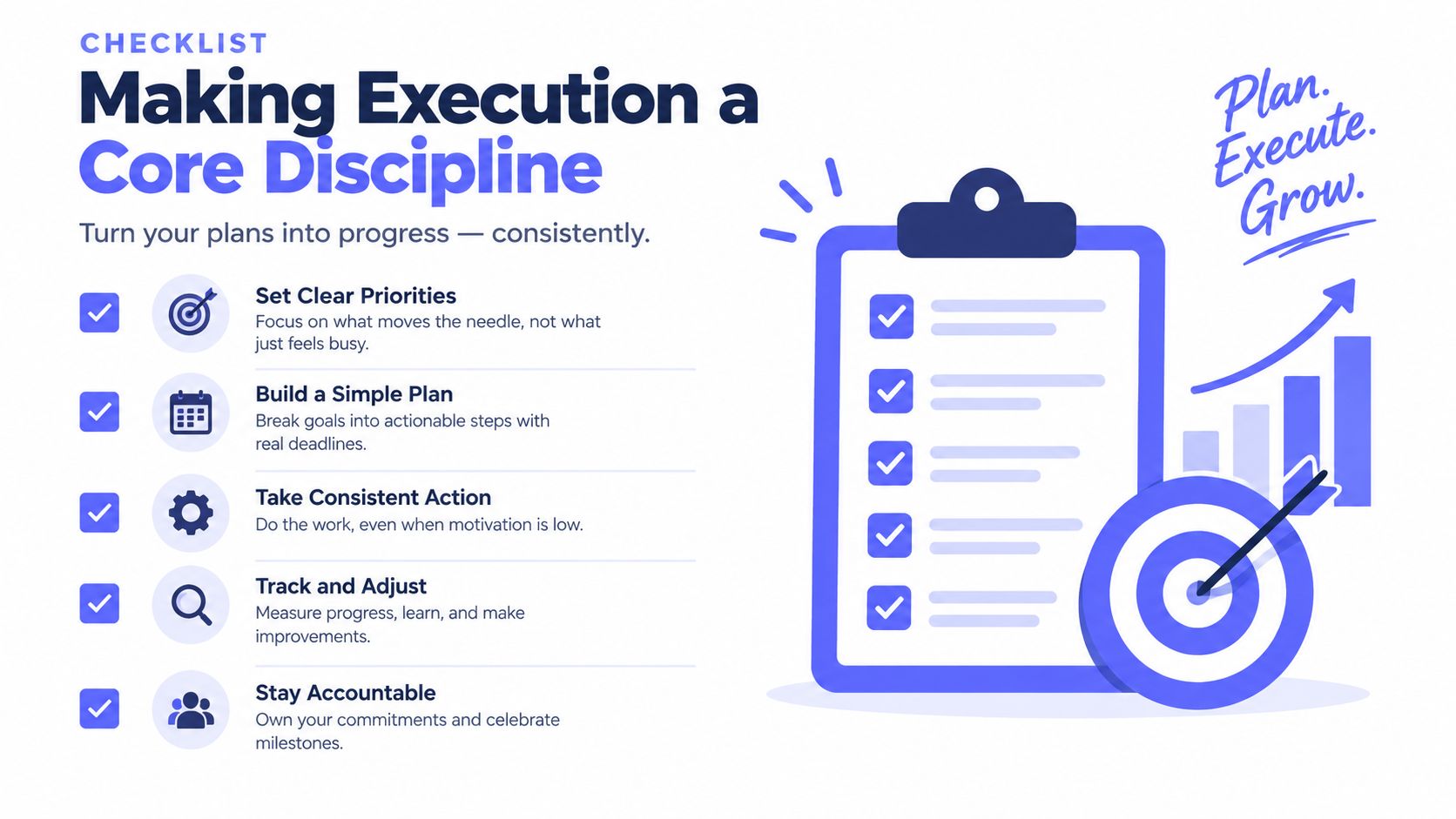
A durable execution checklist
- Audit the rhythm: Review leadership meetings, planning cycles, one-to-ones, and escalation routes. Identify where strategic outcomes are absent.
- Reduce active priorities: Make trade-offs explicit. If every initiative remains active, teams will continue to choose based on noise, hierarchy, or proximity.
- Clarify decision rights: State who decides, who contributes, and when an issue must move to another forum.
- Inspect the measures: Remove activity metrics that create the appearance of progress without showing whether the intended outcome is changing.
- Build internal ownership: Train and coach managers to run the system. Don't make the consultant the permanent source of challenge.
The public sector offers a clear example of this shift from aspiration to control. A UK government efficiency framework requires departments to maintain central data monitoring processes for delivery and the realisation of cash-releasing and monetisable non-cash-releasing efficiency savings agreed with HM Treasury. (UK government efficiency framework) The principle applies beyond government: important outcomes need visible ownership, agreed measures, and a review mechanism that can trigger action.
Bring in external expertise when leaders can't agree on the diagnosis, when internal politics block honest review, or when the organisation has tried several frameworks without changing behaviour. Start with an execution audit, not a software purchase. The right partner should help you identify the operating constraints, redesign the rhythm, and leave your managers more capable than they were at the beginning.
The OKR Hub helps leadership teams diagnose strategy-execution gaps, design practical OKR systems, and embed them into governance, planning, and weekly team routines through its OKR Focus Flow. Visit The OKR Hub to explore consulting, implementation, training, and coaching support for making execution measurable and repeatable.