
A growth business is typically a company with 10 or more employees growing turnover or headcount by at least 20% a year over a three-year window. Leaders should treat that label as a description of operating tempo, not just a number on a chart.
That definition is useful, but it isn't sufficient. The popular advice says growth means more revenue, more employees, or a larger customer base. That shorthand works in an investor update. It fails in a leadership meeting where you have to decide which teams to fund, which initiatives to stop, and who owns the trade-offs.
A growth business is an execution system under pressure. Its hiring curve changes. Its decisions multiply. Its capital gets absorbed faster. Its old meeting rhythm starts to break. If you don't define that operating condition clearly, your OKRs become a list of ambitions rather than a mechanism for turning strategy into coordinated action.
The Definition Leaders Actually Need
Revenue growth alone doesn't make a business a growth business. A company can increase sales while margins deteriorate, customer delivery becomes unreliable, and senior leaders spend every week resolving issues that should have been handled by teams.
Headcount alone is no better. Hiring people into a poorly designed operating model creates more handovers, more meetings, and more opportunities for accountability to disappear. Growth needs to show up in the way the organisation makes decisions and delivers work.
Growth is an operating condition
A practical definition has to answer a Monday morning question: what must change because the business is moving faster?
Look for four linked shifts:
- Tempo: Teams make decisions and ship work at a faster rate.
- Capacity: The organisation adds people, technology, suppliers, or capital to support demand.
- Complexity: More customers, products, markets, and dependencies require clearer ownership.
- Cadence: The leadership team reviews progress more frequently and reallocates resources sooner.
These shifts distinguish a genuine growth phase from a good trading period. A business that wins a large contract but keeps the same delivery model may be busy, not structurally growing. A business that repeatedly expands demand, capacity, and organisational responsibility is operating in a different mode.
Practical rule: Define growth by the operating changes it forces, not by the celebration attached to the result.
This matters for OKRs because objectives are only useful when they reflect the actual constraint. If the problem is customer acquisition, the objective may focus on qualified demand and conversion. If the problem is delivery capacity, it may focus on implementation speed, quality, and hiring readiness. If the problem is leadership alignment, the objective must make choices visible across functions.
UK leaders also need to separate business creation from scalable growth. The UK had 2.73 million VAT and/or PAYE businesses in March 2025, and the total business population increased by 191,000, or 3.5%, in 2025, with non-employing businesses growing faster than employing businesses, according to the ONS business activity and size release. More businesses doesn't automatically mean more businesses have the management system required to scale.
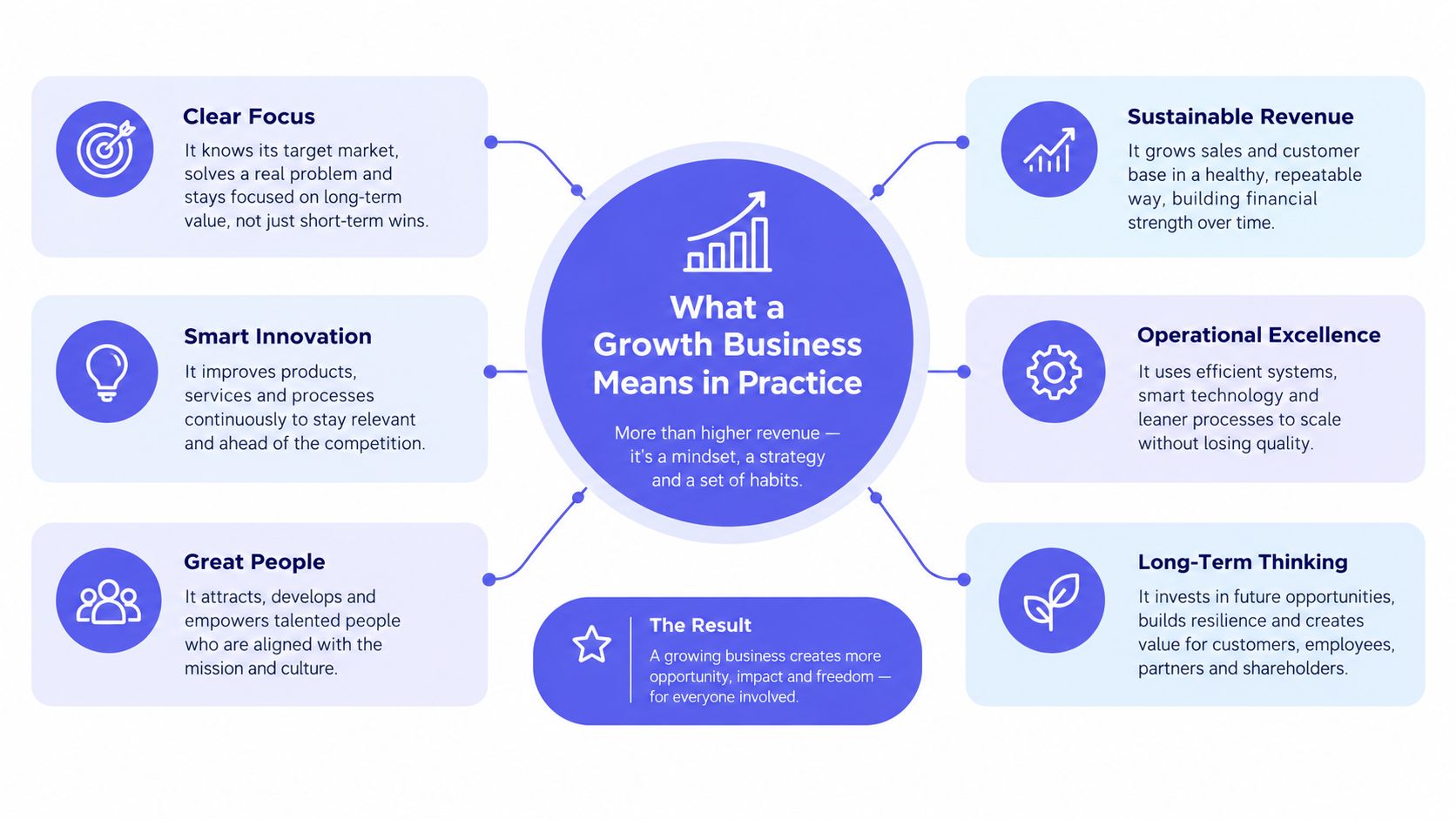
What a Growth Business Means in Practice
The OECD and UK official statistics provide a workable starting point. A high-growth firm generally has at least 10 employees and achieves annual growth of 20% or more in staff or turnover over a three-year period. The ONS uses a closely aligned employment-based measure in its business demography reporting.
The definition has three parts.
Start with the minimum size
The 10-employee threshold prevents very small movements from being treated as evidence of an established high-growth organisation. A founder-led firm can grow rapidly, but the operating implications become more visible once the business has a meaningful workforce and more than one layer of responsibility.
Measure the rate, not just the direction
The threshold is 20% annual growth, measured through employment or turnover. The rate matters because gradual expansion and rapid expansion create different management problems. A team can absorb modest change through informal coordination. Sustained growth at this pace puts pressure on recruitment, onboarding, forecasting, service quality, systems, and decision rights.
Use the three-year window
One strong year can reflect a contract, a market shock, or a temporary demand spike. A three-year period tests whether the organisation can repeatedly convert opportunity into capacity and output. It also exposes whether leaders have built an operating rhythm that survives the next wave of complexity.
In the latest ONS release, the UK recorded 14,330 high-growth businesses in 2024, up from 13,750 in 2023. The high-growth rate rose to 4.9% from 4.7%, its highest level since 2018, when it reached 5.0%, as reported in the UK Government evidence annex on business growth.
The threshold isn't a magic trigger. It is a useful warning that the old operating model may no longer be adequate. Treat it as a decision point. If your organisation is approaching the threshold, review its planning cadence, ownership model, hiring assumptions, and cross-functional dependencies before performance begins to degrade.
A steady-state business can enter growth mode, then leave it. Growth is a phase with a distinct tempo, not a permanent identity. Your OKRs, governance, and resource allocation should change with that phase.
Signals That a Business Is Genuinely Growing
A business can add customers without becoming more capable. It can benefit from a favourable market while its internal processes remain fragile. Leaders need a pattern of signals, not a single headline metric.
The first signal is revenue velocity. Look at the consistency of turnover growth, the quality of the revenue, and the operational work required to deliver it. Fast sales with weak retention or poor gross margin may create activity without creating a stronger business.
The second is headcount trajectory. Hiring should follow a deliberate capacity plan rather than a sequence of urgent replacements. If teams are repeatedly adding roles, managers, and specialist capability to support demand, the organisation is absorbing structural growth.
The third is capital deployment rate. Growth businesses make larger commitments to people, systems, product development, market entry, and delivery infrastructure. The question isn't whether leadership is spending more. It is whether investment decisions connect clearly to the growth constraint and produce evidence for the next allocation.
The fourth is repeated reorganisation. Reorganisation isn't automatically a sign of health. Frequent redesign can indicate that the business is discovering where its former structure no longer fits. Leaders should distinguish purposeful redesign from constant reshuffling that leaves employees unsure who decides.
| Signal | What to Measure | Threshold That Suggests Real Growth | Why It Matters |
|---|---|---|---|
| Revenue velocity | Turnover trend, retention, margin quality, delivery load | Sustained expansion rather than a single favourable period | Shows whether demand is becoming durable and economically useful |
| Headcount trajectory | Hiring cohorts, manager capacity, onboarding load, capability gaps | Planned additions linked to demand and operating capacity | Reveals whether the organisation can fulfil what it sells |
| Capital deployment rate | Investment in people, systems, product, and market development | Increasing commitment tied to explicit growth bets | Tests whether leaders are funding a strategy or reacting to pressure |
| Repeated reorganisation | Changes to ownership, reporting lines, teams, and decision rights | Structural changes that follow rising complexity | Shows whether the operating model is adapting deliberately |
Scale matters because a small share of firms carries a disproportionate share of employment and output. Scale-ups represent 1% of SME firms, yet account for 8% of SME employment and 22% of SME turnover, with nearly 1 million people employed in scale-up companies, according to the Social Market Foundation analysis of the scale-up opportunity. A ScaleUp Institute summary also reports £1.4 trillion in turnover, equal to 55% of the UK SME total, for UK scale-ups representing 0.6% of the business population.
Use leading indicators for growth decisions to build a weekly view of these signals. The purpose isn't to create a larger dashboard. It is to spot a change in operating conditions early enough to alter priorities, capacity, or ownership.
Strategic Implications for Resourcing and OKR Design
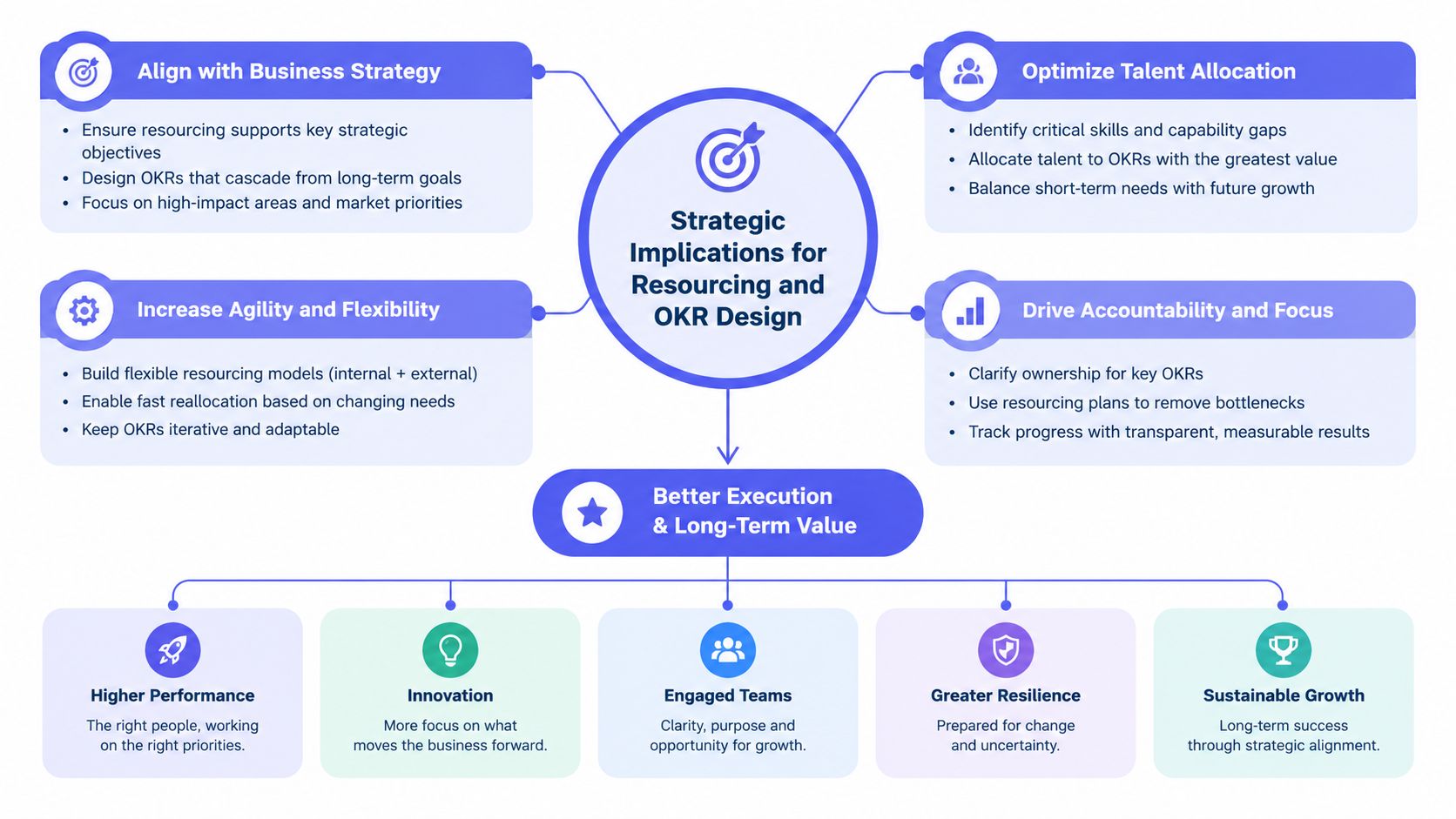
The definition becomes useful when it changes what leaders do. Growth mode should alter resourcing, governance, and team design. If it doesn't, the organisation is carrying a growth target on top of a steady-state operating system.
Resource cohorts, not vacancies
Backfill planning assumes the organisation already knows what the role should do and where it belongs. Growth businesses need a different model. Plan hiring in cohorts around capability needs, ramp time, management capacity, and the sequence of growth bets.
A product expansion may require product management, engineering, customer success, commercial enablement, and analytics together. Hiring one role at a time into separate functions creates delays and hidden dependencies. A cohort plan makes the capacity wave visible.
Ring-fence capacity for unproven bets, but attach clear learning outcomes to it. Leaders shouldn't fund speculative work indefinitely. They should define what evidence would justify continuation, redirection, or closure.
Move decisions closer to delivery
As the business grows, senior leaders can't remain the approval point for every trade-off. Decision rights need to move towards the teams with the relevant information. Weekly business reviews should focus on movement, risks, and decisions, rather than repeating a monthly board pack.
Make the speed-versus-quality choice explicit. A growth team may accept a narrower first release to learn faster. A regulated service may protect quality even when that slows expansion. The OKR should make the choice visible so teams aren't punished for following an unstated priority.
Give one person the outcome
Cross-functional squads work better when one accountable owner coordinates the result. Shared accountability often sounds collaborative but produces ambiguity when the objective slips. Contributors can be distributed. Ownership can't.
The scale-up evidence shows why this isn't optional polish. A relatively small group of firms carries a large share of employment and turnover, so leadership teams need an operating system that can handle rapid increases in responsibility. The resource allocation decisions guide provides a useful discipline for connecting investment choices to strategic outcomes.
GTM hiring is another decision leaders often delay. Before adding a permanent executive or building a full commercial function, compare the required capability, time horizon, and internal management load through a practical GTM hiring decision guide. The right answer depends on the growth constraint, not on what a similarly sized company has hired.
UK mid-size businesses face investment choices that shape their future direction, not just their next trading period. The Government research into mid-size business growth reinforces the need to align capital, people, and operating decisions with an executable growth plan.
How OKRs Differ in Growth and Steady-State Organisations
The same OKR framework shouldn't run every organisation in the same way. A growth business needs faster learning, tighter focus, and more frequent intervention. A steady-state organisation needs predictable performance, controlled improvement, and enough planning stability for functional teams to deliver reliably.
| Design Element | Growth Business | Steady-State Organisation |
|---|---|---|
| Objective horizon | Usually quarterly | Usually half-yearly |
| Primary weighting | Learning alongside performance | Performance and dependable delivery |
| Stretch targets | Built around bold assumptions and evidence gathering | Built around forecast confidence and operational capacity |
| Review cadence | Weekly | Monthly |
| Concurrent Objectives | Fewer, with sharper trade-offs | Broader coverage across established responsibilities |
| CEO role | Visible sponsorship and active removal of blockers | Direction setting with ownership distributed through functional heads |
Why the horizon changes
Quarterly objectives suit a business whose assumptions are moving quickly. The team needs enough time to produce evidence, but not so much time that a weak assumption survives unchallenged. Weekly reviews should ask what changed, what was learned, and what decision is now required.
Steady-state organisations can plan over a longer horizon because their products, processes, and responsibilities are more stable. Monthly reviews can focus on performance against plan, exceptions, and improvement actions.
Why learning belongs in growth OKRs
Growth targets often depend on uncertain product, market, pricing, or channel assumptions. A learning Key Result can be more valuable than a superficial commitment to an outcome the team can't yet control. It might test whether a new segment retains, whether a proposition converts, or whether a delivery model can support expansion.
That doesn't mean growth OKRs should become a licence for activity without results. Learning must change a decision. If the team gathers evidence but keeps the same plan regardless, the Key Result is theatre.
The distinction matters because UK leaders are balancing several competing priorities. In a YouGov survey of UK business decision-makers, 56% of large businesses prioritised digital transformation, while 55% of medium and large businesses focused on cost reduction and efficiency improvements. 45% of large businesses planned to launch new products or services, and 37% planned strategic partnerships or collaborations, according to the YouGov survey of UK business growth strategies.
Use the annual versus quarterly OKRs comparison to choose the cadence that matches the operating condition. Don't default to annual objectives because the planning template already exists.
Two Short Scenarios From the Leadership Room
The difference becomes obvious when leaders have to choose what not to do.
Scenario one, the scaling SaaS company
A Series B SaaS company has reached the OECD-style growth threshold. Its leadership team has a long list for Q3: launch a new product tier, improve onboarding, enter a new segment, and reduce support volume.
The chief executive cuts the list down to one cross-functional Objective focused on product-led expansion. Product, engineering, marketing, sales, customer success, and finance agree what they each control. The team reviews progress weekly. One learning Key Result tests whether improved retention in the target segment can support expansion. The result isn't treated as proof of success by itself. It is evidence for the next investment decision.
The trade-off is uncomfortable. Several attractive initiatives lose funding for the quarter. That discomfort is useful. It tells the leadership team that the OKR is forcing a real choice rather than decorating an existing roadmap.
Scenario two, the established services firm
A profitable professional services firm with a 15-year operating history decides not to chase maximum top-line expansion. The partners want to hold the line on margin while improving the client and employee experience.
They set three Objectives across efficiency, client satisfaction, and team development. Functional heads own the outcomes. The leadership team reviews them monthly because delivery commitments, staffing patterns, and client relationships require a more stable cadence.
The firm isn't less ambitious. It is optimising for a different condition. It won't use a growth-company cadence just because quarterly OKRs are fashionable. Its measures focus on reliable delivery, profitable utilisation, client outcomes, and capability development.
For leadership teams working through competing futures, a structured scenario analysis guide can help test how different assumptions affect priorities, capacity, and risk. The point isn't to predict perfectly. It is to make the trade-offs discussable before the next planning cycle locks them in.
Common Misconceptions That Stall Growth Businesses
The first misconception is that more goals create more progress. They don't. More goals usually mean more negotiation, more dependencies, and less clarity about what matters when resources collide.
The second is that a bigger team will move faster automatically. Hiring adds capacity only when managers define ownership, interfaces, and decision rights. Otherwise, the organisation adds coordination work faster than delivery capacity.
A third misconception is that startup rituals remain effective as the company scales. Informal decisions, founder escalation, and constant Slack negotiation may feel like culture in a small team. In a larger organisation, they often create hidden power structures and inconsistent decisions.
The financial myths are just as damaging
Leaders also confuse top-line growth with economic progress. Revenue can rise while the organisation underprices work, serves unprofitable customers, or carries excessive delivery effort. A growth OKR must connect commercial ambition to the constraints that determine whether growth creates value.
Another common error is treating growth as a marketing problem. Marketing can create demand, but product, sales, finance, operations, people, and customer success determine whether the organisation can convert and retain that demand. A campaign can't repair an unclear operating model.
Finally, many teams bolt on execution systems after setting the strategy. That sequence creates attractive strategy documents and weak delivery. Ownership, measures, review cadence, and resource decisions need to exist when leaders choose the strategy, not after the first missed quarter.
UK leaders report strong appetite for expansion, but intent doesn't remove operating pressure. 77% of owners wanted to grow, and 84% started 2026 with plans to invest in new growth initiatives, while rising costs, recruitment challenges, and margin pressure remained concerns, according to the QuickBooks UK SME insights report. The same source reported real revenues up 3.3% and profits up 6.2% in Q4 2025, while expenditure rose 2.1%.
A strategy-execution survey of UK companies with £20m or more in turnover found that only 18.4% achieved more than 80% of their aspirational growth goals within three years, while 41.2% failed to achieve 60% or more of their stated targets. Only 46% had a clearly measurable value gap, according to the 2025 strategy execution research findings. The leadership lesson is direct: ambition is common; measurable translation into delivery is not.
What to Do Next as a Leader
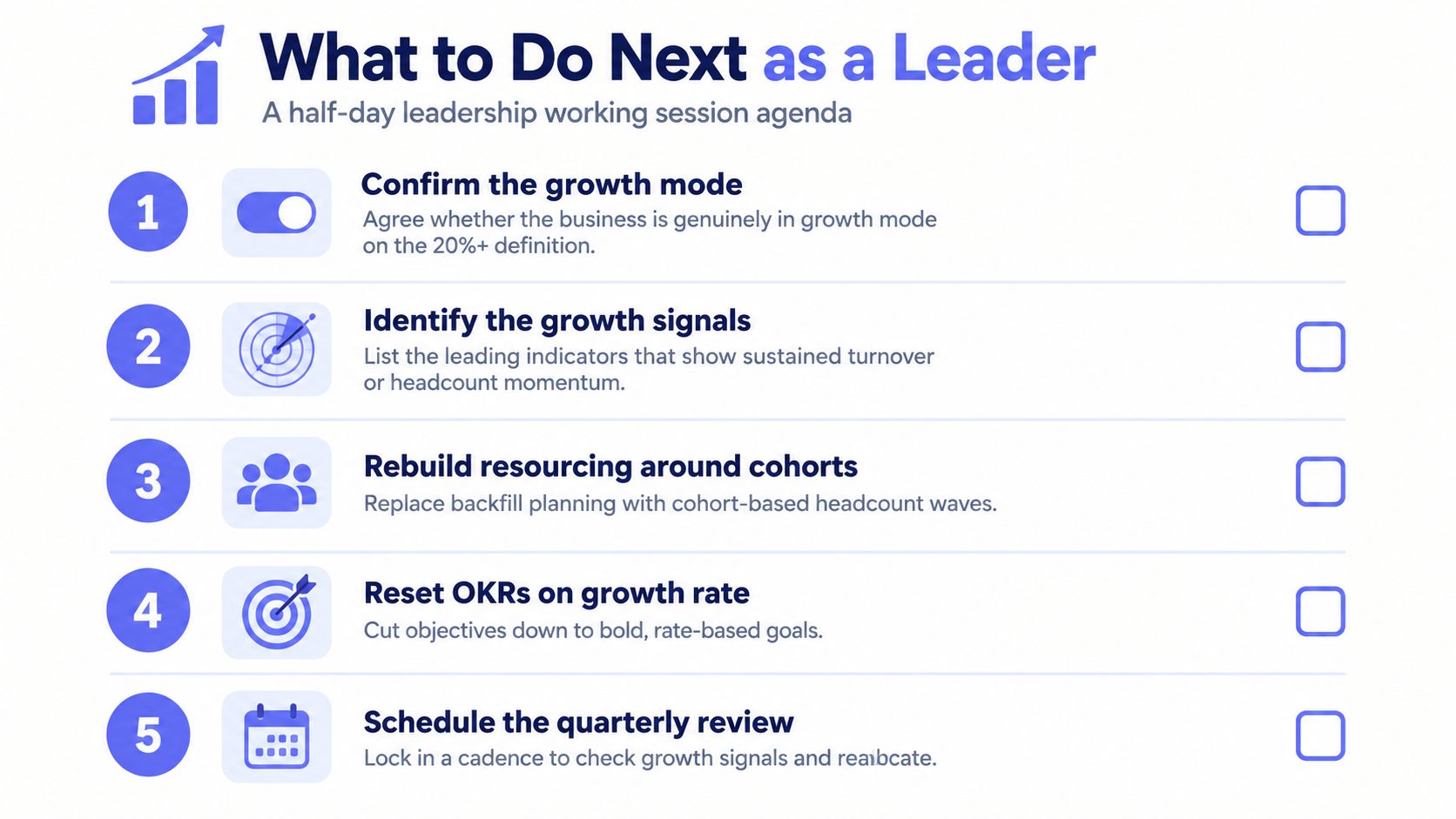
Run a focused leadership review. Don't begin by rewriting every team objective. Start by deciding which operating condition you're managing.
- Confirm the growth mode. Check whether the organisation meets the practical OECD and ONS-style definition, then ask whether its hiring, turnover, capacity, and decision tempo reflect that reality.
- Audit the four signals. Review revenue velocity, headcount trajectory, capital deployment, and repeated reorganisation. Look for a consistent pattern rather than one favourable metric.
- Choose the required tempo. Decide whether the next two quarters demand rapid learning and weekly intervention, or dependable performance and a steadier monthly cadence.
- Rewrite the top three OKRs. Remove objectives that describe activity. Keep outcomes that express the few choices capable of changing the growth constraint.
- Assign ownership and review dates. Name one accountable owner for each outcome, define the evidence required, and schedule the review before work begins.
The OKR implementation roadmap can help leadership teams turn that decision into a practical sequence of design, rollout, review, and capability building.
You don't need to manage the business you had before the growth phase. Design the operating rhythm the next phase requires, then make resourcing, governance, and OKRs reinforce it.
The OKR Hub helps leadership teams connect growth outcomes to practical OKR design, ownership, governance, and review rhythms. If your strategy is clear but delivery remains slow or misaligned, visit The OKR Hub to explore consulting, implementation, training, and hands-on coaching.