
A strategic manager converts board-level intent into resource-allocation choices, decision cadences, and frontline execution. In the UK, firms' average management-practice score rose from 0.49 in 2020 to 0.55 in 2023, showing why structured management matters.
The popular advice says strategy starts with a bold vision, a polished plan, and a communication programme. That advice is incomplete. A strategy only becomes useful when somebody decides what will stop, who owns each priority, how progress will be inspected, and what happens when delivery moves away from intent.
That operator is the strategic manager. I don't define the role as the person who writes the strategy document. I define it as the person who builds the management infrastructure that makes strategic choices visible in daily work.
The Real Reason Strategy Fails in Growing Companies
Leadership teams often diagnose strategy failure as a vision problem. The market changed. The ambition wasn't clear enough. Competitors moved faster. The board needs another offsite.
Sometimes those explanations are valid. More often, the strategy fails because the organisation has no reliable mechanism for turning choices into coordinated action. Teams continue to use legacy targets. Functions protect their own roadmaps. Leaders approve new initiatives without stopping old ones. Nobody has clear authority to resolve conflicts.
A March 2025 survey of 250 UK companies with turnover above £20 million found that only 18.4% achieved more than 80% of their aspirational growth goals within three years. More than half of leaders identified talent and capability gaps as a major internal barrier, while weak alignment between operations and strategy ranked among the leading execution obstacles, according to the Strategy Execution 2025 research findings.
That evidence points to a management infrastructure problem. A leadership team can make a sound strategic choice and still fail to fund it properly, explain its implications, assign ownership, or review the outcomes frequently enough.
The document is not the operating system
A strategy document describes direction. It doesn't decide whether product capacity should move from a legacy feature to a new market. It doesn't resolve a conflict between sales commitments and delivery capability. It doesn't tell a manager which project loses funding when priorities collide.
The strategic manager does those things through repeatable mechanisms:
- Resource allocation: Match people, budget, leadership attention, and technology investment to the few outcomes that matter most.
- Decision cadence: Create regular forums where leaders make choices, rather than meetings where teams only report activity.
- Ownership: Give each strategic outcome an accountable leader with enough authority to influence it.
- Feedback loops: Compare intended outcomes with actual behaviour, then adjust priorities, measures, or capability.
- Stop rules: Remove work that no longer supports the strategy, even when a senior stakeholder originally sponsored it.
Practical rule: If a strategic priority doesn't change what somebody stops doing, it probably isn't a priority yet.
I see this most clearly in growing organisations. Growth adds teams, products, customers, and dependencies faster than governance matures. A founder may still make decisions informally while functional leaders optimise their own areas. By the time the organisation notices the misalignment, people are busy, morale is lower, and the leadership team is debating symptoms.
My view on why strategy execution fails is simple: leaders rarely need another inspirational workshop before they need clearer decision rights, measurable outcomes, and a disciplined review rhythm. A strategic manager provides that operating discipline.
Core Responsibilities of a Strategic Manager
A strategic manager converts organisational direction into structured management practices. On a Tuesday morning, that might mean reviewing a delayed commercial initiative, challenging a resource request, clarifying an owner for a cross-functional result, or removing a measure that rewards the wrong behaviour.
The role combines strategic judgement with operational discipline. The Cambridge Judge Business School definition of strategic management places CEOs, senior executives, and boards at the centre of decisions about growth direction, competitive strategy, organisational boundaries, governance, decision processes, and stakeholder management. A strategic manager makes those responsibilities usable beyond the boardroom.
What the role controls
The responsibilities usually fall into four connected areas:
-
Set targets that express the strategy.
The manager turns broad intent into outcomes that teams can understand and influence. “Become more customer-led” isn't enough. The organisation needs a defined result, a responsible owner, and evidence that customer behaviour or value has changed. -
Monitor performance without creating reporting theatre.
Monitoring isn't collecting every available metric. It's identifying the signals that show whether strategic outcomes are moving, then using them to trigger decisions. A red result should lead to diagnosis, support, reprioritisation, or escalation. -
Allocate resources against evidence.
Strategy becomes credible when investment follows it. The strategic manager tests whether hiring, product capacity, commercial effort, and leadership attention support the stated direction. That may require saying no to a popular initiative. -
Coordinate execution across functions.
Cross-functional outcomes need shared ownership and visible dependencies. The strategic manager helps sales, product, operations, finance, and people leaders work from the same priorities instead of producing disconnected commitments.
The ONS Management and Expectations Survey measured UK management practices on a scale from 0, meaning no implementation of structured practices, to 1, meaning full implementation. The average UK and Great Britain score reached 0.55 in 2023, compared with 0.49 in 2020. The improvement was driven particularly by firms below the median.
That matters because strategic management isn't reserved for senior leaders with impressive titles. It is a capability built through repeatable practices. The ONS associates stronger management practices with higher productivity and resilience. A strategic manager therefore creates a system in which good decisions can be repeated, inspected, and improved.
How to test whether the role exists
Look at behaviour rather than job titles. Ask whether leadership meetings make resource decisions, whether every strategic result has a clear owner, whether teams can explain how their work supports the strategy, and whether obsolete priorities are actively removed.
If the answer is no, adding a strategy manager to the organisation chart won't solve the problem. The role only works when the manager has access to performance information, influence over planning, and permission to challenge functional priorities. For more on the accountability dimension, see role clarity and execution.
Using OKRs to Bridge Strategy and Execution
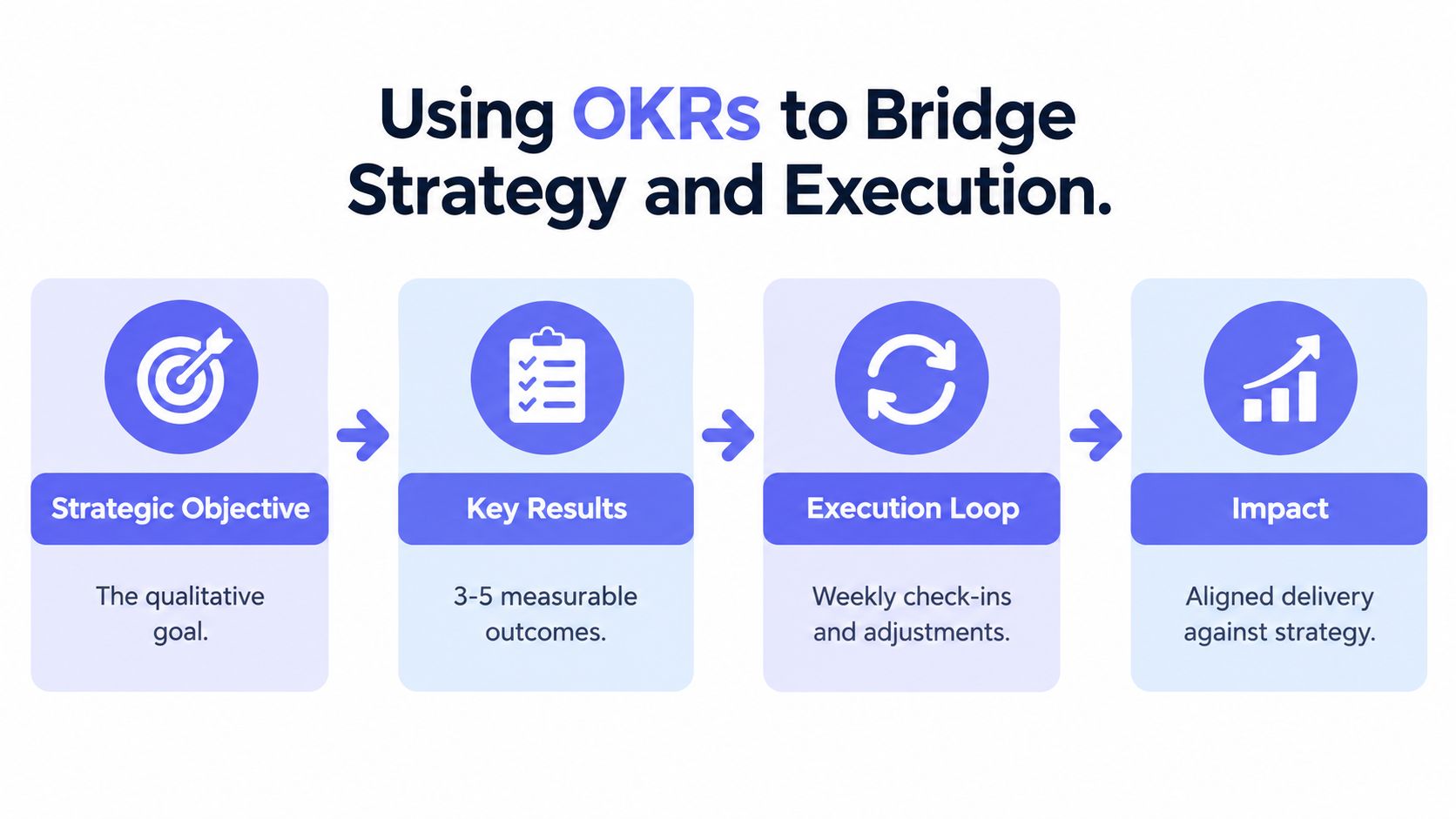
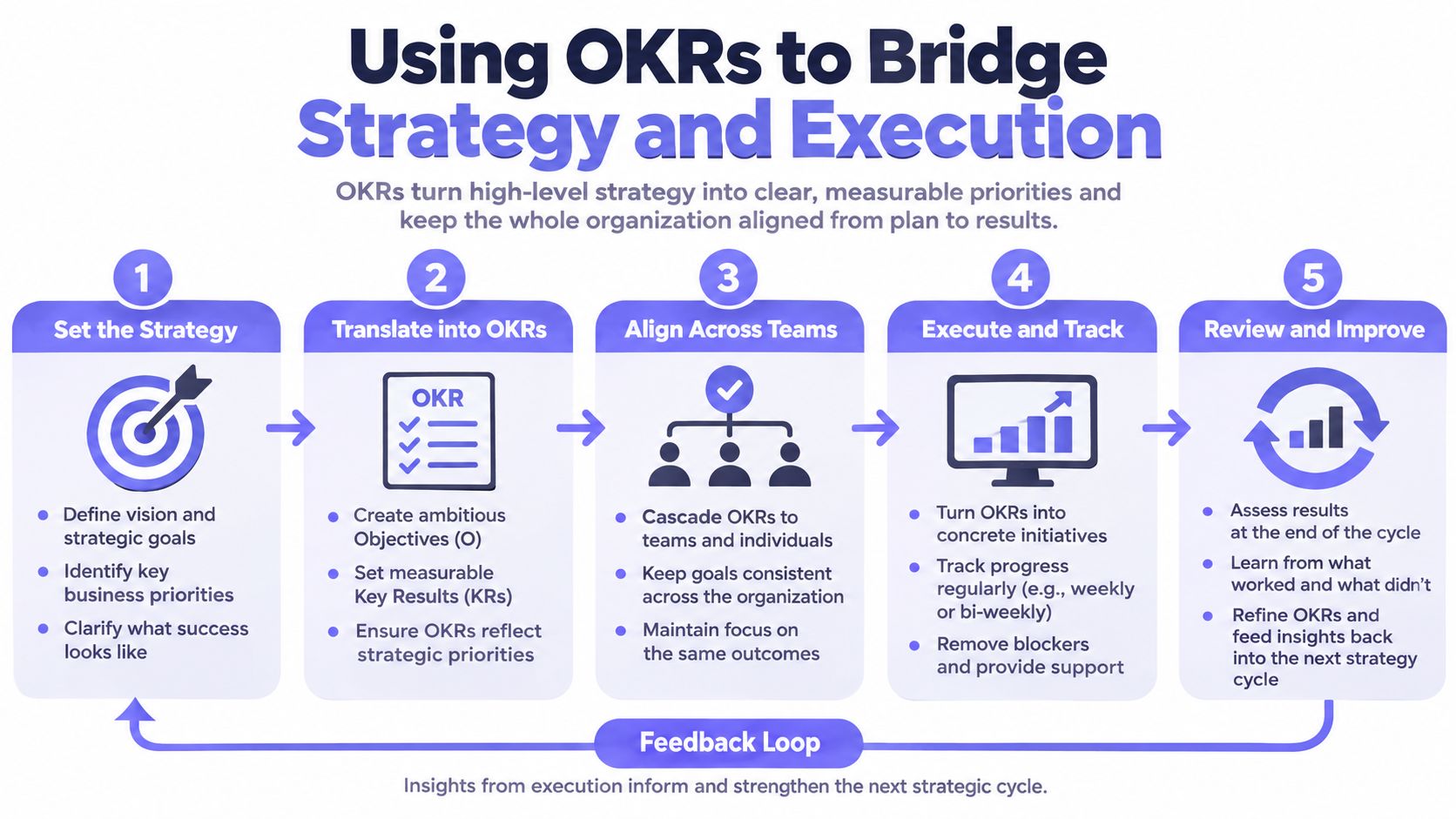
OKRs give the strategic manager a practical operating system for turning ambition into choices. They aren't a decorative goal-setting exercise. Used properly, they clarify what matters, expose trade-offs, and give leaders a recurring way to detect divergence between strategy and delivery.
The critical distinction is between an Objective and a list of activities. An Objective expresses the strategic result the organisation wants. Key Results describe observable evidence that the result is moving. Initiatives are the work people choose to influence those results.
That separation prevents a common failure. Teams often present a project plan as proof of progress. A project can be on schedule while the strategic outcome remains unchanged. The strategic manager keeps attention on the result.
The operating rhythm
I use five practical questions to connect board-level intent with frontline execution:
-
What choice has leadership made?
Start with the strategic decision, not a generic aspiration. Which market, customer problem, capability, or value driver deserves attention? -
What outcome would prove progress?
Define evidence that can be reviewed. The measure should help leaders decide, not merely make a dashboard look complete. -
Who owns the outcome?
Assign one accountable owner. Contributors can be many, but shared accountability often becomes no accountability when nobody has the final responsibility to coordinate action. -
What work will stop or change?
This is where OKRs become a prioritisation tool. If every existing initiative survives, the organisation has added language without creating capacity. -
What will the review change?
A check-in should result in a decision, an intervention, or a clear continuation. It shouldn't be a sequence of updates that leaves the operating plan untouched.
A strategic manager might take a company objective focused on profitable expansion and connect it to outcomes owned across commercial, product, and operations teams. The manager then tests dependencies. If sales needs a capability that product can't deliver without delaying a strategic release, leadership must choose. The OKR rhythm makes that conflict visible before it becomes a missed commitment.
Stopping legacy work
Legacy work survives because it has history, sponsorship, and established reporting. It rarely survives because somebody has recently proved that it still matters.
The strategic manager reviews existing initiatives against current Objectives and Key Results. Work with no credible connection is paused, redesigned, or stopped. That decision can be uncomfortable, particularly when teams have invested heavily in the initiative. It is still better than forcing people to split their attention across incompatible priorities.
The OKR strategy guidance from The OKR Hub is useful here because the framework only creates value when it changes operating behaviour. Writing stronger objectives won't fix a leadership team that refuses to make trade-offs. The manager must connect the framework to governance, planning, and resource decisions.
An OKR cycle should make misalignment easier to see and harder to ignore.
That requires a clear distinction between weekly execution conversations and strategic reviews. Weekly conversations focus on obstacles, confidence, and next actions. Strategic reviews examine whether the chosen outcomes still matter, whether the evidence is credible, and whether investment needs to move.
Essential Skills for Sustaining Strategic Change
Launching a strategy is visible. Sustaining it is quieter and harder. Once the programme office closes, new processes become ordinary work, senior attention moves elsewhere, and teams return to measures that feel familiar.
A strategic manager protects the change after the launch. That requires more than communication skill. It requires the ability to observe behaviour, challenge incentives, redesign routines, and remove measures that pull people back towards the old operating model.
Detecting drift early
Drift rarely begins with an obvious rejection of strategy. It appears in small decisions. A team adds a low-value feature because an important customer asked for it. A sales leader rewards bookings that create delivery strain. A functional manager delays a cross-business initiative because local targets are easier to defend.
The strategic manager creates signals for those patterns. Useful signals include missed dependencies, repeated exceptions, decisions made outside agreed governance, and teams reporting activity without outcome movement.
The manager also needs enough proximity to frontline work to distinguish resistance from a legitimate operational constraint. A delayed result may indicate weak adoption, poor capability, an unrealistic target, or a flawed assumption. Treating every problem as a motivation issue creates change fatigue.
Making change part of management
A transformation becomes durable when leaders use the new behaviours in normal decisions. If the organisation says it values customer outcomes but promotion, budget, and performance conversations still reward internal activity, employees will follow the incentives.
This is why governance matters. Review agendas, decision rights, capability development, and performance measures must reinforce the intended change. Managers need practical coaching on how to use the new system, not just an announcement from the executive team.
A useful companion for leaders redesigning commercial operating habits is this change management playbook for RevOps. Its relevance extends beyond revenue operations. Any function introducing new workflows needs to connect adoption to roles, routines, and visible leadership behaviour.
Evidence from a 2025 survey of more than 750 executives found that 56% said transformations initially achieved most or all performance goals, but only 12% reported that the gains lasted more than three years, as discussed in McKinsey's analysis of making change stick. The lesson is not that transformation programmes are pointless. It is that launch performance doesn't prove lasting adoption.
Removing obsolete measures
Sustained change often requires subtraction. A strategic manager retires measures that reward the previous strategy, closes forums that no longer support decisions, and stops asking teams for reports that nobody uses.
This matters for technology adoption too. UK Chartered Management Institute data cited in the same McKinsey discussion reported that only one in 20 managers saw substantial transformational productivity gains from AI investment, while one in four saw no benefit. The technology may be capable, but capability alone doesn't change operating performance. People need clear use cases, decision rules, training, and measures that show whether new behaviour creates value.
The organisational change management perspective from The OKR Hub reflects this practical reality. Strategic change is sustained when the management system makes the new way of working easier to repeat than the old one.
Measuring Impact Through Management KPIs
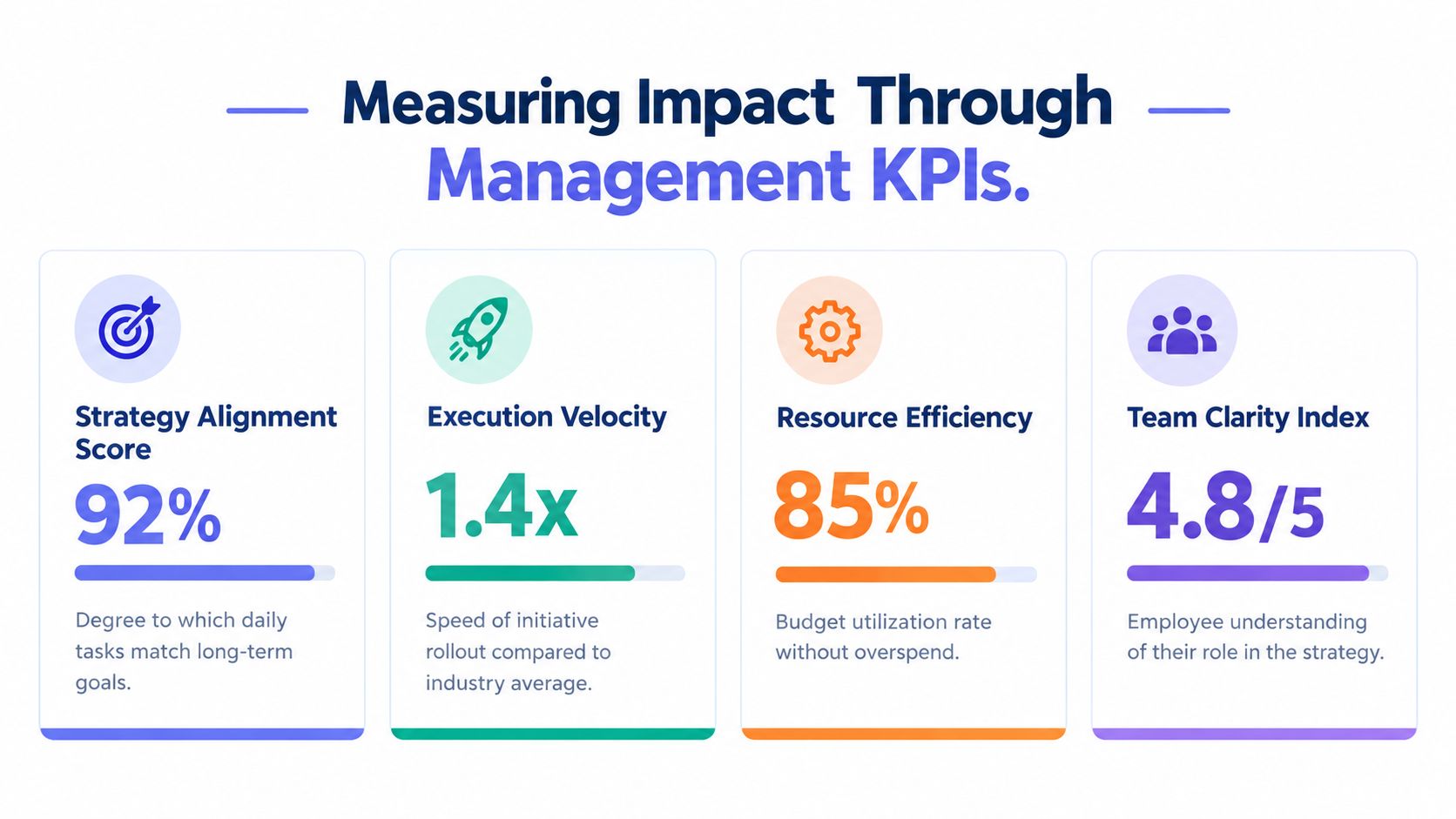
Judge a strategic manager by what changes in decisions and delivery. Plans produced and meetings facilitated are activity measures. They reveal little about whether the management system is working. The practical test is whether strategy changes what leaders measure, where they allocate resources, and how quickly they respond when performance falls behind.
I separate management KPIs from business outcome KPIs. Business outcomes may include commercial performance, customer value, operational quality, or capability growth. Management KPIs show whether the organisation is creating the conditions required to produce those outcomes consistently. They make the operating system visible.
The measures that reveal management quality
A practical scorecard might include:
| Management signal | What it reveals |
|---|---|
| Priority alignment | Whether team commitments connect to current strategic outcomes |
| Outcome ownership | Whether each result has a named person with decision authority |
| Review action rate | Whether performance reviews produce decisions and follow-through |
| Resource movement | Whether investment changes when evidence changes |
| Dependency resolution | Whether cross-functional obstacles receive timely decisions |
| Measure quality | Whether teams track outcomes instead of activity alone |
The scorecard needs a clear operating purpose. Counting completed check-ins while stalled outcomes receive no attention creates reporting theatre. I use these KPIs to expose decision quality, execution friction, and the points where management attention is failing to reach the work.
UK government evidence identifies target setting, operational analysis, performance monitoring, and incentive management as practices strongly correlated with firm productivity. The evidence also reports that a 0.1-point increase in management-practice scores was associated with a 9.6% increase in productivity, as set out in the government evidence annex for small and medium-sized businesses.
Turning measurement into intervention
A KPI earns its place when it leads to a decision. A weak alignment signal may call for clearer cascading, fewer objectives, or a reset of team commitments. Slow dependency resolution may require an executive decision forum, with authority to settle trade-offs, instead of another project tracker.
Define the response before a metric turns red. A missed result could trigger a root-cause review, a capacity decision, a scope change, or targeted coaching. The appropriate response depends on the cause. The review meeting should already establish who can act, what evidence they need, and when the decision will be checked.
For a fuller framework on converting these signals into reporting and action, see our guide to impact measurement.
Metrics dashboards help teams see patterns when they support decisions and expose ownership. Commercial leaders can use these metrics dashboards for sales teams as a reference for presenting operational signals clearly, then adapt the format to their own review rhythm.
The UK Parliament evidence adds further context. Up to 50% of the UK-US productivity gap has been associated with management capability, and UK firms in the top productivity decile were 20% more likely than average-productivity firms to provide formal management training, as detailed in the written evidence submitted to Parliament. The same evidence reported that small improvements in management practice were associated with productivity-growth rates up to 5% higher.
Those figures do not make management a mechanical formula. They make the leadership test more concrete. A strategic manager should show how the management system improves clarity, accelerates decisions, redirects resources, and strengthens execution. When a KPI reveals a problem, the manager creates the cadence and authority needed to address it.
Building Your Strategy Execution Engine
A strategic manager is the owner of the rhythm between leadership intent and operational behaviour. The role isn't complete when the board approves a direction. It becomes useful when teams know what matters, managers know what to stop, and leaders can see when execution is drifting.
Founders and scale-up leaders should look for three signs of a functioning execution engine. Strategic choices influence resource decisions. Teams can trace their work to outcomes. Review meetings produce decisions rather than summaries.
Enterprise strategy and transformation leaders face a different risk. Their organisations often have plenty of planning, reporting, and governance, but the mechanisms operate separately. The strategic manager connects them. A planning cycle informs OKRs. OKRs inform team commitments. Performance reviews inform resource allocation. Resource decisions feed the next strategic review.
What to install first
Start with a limited set of strategic outcomes. Give each outcome a clear owner and define the evidence that will demonstrate progress. Then establish a review rhythm with a fixed purpose, trusted data, and explicit decision rights.
Next, audit the work already underway. Identify initiatives with no current strategic connection, duplicated efforts across functions, and targets that reward behaviour leaders no longer want. Stopping work is a strategic act, not an administrative clean-up.
Finally, build capability in the managers who translate priorities into daily choices. They need to know how to run meaningful check-ins, surface risks, resolve dependencies, and distinguish a temporary setback from a structural problem.
Strategy becomes operational when the organisation can make a different decision on a busy Monday morning.
A peer discussion can sharpen those choices, especially for leaders navigating growth, transformation, or competing stakeholder demands. The strategy peer group resource on ForumSpace offers a useful starting point for thinking about how strategy evolves as conditions change.
The strategic manager brings this work together. They don't own every decision, but they design the conditions in which the right decisions are made at the right level. They don't replace functional leadership, but they make competing priorities visible and force the organisation to resolve them.
I help leadership teams turn strategy into clear choices, measurable OKRs, and operating rhythms that improve alignment and execution. If your strategy is sound but delivery remains inconsistent, book a conversation.