
Everyone loves to say strategy fails because leaders did not explain it well enough. That excuse is convenient. It is also usually wrong.
In most organisations, the strategy is not the main problem. The operating system is. Leaders know the destination, but the business has not been built to convert intent into decisions, trade-offs, and delivery. That is why strategy in an organisation often looks impressive on slides and weak in practice.
The UK evidence points in the same direction. The ONS shows that management practice is tied to productivity because repeatable disciplines, like targets, KPIs, continuous improvement, and handling underperformance, are what turn priorities into action, not the strategy document itself ONS management practices survey. If you want a practical resource on how AI analytics can speed strategy, this piece on how AI analytics speeds strategy is worth a look, because faster insight only matters when the organisation can act on it.
Why Most Strategy Fails at Execution

Leaders usually blame confusion. The underlying issue is more operational. The organisation has no reliable system for turning decisions into action, so strategy looks clean in the deck and messy in delivery.
The same ONS management-practice data cited earlier points in the same direction. It shows an average UK management-practice score of 0.55 and a median of 0.60 on a scale from 0 to 1, which means many organisations have adopted pieces of discipline, but not the operating rhythm needed to make execution consistent. The problem is not a lack of strategy language. It is a lack of structure around the strategy.
Two failure types and the tell that separates them
A strategy-design failure shows up when the objectives are vague, the outcomes are not measurable, and the leadership team cannot explain success in operational terms. A execution-system failure looks different. The strategy is clear, the people are capable, but delivery still slips because ownership, governance, and decision rights are weak.
The third signal is simple. Weak organisations keep treating missed delivery as a communication problem. Strong organisations open the governance mechanism and inspect the decision rights, because that is where the breakdown sits.
Practical rule: if leaders keep asking for more updates but not making more decisions, the problem is not communication. It is governance.
That is why leaders should inspect the operating model before they rewrite the strategy deck. If you want a useful companion read, the OKR Hub's strategy of execution covers the same operational logic. Strategy only matters when the business can execute it, and how AI analytics speeds strategy is only useful when the organisation can act on faster insight.
The Three Hidden Failure Modes
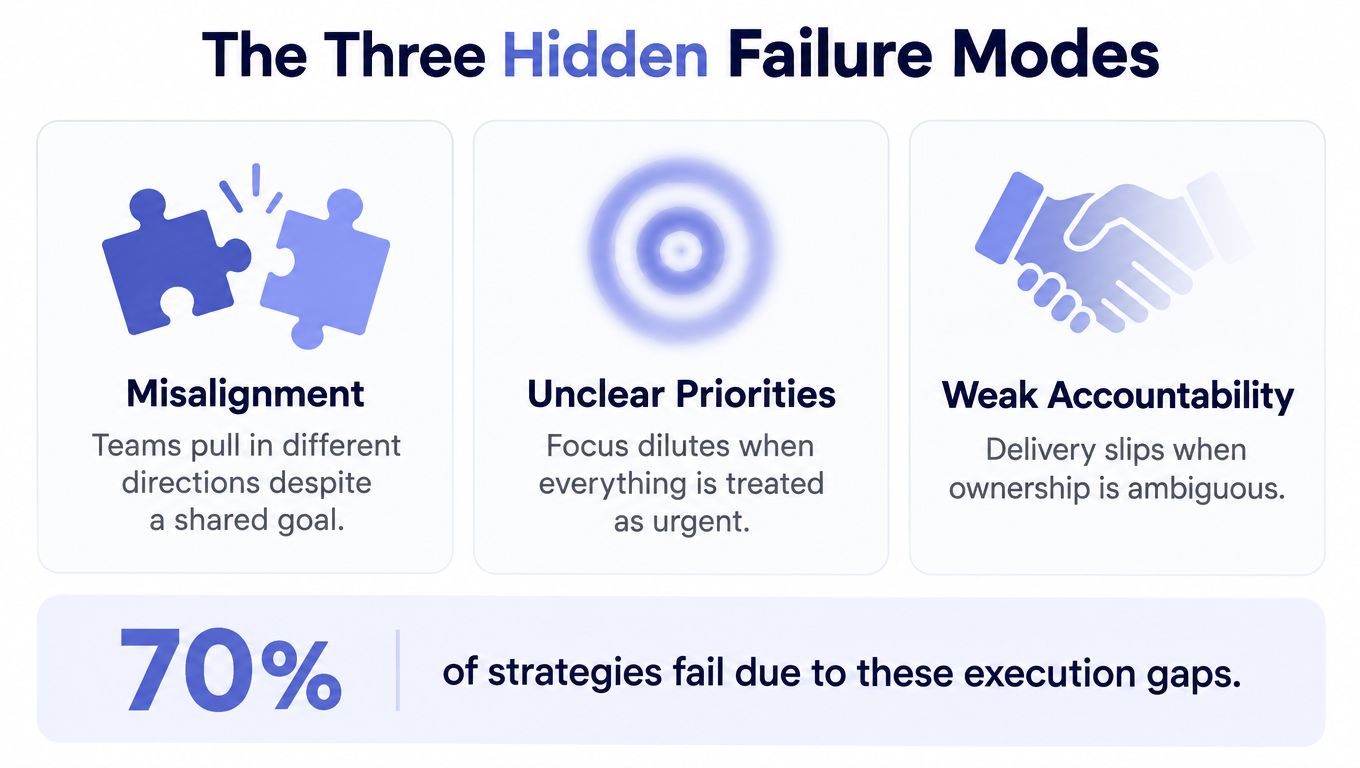
Most leadership teams don't fail all at once. They fail in one of three ways, then pretend the problem is broader than it is. That is a mistake. If you can name the dominant failure mode, you can stop wasting time on the wrong fix.
Misalignment
Misalignment shows up when teams are working hard and still pulling apart. Marketing pushes one message, product pushes another, and sales is left to explain why the customer journey feels stitched together. Everyone can sound committed in the room, yet the business acts like three separate organisations.
Strategy in an organisation usually starts to leak here. The top team agrees on a direction, but function-level decisions are not forced to line up. The result is local optimisation. Each team improves its own patch, while the overall strategy loses coherence. The OKR Hub's 4 dimensions of execution is a useful way to think about that cross-team tension.
Unclear priorities
Unclear priorities dilute focus fast. One leadership meeting says growth matters. The next says margin matters. Then somebody adds a customer experience initiative, and suddenly every team is treating every request as urgent. That is not ambition. It is noise.
The UK survey evidence on busy work is relevant here. Teams lose an average of eight hours each week to busy work, and more than half of decision-makers still use busyness as a primary measure of productivity Smartsheet busy work research. That is exactly how priorities get blurred. Activity crowds out outcomes.
Weak accountability
Weak accountability is the quiet killer. It rarely looks dramatic. It shows up as meetings with no decisions, owners who are “supporting” but not accountable, and milestones that slide because nobody is willing to name the blocker. People stay polite. Delivery slips anyway.
A simple test helps. If a quarterly review ends with the same actions it started with, accountability is weak. If nobody leaves the room with a decision, it was a status meeting dressed up as governance. The OKR Hub's performance diagnostics fits well here because the issue is not effort. It is clarity about who owns the outcome.
If the same issues appear every quarter, you do not have a motivation problem. You have a mechanism problem.
Diagnosing Whether Your Problem Is Design or Delivery
Not every strategy problem deserves the same fix. Leaders waste months because they treat every miss as if it came from the same root cause. It doesn't. Start with the diagnosis, then choose the intervention.
| Root Cause | Key Signal | Fix |
|---|---|---|
| Strategy design problem | Objectives are broad, abstract, or impossible to measure | Narrow the choices, define outcomes, remove vague language |
| Capability problem | The plan is clear, but teams lack the skill or capacity to deliver | Build capability, reset workload, and train managers |
| Execution-system problem | Good people, clear strategy, inconsistent delivery | Fix governance, cadence, ownership, and escalation |
A design problem is easy to spot once you stop hiding behind jargon. If a leader cannot say what will change, by how much, and where the proof will appear, then the strategy is still too loose. The problem is not delivery. The problem is thinking.
A capability problem looks different. Teams understand the objective, but they cannot produce the result because the skill, tools, or capacity are missing. In that case, more pressure only makes things worse. The answer is not a sharper speech. It is resourcing and capability building.
An execution-system problem is the one that frustrates experienced leaders most. The people are strong. The direction is sensible. Yet delivery remains inconsistent because the business does not have a mechanism for making decisions, surfacing blockers, and correcting drift quickly. That is where operating rhythm matters.
Diagnose the layer that is failing. Then fix that layer only.
If you want to test your organisation rigorously, ask these questions in the next leadership meeting. Are the objectives specific enough to guide trade-offs? Do teams have the capability to deliver what they have been asked to own? Does governance produce decisions, or just reporting? The OKR Hub's alignment with strategy pairs well with this, because alignment is not a slogan. It is a system.
How OKRs Close the Gap Between Strategy and Execution
OKRs work when they are treated as an operating system, not a document. That is the difference most leadership teams miss. They try to write better goals, but the true value comes from building a repeatable link between strategic intent, measurable outcomes, and review discipline.
The strongest OKR setups separate durable objectives from changeable key results. The objective names the direction. The key results prove whether progress is real. That distinction matters because strategy should stay stable long enough for teams to learn, while the measures can change when the evidence says they should.
The other mistake is treating reviews as performance theatre. A good review meeting does not exist to admire dashboards. It exists to inspect leading indicators, identify blocked dependencies, and force decisions on resource shifts or priority changes. Missed results should trigger system questions. What slowed us down? Where did ownership break? Which dependency sat outside the team's control?
If you want a simple comparison between KPI and OKR thinking, Spark's confronto KPI e OKR is a helpful reference because the distinction becomes clearer when you look at what each measure is meant to do. KPIs tell you how the business is performing. OKRs tell you what the business needs to change.
Put OKRs into the rhythm that already exists
Do not launch OKRs as a side project. Embed them into the monthly review, the quarterly planning cycle, resource allocation decisions, and capability planning. That is where they become useful. Anything less becomes another layer of admin.
The UK government review on business productivity makes the point plainly, small improvements in management practice can be associated with up to a 5% increase in productivity growth rate UK business productivity review. I read that as a leadership warning. The cadence matters as much as the content. Use the system well, and strategy starts moving. Use it badly, and the same goals just get repackaged.
A Real Scale-Up Story Where Execution Was Broken
A founder I worked with had no problem describing the company's direction. The issue was that each function interpreted that direction differently. Product was pushing roadmap speed. Sales was chasing short-term numbers. Operations was trying to stabilise delivery. Everyone was busy. Nobody was aligned.
The quarterly planning cycle made it worse. Every three months, priorities shifted. Teams re-read the deck, nodded, and then went back to their own local fires. Accountability blurred into meeting culture. The calendar filled up. Delivery did not get cleaner.
The fix was not another strategy workshop. It was an operating change.
First, the leadership team cut the number of active priorities. Then it tied each priority to a small set of measurable key results. Review meetings stopped being update sessions and became decision sessions. If a dependency blocked progress, it was named in the room. If a team lacked capacity, that was visible too. If a project no longer supported the objective, it was stopped.
That shift changed the behaviour of the business. People stopped guessing what mattered. They could see it. The most important change was not the format of the OKRs. It was the discipline around how decisions moved through the company.

What changed in practice
- Review cadence became real: the team stopped treating meetings as a ritual and started using them to force trade-offs.
- Owners became visible: each key result had one accountable lead, not a committee.
- Priority churn dropped: leaders separated stable outcomes from changeable initiatives.
- Execution became discussable: missed results exposed system faults instead of generating vague blame.
That is the point. Strategy improved only after the operating rhythm changed. The OKR Hub's BBC Studios case study sits in the same category of problem solving, because the win is not the framework. The win is the discipline.
Why Embedding Beats Introducing OKRs
Most OKR rollouts fail because they are launched like a programme. People get trained, templates are shared, and then the old governance system keeps running underneath it all. Nothing meaningful changes. The business gets new language, but the same habits.
Embedding is different. It means the OKR conversation sits inside the meetings that already matter. Monthly reviews use key results to guide decisions. Planning cycles use them to allocate resources. Capability planning uses them to show where teams need support. That is how OKRs become part of management, not a parallel exercise.
A separate rollout often creates cynicism. People see another framework arrive, then disappear. An embedded approach does less theatrics and more work. It gives leadership a clearer line of sight on delivery and creates a better way to ask whether the strategy is being lived.
The test is simple. If a leadership team can't point to the meeting where an OKR changes a decision, the system is not embedded. It is decorative.
What I Help Leadership Teams With
I help leadership teams diagnose whether their strategy failure is a design problem, a capability problem, or an execution-system problem. Then I help them build the OKR-aligned operating rhythms that close the gap between strategy and delivery. That means clearer priorities, sharper governance, and accountability that shows up in the work, not just in the slide deck. If that is the problem you're facing, book a conversation