
The most popular advice on strategy and execution is to communicate the strategy more clearly, cascade the goals and hold people accountable. That advice misses the harder problem. Most leadership teams can explain what they want to achieve; execution falters because the organisation hasn't designed how priorities shape decisions, capacity and trade-offs.
I see the same Monday-morning symptoms: teams chasing different priorities, meetings that report progress but make no decisions, and leaders discovering too late that nobody owns the outcome. OKRs can help, but only when they become part of the operating system. Better goal wording won't fix a system that leaves priorities unchanged and accountability diffuse.
Why Strategy Is Rarely the Problem
When delivery slips, leaders often reopen the strategy. Sometimes that's necessary. More often, the strategy is clear enough, but teams can't tell what to prioritise, what to stop or who can resolve a dependency. The breakdown happens between leadership intent and the decisions people make about their work.
UK management data points to the operating system, not the plan, as a practical place to start. The Office for National Statistics scores firms from 0 to 1 across management practices such as continuous improvement, performance measures, target-setting and employment management. The UK-wide mean rose from 0.49 in 2020 to 0.55 in 2023, and the median reached 0.60 in 2023. A score of 0 means no implementation, while 1 means full implementation. The figures show progress, but not consistent adoption across firms. ONS management-practice data
The Productivity Institute's analysis of ONS data found that a 0.1-point increase in a firm's management-practice score corresponds to an 8.6% increase in productivity. That relationship makes the issue more than a matter of administrative neatness. Measurable targets, regular reviews, problem-solving routines and effective people management are the mechanisms that connect strategic choices to day-to-day action.
I treat execution as a designed capability with three connected layers:
- Objectives clarify the outcomes that matter and the measures that indicate progress.
- Operating rhythms give leaders and teams a reliable time to review evidence and resolve blockers.
- Governance defines ownership, decision rights and what happens when delivery diverges from intent.
A plan can point the organisation in the right direction. It can't make those mechanisms work by itself.
My starting point: Don't ask whether employees have heard the strategy. Ask which decisions have changed because of it.
For leaders balancing growth ambitions with the reality of limited capacity, fractional CMO insights for venture-backed teams offer a useful perspective on connecting commercial direction to execution. The principle applies beyond marketing: priorities matter when they alter the work and the resources assigned to it.
The Four Execution Gaps Leaders Keep Hitting
Execution failures often look like individual teams underperforming. Look closer and four system gaps recur: unclear priorities, misalignment, weak cadence and diffuse accountability. Naming the gap matters. A team that lacks decision authority needs a different remedy from a team that hasn't agreed what success means.
Clarity and alignment
Unclear priorities show up when every initiative is labelled strategic. A scale-up announces a new market push, a product refresh and a customer-retention drive, but nobody can say which takes precedence when the same specialists are needed for all three. The result is not necessarily poor effort. It's diluted capacity.
Misaligned teams emerge when functions interpret the same strategic goal differently. Sales pushes for custom features to close deals, product protects the roadmap, and operations tries to limit complexity. Each choice may look reasonable locally, but the organisation has no shared outcome or decision rule to resolve the conflict.
UK evidence shows how far communication can sit from practical clarity. Fewer than half of surveyed employees had been informed of their organisation's strategic goals and priorities; among those informed, only 40% felt extremely clear about their role, and around one-third believed their skills were well aligned with organisational objectives. UK survey findings on strategic communication and skills Publishing a strategy doesn't settle what teams should stop doing or how work should be prioritised.
Cadence and accountability
Weak cadence means leaders discover a delivery problem after it has already constrained the outcome. A programme director sees green status reports until a deadline is close, then learns that a supplier dependency has been unresolved for weeks. A review rhythm that only gathers updates has failed to surface the decision in time.
Diffuse accountability appears when ownership belongs to a committee or function rather than a person with authority to act. If a key result is off track, everyone can explain their contribution, but nobody is responsible for the recovery plan.
These gaps are management-system problems, not personality diagnoses. ONS analysis found a statistically significant positive relationship between management-practice scores and labour productivity, with continuous improvement and employment-management practices among those most associated with productivity. A UK Government review reported that a 0.1-point increase on the 0–1 scale was associated with a 9.6% increase in gross value added per worker. ONS analysis of management practices and productivity
Before adding a framework, identify the failure mode. Leaders reviewing a business growth strategy and long-term plan can use the same test: do priorities determine what gets funded, staffed and reviewed? My four dimensions of execution provide a practical lens for diagnosing where the system breaks.
Designing OKRs That Change Decisions
A useful OKR should change what a team does when evidence changes. If an objective can sit untouched in a presentation while the roadmap, hiring plan and meeting agenda carry on as before, it isn't controlling execution.
Start with the outcome, then make the key result precise enough to guide action. For each key result, specify the metric, baseline, target, owner and review interval. A team trying to improve reliability, for example, needs an observable measure of service quality, a known starting point and a named owner. “Make the platform more reliable” expresses intent; it doesn't tell the team whether to prioritise incident prevention, response speed or another constraint.
Measure outcomes, not effort
Activity can signal work without proving that it created value. Workshops delivered, features shipped and meetings held are outputs. Retention, cycle time and defect escape rate are closer to the outcomes leaders need to influence. Choose a key result that tests whether the work is moving the intended business measure, then identify activity separately if it helps diagnose the cause.
Keep the set of key results small enough to review properly. If a team tracks a long list, leaders can't see which measures matter most or which trade-offs require a decision. I ask a simple question: would this OKR change what the team discusses on Monday morning? If the answer is no, sharpen it or remove it.
| Common Leader Pain | Weak Key Result | Well-Formed Key Result |
|---|---|---|
| Pipeline | Improve sales pipeline | Increase qualified pipeline value from the agreed baseline to the quarter-end target, with one named owner |
| Retention | Improve customer retention | Raise the defined customer-retention measure from its baseline to its target by quarter-end |
| Time-to-market | Launch products faster | Reduce median time from approved scope to release against an agreed baseline and target |
| Reliability | Improve service reliability | Reduce the agreed incident or defect measure from baseline to target, while monitoring service quality |
These examples show the form, not real company results. Set values only after confirming the baseline and deciding what the team can influence. A strong key result makes the intended change measurable without pretending that the example supplies a benchmark.
The UK field experiment discussed below also reinforces the value of specific, observable targets. For the practical design work, see how to write objectives that support execution. The standard is not elegant wording. It's whether the measure leads to a decision about what to start, stop or escalate.
Operating Rhythms That Match the Decision
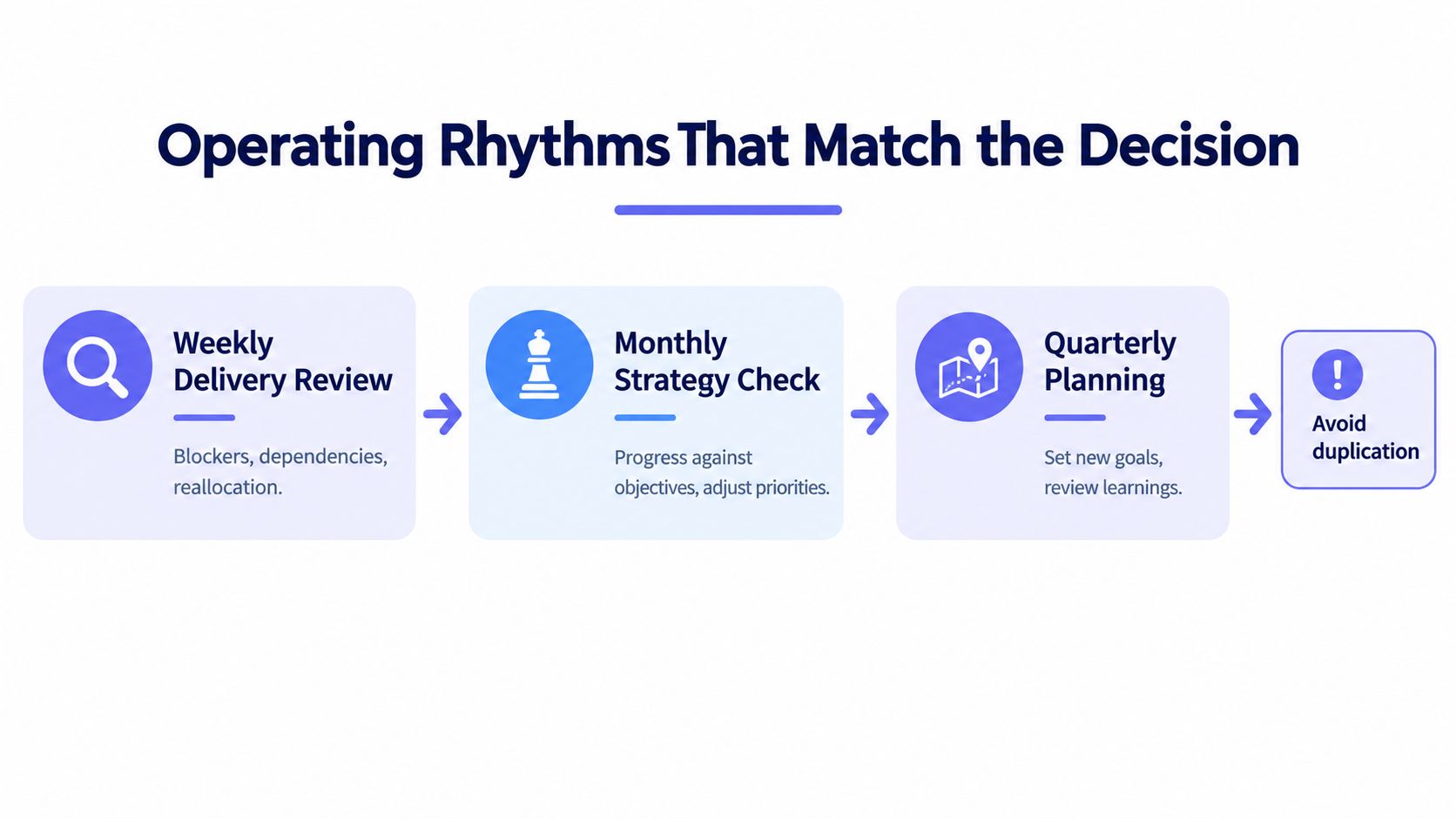
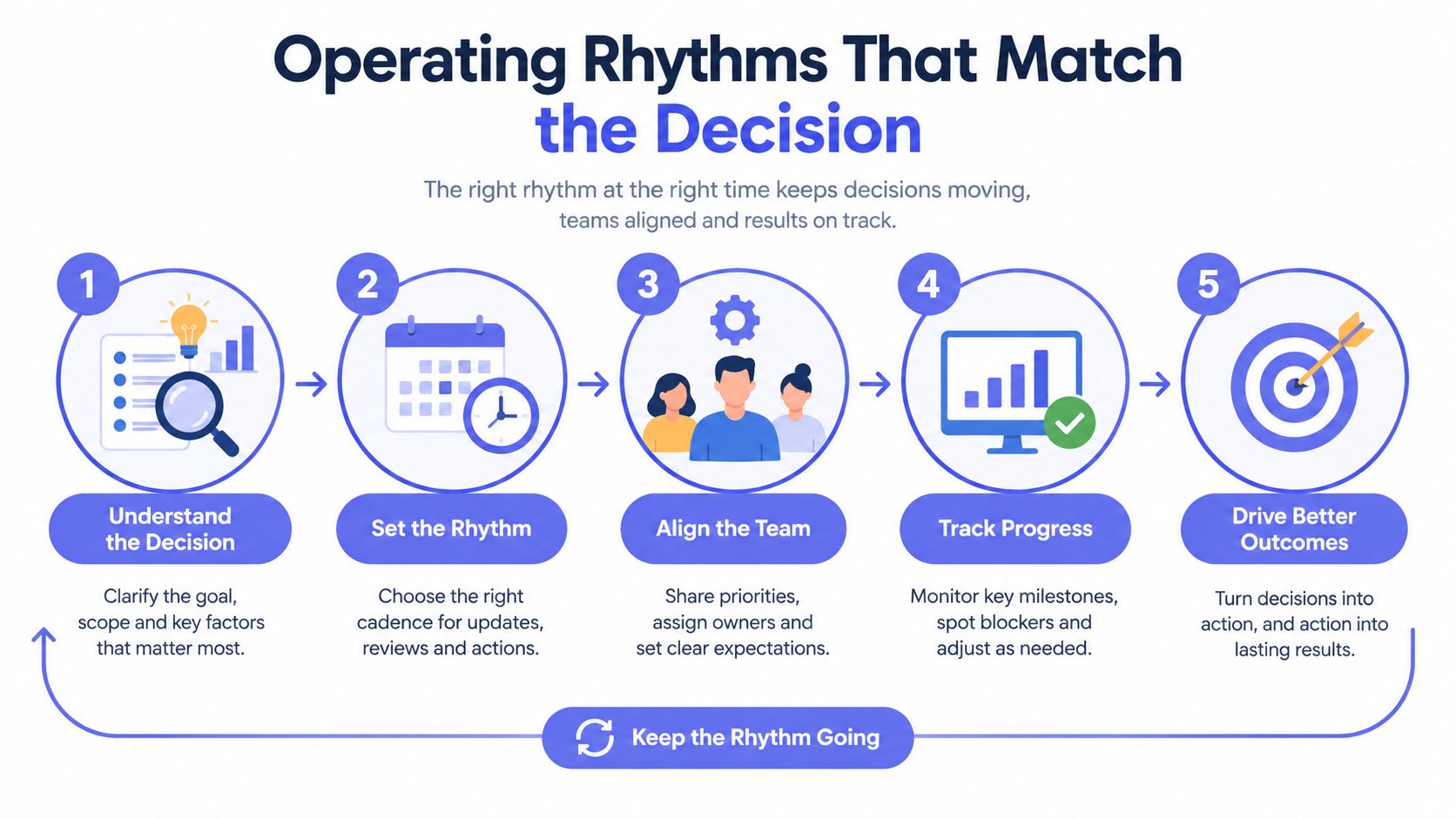
A meeting cadence works when each forum has a distinct decision to make. Don't put delivery blockers, strategic choices and quarterly planning into one recurring meeting and call it alignment. That approach creates status updates without giving any issue the time or authority it needs.
The weekly delivery review should resolve immediate obstacles. Teams raise dependencies, capacity conflicts and delivery risks, then agree who will act and what resources need to move. The purpose is not to restate the whole strategy or debate whether the organisation should enter a new market.
The monthly performance review should examine variance against OKRs. Leaders ask what moved, what didn't, why the gap exists and what corrective action follows. If an objective is off track, the meeting should produce a decision, not another request for a refreshed slide.
The quarterly strategy forum considers whether priorities still fit the evidence. Leaders can reallocate resources, adjust objectives and retire work that no longer makes sense. A useful cross-functional alignment playbook can help clarify how functions resolve dependencies, but the leadership team still needs to decide which forum owns each trade-off.
Use feedback to make targets consequential
A UK field experiment with commercial airline pilots found that monitoring and target-setting significantly increased productivity on fuel-saving behaviours. Personalised targets also increased adoption of fuel-saving practices without increasing flight delays. The airline-pilot field experiment The lesson for leaders is direct: a target needs credible measurement and feedback, not just a place in a planning document.
Use the weekly forum to unblock work, the monthly forum to correct performance and the quarterly forum to change direction. Keep the inputs and decisions distinct, and record what each meeting changes. My guide to building an operating rhythm for execution goes deeper on designing that cadence.
Two Scenarios From the Field
The right execution system depends on the work and the organisation's constraints. A scale-up needs to protect scarce capacity while preparing for growth. An enterprise function may need to coordinate across business units that have different data, budgets and incentives. The design changes, but the test stays the same: do priorities alter hiring, roadmaps and meeting agendas?

A scale-up preparing for its next funding stage
Consider a 120-person scale-up preparing for a Series B. The leadership team has committed to improve retention, strengthen the sales pipeline and prepare the product for larger customers. Product and sales keep escalating bespoke requests, while customer success asks for more capacity to address recurring issues.
The team stops treating every request as urgent and makes the trade-off visible. It reviews delivery blockers weekly, then examines progress against the priority outcomes monthly. At executive level, it keeps three results in view: the agreed customer-retention measure, qualified pipeline against its target, and progress on the product capability needed for larger customers. Hiring requests must connect to those outcomes or wait for a leadership decision.
The change isn't a new forecast or a more polished dashboard. It's a rule: when a new request competes for the same capacity, leaders decide what moves out.
An enterprise function inside a large group
Now consider a function inside a 4,000-person enterprise. Its transformation programme depends on shared data and approvals across several departments. Each unit reports progress, but nobody owns the end-to-end outcome, so unresolved dependencies survive from meeting to meeting.
The function gives each objective a named executive owner, sets a weekly forum for operational blockers and adds a monthly review focused on variance and decisions. It keeps a small number of outcomes visible at executive level, such as the agreed customer or service result, the delivery measure linked to the transformation, and the key dependency that could prevent either. Quarterly, leaders decide which work to continue, change or stop.
These are illustrative scenarios, not reported case studies. In both, the important shift is from tracking activity to making resource and priority decisions against shared outcomes. OKRs only help when teams can see what the leadership team chose to protect and what it chose to deprioritise.
What Happens to Objectives When the World Changes
An annual plan shouldn't become a promise to ignore new evidence. Leaders need enough discipline to execute and enough judgement to change course when assumptions no longer hold. Without an agreed mechanism, teams either defend outdated objectives or chase every new signal.
UK public-sector transformation data makes the challenge plain. In a 2025 survey of 400 UK public-sector decision-makers, 41% identified changing priorities as one of the biggest transformation challenges. Only 16% said transformation strategies were fully implemented across their organisation, down from 23% in 2023. UK public-sector transformation survey
The answer isn't to protect the plan at all costs. It's to set review triggers in advance. A material movement in a key metric, a credible competitor signal or a funding change can prompt leadership to reassess an objective. A trigger starts a decision; it doesn't automatically create a new priority.
Make the trade-off visible
When assumptions change, record what leaders decided and what that decision costs. A simple trade-off log should show the signal, the decision, the owner, the work to stop or reduce, and the consequence for capacity or timing. This stops a new initiative being added on top of existing commitments without anyone acknowledging the burden.
Retire work visibly. Tell affected teams which activity is ending, who will reassign the capacity and whether any deliverable remains essential. If leaders leave old objectives open while announcing new ones, teams accumulate abandoned initiatives and lose confidence in the next priority.
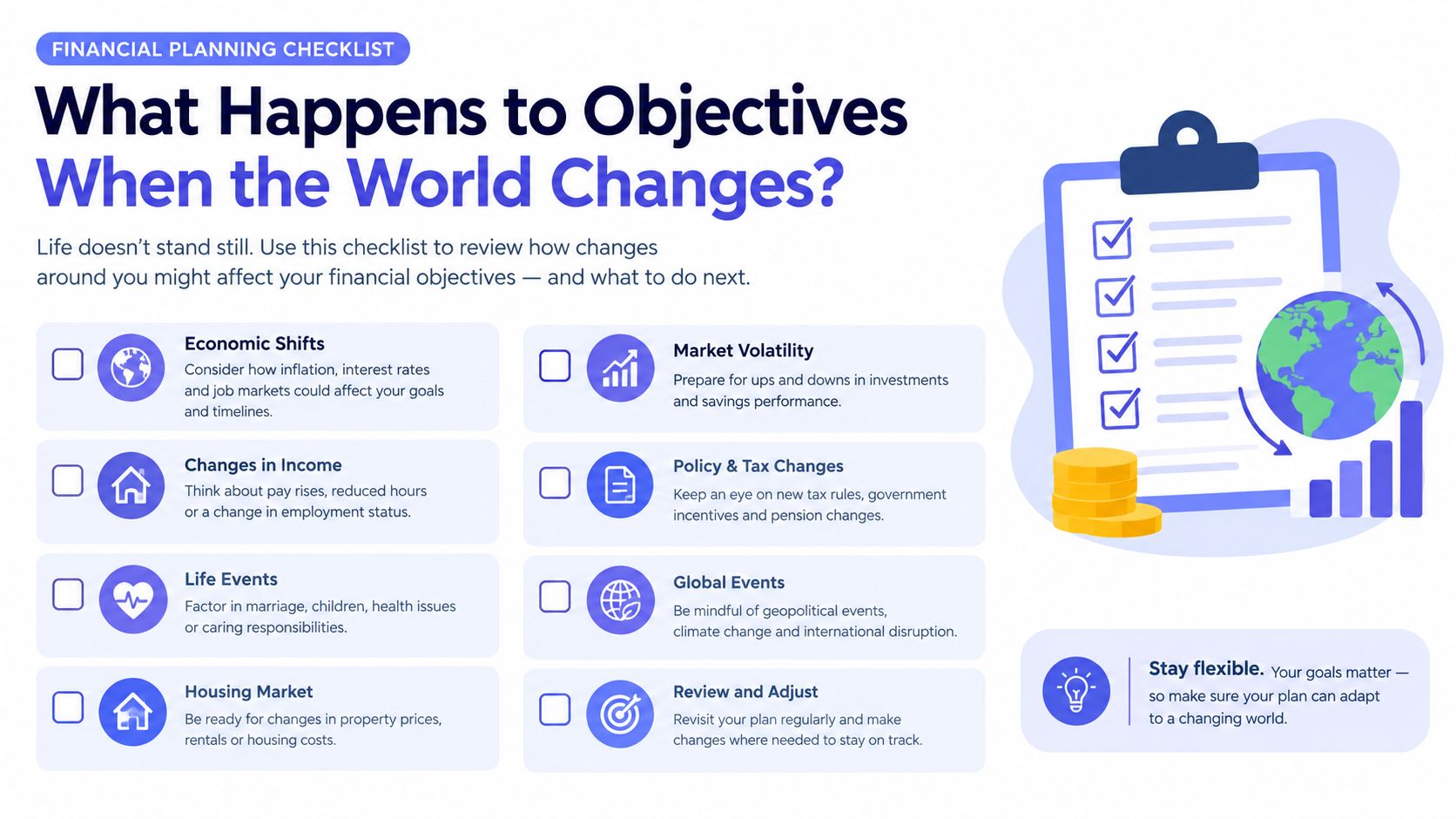
Quarterly strategy forums should decide whether objectives remain valid. Weekly reviews can resolve immediate consequences, while the monthly performance review tests whether the change is producing the intended effect. My guide to iterative planning and controlled reprioritisation expands on how to adapt without turning every review into a reset.
A system that cannot change priorities isn't reliable. It's slow. A system that changes them without recording what stops isn't agile. It's accumulating commitments.
A 30-60-90 Diagnostic for Your Execution System
Start by observing the system you have, not by launching a new one. For leaders who want a structured view of current practice, performance diagnostics for execution can help frame the review.
- Days 1–30, establish the baseline. Map what your current meetings decide. Identify which objectives changed behaviour during the last quarter and where ownership is unclear. Check whether teams can point to work they stopped because of a priority.
- Days 31–60, design the minimum viable system. Agree a small set of outcome-based OKRs. Give each result a named owner, a measure and a review interval. Set a weekly delivery review and a monthly performance review, each with a clear decision remit.
- Days 61–90, make the system stick. Define escalation triggers, start a trade-off log and make retired work visible. Review whether leadership decisions changed staffing, roadmaps or capacity, then adjust the cadence if meetings are duplicating one another.
Don't measure success by the number of OKRs written or meetings scheduled. Measure it by whether leaders make clearer choices, teams understand what to prioritise, and delivery problems reach someone who can act.
I help leadership teams turn strategy into an operating system that clarifies priorities, strengthens accountability and improves delivery through practical OKR design and governance. If you want to address the gap in your organisation, book a conversation.