
Only 18.4% of companies achieved more than 80% of their aspirational growth goals within three years in a 2025 survey of 250 UK companies with turnover above £20 million, while only 46% had a clearly measurable gap between current performance and their ambition. That changes the question leaders should ask. It's not whether the strategy is convincing, but whether anyone can measure the distance to the outcome and decide what happens next.
I judge operating management systems by that standard. A framework earns its place when it connects a leadership decision to weekly action, exposes drift and gives someone the authority to respond.
Why Good Strategies Still Stall in Execution
0.55 was the average management-practices score in 2023, compared with 0.49 in 2020, according to the ONS Management and Expectations Survey methodology. The median was 0.60; regional means ranged from 0.52 in Scotland and Northern Ireland to 0.56 in England. The scale measures implementation of structured practices. These official statistics are based on a voluntary survey and do not measure execution quality directly.
The missing distance between ambition and delivery
A 120-person scale-up has a clear three-year plan. By March, sales treats international expansion as the priority, while product focuses on retention. Without a measurable view of the gap between current performance and the ambition, leadership cannot make the trade-off explicit or direct this week's work.
The symptoms are recognisable:
- Slogan objectives: Leaders approve ambitions without baselines or observable results.
- Planning resets: Quarterly planning starts over instead of using unfinished commitments to guide decisions.
- Lost confidence: After two cycles without follow-through, teams may treat the plan as presentation material.
Structured management has economic relevance, although association isn't causation. Leaders should treat links between management scores and productivity as correlation, not proof.
A strategy becomes operational when leaders turn a performance gap into an owned outcome and a decision about this week's work.
That is the work of closing the execution gap, not producing another strategy document. The test for OKRs, Balanced Scorecard, EOS and MBO is whether each connects a decision to an owner, a review rhythm and a response when delivery slips.
Four Systems Compared on Rhythm and Accountability
Operating systems compared on core criteria
| System | Core idea | Review rhythm | Main strength | Main limitation |
|---|---|---|---|---|
| OKRs | Quarterly objectives with measurable key results | Weekly check-ins, quarterly scoring | Focus and transparency across teams | Fails without named owners and honest scoring |
| Balanced Scorecard | Strategy mapped across financial, customer, process and learning measures | Monthly or quarterly performance reviews | Links financial and operational measures | Heavy to build and can become a reporting exercise |
| EOS | Vision, traction and people tools run through a fixed meeting system | Weekly leadership meeting, quarterly priorities, annual planning | Strong meeting discipline and simple tools | Relies heavily on the leader and integrator role |
| MBO | Individual objectives agreed with a manager and linked to appraisal | Annual review with interim checks | Clear personal accountability | Encourages low targets and weak cross-team work |
Read the review rhythm column first. These are practical implementation patterns, not guarantees. The interval between reviews determines how long a blocked priority can remain invisible.
All four systems can work. All four also fail predictably when leaders adopt the paperwork without changing how they make decisions.
What each system catches, and what it misses
OKRs expose gaps in shared ownership. Say sales and product agree to improve customer activation, but neither accepts responsibility for the result. A proper check-in makes that unresolved accountability visible before the quarter ends. Without a named owner for each key result, the same framework becomes a shared wish list.
I favour OKRs when leaders need several functions to change an outcome together. Honest scoring matters more than polished wording. A missed result should trigger a decision about assumptions, resources or execution, not a debate about making the score look respectable.
Balanced Scorecard exposes an unbalanced view of performance. Revenue can look healthy while customer retention deteriorates. Reviewing financial, customer, process and learning measures together gives leaders a reason to question whether current revenue is sustainable.
Its weakness is the distance between the dashboard and the work. A measure assigned to a function isn't necessarily owned by a person with authority to change it. Building an elaborate scorecard also consumes management time before anyone makes a better decision.
EOS exposes stalled commitments through meeting discipline. In a hypothetical quarterly priority, a weekly leadership meeting can catch a blockage in week three rather than at quarter end. The single owner must explain the obstacle and secure a resolution.
The risk is dependence on the leader and integrator. If they tolerate vague updates or avoid difficult issues, a fixed agenda won't create accountability by itself.
MBO exposes individual underperformance but can miss collective failure. Every manager might achieve a personal target while a shared product launch slips. Sales protects bookings, engineering protects delivery commitments, and nobody owns the commercial launch outcome.
Linking objectives to appraisal and pay sharpens personal attention. It can also encourage conservative targets and make cross-team assistance feel like unrewarded work.
Objectives need a complete management loop
CIPD's analysis of 2023 UK employee data found 28% reported systematic performance management, including objective-setting, monitoring, feedback and accountability, while 48% reported at least basic performance management; 89% under systematic management reported achieving objectives and fulfilling requirements, compared with 76% reporting no performance management. These are employee-reported associations, not a head-to-head trial of frameworks.
CIPD also cautions that specific, challenging goals suit relatively straightforward tasks better than complex, interdependent work. For product development and transformation, I would review learning, dependencies and customer evidence beside the number. Otherwise, leaders can reward a target while discouraging the adaptation needed to deliver it.
A useful operating rhythm gives leaders somewhere to resolve that tension. It's not a recurring status meeting.
My shortlist comes down to two filters: how many teams must pull together within a quarter, and how often leaders will review progress. For any miss, the minimum test is simple: can someone name the accountable owner and the next review date?
Matching the System to Your Stage and Structure
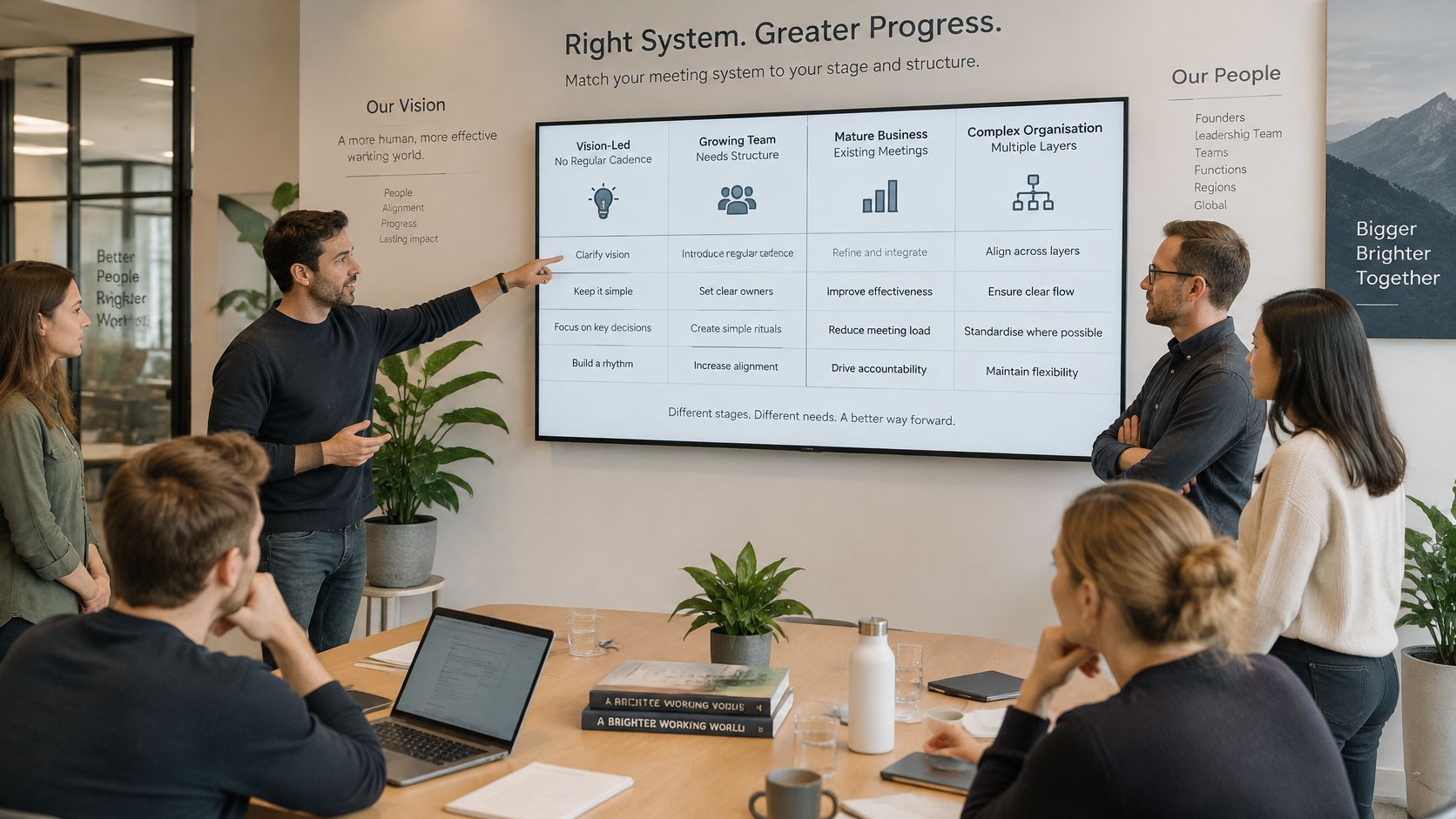
I wouldn't choose operating management systems by company size alone. Size is a clue. The stronger signals are where decisions get stuck, how teams depend on each other and whether leadership already has a reliable cadence.
Match the coordination problem
Consider a hypothetical founder-led business of about 60 people. The founder communicates the vision clearly, but priorities change through informal conversations. I would start with EOS to establish a dependable weekly leadership meeting, then add OKRs when more than three functions need to contribute to the same quarterly outcomes.
Now consider a hypothetical 150-person scale-up where product and sales name different top priorities by March. Another meeting template won't settle the disagreement. I would use OKRs to force explicit choices about shared outcomes and retain a short financial scorecard so operational focus doesn't weaken financial control.
Which system fits the stage
| Situation | Scale signal | System to use | Working signal |
|---|---|---|---|
| Founder-led, vision but no cadence | Hypothetical business of about 60 people | EOS first, OKRs once more than three functions share a quarter | Weekly meeting held and priorities still standing after two cycles |
| Scale-up, functions pulling apart | Hypothetical business of about 150 people | OKRs for shared outcomes, simple scorecard for finance | Fewer cross-team escalations and one set of quarterly priorities |
| Multi-division enterprise with a PMO | Hypothetical enterprise with 12 divisions | Balanced Scorecard as the spine, OKRs inside teams | Division measures and team outcomes reviewed on one calendar |
| Owner-managed, pay tied to personal targets | Individual appraisal drives behaviour | Keep MBO, add a small set of shared objectives | Personal targets no longer beat the shared launch |
An enterprise with a hypothetical 12 divisions and a PMO needs a common governance spine. I would keep the Balanced Scorecard at enterprise level and use team OKRs to express the changes needed beneath it. Division reporting and team execution should inform the same investment decisions, rather than create competing approval routes.
An owner-managed firm with pay tied to personal targets needs a different adjustment. Removing MBO abruptly can unsettle established expectations. I would retain individual appraisal and introduce shared objectives that make the launch, customer experience or delivery commitment visible alongside personal performance.
Build capability around the choice
For Shell NewMotion, The OKR Hub designed a bespoke Strategic Management framework, trained the entire company and built an internal coaching capability that sustained the programme. The relevant lesson is the combination of design and capability, not the appeal of a framework name.
For founders weighing OKRs for startups, I would look for fewer cross-team escalations and priorities that survive consecutive planning cycles. Stability doesn't mean refusing to change direction. It means changing priorities deliberately, with an explicit trade-off.
Take the matching situation into rollout. Don't install another framework on top of a cadence that already fails.
Running OKRs Alongside Your Existing Systems
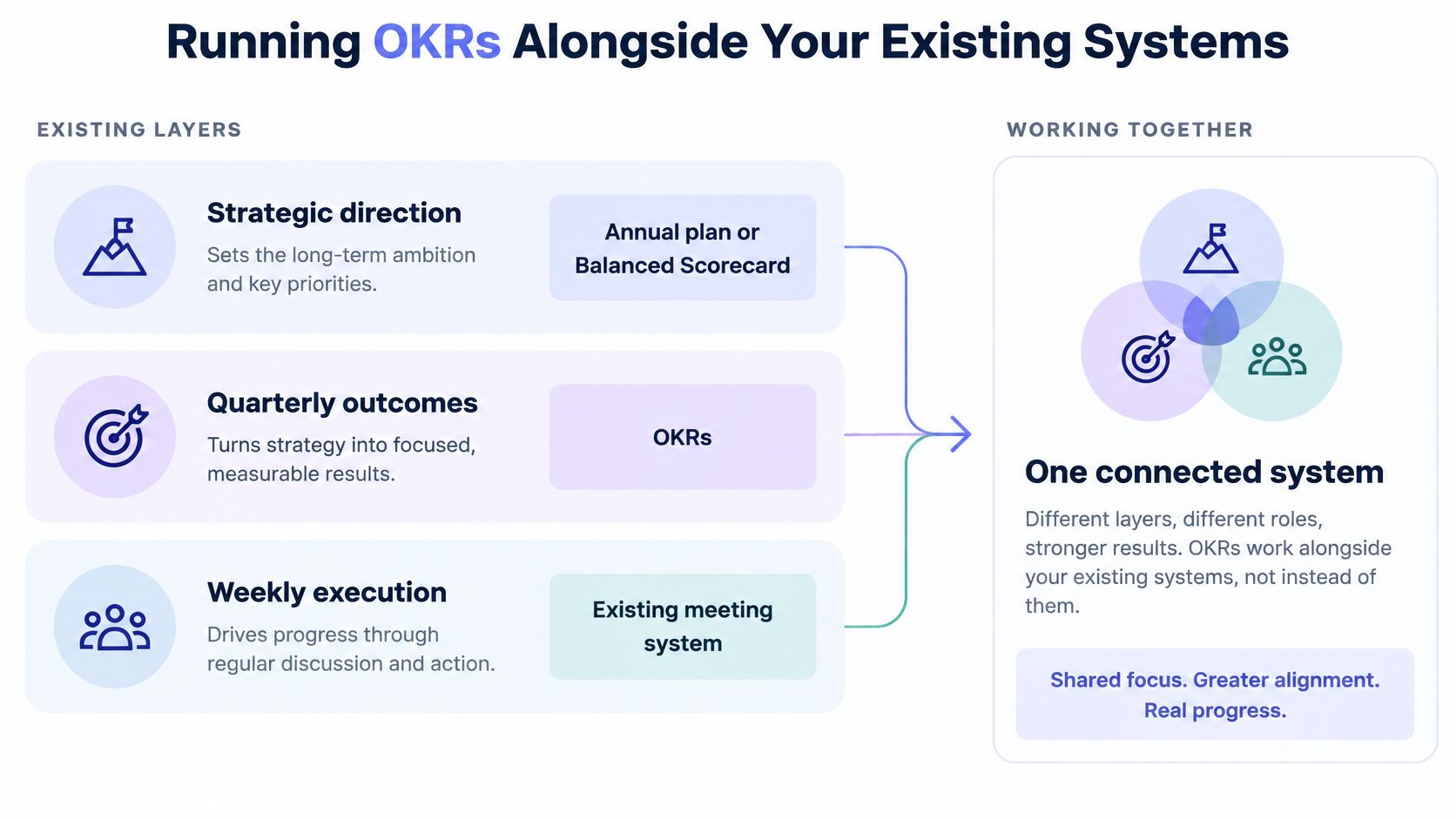
OKRs don't need to replace every existing management process. I would give each layer a distinct job, then remove the duplicate reporting between them. The expensive mistake is asking managers to maintain several versions of the same commitment.
Give each layer a clear purpose
Strategic direction stays in the annual plan or Balanced Scorecard. It records the choices about customers, markets, capabilities and investment that leadership intends to pursue.
Quarterly outcomes sit in OKRs. They describe the measurable changes that deserve concentrated attention now, rather than reproducing every operational metric.
Weekly execution runs through the existing meeting system, whether that's an EOS meeting or a standing leadership review. Managers discuss evidence, blockers and decisions there, rather than creating a parallel OKR meeting for the same people.
Individual reviews remain in MBO or the appraisal process. I would keep OKR scoring separate from individual pay decisions so that an ambitious shared outcome doesn't become an incentive to negotiate an easy personal target.
The distinction between OKRs and KPIs matters here. A service-quality KPI can remain under routine monitoring while an OKR focuses attention on a specific improvement. Neither needs to be copied into every tracker.
Make the connections explicit
- One owner per priority: Name the person accountable for coordinating delivery and securing decisions.
- One review calendar: Put outcome reviews inside existing governance wherever the participants and decisions overlap.
- One place for the truth: Maintain the current baseline, result, commentary and action record in a shared location.
Distributed teams need clearer decision rules, not more surveillance. CIPD's 2025 UK hybrid-working report found 74% of organisations use hybrid working, while 41% of employers believe increased home or hybrid working has improved productivity and 16% believe it has reduced productivity. Those perceptions don't establish that a location policy causes better or worse performance.
I would handle routine progress updates, evidence sharing and straightforward approvals asynchronously. Conflicting priorities, disputed evidence and decisions that shift capacity between teams deserve a live conversation. Record the resolution where absent colleagues can understand the change.
Integration test: For any priority, a leader should be able to say which system holds it, who owns it and when it will next be reviewed.
Watch for duplicated trackers nobody updates, OKRs becoming individual ratings, and scorecard measures without accountable owners. Each failure creates a different version of reality. Judge progress through customer behaviour, delivery evidence and business outcomes, not online presence or activity counts.
How to Choose and Roll Out Your System
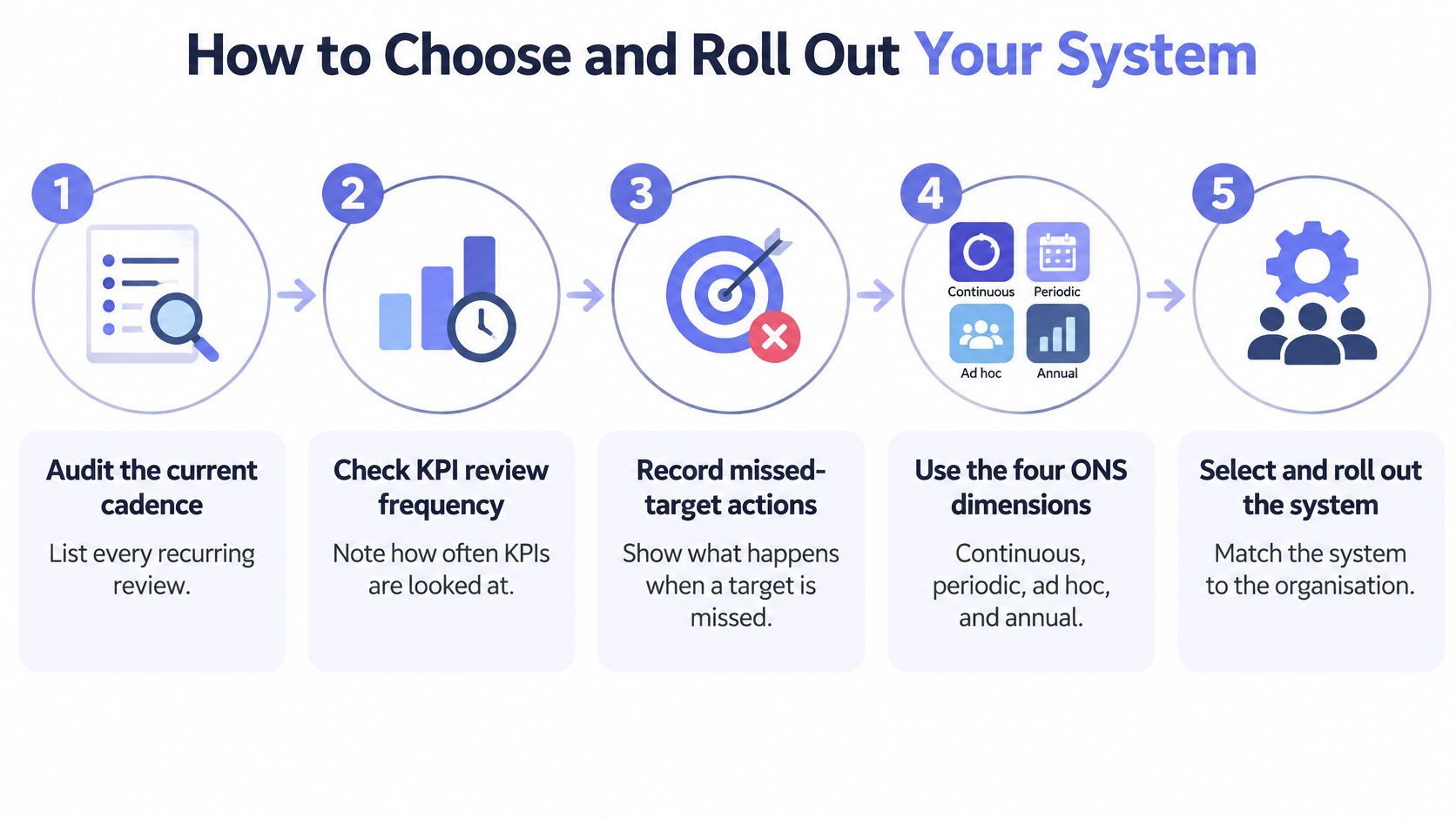
I would treat system selection as a controlled operating change, not a software procurement exercise. Establish the decisions and behaviours that must improve before choosing templates or tooling. Otherwise, leaders can spend the first cycle configuring a system that preserves the old problems.
Run a bounded implementation
-
Audit the current cadence. List every recurring review, how often managers inspect KPIs and what happens after a missed target, using the ONS management-practices framework to check continuous improvement, KPI use, target-setting and employment practices. Capture actual behaviour, including promotion, training and responses to underperformance, rather than relying on the written policy.
-
Write the value gap, then name the decision. Record current performance, the ambition and the measurable distance between them before choosing the decision the system must improve, such as product investment or sales-and-delivery capacity. If leaders can't express that gap numerically and use it to make trade-offs, don't start the implementation cycle.
-
Shortlist two systems against the coordination problem. Use the comparison criteria to test how each candidate would handle a real unresolved decision, rather than asking which framework leaders prefer. Include the management cost: preparation, meeting time, data maintenance and the effort required to build ownership.
-
Choose one and run a first cycle of 12 weeks. A first-cycle OKR implementation typically runs across that period; OKR Implementation is designed for organisations starting from scratch or restarting after a failed first attempt. Define the boundaries of the pilot, including which leadership group participates and which existing reviews it replaces.
-
Assign ownership before launch. Give every priority an accountable owner, a review date and an agreed evidence source, then confirm who can resolve dependencies beyond that owner's authority. A name without decision rights creates an escalation bottleneck, not accountability.
-
At week 12, decide whether to keep, adjust or change. Score the cycle, inspect the decisions it improved and identify where managers still worked around the process. Keep the system if it improved execution, adjust the weak routines if adoption was inconsistent, and change it only when its underlying design doesn't fit the work.
Assess the quality of decisions
The most useful rollout planning includes an explicit record of decisions, not just attendance and completed training. Note which activities stopped, which resources moved and which assumptions changed after reviewing evidence. That makes it possible to distinguish adoption from administrative compliance.
Restart rule: Diagnose the failed routine before replacing the framework.
If the first attempt failed, begin with the cadence audit. Look for cancelled reviews, inaccessible evidence, owners who couldn't secure decisions and priorities added without removing anything else. A different framework won't correct those behaviours automatically.
I would also test whether the organisation can run the process without external prompting. The goal isn't permanent dependence on a facilitator. It's a leadership team that can recognise drift, resolve disagreements and maintain the practice itself.
Decide on Your Operating System This Quarter
The decision starts with three questions: where does strategy break today, which situation matches the organisation's structure, and who owns the first 12 weeks? If leaders answer those plainly, the shortlist should become manageable. If they can't, another framework presentation won't resolve the uncertainty.
For a broader view of how workforce coordination connects to management design, Turn On Work's workforce systems guide is a useful companion. Keep the distinction clear between organising work and selecting the leadership routines that govern it.
Make the next 10 working days count
- Gather the operating evidence: Pull together recurring reviews, KPI review frequency and the actions taken after missed targets.
- Set the decision boundary: Agree the measurable performance gap and the decision that better governance must improve.
- Choose deliberately: Shortlist two systems, test them against that decision and select one.
- Prepare accountability: Confirm an owner and review date for every priority before the cycle begins.
Some clients start with an OKR Maturity Assessment and a single leadership workshop before deciding next steps. Others arrive with a clear brief for a full implementation programme. The useful distinction is whether leadership understands the execution problem, not how much implementation activity it can commission.
94% of OKR Implementation clients run a successful second cycle. That's a continuation measure, not a promise of a particular business result. If the choice remains unclear, a diagnostic conversation is more useful than adding another framework.
I help leadership teams in scale-ups and enterprises turn strategy into execution by choosing an operating system and establishing the cadence, ownership and reviews that make it hold. To discuss the execution problem your leadership team needs to solve, book a conversation.