
Only 18.4% of large UK businesses achieved more than 80% of their aspirational growth goals within three years of setting them, according to research by Strategy Management Partners reported by Financial Management. Strategy decision making often fails before delivery begins: leaders state a direction, then fund work that doesn't reflect it. A real decision needs a primary objective, evidence, one owner, a time horizon and an explicit stop. If one of those is missing, the choice isn't ready to become work.
Why Strategic Choices Fail Before Execution Starts
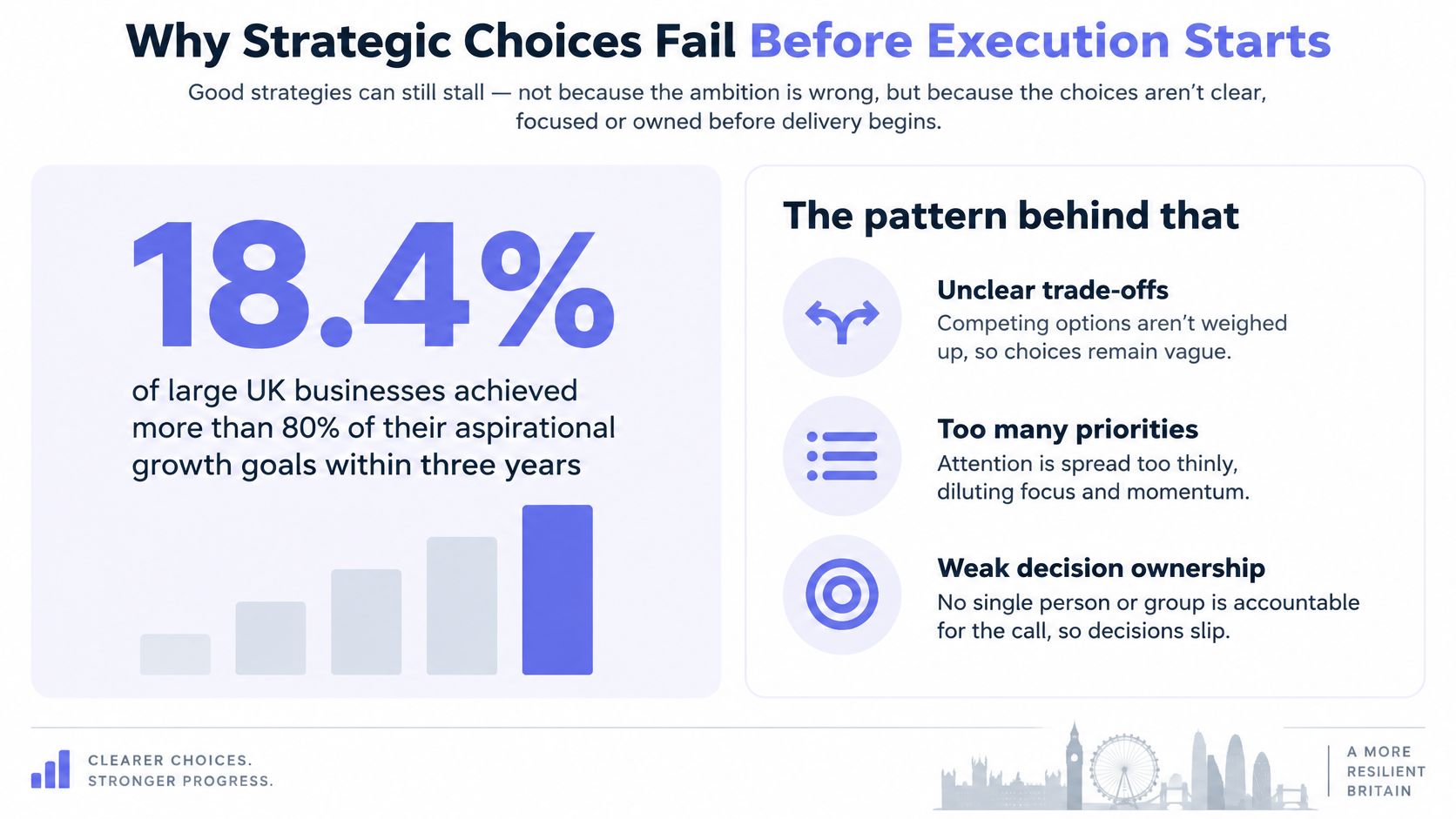
Ambition is rarely the problem. Many firms name productivity as a goal when they invest, yet it is seldom the main reason the money moves. The gap between a stated aim and the actual funding choice is where execution starts to drift.
A leadership team runs six live priorities, a full backlog and a quarterly review that reports completed activity. The executives agree that growth matters, but nobody can say which work lost capacity when the newest initiative was approved. That is evidence the priority was never funded as a real choice.
The test I apply in the room: if two executives can't say what stopped so the priority could be funded, the choice hasn't been made.
Each missing element fails in a predictable way. Objectives go vague when they are written to please everyone in the room. Ownership gets shared because naming one person feels risky. The stop rule disappears first, since it forces the team to state in advance what failure looks like. Without it, commitment becomes automatic and the choice survives on inertia rather than evidence.
Score one recent investment against the full set this week. If the objective is vague, the owner is shared or no work stopped to make room, record the gap and take it into the next decision meeting. The OKR Hub starts with the strategy execution problem and works downstream from there, tracing the choice into the work and the measures so strategy and delivery stay in one conversation. Why strategy execution fails covers the common patterns behind that drift.
Strategy decision making is the evidence trail, the named owner and the stop rule that turn a choice into resourced work inside the OKR cycle. Anything less is a preference stated out loud.
Decision Models for Different Strategic Choices
Strategy decision making gets clumsy when leaders force every choice through the same model. Use this table as a practical starting point. It matches the decision to the question it needs to answer, the evidence to bring and the failure mode to guard against.
| Model | Use it when | Question it forces | Evidence it needs | Usual failure |
|---|---|---|---|---|
| Playing to Win | Annual direction or a funding bet | Where to play, how to win, which capabilities | A choice set the team can resource | A narrative with no owner |
| OODA loop | A competitive response that cannot wait a quarter | What changed, and what do we do now? | A fresh observation, not last quarter's slide | Speed with no recorded assumption |
| Evidence stage-gate | Spend above an agreed threshold | What would falsify this bet? | Baseline, confidence level and a kill line | The bar is only that a slide exists |
| Decision rights | A cross-functional trade-off | Who proposes, who decides, who accepts the risk? | Named decider and the trade-off written down | A RACI chart with no outcome |
| OKR governance | Keeping a choice alive after it is made | Is this still worth the capacity? | Leading indicator, downside signal, stop threshold | Status reporting dressed up as a decision |
Match the model to the stake
I use Playing to Win for annual direction and major funding bets. It forces leaders to make three strategic choices: Where to Play, How to Win and Capability Focus. That makes it useful when a team needs to narrow options and commit resources. It fails if the discussion produces a persuasive narrative but leaves without a named owner. The choices must fit the organisation's actual capacity, or the strategy is only aspirational.
The OODA loop, Observe, Orient, Decide, Act, suits a competitive response that can't wait for a quarterly planning cycle. It gives the team a way to act on a fresh change in conditions. But urgency isn't a reason to hide assumptions. Record what changed and what the team believes that change means. Otherwise, speed makes it harder to learn from the call.
An evidence stage-gate works for spend above a threshold the organisation has agreed in advance. Before releasing more capacity, require a baseline, a confidence level and a clear condition for stopping. The gate should test the bet, not the quality of the slide deck. For an AI initiative that needs a bounded test, a practical guide to planning your AI proof of concept can help make the experiment concrete before further commitment.
Give decisions a route into delivery
Decision rights matter when functions have competing needs. Name who proposes, who decides and who accepts the risk. A RACI chart on its own doesn't settle a trade-off. The decision still needs an intended outcome, an accountable decider and a record of what each side gives up. A practical four-action framework can help leaders turn a chosen course into actions with clear accountability.
OKR governance has a different job. It doesn't choose the strategy. It keeps the chosen strategy funded, measurable and open to revision. One objective, measurable key results, a named owner and a review that can stop work make the choice visible after approval.
A scale-up with fewer than about 100 people can often keep decision rights within the executive team. It still needs an evidence bar and a stop rule. An enterprise PMO doesn't need to introduce another model or forum. Attach the evidence bar to the governance meeting it already runs.
Use Playing to Win to choose, decision rights to assign, and the OKR cycle to fund, review and kill.
Who Decides and What Evidence Is Required
Perfect information never arrives before the commitment does. In 2025, 71% of high-value business decisions at UK companies were made using incomplete or partial data, while only 29% used complete and reliable data, according to EY research involving 250 UK business leaders. The workable discipline is agreeing the minimum evidence required before more capacity is released, and knowing what would change the decider's mind.
| Choice | Who decides | Minimum evidence | Review | Stop rule |
|---|---|---|---|---|
| Company priority | CEO with the exec team | Outcome baseline and the capacity given up | Quarterly | Two cycles below the key-result threshold |
| Major investment | Sponsor, with delivery owner | Business case, disconfirming evidence, confidence level | At the gate, then quarterly | Kill if the leading indicator is flat |
| AI or cross-functional initiative | Accountable executive plus risk owner | Value hypothesis and cost visibility | Monthly, then quarterly | No extra capacity without a commercial signal |
| Blocked dependency | Delivery owner with the exec | Dependency map and downside signal | Fortnightly OKR check-in | Reallocate if still blocked past the agreed date |
Put the minimum bar in writing
A company priority sits with the CEO and executive team. They agree the outcome baseline and the capacity being given up, then test the key result quarterly. Below its threshold for two cycles, the review becomes a stop decision.
For a major investment, the sponsor and delivery owner bring the business case, the evidence that could disprove it and a recorded confidence level. Review at the gate, then quarterly. A flat leading indicator is the signal to stop.
An AI or cross-functional initiative needs one accountable executive and one risk owner, plus a value hypothesis and cost visibility. Review monthly, then quarterly. If the commercial signal has not appeared, refuse extra capacity. A bounded test still teaches something; early activity is not proof of value.
A blocked dependency calls for a different response. The delivery owner and executive review the dependency map and downside signal at a fortnightly OKR check-in. If the work stays blocked past the agreed date, reallocate the team. The record should also name which outcome loses capacity as a result.
Challenge the case before committing
Every review should state what would falsify the plan. Ask the decider to write the disconfirming case first, and separate confidence in the evidence from commitment to act. Writing the disconfirming case first exposes the assumption the plan depends on most. A leader can then make a clear choice without pretending the information is more certain than it is.
Cognitive bias and misaligned incentives weaken decision quality, even in experienced teams. Make the sponsor and delivery owner sign the same success measure before approval, so one definition of success governs the work. Schedule a post-decision review at the gate as well. An Institute for Government review of six major UK projects identified weak post-project evaluation among the problems affecting decision making. Without a review after delivery, the organisation never tests its assumptions against what happened, and the next business case gets built on unchallenged reasoning.
I treat the written record as the point of the exercise: a named decider, the evidence that was enough, and the condition that stops the work. Pick one live decision and complete its row before the next leadership meeting. If the decider, minimum evidence or stop rule is still unclear, resolve that before approving more capacity. Where teams need to move quickly inside agreed boundaries, autonomy at work can sit alongside explicit accountability.
How to Handle Trade-Offs Without Overloading Teams
Teams lose an average of eight hours per week to busy work, equivalent to ten full working weeks per year, according to a survey of 500 UK business decision-makers. That makes overload a leadership decision, not an individual time-management problem. If leaders keep adding priorities without removing lower-value work, teams stay busy while strategic progress slows.
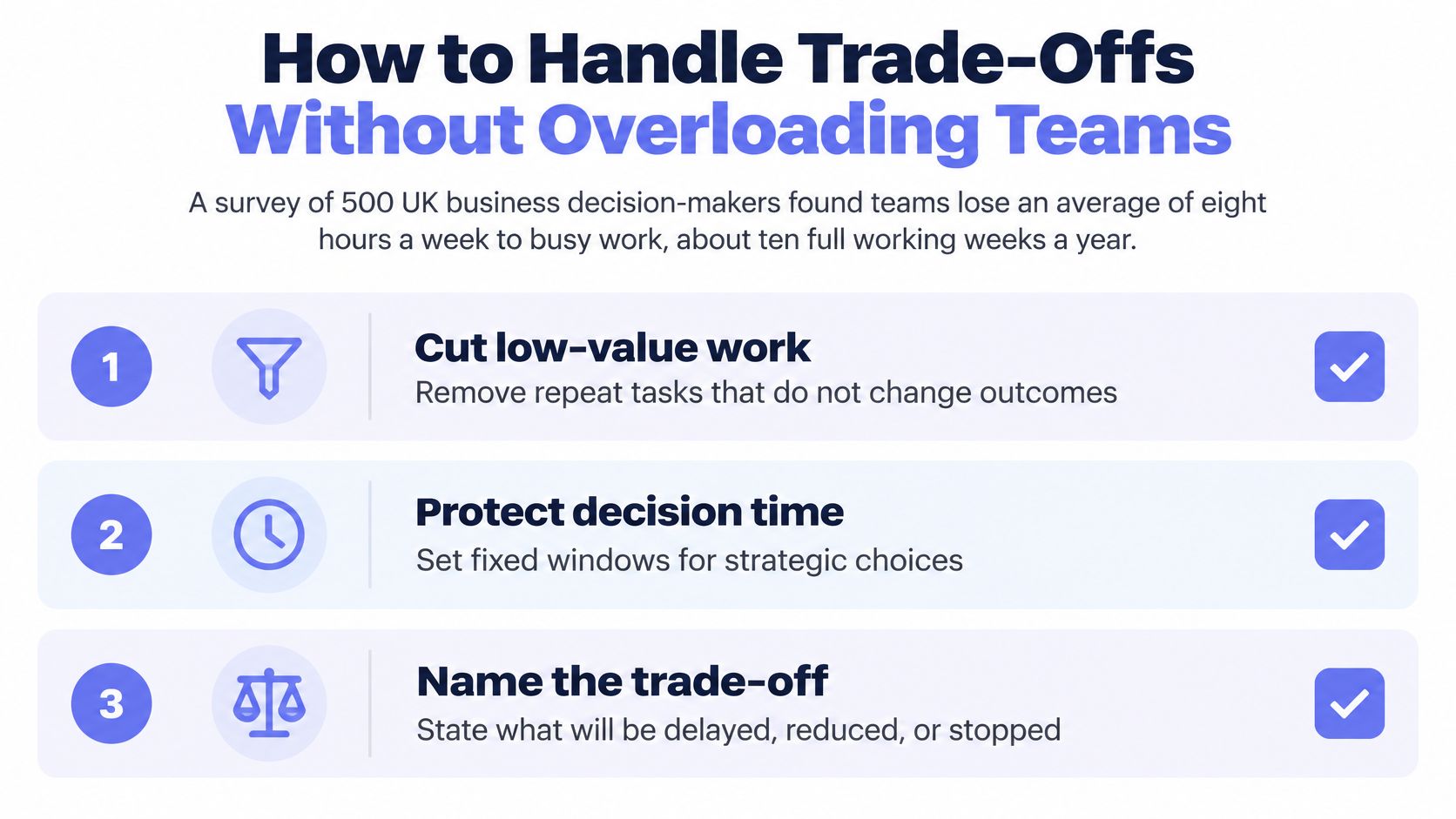
The rule I insist on: Every new priority must name what will stop, reduce or move later.
Keep company objectives to three to five. That limit forces leaders to choose what deserves attention instead of asking every team to treat every initiative as urgent. A clear strategic trade-off should make the cost of a choice visible in the work plan.
Make one real capacity call
Consider a scale-up preparing for funding. Leadership is weighing another growth experiment against platform remediation. The growth bet may help the company demonstrate commercial momentum, while remediation may protect revenue and reduce the risk of disruption. The answer isn't automatically to favour growth or technology. Score both choices on three criteria: the commercial outcome in the next two quarters, dependencies that could block it, and how reversible the spend is.
A clear call might be to keep the remediation that protects revenue, pause the second growth experiment and move its people onto the bet with the clearer outcome. That doesn't mean abandoning growth. It means refusing to fund two competing experiments when one has a better path to a measurable result and the existing platform needs protection.
The executive team should keep a capacity log with five fields: priority, owner, capacity added, work stopped and the date of the next decision. Use it in the same meeting where the priority is approved. If the log only records what starts, it hides the true cost of the decision. If it records what stops as well, teams can see which work is authorised and which work has been deferred.
The same rule applies to established enterprises with complex portfolios. A new objective should trigger a conversation about existing commitments, not an assumption that teams will absorb more work. Review activity against the intended outcome and move capacity when the evidence changes.
A clear objective without a stop line leaves the team busy and the strategy unfunded.
Decisions Leaders Recognise in Real Organisations
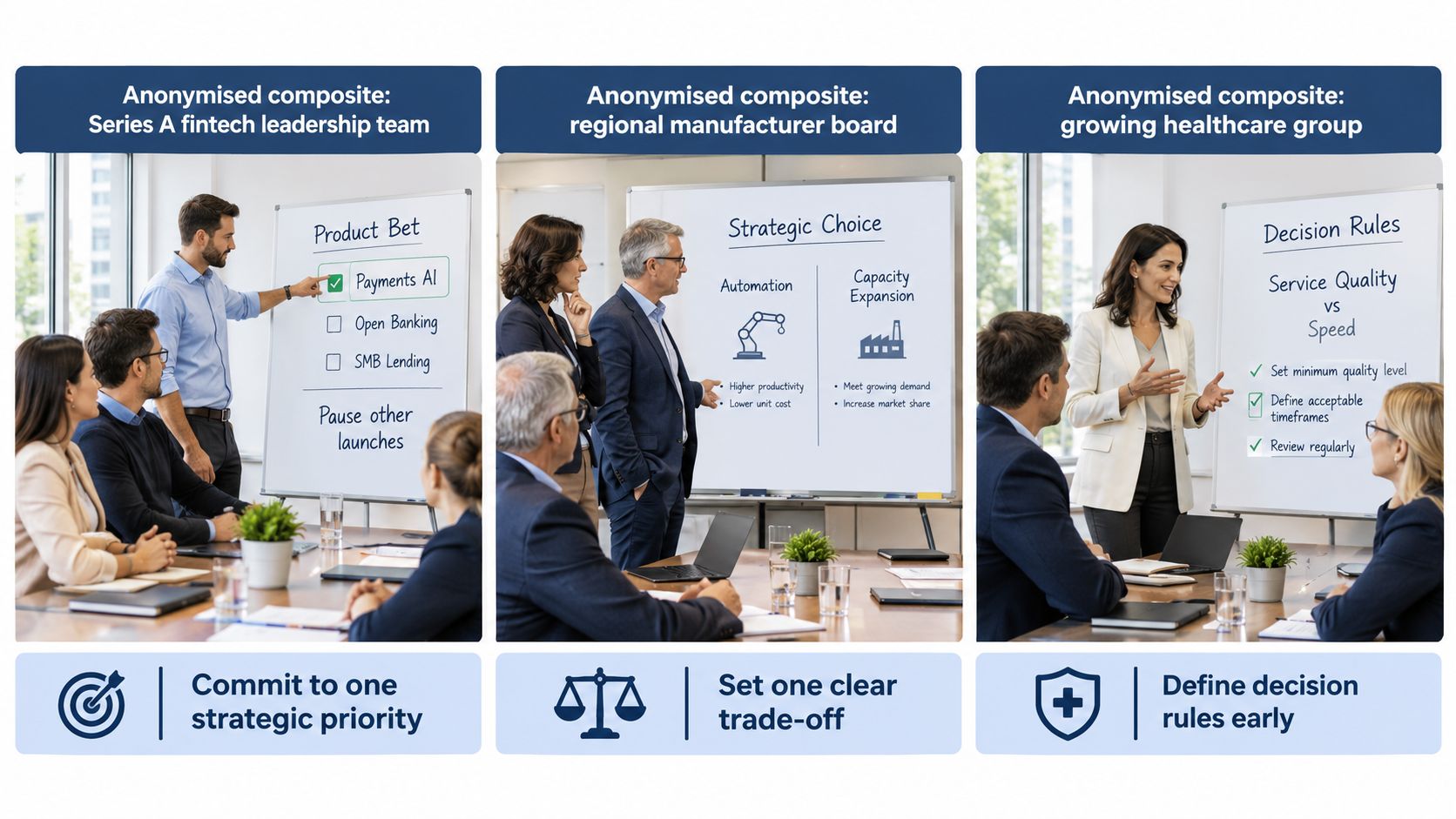
The situations below are anonymised composites of recurring patterns, with details changed. Each one shows how a choice becomes resourced work once leaders stop trying to keep every priority alive.
A fintech team chooses three outcomes
A Series A fintech leadership team arrives with six conflicting views of the company's priorities. Each executive can argue a credible case, yet the group cannot fund six outcomes without thinning attention across all of them. The key decision is which three outcomes get owners, budget and a review date, and which three views are parked with a reason recorded.
A CEO from a Series A fintech described the value of a facilitator this way: “We came in with six conflicting views on priorities and left with three company OKRs we all believed in. Having an external facilitator made all the difference. It meant the leadership team could participate rather than manage the room.”
Move to copy: Use an outside facilitator when every executive needs to argue, decide and commit inside the same room.
An enterprise rollout resets ownership
An enterprise rollout stalls after earlier OKR attempts fail. Another template will not solve the underlying problem. The rebuild combines training, coaching and a cross-business strategy workshop spanning New York and London.
The core decision is who owns each outcome across sites. Shared ownership sounds collaborative, but it leaves delays with no one able to change the plan. Each site needs one named owner who can surface blockers, escalate conflict and make the work visible to the wider programme. I would copy that move and leave the template alone.
Move to copy: Give each site outcome one named owner and write the stop rule beside it.
An AI approval waits for commercial evidence
An AI initiative can look successful early because teams point to better innovation and efficiency. Operational improvement does not automatically mean more revenue or lower cost. In the EY Responsible AI Pulse, 100 UK C-suite leaders reported gains of 80% for innovation and 79% for efficiency or productivity, while only 50% reported improved revenue growth and 49% cost savings; organisations with AI oversight committees reported 35% more revenue growth and 40% higher cost savings than those without such arrangements.
That gap turns governance into an operating decision. Leaders need the initiative owner, the escalation route, the value hypothesis and the evidence that earns more capacity. Without that trail, approval becomes a one-off hurdle and the spend keeps rolling after the signal has gone flat.
Move to copy: Set a value hypothesis and review point, then refuse extra capacity until the commercial signal appears.
The shared pattern is fewer choices, a named owner and evidence that can kill the bet.
How to Embed Decisions into the OKR Cycle
Tie the rhythm to performance, not paperwork. A UK Government evidence review reported that a 0.1-point increase in management-practice scores was associated with a 9.6% increase in productivity. The scores use a 0-to-1 scale and cover practices including performance measurement, target-setting, continuous improvement and employment management, according to the UK Government evidence review. The point for strategy decision making is practical: a choice needs a routine that translates it into measures, review and accountable action.
Six moves for the quarterly review
-
Lock the choices before drafting OKRs. Confirm which strategic choices the organisation will fund, then write the OKRs that express them. The reason is simple: objectives should represent a choice, not decorate a backlog. The slip is writing OKRs for every idea that has attracted attention.
-
Write the outcome hypothesis and what would disprove it. State the expected change and the evidence that would show the bet isn't working. This gives the team a way to learn and stop. Avoid an outcome statement that can't fail.
-
Assign the owners already set out in the decision-rights table. The purpose is to keep accountability aligned with authority. A delivery owner who can't reallocate capacity can't act on the evidence. Don't create another owner just to make a chart look complete.
-
Attach a leading indicator, a downside signal and a numeric stop threshold to each key result. These measures show whether the work is moving towards the outcome and when it may be causing harm or losing value. Don't wait until the review to invent the threshold after the result has missed.
-
Use the quarterly review to decide continue, pivot or stop. Move capacity in the same meeting so that the choice changes the work. Deferring reallocation to another meeting keeps the old plan alive by default.
-
Record the call in a decision log. Capture the assumption, confidence level and date of the next review. This gives the next cycle a record it can test. Don't create a log that nobody audits.
After one cycle, good looks like fewer objectives, one public reallocation and a decision log the next quarter can audit. A sound strategic choice still fails if it never becomes a measure, a review and an owner. For practical OKR planning, keep the choice and the evidence visible as teams translate strategy into commitments. Phase 04 of the Strategic Execution Advisory translates validated strategic choices into OKRs, investment priorities and governance cadences. Coaching and training can support the client's thinking and capability, but they don't replace internal governance and decision making.
Reset the Decision System Before the Next Cycle
Test your last strategic choice. Did the model fit the stake? Was one person accountable? Did the team name the evidence it needed? Did work stop so the priority could start? If any answer is no, the next OKR cycle may report activity again without resolving the decision.
Start by testing one live decision against the five items: primary objective, evidence, owner, time horizon and stop rule. Fix what is missing before the next review. That is more useful than adding another priority or rewriting an objective that still has no capacity behind it.
I help scale-up founders, enterprise strategy and transformation leaders, HR and L&D leads, and chiefs of staff turn strategic choices into owned, measurable commitments, then run those commitments through an OKR cycle so trade-offs are made in public. If you're ready to test a live decision, book a conversation.