
The usual advice is to fill every box in the 4 Action Framework. I would start by questioning the busiest box: Create. A new service or capability can sound strategic while making an already overloaded organisation harder to run.
Why Four Action Workshops Keep Producing Lists
Say a leadership team spends two hours generating forty sticky notes. The Create column fills up. Everyone leaves energised, but nobody has decided what stops.
The problem isn't a shortage of ideas. It's the absence of decisions about capacity, priorities and accountability.
The costs leaders inherit
- Priorities multiply. Each function selects the ideas that suit its existing plans. Leaders agree on the workshop output but disagree through their resource decisions.
- Delivery slips. Teams absorb additional commitments without losing existing work. Managers negotiate deadlines instead of resolving the overload.
- OKRs describe yesterday's work. Teams write objectives around existing projects, then attach the new ideas. The framework adds another management layer rather than changing the choices.
A polished grid doesn't resolve these problems. Neither does another round of objective writing.
For BBC Studios, after early OKR attempts had stalled, The OKR Hub rebuilt the approach with training, coaching and a cross-business strategy workshop spanning New York and London. The important distinction is between improving the conditions for execution and merely asking people to rewrite objectives.
My starting rule: A strategic workshop should remove commitments, not just produce them.
I recommend a stricter route: identify a short set of prioritised moves, test the assumptions, then convert the survivors into OKRs and a delivery plan. That gives leaders a basis for rejecting attractive ideas before teams inherit them.
The grid is only as good as the decisions it forces. The first test is whether anything comes off the plan.
What Each of the Four Actions Asks You to Decide
The Four Actions Framework comes from Blue Ocean Strategy, written by W. Chan Kim and Renée Mauborgne. Its purpose is to redesign value rather than compete only within existing market rules.
The questions are deliberately different. Eliminate challenges whether a factor should exist; Reduce challenges how much of it customers need. Raise and Create ask where an organisation should invest to offer something meaningfully better.
The four actions, the question each answers and the test to run
| Action | Question it answers | Typical example in a services business | Test before you commit |
|---|---|---|---|
| Eliminate | Which factors does the market take for granted that the business should drop? | Monthly status decks that nobody reads or acts on | Would any customer, regulator or team notice if it stopped? |
| Reduce | Which factors does the business over-deliver against the market standard? | Repeated internal reviews of routine client proposals | Does the reduction keep the decision quality customers rely on? |
| Raise | Which factors should the business push well above the market standard? | Response time on priority client issues | Will the customer notice, prefer or pay for the change? |
| Create | What has nobody in the market offered yet? | Self-service onboarding that removes the kickoff call | Is there evidence from customers, not just a workshop idea? |
Keep both sides of the decision
Eliminate and Reduce release cost and effort. Raise and Create should improve value that customers can recognise. A grid containing only the value half is a wish list; one containing only the cost half is a cost-cutting exercise.
Resource allocation is the practical connection to the UK Innovation Strategy, which committed to increasing annual public research and development investment to £22 billion. That's a national policy commitment, not evidence that a particular workshop produces innovation. The relevant lesson is that ambitions need explicit investment decisions.
The strategy canvas supplies the picture behind the grid. Plot the factors customers compare, such as price, speed, service complexity and convenience, against the level delivered by the business and its rivals.
A factor is something a buyer experiences, not an internal department or project. Decision speed is a factor; a procurement transformation programme is a proposed intervention.
I would settle the factors before discussing solutions. Each action must name a specific factor from the canvas, otherwise leaders can approve projects without agreeing which part of the customer experience needs to change.
How to Build the Grid Without Feature Inflation
The Blue Ocean Strategy explanation of the Four Actions Framework positions it as a way to reconstruct buyer value through elimination, reduction, raising and creation. I use that logic to expose operating-model trade-offs, not to maximise the number of ideas.
The working sequence needs to make those trade-offs visible.
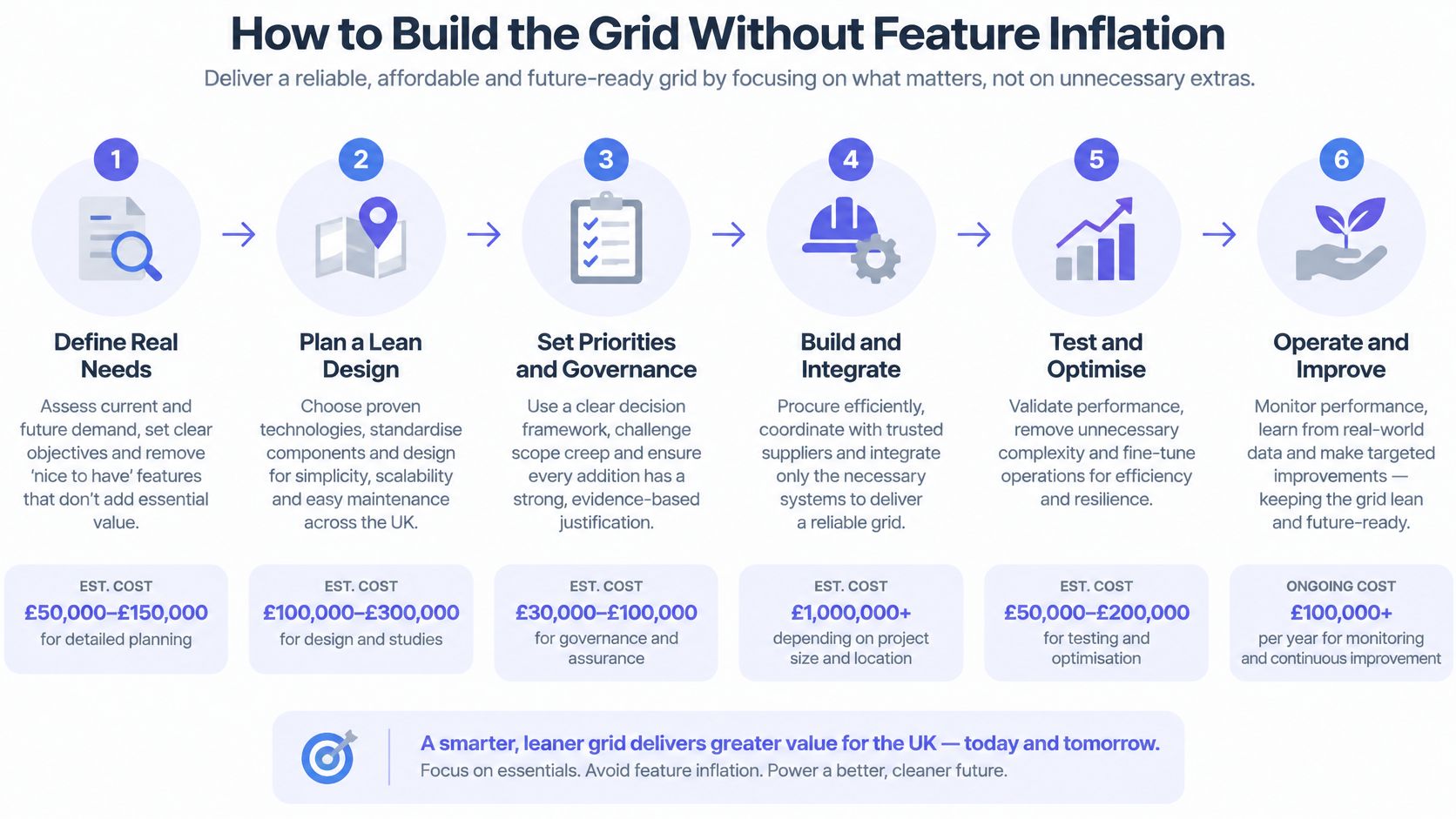
Build the decision grid
-
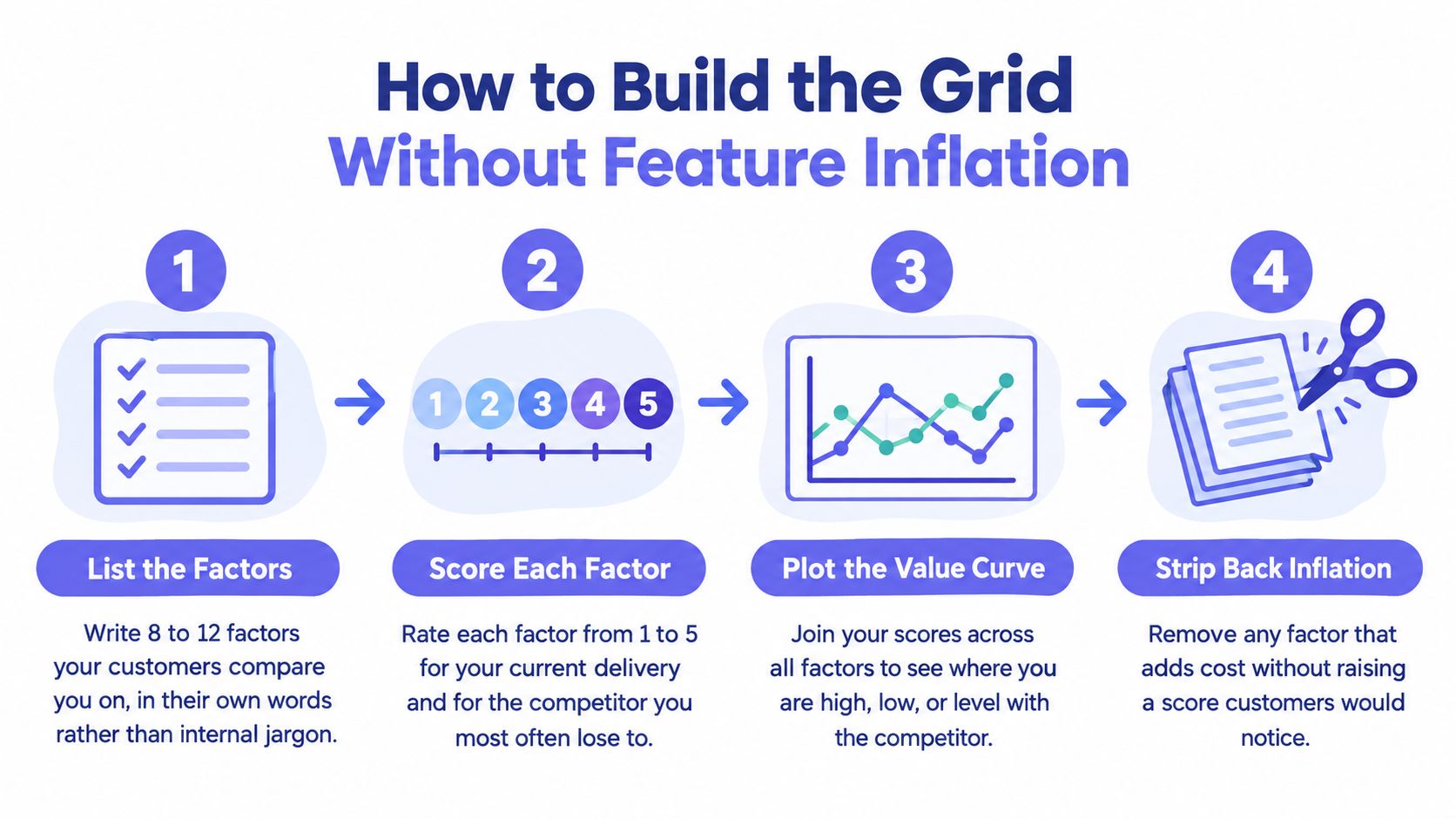
List the comparison factors. I recommend starting with eight to twelve factors, using customers' language rather than internal jargon. Include the reasons buyers reject the business, not just the strengths salespeople prefer discussing.
-
Score delivery candidly. Use a simple scale from one to five for the business and the competitor it most often loses to. Treat these as provisional judgements until customer interviews, lost-deal notes or service records support them.
-
Plot both value curves. Join the scores across the factors and circle the gaps. Look for expensive over-delivery as carefully as weaknesses, because an unnecessary premium can consume the capacity needed elsewhere.
-
Assign an action to each factor. Eliminate what nobody values, reduce unnecessary provision, raise factors that influence buying decisions and create only where an unmet outcome warrants it. Don't confuse an absent feature with an unmet need.
-
Pair added effort with released capacity. Write the funding eliminate or reduce beside every raise and create. Name the budget, specialist time or management attention released, because savings in one place may not fund the capability needed somewhere else.
-
Write each move as a hypothesis. State the change, expected customer effect and internal cost. For example, removing manual handoffs should shorten onboarding without increasing correction work.
-
Limit the active portfolio. I would cap the initial list at five to seven moves and park the rest. Sequence dependencies before approval so that teams don't start a new capability before its funding change takes effect.
These are workshop operating rules, not performance benchmarks. Their purpose is to make disagreement specific enough to resolve.
Check the funding, not just the columns
A grid with twelve raises and no eliminates is feature inflation. The team has added effort without choosing.
If raises outnumber eliminates and reduces, return to the action assignments and challenge the funding assumptions. An ambitious reduction might support several improvements, but leaders still need to demonstrate that the released capacity is sufficient.
Use a portfolio prioritisation process to compare the surviving moves against other commitments. The finished output should be a four-column grid in which every addition has a named source of funding, not a promise to find efficiencies later.
A Worked Example From Grid to Measurable Moves
Comic Relief illustrates why the actions need to work together. Sarah Robertson Consulting's account of its strategic redesign describes a participatory, entertainment-led event open to small donors, increased corporate sponsorship to cover operating costs, reduced expensive gala dinners and advertising campaigns, and an event cycle moved to once every two years.
The operating logic matters more than the labels. Broader participation can widen the donor base. Lower-cost delivery protects fundraising economics, while sponsorship changes how operating costs are funded.
Apply the logic to a services firm
Consider a hypothetical professional services firm of about 220 staff. All figures and targets in this scenario are illustrative, not client data.
| Action | Proposed move | Operational consequence |
|---|---|---|
| Eliminate | Stop monthly status decks | Release senior preparation and review time |
| Reduce | Simplify four approval layers for spend under £5,000 | Shorten routine decisions while preserving spending controls |
| Raise | Improve responses to priority client issues | Redirect senior attention towards accounts at risk |
| Create | Introduce self-service onboarding | Replace the kickoff call and two review meetings |
The onboarding proposal only has funding if those existing interactions disappear. Keeping them as reassurance would leave the firm supporting both models.
The test then changes the decision. In this scenario, customer conversations produce no evidence that buyers want self-service onboarding; they want a named person who resolves problems promptly. No customer asked for the proposed experience, and the team hasn't demonstrated an underlying unmet need.
A rejected Create idea can be a better strategic outcome than an approved project.
Measure the choice that survives
The firm drops self-service onboarding and keeps the response improvement. It measures time to a useful answer, unresolved priority issues and key-account retention, rather than counting messages sent.
The reporting reduction needs its own check: preparation time should fall without clients losing information they use. The approval change needs a control check, including exceptions and inappropriate commitments.
That distinction between activity and benefit is central to measuring outcomes. Launching a portal is an activity; helping clients reach value sooner is an outcome.
Creating additional demand without removing delivery friction can make service less consistent. The correct decision may be to improve an existing promise rather than invent another one.
Tests That Separate Strategic Moves From Wish Lists
A grid without tests is a brainstorm. I wouldn't let a move enter the execution plan because its sponsor presented a convincing slide.
The organisational context matters. The Strategy Execution 2025 research surveyed 250 UK companies with turnover above £20 million and international operations in March 2025. In organisations with multiple functions and governance layers, an apparently simple change needs explicit ownership and dependency checks.
Set the admission criteria
The thresholds below are my recommended decision rules, not findings from that survey. Apply them before allocating delivery capacity.
Six tests every ERRC move must pass before it enters the plan
| Test | Question to ask | Passes when | Kill or pause when |
|---|---|---|---|
| Customer evidence | Has a customer or frontline team asked for this? | At least three customer or frontline examples | Support comes only from leadership opinion |
| Named owner | Who is accountable for the outcome? | One executive owns the result | Ownership is split across three or more teams |
| Leading indicator | What moves first if it works? | A weekly metric is set before launch | No measure exists until after launch |
| Explicit trade-off | What existing work stops or slows? | A named item is removed from the plan | The idea is added on top of current work |
| Stakeholder impact | Who loses status, capacity or income? | Transition support and communication are planned | Affected groups haven't been consulted |
| Test window | Can the assumption be proved or disproved in 30 to 90 days? | A defined test has a review date | An open-ended pilot has no end date |
Customer evidence doesn't have to mean customers designed the solution. Frontline examples of repeated frustration can establish a problem worth testing. They cannot, by themselves, prove that the proposed solution will work.
Stakeholder review needs equal care. Removing approval layers may shift risk onto junior colleagues; reducing meetings may remove access for people excluded from informal conversations. Check inclusion, operational controls and legal or regulatory exposure before implementation.
Write the stopping condition first
A kill criterion specifies what evidence would make the owner stop or redesign the move. I would agree it before launch, while sponsors can still discuss failure without defending sunk effort.
For example, a hypothetical test might pause at day 60 if its leading indicator hasn't improved despite adequate adoption. A service-quality deterioration could trigger an earlier stop.
Record the decision alongside the strategic trade-offs, including what happens to released capacity if the test fails. Otherwise, a stopped pilot can leave its resources permanently committed.
Create isn't automatically innovation. Novelty earns a test, not permission to bypass evidence, funding or accountability.
Turning Grid Decisions Into OKRs and Delivery Plans
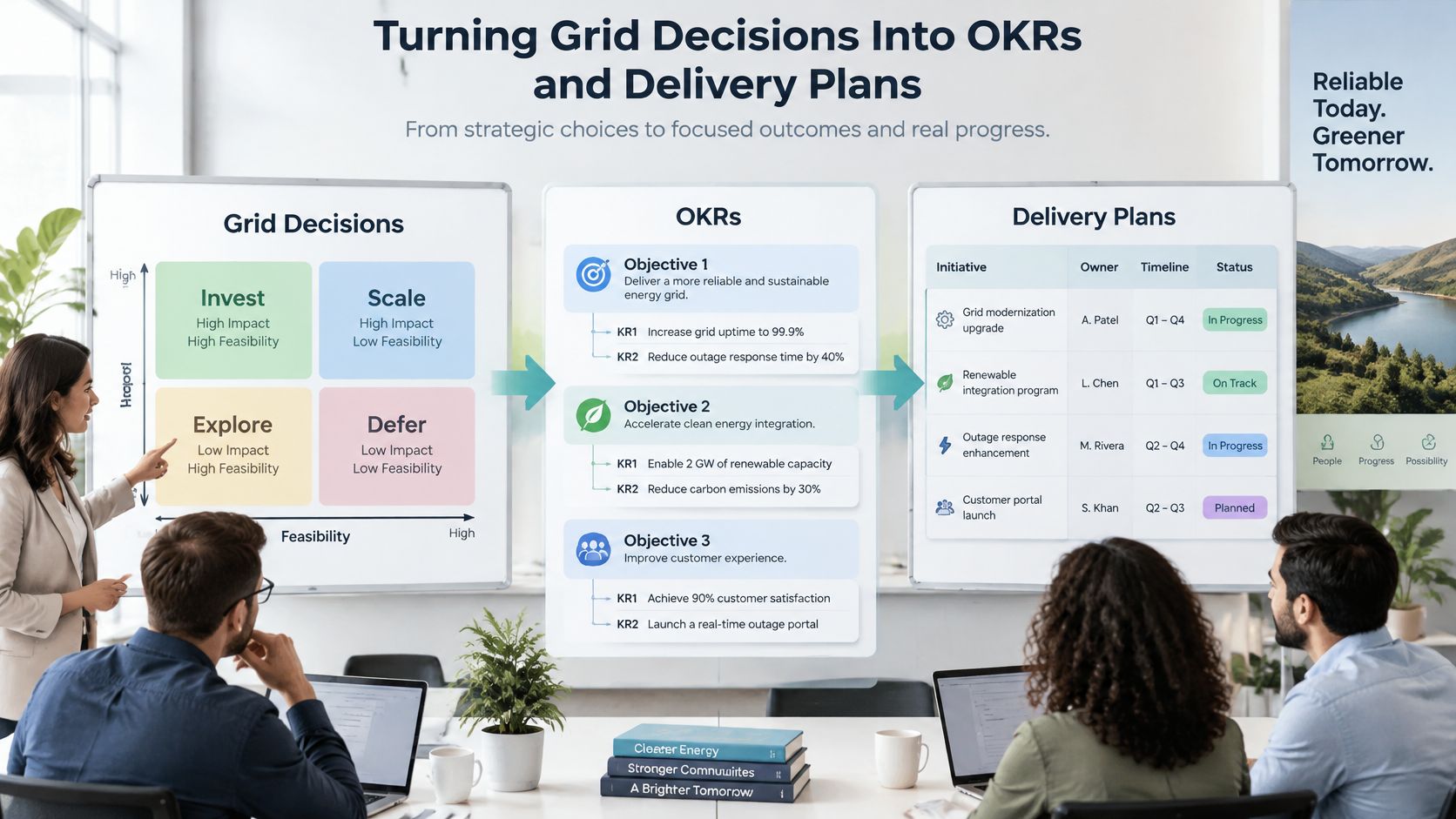
From grid action to objective, key result and owner
The following targets continue the hypothetical services-firm example. They're illustrative commitments, not reported results; the rejected Create row shows what remains outside the approved portfolio.
| Grid action | Move | Objective | Key result | Owner |
|---|---|---|---|---|
| Eliminate | Stop monthly status decks | Free senior time for client delivery | Senior hours on reporting fall by 40% from the week-one baseline | Chief Operating Officer |
| Reduce | Simplify routine spend approvals | Decide spend faster without shifting risk to junior staff | Median approval time falls from five working days to two; no increase in unauthorised spend | Finance Director |
| Raise | Faster response on priority client issues | Protect retention in key accounts | 90% of priority issues answered within 4 hours; key-account retention holds at 95% | Head of Client Services |
| Create | Self-service onboarding, not approved | Shorten time to first value | No committed key result or delivery allocation until customer evidence passes | Chief Product Officer |
I recommend one outcome objective for each surviving move, with two or three key results. Include a leading indicator and a measure of the trade-off so that improvement in one area can't conceal extra cost elsewhere.
For reporting, add a check that clients still receive decision-critical information. For approvals, measure exception handling as well as speed.
Make ownership change behaviour
A leadership team might raise customer retention and reduce internal reporting, yet still reward managers for completing reports. The objective won't change behaviour if nobody owns retention, teams can't see the metric or managers continue prioritising the old work.
The accountable executive must resolve those contradictions. Functional managers then translate the objective into changed responsibilities, decision rights and workload.
Give each objective a delivery plan
For this illustrative implementation, I would use the following milestones and responsibilities:
- Day 30, establish evidence. The owner confirms baselines, tests the changed workflow and verifies that displaced work has stopped.
- Day 60, challenge the hypothesis. The executive reviews the leading indicator, customer feedback and unintended consequences against the agreed kill criterion.
- Day 90, decide the operating model. The sponsor decides whether to embed, revise or stop the change, with the resource implications recorded.
- Weekly, remove delivery obstacles. The delivery lead checks progress, dependencies and decisions needed. This isn't a round-robin status presentation.
- Monthly, make the continuation decision. The executive owner reviews benefit, cost and risk, including the investment line displaced by the move.
A shared delivery plan should name the owner, milestones, dependencies and displaced investment for each approved objective. Keep these details connected to OKR planning, rather than maintaining an objective document that delivery teams rarely consult.
For product-related changes, Wonderment Apps' product roadmap planning tips offer a useful companion when organising the roadmap. Keep the distinction clear: the roadmap sequences delivery; the OKRs establish whether delivery improves the chosen outcome.
An OKR review needs permission to stop work. Otherwise, it's a reporting meeting.
In my Strategic Execution Advisory work, Phase 04 translates validated strategic choices into OKRs, investment priorities and governance cadences. That conversion matters because an objective without resource decisions and a review rhythm won't resolve competing demands.
Confirm the Stop List Before Setting Next Quarter's OKRs
- Assign ownership and dates. Every eliminate and reduce needs a named owner and a stop date. Someone must be accountable for making the removal happen.
- Delete the work. Remove stopped activities from calendars, backlogs and recurring requests. Moving them to a later quarter doesn't release capacity.
- Show the funding line. Every raise and create must identify the investment it displaces. Confirm that the released capacity matches the skills and timing required.
- Agree the exit condition. Give every move a kill criterion and review date. Record who can authorise continuation or stop delivery.
- Confirm collective agreement. The executive team agrees the list in a single session, rather than approving different versions through side conversations.
Make the stop list operational
Skipping this decision leaves teams writing OKRs on top of old commitments. Managers then receive conflicting instructions: deliver the new outcome, preserve existing service and continue every historical report.
The grid becomes another deck nobody reopens. Teams learn that priorities are additions rather than choices, so they protect local commitments and negotiate around the official plan.
I would make the stop list part of the distinction between annual and quarterly OKRs. Annual direction establishes the outcomes worth pursuing; quarterly commitment must reflect the capacity available to pursue them.
Use this month to validate the choices
Run the grid with the leadership team in a single session, using the decision tables as the agenda. Bring customer evidence, current commitments and resource constraints into the room so leaders can make decisions rather than commission another presentation.
I recommend an initial 30-day test of the surviving moves. That period is an evidence checkpoint, not a promise that every commercial outcome will be visible.
Before setting the quarterly OKRs, confirm that stopped work has actually disappeared and that the owners accept the remaining commitments. Sign the stop list first, then commit to the outcomes.
The result should be fewer competing demands, clearer accountability and an operating plan leaders can challenge with evidence.
I help leadership teams turn strategic choices like these into OKRs and delivery plans that hold up in practice. To discuss where priorities, trade-offs or accountability need tightening, book a conversation.