
Your leadership team has agreed the objectives. The all-hands sounded convincing, the dashboards are live, and people are busy. Yet the quarter is slipping away without a measurable change in the results that matter.
I wouldn't start by rewriting the objectives. I'd examine what happens after everyone agrees them: who makes the trade-offs, who resolves dependencies, and what happens when a team realises the commitment won't hold.
The Goal You Set Is Rarely the Goal You Get
Goal setting for teams is an execution-design problem, not just a writing exercise. A polished objective doesn't establish ownership. Publishing a dashboard doesn't create a decision process. And an enthusiastic planning session doesn't release capacity from existing commitments.
The leadership team may leave an offsite believing everyone understands the strategy. Product leaves thinking activation matters most. Sales assumes new revenue remains the priority. Customer success continues firefighting because nobody has agreed what it can stop doing.
Each function has a reasonable interpretation. Together, they produce competing demands on the same people.
The planning event isn't the operating system
If you're preparing a leadership session, Madeira Remote's resource on how to organize an offsite is useful planning context. But I'd judge the session by the decisions people can execute afterwards, not the quality of the discussion in the room.
The distinction matters. The CIPD evidence review on people performance describes team effectiveness through connected conditions: clear goals, defined roles, effective processes and constructive relationships. It also cautions that their interaction hasn't been empirically tested as a complete model.
My practical reading is straightforward. Don't separate the target from the conditions needed to deliver it.
A team hasn't committed to an outcome until leadership has agreed the conditions under which it can deliver.
Before approving an objective, I want evidence that:
- Ownership is real. Someone can make decisions, not merely collect updates.
- Dependencies are acknowledged. Contributing teams have accepted their part.
- Capacity is available. Leaders have named the work that will stop or wait.
- Intervention is possible. There's a route for resolving problems before the deadline.
That's a more demanding standard than agreeing attractive wording. It can expose disagreements that a planning workshop would otherwise leave unresolved.
I'd rather surface those disagreements before commitment. An uncomfortable conversation about scarce engineering capacity is more useful than a confident objective built on capacity nobody has authorised.
For leaders who already understand OKRs, this is the next step: stop asking whether an objective sounds right. Ask whether the organisation is set up to act on it.
Designing a Team Objective That Survives Week Three
Consider a product team asked to improve activation. Shipping a new onboarding journey might be sensible work. It isn't sufficient evidence that customers reach value sooner.
I'd make the team define the customer behaviour that counts as activation before approving delivery work. Then I'd establish the baseline, agree the target and deadline, and confirm that the underlying events are captured reliably.
The implementation gap is real. In a UK practitioner survey of 507 respondents, 85.2% identified objective-setting as essential, but only 75.3% set objectives and 62.7% conducted regular review meetings. Agreement that goals matter is plainly different from operating them.
Four-Part Check Before a Team Objective Is Committed
| Question | What it forces you to define | Common failure when skipped |
|---|---|---|
| What outcome matters? | The observable change, baseline, target and deadline | The team completes work without improving the business result |
| Who owns it? | An accountable decision-maker and named contributors | Everyone contributes, but nobody resolves trade-offs |
| How will progress be evidenced? | The indicator, data source and measurement definition | Teams debate the dashboard instead of acting |
| What happens when conditions change? | The escalation trigger, decision-maker and response | A blocked objective stays nominally on track |
For the activation example, the accountable product lead would own the outcome. Engineering and design would contribute delivery capacity. Analytics would confirm the measurement definition. Customer success might provide evidence about where customers get stuck.
The owner shouldn't be accountable for absorbing everyone else's delays without comment. The commitment must identify which decisions that person can make and which require leadership intervention.
A commitment template worth using
I'd capture the agreement in a shared document, alongside the relevant OKR:
- Outcome: Help the agreed customer segment reach its first meaningful product result.
- Measure: Move the defined activation indicator from its verified baseline to the agreed target by the commitment date.
- Ownership: Name the accountable lead, contributors and dependency owners.
- Evidence: Identify the dashboard, event definition and customer evidence used to judge progress.
- Escalation: Specify the condition that requires a decision, and who must make it.
For the measurement component, my guidance on how to write measurable outcomes addresses the distinction between finishing work and changing results.
Don't manufacture precision when the baseline is missing. Make establishing a reliable baseline explicit, then approve the performance commitment using that evidence. An invented target is no more rigorous than an unmeasurable slogan.
Why Alignment Collapses Between Senior, Middle, and Frontline
A company objective can be perfectly clear to the executive team and almost useless to the people allocating work.
UK performance-management research reported strong alignment at 77% for senior management, 45% for middle management and 17% for frontline employees. 40% described frontline alignment as very weak or non-existent, according to the report on goal setting in performance appraisals.
That's the gap I'd investigate before commissioning another alignment workshop.
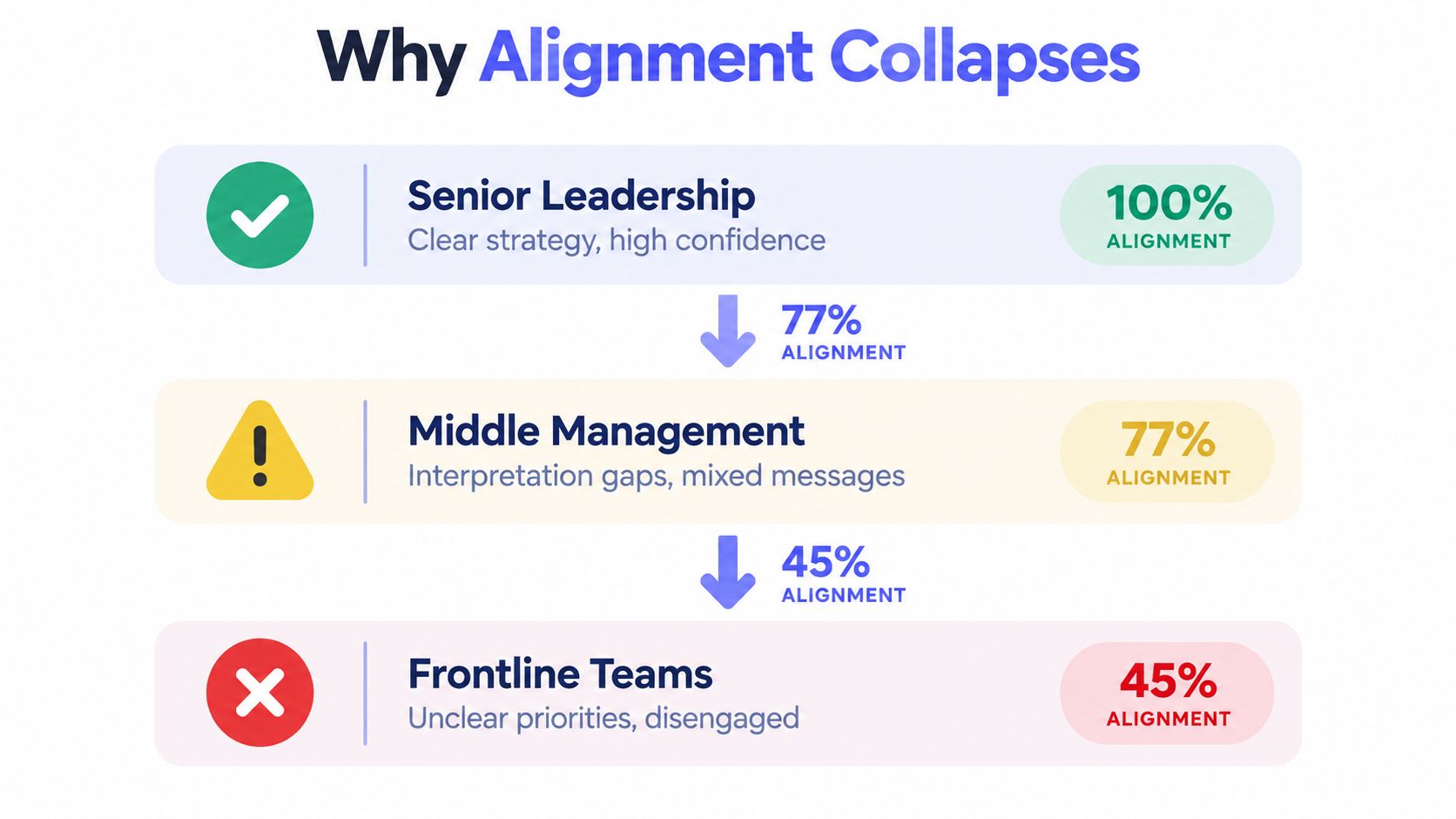
Use the cited figures in the text as the evidence benchmark. The illustration's percentage labels don't match the reported findings.
Cascade contribution, not wording
Suppose leadership prioritises revenue retention. Copying that objective into customer success, product and support doesn't explain what each function should change.
It also creates an accountability trap. Each team can claim it supports retention while choosing unrelated local priorities.
I'd translate the strategic intent into a contribution agreement. For a hypothetical customer success team, that might mean improving the proportion of renewal-risk accounts with a verified recovery plan and evidence of restored product value. The team would also track subsequent renewal outcomes.
That contribution isn't the whole retention result. Product reliability, commercial decisions and customer circumstances still matter. The point is to distinguish the change customer success owns from the wider result it influences.
Alignment test: Ask a team to identify the company-level result it influences, then explain the measurable change it owns.
A vague answer usually means leaders have communicated the ambition without resolving the operational translation.
My approach to cascading communication is to make that translation explicit rather than sending the same objective through successive management layers.
Give middle managers a decision to make
Middle managers shouldn't act as forwarding addresses for leadership messages. They need authority to reconcile demand across teams.
For the retention example, that means deciding whether customer success should prioritise recovery work over expansion campaigns. It means securing product input where recurring defects threaten renewals. It also means challenging a company target whose delivery assumptions don't survive contact with customer evidence.
I'd ask each management layer to show the trade-off it has made. If nobody can identify what became less important, the organisation may have added objectives without changing priorities.
That's how apparent alignment becomes a larger workload rather than a clearer direction.
The Operating Rhythm That Turns Objectives Into Delivery
An OKR review should end with a decision. If everyone leaves with the same plan despite evidence that it isn't working, the meeting has provided visibility without management.
A 2025 survey of 250 UK companies with turnover above £20 million found that only 18.4% achieved more than 80% of their aspirational growth goals within three years. The same research found 59.6% treated execution as a core discipline through structured frameworks and regular progress tracking. Those findings describe the sample, not proof that a particular cadence causes success.
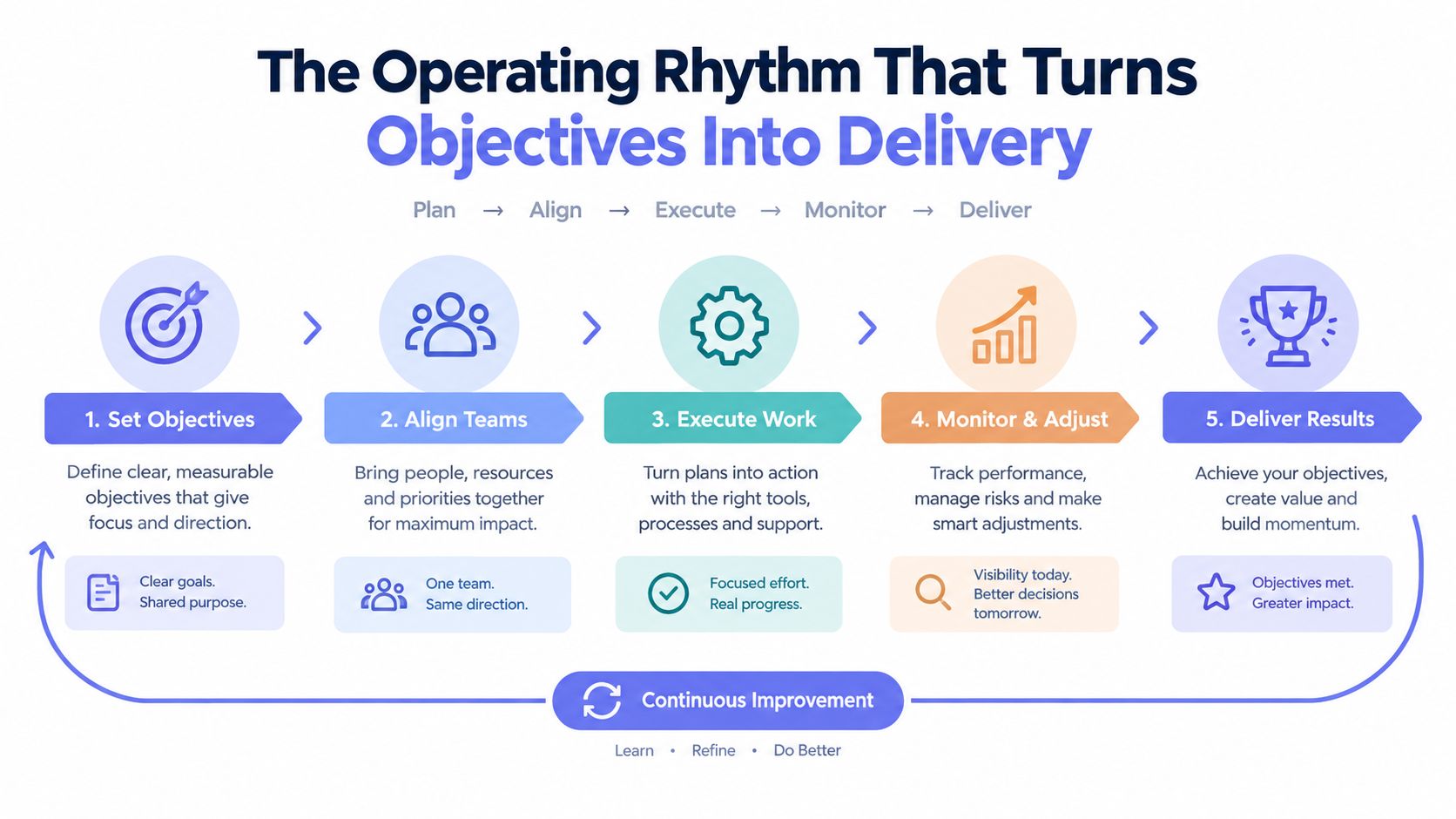
Make the team review a decision meeting
My recommended starting rhythm is a fortnightly team review, supported by asynchronous evidence updates. I'd use this agenda:
- Evidence of progress: What changed in the outcome measure, and what explains it?
- Confidence: Does the owner still believe the commitment is achievable? On what evidence?
- Blocked dependencies: Which unresolved contribution requires intervention?
- Resource trade-offs: What needs to stop, move or receive additional capacity?
- Next decision: What will change, who owns the action, and when must it happen?
The record should capture the decision, owner, deadline and expected effect. Don't substitute a transcript or a collection of presentation slides.
If no decision is needed, keep the update asynchronous. Meeting time should be reserved for judgement, disagreement and intervention.
Separate team decisions from leadership decisions
I'd add a monthly leadership review for cross-team dependencies and a quarterly re-prioritisation window for material changes in strategy, market conditions or capacity.
Don't make teams wait for either forum when delivery is already impossible. An escalation trigger should bring the relevant decision-maker into the issue when it occurs.
For a specialist function, the guide from PreSales Unleashed on SE leadership, published by PreSales Unleashed GmbH, provides relevant context for considering direction, rhythm and coverage together.
The wider principle behind my recommended operating rhythm is that the meeting structure must match the decisions people need to make.
Don't introduce another OKR meeting if an existing delivery forum can do the job. Replace its agenda. Preserve useful operational detail, but insist that discussion connects to the outcome and the intervention required.
Letting Teams Challenge Goals Before They Quietly Fail
I don't regard an unchallenged objective as a sign of strong commitment. It may mean nobody thinks disagreement is safe.
UK employee research found that more than three in ten employees preferred to discuss priorities and plans, an increase of 11 percentage points since 2023. A separate 2025 survey of over 2,000 UK employees described speaking up as fraught with uncertainty, as discussed in the IoIC report on communication channels.
My recommendation is to make challenge part of the commitment process, not a test of personal courage.
Require a challenge window
Before approving an objective, I'd ask the team to record its assumptions and identify the earliest evidence that would invalidate them. Then I'd hold a scheduled challenge window.
The discussion should address:
- Feasibility: Which assumption is most likely to make this commitment unachievable?
- Disconfirming evidence: What would show that the current approach or target is no longer valid?
- Authority: Who can resolve the constraint or approve a revised commitment?
- Consequences: What happens to the wider strategy if this outcome changes?
This isn't an invitation to negotiate every difficult target downwards. The team must distinguish discomfort from evidence.
I'd also separate challenging the goal from challenging the delivery approach. A weak initiative may need replacing while the outcome remains entirely valid.
Renegotiate without rewriting history
Consider a hypothetical onboarding team whose objective depends on simplifying customer verification. A regulatory change introduces an additional mandatory check, invalidating the planned journey.
The team should submit the new requirement, its effect on the original assumptions, and the feasible alternatives. Leadership should then decide whether to change scope, provide capacity or revise the target.
I'd retain the original commitment in the record. The revised agreement would show the evidence, approval, new measure and implications for dependent teams.
Changing a goal with evidence is disciplined management. Quietly changing the definition of success is not.
That distinction is why I connect psychological safety with accountability. People need permission to surface unwelcome information, but they still owe leadership a clear explanation and a workable recommendation.
Leadership has a corresponding obligation: respond to the constraint. Thanking someone for speaking up while leaving an impossible commitment untouched won't make the next challenge more likely.
Common Failure Modes I See Inside UK Leadership Teams
The diagnostic question I use isn't whether a team has OKRs. It's whether those OKRs change a meaningful decision when people face competing demands.
A UK employer study reported that 96% of qualifying Top Employers realigned performance goals during the year and 84% evaluated performance continuously rather than relying only on an annual cycle, according to the report on the shift towards ongoing performance dialogue. That's a selected employer group, not a representative benchmark for every UK organisation.

Recognise the moment, then diagnose the cause
| Recognisable moment | Underlying cause | Correction I'd apply |
|---|---|---|
| Leaders describe progress enthusiastically but can't show a changed result | Aspirational language has replaced an observable outcome | Require evidence that would distinguish success from activity |
| A team accepts the target, then immediately requests more people | Ambition was agreed before available capacity was assessed | Reconcile commitments with actual staffing and existing obligations |
| Every review repeats the same unresolved blocker | Attendees lack decision rights | Give the forum authority or remove it from the escalation route |
| The workshop produces objectives, but the backlog stays untouched | Leadership hasn't withdrawn competing priorities | Require an explicit stop or defer decision |
| OKRs reappear only when quarterly scoring is due | Reporting sits apart from normal management | Put the outcome into the forum where work and resources are allocated |
The earliest symptom is often a mismatch between the language leaders use and the choices they make. They call an objective critical, then repeatedly lend its delivery capacity to something else.
I'd treat that as a leadership decision, not a team motivation problem.
Don't prescribe more process by default
A founder-led scale-up may need a clearer rule for accepting urgent requests. An enterprise team may need a sponsor who can resolve a dependency across functions. Neither necessarily needs another template.
Before changing the system, I'd examine a recent missed commitment. Which decision was delayed? Who could have made it? What information did that person have, and what prevented action?
That diagnostic approach sits behind my view of why strategy execution fails. The correction should address the mechanism that caused the miss, not add administration around it.
If leaders repeatedly override agreed priorities, better-written goals won't fix delivery. Leaders must change how they allocate attention and resources.
What to Change in the Next 30 Days
I'd start with the most important existing team objective, not an organisation-wide rewrite.
- Pressure-test the commitment. Apply the design check and resolve any unanswered ownership or measurement question.
- Expose the assumptions. Record what must remain true and the earliest signal that would disprove it.
- Challenge before approval. Give contributors a defined opportunity to contest feasibility.
- Put decisions on the calendar. Schedule the fortnightly review and agree the decision-record format.
- Test the translation. Ask the team to connect its contribution to the company result.
Specificity matters. UK-linked group goal-setting research reported brainstorming improvements roughly twice as large under directive and participative goals as under generic instructions to do your best. It also cited earlier research finding performance almost one standard deviation better with specific, difficult group goals. Those are controlled research findings, not a promised workplace uplift.
I help leadership teams turn strategic priorities into team-owned outcomes, credible commitments and reviews that produce decisions. If your objectives look aligned but delivery remains inconsistent, book a conversation.