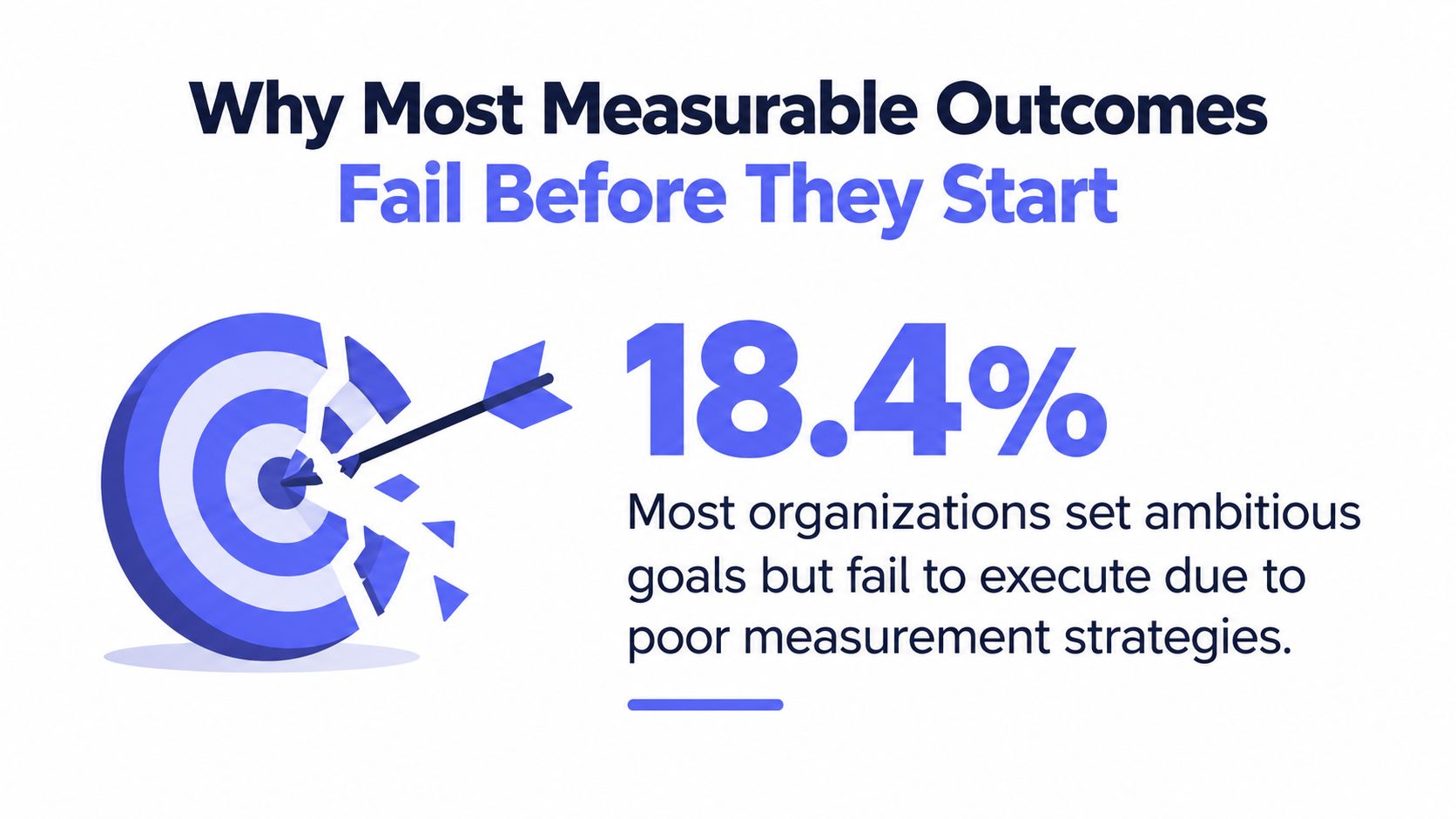
Only 18.4% of large UK companies achieve more than 80% of their aspirational growth goals within three years. The practical answer to how to write measurable outcomes is to define a specific change, attach a reliable metric, name the population or business area affected, and set a deadline that leaders can review.
That failure rate isn't caused by a shortage of ambition. It comes from the gap between writing an OKR and proving that it changed the business. A polished Objective can still leave teams unclear about priorities, ownership, evidence, or the action required when progress stalls.
Measurable outcomes close that gap. They turn strategy into something leaders can inspect, teams can influence, and governance forums can use to make decisions. The standard isn't whether an outcome sounds strategic. The standard is whether you can establish a baseline, track movement, diagnose weak execution, and evaluate the result at a defined point.
Why Most Measurable Outcomes Fail Before They Start
Large organisations often have a strategy problem disguised as an execution problem. Leaders agree on growth, customer value, operational improvement, or capability building. Teams then write Objectives such as “strengthen our market position” or “improve the customer experience”. These statements sound credible, but they don't tell anyone what must change, how much change matters, or how to respond when delivery slows.
Research on UK businesses makes the consequence clear. Only 18.4% of large UK companies achieve more than 80% of their aspirational growth goals within three years, while 41.2% fail to achieve even 60% of their stated targets. The same research reports that only 46% define a clearly measurable value gap between the current state and the desired future state. These figures are reported by FM Magazine's coverage of UK growth ambition and execution research.
Vague ambition hides the real constraint
A vague outcome creates several failure modes at once:
- Prioritisation failure: Teams interpret “improve retention” differently and fund disconnected initiatives.
- Accountability failure: Leaders can't tell whether a missed target reflects poor delivery, an unrealistic assumption, or a missing capability.
- Coordination failure: Functions optimise their own outputs without proving their contribution to the shared result.
- Learning failure: The organisation reaches the review point with opinions, anecdotes, and completed tasks, but little evidence of impact.
A team that reports ten launched initiatives may have been busy. It hasn't necessarily improved service quality, customer behaviour, commercial performance, or strategic position. Outcomes must expose that distinction.
Practical rule: If a leader can't ask “what changed, compared with what baseline, by when?” the statement isn't ready for an OKR.
The common OKR mistakes guidance from The OKR Hub is useful here because the recurring errors are operational, not academic. Teams confuse work with results, write too many priorities, and treat the quarterly score as the finish line rather than evidence for a management decision.
Measurable outcomes act as diagnostic tools. If the metric doesn't move, leaders can investigate adoption, capability, dependencies, decision speed, or the underlying strategy. That is far more useful than declaring an Objective “on track” because a project plan is green.
The Correct Sequence for Writing Outcome Statements
Don't start by asking a team to write a clever Key Result. Start with the change the organisation needs to create. UK government guidance recommends a sequence that prevents activity from being mistaken for impact: identify expected outcomes, develop a theory of change, select priority outcomes, design activities using evidence of what works, target measurement at those outcomes, then choose an evaluation method and data sources capable of proving the result within the intervention window. The UK government guide to outcomes frameworks also stresses that outcome statements should be clear, concise, standardised, meaningful, and distinct from inputs and outputs.
Start with the end state
Write the expected change in plain language. Avoid describing the project. Describe the condition that should exist because the work succeeded.
“Launch a new onboarding journey” describes delivery. “New customers reach first-value with less friction” describes a result, although it still needs a measure. The first statement can be marked complete on launch day. The second forces the team to define what first value means and how customer behaviour will demonstrate it.
Then develop the logic:
- Expected outcome: What will be different?
- Theory of change: Why should the proposed intervention create that difference?
- Priority outcome: Which result matters most to the strategy?
- Activities: What work will influence it?
- Measurement: What evidence will show movement?
- Evaluation: How and when will leaders judge whether the change occurred?
This sequence keeps initiatives subordinate to outcomes. If an initiative changes but the outcome doesn't, the team must change the initiative, not quietly redefine success.
Lock down the measurement statement
An outcome statement identifies four elements:
- Change: the result that must improve, reduce, increase, stabilise, or become more consistent.
- Measure: the metric and its definition.
- Population or scope: the customers, employees, product area, market, or service affected.
- Time: the date or review point when the result must be assessed.
For example:
Increase successful activation among newly contracted enterprise customers from the agreed baseline to the target level by the end of the planning cycle.
That sentence isn't complete until the team defines “successful activation”, confirms the baseline, names the reporting system, assigns an owner, and agrees the review date. Precision lives in those details.
The VideoLearningAI objectives tips offer a useful supporting perspective on writing objectives that describe observable results rather than broad intentions. Use that discipline in business settings, then add the baseline, data source, scope, and governance needed for an organisational OKR.
The UK government's Green Book 2026 guidance treats SMART objectives as necessary for thorough monitoring and evaluation. It also says practitioners should define who benefits, how many beneficiaries there are, where they are located, and when intended outcomes should be realised. For business leaders, the lesson is direct: an outcome should identify the measurable change, affected population, place or business context, and deadline. It must be checkable during delivery and evaluable at a fixed point.
Distinguishing Inputs, Outputs, and Outcome Metrics
Most broken OKR systems don't lack metrics. They use the wrong ones.
An input is a resource. It could be budget, headcount, specialist time, data, or technology. An output is something the organisation produces, such as a feature, campaign, training session, process change, or report. An outcome is the change that follows, such as improved adoption, faster resolution, stronger retention, better service quality, or increased strategic value.
The categories are related, but they aren't interchangeable.
| Metric type | What it measures | Typical leadership question |
|---|---|---|
| Input | Resources committed | Did we provide the capacity? |
| Output | Work completed or delivered | Did we produce the agreed intervention? |
| Outcome | Change created by the work | Did the business, customer, or service improve? |
Use outputs as evidence, not as the finish line
“Deliver the pricing redesign” is an output. It may be necessary, but it doesn't prove that customers understand the offer or that commercial performance improved.
“Complete customer research interviews” is also an output. It tells leaders that research happened. It doesn't show whether the findings changed product decisions or reduced uncertainty.
Rewrite the OKR so the output supports an outcome:
- Weak Key Result: Launch the new pricing page.
- Stronger Key Result: Increase qualified visitors who select the appropriate pricing option, measured through the agreed product analytics event, by the review date.
- Weak Key Result: Deliver manager training.
- Stronger Key Result: Increase consistent use of the agreed performance process among people managers, measured through the defined audit, by the review date.
The stronger versions still need baselines and targets. Their advantage is that they point towards changed behaviour or performance rather than stopping at delivery.
The inputs, processes, and outputs explanation provides a useful reference when teams need to separate the work from the value the work is meant to create. Make the distinction explicit in planning sessions. Put initiatives beneath Key Results, not in their place.
Test the quality of the data
The UK Local Outcomes Framework sets a practical standard for outcome data. Data should already exist and be publicly available, be reported at the relevant local level, draw on official statistics where possible, occur frequently enough to show trends, ideally at least annually, and be standardised enough to support comparison. It also says priority outcomes should be measured primarily through outcome metrics, using outputs only where the outcome is difficult to isolate or a proxy is needed.
Apply the same test inside a business:
- Can the team access the data without manual reconstruction?
- Does everyone use the same metric definition?
- Is the reporting cadence frequent enough to reveal movement?
- Can leaders compare the result with a baseline or consistent peer group?
- Is the metric close enough to the outcome for the team to influence it?
If the answer is no, don't claim the metric is reliable. Improve the measurement system or choose a defensible proxy and label it as one.
Aligning Measurable Outcomes Across Leadership Layers
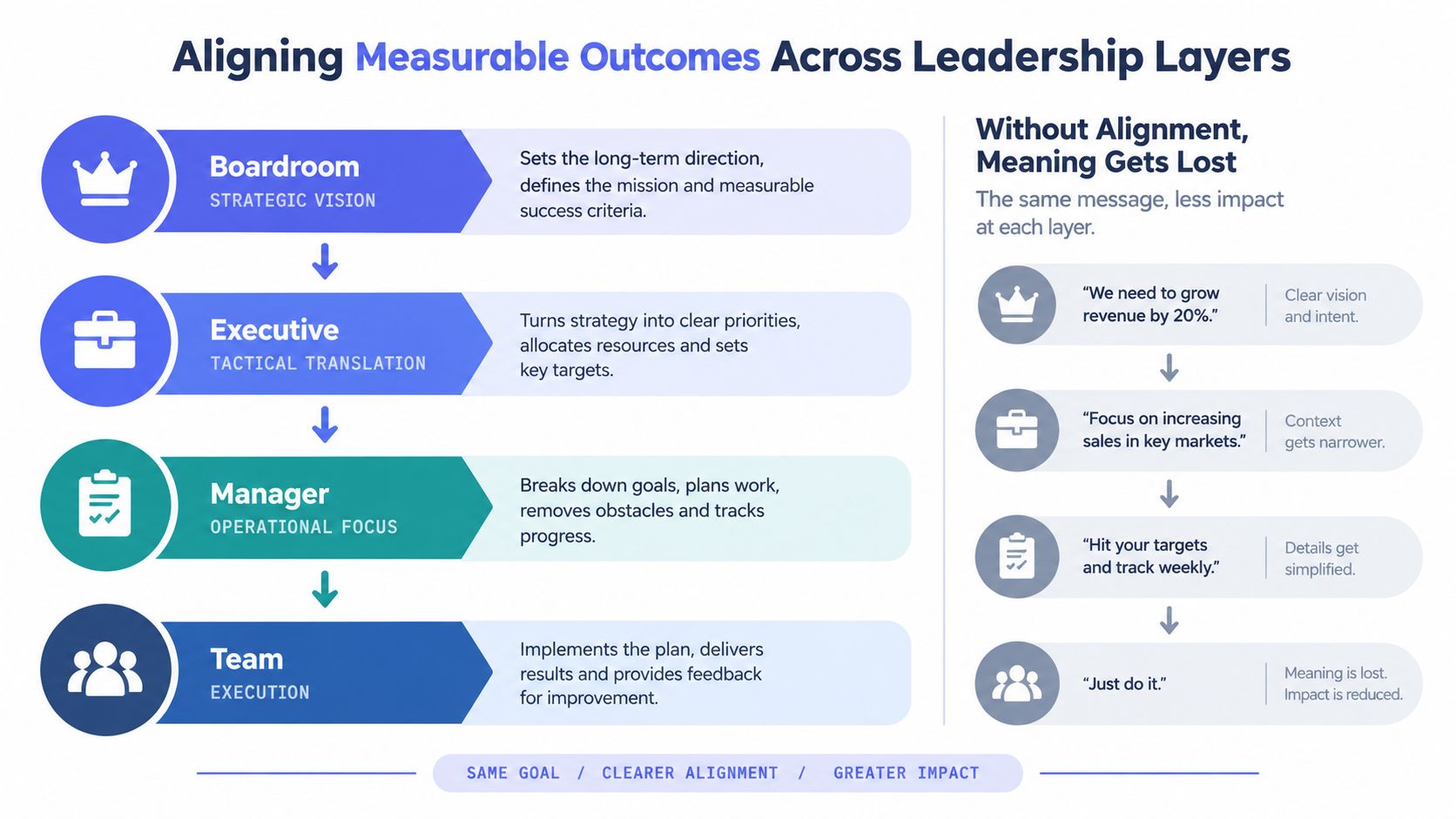
An outcome loses power when it cascades through the organisation as a series of disconnected tasks. The board discusses strategic value. Executives translate it into a portfolio. Managers convert it into priorities. Teams receive a list of deliverables. By the time the work reaches execution, the original outcome has disappeared.
The fix isn't to copy the same Key Result at every level. The fix is to create a chain of evidence.
Preserve meaning while changing the level
A board-level outcome might focus on strategic performance. An executive outcome might measure the value delivered by a portfolio. A team outcome should measure the customer, operational, or product change that team can influence. Each level needs its own metric, but the relationship must be explainable.
Use three questions:
- Contribution: Which higher-level outcome does this support?
- Influence: What part of that result can this team directly affect?
- Evidence: What movement would demonstrate that the contribution is working?
Suppose the board wants stronger enterprise customer value. The product executive might own improved adoption across the enterprise proposition. A product team could measure the proportion of target users completing a critical workflow. A customer success team might measure sustained usage among accounts receiving the intervention. None of these measures should be copied blindly across layers. Each should show a meaningful part of the causal chain.
UK performance guidance warns that measures should be limited in number, comparable over time, linked to action and strategy, and set at different organisational levels. The OKR alignment guidance applies that principle to day-to-day OKR design. Alignment means connected choices, not identical wording.
Diagnose horizontal and diagonal misalignment
Alignment isn't only vertical. Teams can agree with the board and still work against neighbouring teams. Product may optimise feature adoption while operations optimise cost reduction. Sales may pursue volume while delivery teams absorb unplanned complexity. A measurable outcome should make these trade-offs visible.
Research involving UK companies reports horizontal misalignment in 73% of respondents, diagonal misalignment in 58%, and vertical misalignment in 46%. Those findings are discussed in The OKR Hub's strategy versus execution analysis. The implication is practical: leadership teams need measures that expose coordination failure, not just individual team performance.
Add narrative context beside the metric. State the dependency, the decision required from another team, and the risk that could prevent movement. This stops a dashboard from presenting a false sense of precision.
Leaders working through complex technology and transformation choices may also find the fractional CAIO model relevant when they need senior capability to connect technical delivery with business outcomes. The principle is the same. Accountability improves when someone can explain how a team-level result contributes to strategic performance.
Embedding Outcomes into Operating Rhythms and Governance
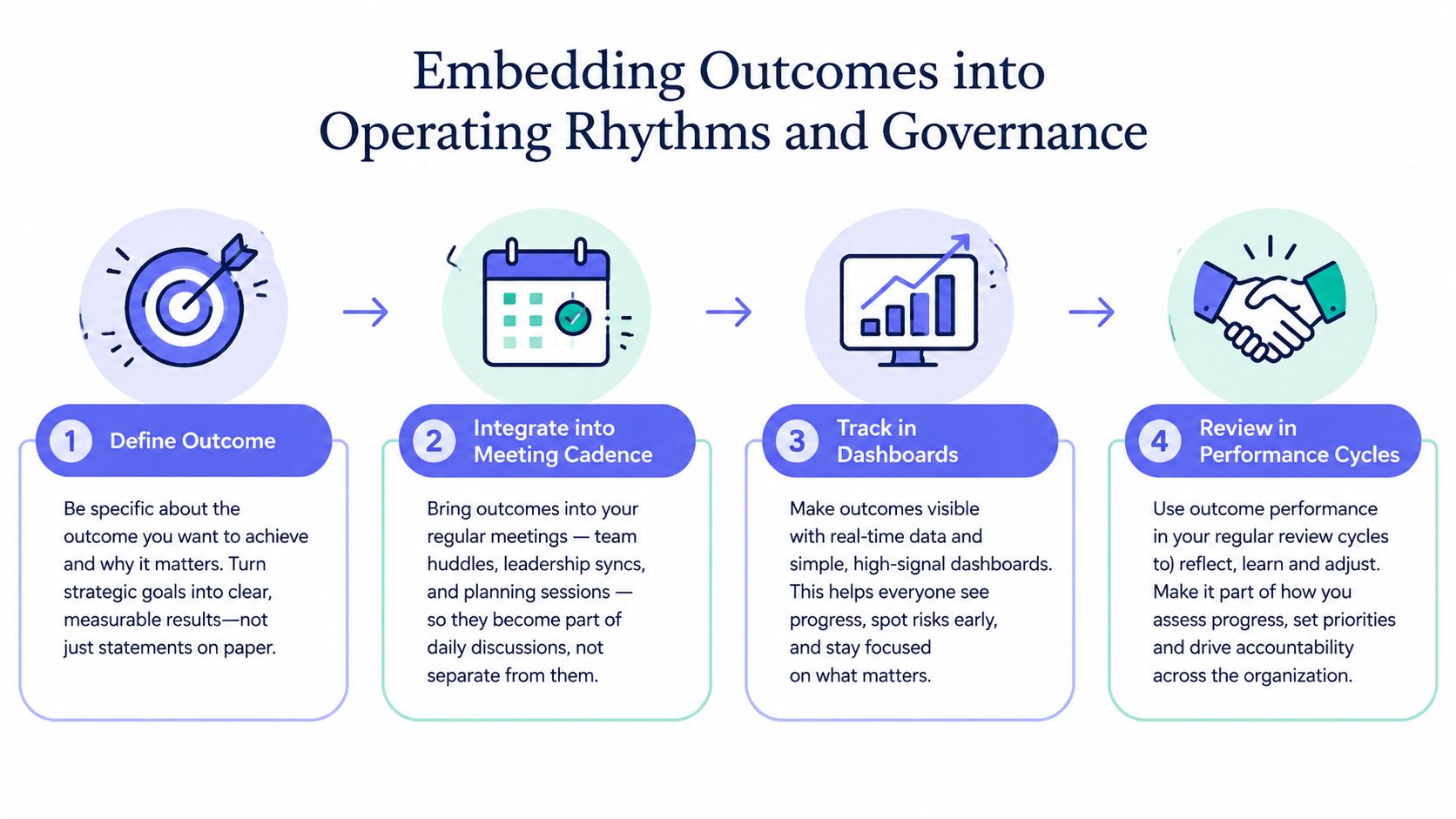
Writing the outcome is only the design stage. Execution begins when the metric enters the conversations where leaders allocate time, money, people, and attention.
An OKR that appears once in quarterly planning is a document. An OKR reviewed in operating meetings becomes a management instrument. The difference is governance.
Put evidence into the meeting cadence
Every review should answer three questions:
- What moved: Which outcome metric changed against the baseline?
- Why did it move: Which initiative, behaviour, dependency, or external factor explains the result?
- What decision follows: What will the team continue, stop, change, or escalate?
Don't let the meeting become a status recital. A green project plan doesn't excuse a stagnant outcome. A red initiative may be acceptable if the team has learned that the intervention won't create the intended change and has chosen a better route.
The operating rhythm guidance is useful for turning this principle into a repeatable management practice. Include outcome review in the forums that already govern delivery. Avoid creating a separate reporting ceremony unless the organisation lacks a place for strategic performance discussion.
Treat stalled movement as a signal
A flat metric can reveal different problems:
- The team lacks a capability required to execute.
- Another function controls a critical dependency.
- Customers or employees aren't adopting the change.
- The initiative addresses a symptom rather than the cause.
- The target is poorly defined or the data is unreliable.
- Leadership has changed the priority without updating the OKR.
Governance should surface these distinctions. The answer isn't always to push the team harder. Sometimes leaders must remove a dependency, fund capability, change the intervention, or revisit the strategy.
The National Audit Office says good performance measurement helps departments identify and communicate priorities, plan cost-effective services, and monitor progress. It also notes that departments struggled to develop quantifiable measures showing their contribution to outcomes and to agree measures across departments. That finding from the NAO's performance measurement report mirrors the problem in large enterprises. Cross-functional outcomes need shared definitions and explicit decision rights.
Overcoming Resistance to Rigorous Measurement
People often resist measurement because they associate it with surveillance, bureaucracy, or simplistic judgement. Leaders make the problem worse when they introduce dashboards without explaining the decisions the data will improve.
Rigorous measurement isn't an administrative burden when it removes ambiguity. It becomes burdensome when teams collect data nobody uses.

Answer the objections directly
“Creative work can't be measured.” Creative quality shouldn't be reduced to a crude activity count. But the effect of creative work can often be assessed through audience behaviour, decision quality, conversion, recall, adoption, or the strength of an agreed proxy. The answer is better outcome design, not no measurement.
“Measurement will slow delivery.” Poorly designed reporting can slow delivery. A small set of trusted metrics can speed decisions by showing where work is stuck and which assumptions are failing.
“The data will be used against the team.” If leaders tie ambitious OKR scores directly to punishment, teams will protect themselves with safe targets and favourable definitions. Separate learning and execution management from simplistic performance ranking.
“Our outcome depends on other teams.” That is precisely why the outcome should be visible. Name the dependency, assign ownership for the shared result, and give each contributing team a measure it can influence.
The guidance on overcoming resistance to OKRs reinforces a simple leadership principle: people accept measurement when they can see its purpose, trust the data, and participate in defining what success means.
Make clarity safer than ambiguity
Start with one important outcome that currently causes disagreement. Define the baseline, metric owner, data source, review cadence, and decision rule. Run the discussion with the people who will use the measure, not just the leaders who requested it.
Then ask teams to challenge the measure. What behaviour could it accidentally encourage? What would a false positive look like? Which quality or adoption indicator would prevent leaders from celebrating an output that creates no value?
Good measurement doesn't remove judgement. It gives judgement better evidence.
A mature organisation uses metrics as prompts for inquiry. It doesn't pretend that a number explains everything. It combines the number with context, customer evidence, operational detail, and a clear decision.
Your Checklist for Writing Measurable Outcomes
Use this checklist before approving an Objective or Key Result. If a statement fails several tests, send it back for redesign. Don't allow elegant wording to conceal weak measurement logic.
Check the outcome itself
- Change: Does the statement describe a change in behaviour, quality, service, value, or strategic performance?
- Scope: Does it identify the customer group, employee population, product area, market, or business unit affected?
- Baseline: Is the current state known and documented?
- Target: Is the desired state defined clearly enough for two people to reach the same conclusion?
- Deadline: Is there a fixed point for reviewing or evaluating the result?
- Strategic link: Can the owner explain which strategic priority the outcome advances?
“Improve customer experience” fails this test. “Reduce avoidable handoffs in the agreed customer journey from the documented baseline to the target level by the review date” gives the team somewhere to start, provided the organisation defines the metric and data source.
Check the evidence
The UK public-sector approach provides a useful discipline for business leaders. Measures should be current, comparable, available from a reliable source, and reported often enough to show movement. The Progress 8 accountability guidance shows the value of assessing progress against a defined benchmark rather than rewarding activity or effort. Its value-added approach focuses attention on progress relative to an expected standard.
Ask:
- Data source: Who owns the system or dataset?
- Definition: What exactly counts, and what is excluded?
- Cadence: When will the measure be updated?
- Comparability: Can the result be compared with the baseline over time?
- Influence: Can the accountable team affect the result?
- Quality check: What second indicator would reveal an unintended consequence?
Check the execution system
A measurable outcome won't fix an organisation that never reviews it. Confirm that:
- Owner: One person or team is accountable for progressing the result.
- Dependencies: Other teams, decisions, or capabilities are named.
- Initiatives: The planned work is separate from the Key Result.
- Cadence: The outcome appears in the relevant operating meetings.
- Escalation: Leaders know what happens when progress stalls.
- Learning: The review will change the next decision, not just produce a score.
The most important question is “what will we do differently if this number doesn't move?” If nobody can answer, the organisation has written a metric, not an outcome management system.
For scale-ups and enterprises, that distinction matters. Leaders don't need more goals in a planning tool. They need a small set of outcomes that expose whether strategy is being adopted, whether teams are aligned, and whether the operating model can deliver.
The OKR Hub helps leadership teams diagnose execution gaps, write measurable OKRs, train teams through live writing exercises, and embed outcomes into operating rhythms and governance. Visit The OKR Hub to explore practical OKR consulting, implementation, training, and coaching for organisations that need strategy to translate into consistent delivery.