
The board has approved the strategy. Your leaders can explain the ambition. Yet delivery is fragmented, priorities change mid-quarter, and every function has a different account of progress. Ask what benefit the business has realised, and the room goes quiet.
I wouldn't start by hiring a transformation director or buying another dashboard. I'd start by examining how leaders prioritise, make decisions and own outcomes. A transformation management office (TMO) is useful only if it changes those behaviours. Otherwise, you've created another reporting layer around the same execution problems.
Why Most Transformation Programmes Stall
An approved strategy isn't an executable agreement. Leaders may agree on growth while disagreeing on which customers to serve, which capabilities to fund and what existing work to stop. Teams inherit those unresolved choices and try to reconcile them through delivery.
The commercial execution gap is substantial. A March 2025 strategy execution survey of 250 UK companies with turnover above £20 million found that only 18.4% achieved more than 80% of their aspirational growth goals within three years, while only 46% had a clearly measurable value gap between current and target performance.
My recommendation is to diagnose the management failure before choosing the management structure. Don't assume a TMO is the answer just because transformation is behind schedule.
Name the failure before designing the office
I use these questions to distinguish an execution problem from a reporting problem:
- Unclear priorities: When urgent work arrives, who decides what gets displaced? If teams must absorb everything, leaders haven't prioritised.
- Weak accountability: Who can explain the outcome, not just the milestone? Shared participation isn't the same as individual accountability.
- Slow decision rights: Can delivery leaders resolve resource conflicts, or must they wait for an executive committee?
- Orphaned benefits: Who remains responsible when the programme closes and operational performance hasn't changed?
Consider a customer onboarding redesign. Product has delivered the workflow. Technology has completed the integration. Operations still uses manual workarounds because nobody resolved the exception-handling process. Every project can look healthy while the customer experience remains unchanged.
That's the distinction I make when diagnosing why strategy execution fails. Teams can execute their assigned work competently without closing the business's performance gap.
Make the TMO responsible for the connection
A useful TMO connects strategic choices, investment, cross-functional delivery and operational adoption. It doesn't take accountability away from executives. It makes that accountability visible and actionable.
Practical rule: If the TMO can describe a problem but can't get the right person to decide, its mandate is incomplete.
I wouldn't spend leadership time on another transformation definition or an OKR-writing workshop. I'd examine whether objectives influence resource allocation and whether reviews change decisions.
OKRs belong inside that management discipline. They should expose the distance between ambition and performance, then help leaders decide what to change. Better wording won't compensate for an executive team that refuses to choose.
Choosing the Right TMO Operating Model
Choose the operating model before drawing the organisation chart. Headcount matters, but so do concurrent programmes, business-unit autonomy and the extent to which benefits depend on several departments changing together.
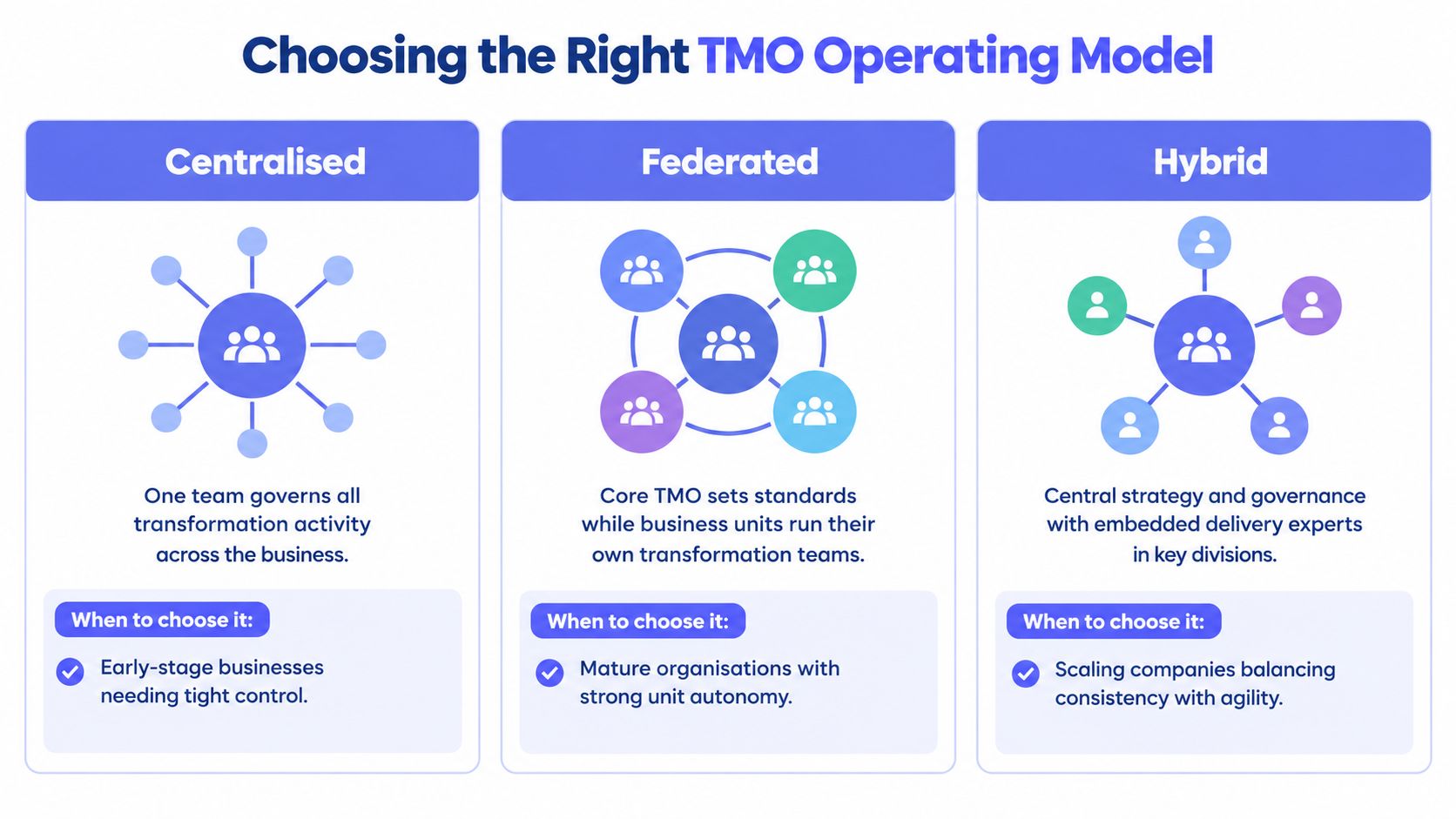
The following models describe where authority and delivery capability sit. They aren't maturity levels.
Match the structure to the execution problem
| Business need | My recommended approach | Trade-off to manage |
|---|---|---|
| Fast-moving scale-up with competing priorities | Light coordination, usually centralised around an executive sponsor | Maintain momentum without leaving operational benefits unowned after launch |
| Cross-functional change requiring hands-on support | Embedded delivery engine, usually hybrid | Give embedded experts clear authority without creating competing reporting lines |
| Enterprise or regulated portfolio with significant investment dependencies | Portfolio control, centralised or federated according to business-unit autonomy | Preserve assurance without making every decision an executive escalation |
A centralised TMO can be small. Centralisation describes authority, not bureaucracy. For an early-stage business, I'd favour a compact coordination function that prepares decisions and makes commitments explicit.
A hybrid model makes more sense when divisions need practical delivery support. Central leadership sets investment priorities and common standards. Embedded specialists help operational leaders redesign processes, resolve dependencies and establish adoption evidence.
For a mature organisation with strong unit autonomy, a federated model can preserve local ownership. But I wouldn't accept different definitions of benefits or incompatible confidence ratings across units. Local delivery needs a common portfolio language.
Pressure-test the choice with leadership
UK public-sector digital-transformation research found only 17% of decision-makers considered their efforts completely successful, with 28% lacking formal prioritisation and 23% identifying change management as a challenge. Those are operating problems, not reasons to default to a larger central office.
Before recruiting, I want leadership to answer:
- Authority: Which decisions should remain local, and which require enterprise trade-offs?
- Capacity: Does the business need coordination, specialist intervention or investment control?
- Ownership: Do benefits cross departmental boundaries?
- Executive appetite: Will sponsors make visible choices, including rejecting work?
The key operating model design decision is where responsibility should sit. Don't select a structure because it looks credible in a board presentation. Select it because it addresses the failure you've identified.
Designing the TMO in Your First 90 Days
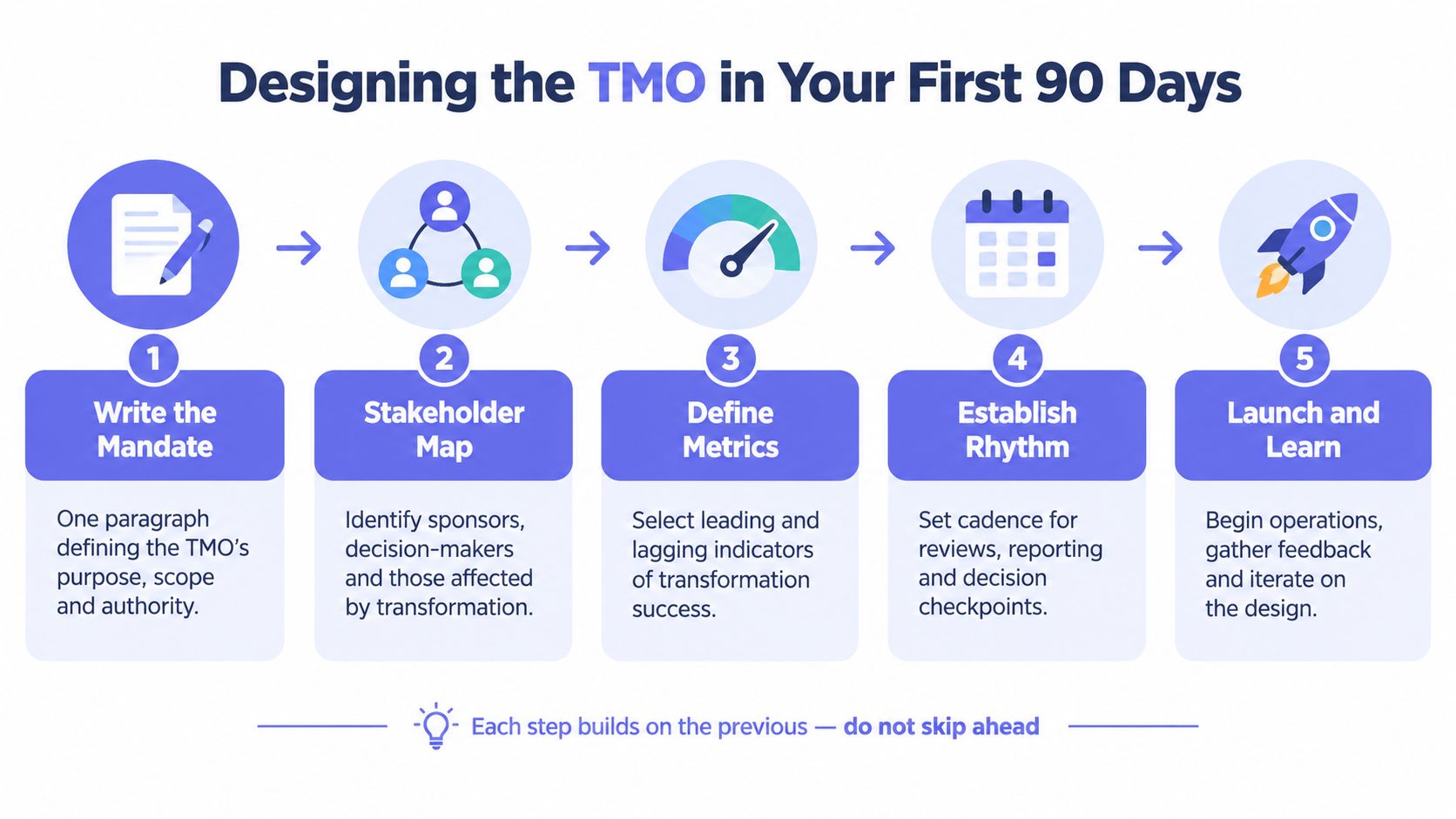
On Monday, write the mandate before opening a recruitment requisition. Keep it to a paragraph covering purpose, scope, authority and the outcomes the TMO exists to improve.
Map the executive sponsor, operational benefit owners, delivery leaders and affected teams. Then distinguish decisions the TMO can make from decisions it recommends and decisions it escalates.
Establish authority before intake
I recommend naming the top five decision areas explicitly: admitting work, recommending investment priorities, sequencing dependencies, escalating exceptions and challenging continued investment. Executive leaders should retain financial authority where appropriate. The TMO's mandate must specify the limits.
Intake should require a strategic connection, intended outcome, operational owner, capacity requirement and credible measurement approach. An attractive presentation isn't sufficient. If an initiative can't identify what changes in the business, return it for clarification.
Starting with tool selection turns unresolved decision rights into a software configuration problem.
Technology deserves consideration after those choices are clear. For that discussion, Wistec solution through technology insights is a supplementary digital-business-transformation resource, not a substitute for an agreed mandate.
Build the minimum evidence set
I wouldn't launch with a library of templates. I'd establish the records needed to support decisions:
- Portfolio view: Shows strategic contribution, investment, confidence and the decision required.
- Dependency log: Identifies the supplying team, receiving team, required commitment and escalation owner.
- Benefits register: Records the outcome, operational owner, baseline, target, evidence source and realisation timing.
- Risk register: Separates uncertain threats from current blockers and identifies the response authority.
Define leading and lagging indicators alongside these records. Don't allow the portfolio view to become a list of project names with coloured dots.
As at the end of March 2024, the Government Major Projects Portfolio contained 227 projects, with whole-life costs of £834 billion and monetised benefits of £719 billion, supported by quarterly delivery-progress returns. The relevant lesson is consistent oversight, not copying government-scale administration.
Set a weekly blocker discussion, a monthly investment-and-benefits review and a quarterly priority reset. Give each forum a decision purpose. Cancel meetings that only repeat the information already recorded.
For the implementation roadmap, my recommended first-90-days sequence is straightforward:
- Week one: Agree the mandate, sponsor and decision boundaries.
- Week four: Run intake and reviews using the minimum evidence set.
- Week twelve: Test whether decisions are faster, remove duplicate reporting and revise the design.
Treat launch as the beginning of learning, not proof that the office works.
Embedding OKRs Into the TMO Operating Rhythm
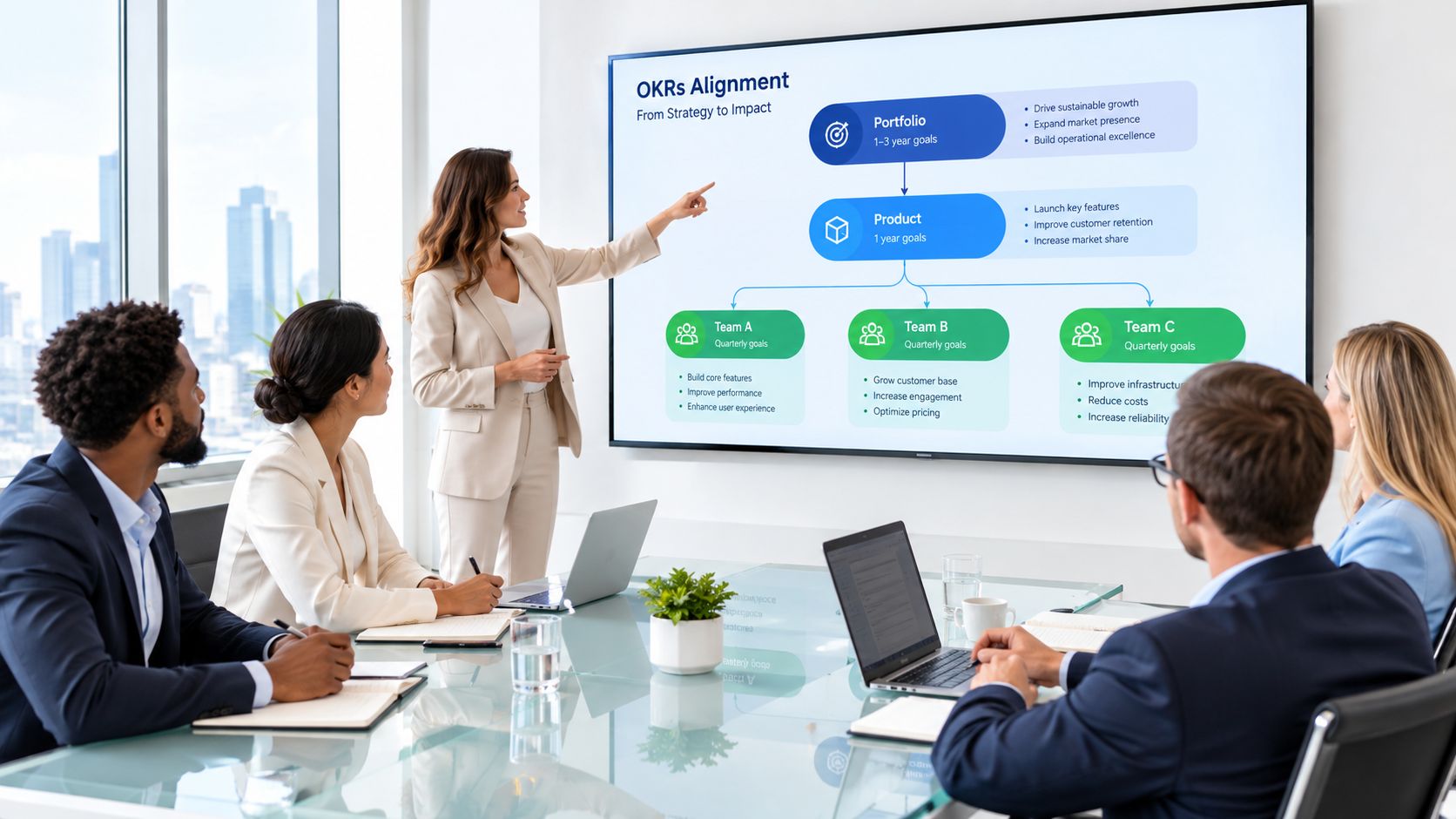
An OKR review that sits outside investment and delivery decisions is an extra meeting. I want the same outcome evidence used by team leaders, the TMO and executive sponsors.
Start with portfolio objectives that describe a business change. For a growth strategy, that might mean making customer onboarding reliable enough to support expansion. Team key results should then measure the contributions required from product, operations and technology.
Make key results auditable
Don't cascade identical targets down the hierarchy. Identify which teams can change which parts of the outcome, and where they depend on one another.
| Activity measure to challenge | Outcome evidence to use instead |
|---|---|
| Training completed | Employees correctly using the new process in live work |
| Platform launched | Eligible transactions completed successfully through the platform |
| Automation delivered | Validated capacity released or expenditure removed |
| Workshops held | Agreed operational changes implemented and sustained |
For product-specific thinking, the SigOS guide to outcome-based OKRs is a useful companion resource. My management test remains simple: can the owner show the underlying data and explain how the result supports the strategic objective?
The Government Efficiency Framework reports Government Digital Service analysis identifying £6.3 billion in potential annual savings, comprising £1.1 billion in cost reduction and £5.2 billion in productivity gains, equivalent to 5.2 million working hours. These are potential benefits, not realised results.
Track financial savings separately from productivity capacity. Time released doesn't become a cash saving unless leaders change expenditure. Record what happens to that capacity rather than adding incompatible benefits into a headline total.
Use confidence to trigger action
Give each key result an on-track, at-risk or off-track assessment, supported by evidence. Feed that assessment into the portfolio's RAG discipline. Don't treat a percentage-complete score as delivery confidence.
Weekly check-ins should answer what changed, which assumption is weakening and what decision is needed. Executive sponsors must resolve trade-offs rather than ask teams to recover every target through additional effort.
At the quarterly review, reprioritise the portfolio using those same results. Don't run a separate prioritisation exercise with different criteria.
That operating rhythm prevents OKRs becoming a tick-box ritual. Completion belongs in the delivery plan. Business performance belongs in the key results.
Governing for Outcomes Rather Than Activity
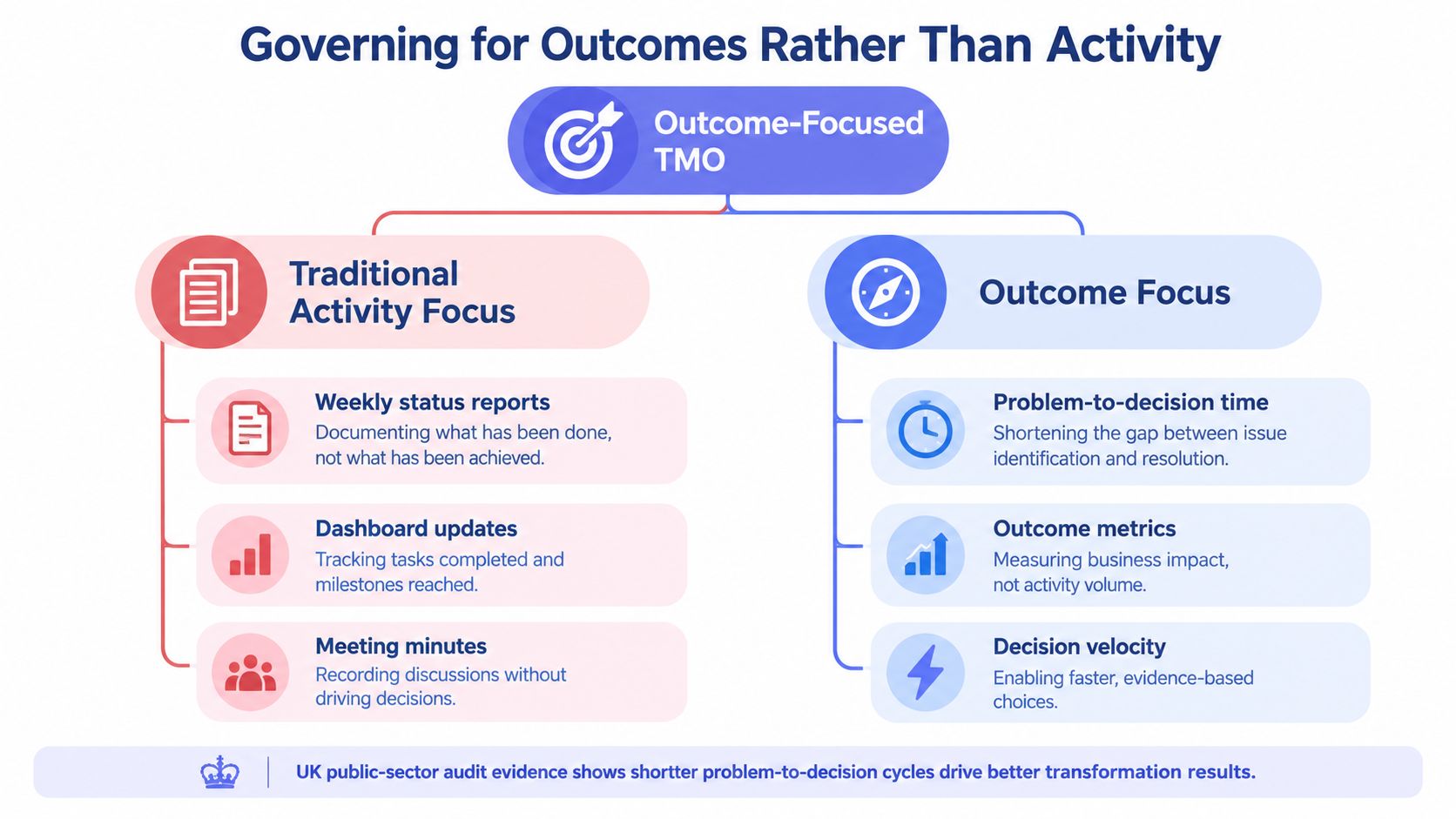
More control doesn't automatically mean better governance. I judge a TMO by the time between raising a material problem and making an actionable decision, not by the completeness of its reporting pack.
Scotland's transformation audit evidence identifies difficulties demonstrating financial and wider benefits, alongside weaknesses in success measures, strategic oversight and connections to financial plans. My conclusion is that leaders need clearer outcome accountability, not another layer of administrative compliance.
Separate assurance from intervention
Assurance independently tests whether plans, evidence and controls are credible. Intervention changes the delivery situation by securing a decision, resolving a dependency or replacing an inadequate plan.
Keep those responsibilities distinct. A TMO shouldn't rescue a programme and then present its own work as independent assurance. Where independent scrutiny is necessary, appoint someone outside the delivery responsibility.
At the end of March 2024, Government Major Projects Portfolio delivery-confidence reporting rated only 25 of 227 projects, or 11%, Green, alongside 163 Amber and 27 Red. The ratings assess the likelihood of delivering objectives to time and cost; Amber means delivery appears feasible but significant issues need management attention.
Use that distinction properly. Amber requires an issue owner, recovery action and decision deadline. Red requires an explicit executive choice about recovery, scope or continued investment. Neither should become a permanent label that everyone learns to ignore.
Governance test: A review should end with a decision, a changed commitment or an explicit conclusion that no intervention is needed.
Stop work that doesn't improve decisions
I would remove these practices unless someone can explain their decision value:
- Duplicate status meetings: Several forums hearing the same update from the same programme leader.
- Manually reconstructed dashboards: Re-entering data instead of examining its reliability.
- Narrative reporting without an ask: Describing problems without options, recommendations or decision owners.
- Automatic milestone approvals: Accepting delivery completion without testing continued business justification.
Protect mandatory assurance and regulatory evidence. Cutting governance theatre isn't permission to weaken legitimate controls.
Keep portfolio prioritisation, dependency resolution, benefits review and rapid escalation. Measure decision latency and whether resolved dependencies stay resolved. Use outcome measurement to distinguish a healthy delivery process from a valuable business result.
Approved business cases are forecasts. They don't absolve leaders from checking what changed.
What Good Looks Like in Month Six
Consider a hypothetical 180-person scale-up, not a reported client case. Its leaders are expanding the business while product, sales and operations pursue conflicting priorities. The proposed rebuild combines a small TMO with linked portfolio and team OKRs.
By month six, I'd expect leaders to use fewer overlapping forums because each remaining meeting has a defined purpose. I'd also expect dependency records to show shorter resolution times against the starting baseline. Those are acceptance criteria for the redesign, not invented performance results.
Follow a blocker through the system
The leadership team uses a one-page portfolio view and a single dependency log. A quarterly outcomes review informs the strategy offsite rather than becoming a presentation about completed projects.
In my proposed rhythm, a weekly ten-minute stand-up identifies exceptions. Suppose an onboarding change needs an operations decision about customer eligibility. The TMO names the decision owner and seeks a same-day resolution within delegated authority; decisions outside that authority follow the escalation route.
The benefits register replaces the dashboard nobody trusted. A named executive is accountable for maintaining the register's integrity, while individual operational leaders retain ownership of their respective benefits.
- Before approval: The owner confirms how the outcome will be measured.
- During adoption: The operational leader checks whether employees use the changed process.
- After transition: Finance and performance owners validate results against the original baseline.
The need for this discipline isn't hypothetical. Reporting on Somerset Council's auditors described projected benefits of £1.83 for every £1 invested, against an original target of £3, and noted that some projects lacked documented delivery plans. The reported return was a projection, not evidence of realised savings.
Expect friction without accepting drift
I wouldn't expect every old ritual to disappear immediately. Some managers may retain local spreadsheets. Metric definitions may need refinement across review cycles. Under pressure, executive sponsors may revert to inspecting individual projects instead of resolving portfolio trade-offs.
Correct those behaviours visibly. Retire duplicate records once the replacement is reliable. Keep a history of metric changes so apparent improvement isn't a new definition.
Month-six success means operational leaders can explain results without the TMO speaking for them. Don't abandon the design because benefits weren't visible in month two. Don't declare victory because the meetings ran on time either.
The Five Tests of a TMO That Actually Works
A TMO should make leadership accountability easier to exercise, not easier to delegate. I use these tests to distinguish a working decision-and-benefits system from a well-organised reporting function.
The UK government's benefits-management guidance defines a five-stage method: identify, analyse/value, plan, realise and review, with tracking, reporting, challenge, assurance and escalation throughout the lifecycle. Project closure isn't the end of outcome responsibility.
Test the evidence, not the presentation
-
Every benefit has a named owner. Ask an operational leader to show the measurement and explain what must change. A sponsor's name on a slide isn't enough.
-
Executives can name the top three delivery dependencies. They should know the contested commitments and who can resolve them. If only the TMO understands the dependencies, leadership isn't governing the portfolio.
-
The governance rhythm shortens decision time. Examine recent escalations. Did the forum produce an actionable choice, or merely request another update?
-
OKRs influence weekly trade-offs. Look for work that changed because outcome evidence changed. Quarterly scoring without intervening decisions is administration.
-
The TMO recommends stopping as well as starting. It should challenge initiatives whose assumptions no longer hold. Don't impose an artificial stopping quota, but don't accept a portfolio where every investment is permanently protected.
Make the office less necessary
The strongest result is a leadership team that can sustain the discipline without depending on the TMO to organise every conversation. Operational managers own adoption. Finance validates financial outcomes. Executives make cross-business choices.
I would review the TMO's continuing role as those capabilities improve. Retain coordination and assurance where they're needed. Remove responsibilities that line leaders are ready to carry.
The office is an enabler, not the permanent owner of improvement. Judge it by the decisions leaders make and the outcomes operational teams sustain.
I help leadership teams design and rebuild transformation management offices that connect strategy, OKRs, decision rights and measurable benefits. To work through your execution gaps and establish a practical operating rhythm, book a conversation