
Your product team missed the quarter. The roadmap was full. Every squad had work in progress. Engineering shipped features, sales promised capabilities, and customer success discovered that nobody had prepared customers to use them. Leadership still called the problem “alignment”.
That diagnosis is too comfortable. The problem was a weak strategy product development system. Strategic intent never became a small set of choices, evidence thresholds, accountable owners, and operating habits. OKRs can fix that gap, but only when they help leadership stop the wrong bets faster, not when they decorate an existing roadmap.
Why Product Development Drifts From Strategy
A leadership team can agree on strategy in the boardroom and still create chaos in delivery.
I've seen this happen after a growth plan identifies enterprise expansion as the priority. The product team continues improving self-service onboarding because those requests are visible. Engineering accepts a platform rewrite because it feels strategically important. Sales pushes for custom reporting for a large prospect. Each decision sounds reasonable in isolation. Together, they consume capacity without building the capability the strategy requires.
The warning signs are familiar:
- Local optimisation: Each function hits its own activity targets while the customer journey remains broken.
- Too many priorities: Leaders call everything urgent, so teams make hidden choices based on whoever escalates most effectively.
- Weak ownership: Several people attend the review, but nobody can decide whether an initiative continues.
- Activity metrics: Teams report releases, tickets, workshops, and sprint completion instead of adoption, margin, revenue, or time-to-value.
- Escalation avoidance: Risks stay inside functions until the launch date makes them expensive.

The operating system is usually the constraint
I don't start by rewriting the strategy document. I inspect how decisions move through the organisation.
Who can stop an initiative? What evidence must a product lead provide before engineering capacity is committed? Which executive owns the outcome? When do commercial, technical, compliance, and service teams challenge the same assumption? What happens when the forecast weakens?
The Office for National Statistics found that a 0.1-point increase in a firm's management-practice score was associated with a 9.6% increase in productivity. The score covers structured practices such as monitoring performance, setting targets, providing incentives, and improving processes, as shown in the UK government evidence annex.
That matters because execution discipline isn't administrative overhead. It changes whether strategy reaches customers.
My test: If a team can't name the outcome, owner, evidence threshold, and next decision date, it isn't executing strategy. It's processing a queue.
Founders dealing with category disruption may also benefit from this practical guide for founders on disruption, particularly when a new business model threatens assumptions behind the current product portfolio. For a sharper distinction between intent and delivery, compare your current habits with this strategy versus execution perspective.
OKRs don't rescue poor strategic choices. They make those choices visible. A strong system tells teams what matters, what won't be funded, what proof is required, and who decides when the evidence changes.
Turning Strategic Intent Into Focused Product OKRs
Start with the business choice, not the feature list.
If the strategy is to win larger customers, “launch enterprise permissions” is not an objective. It's an initiative. The objective should describe the business or customer change leadership wants to create. The key results should show whether that change is happening.
I limit a company product portfolio to three meaningful objectives for a planning cycle. More than that usually means leadership hasn't made the trade-offs.
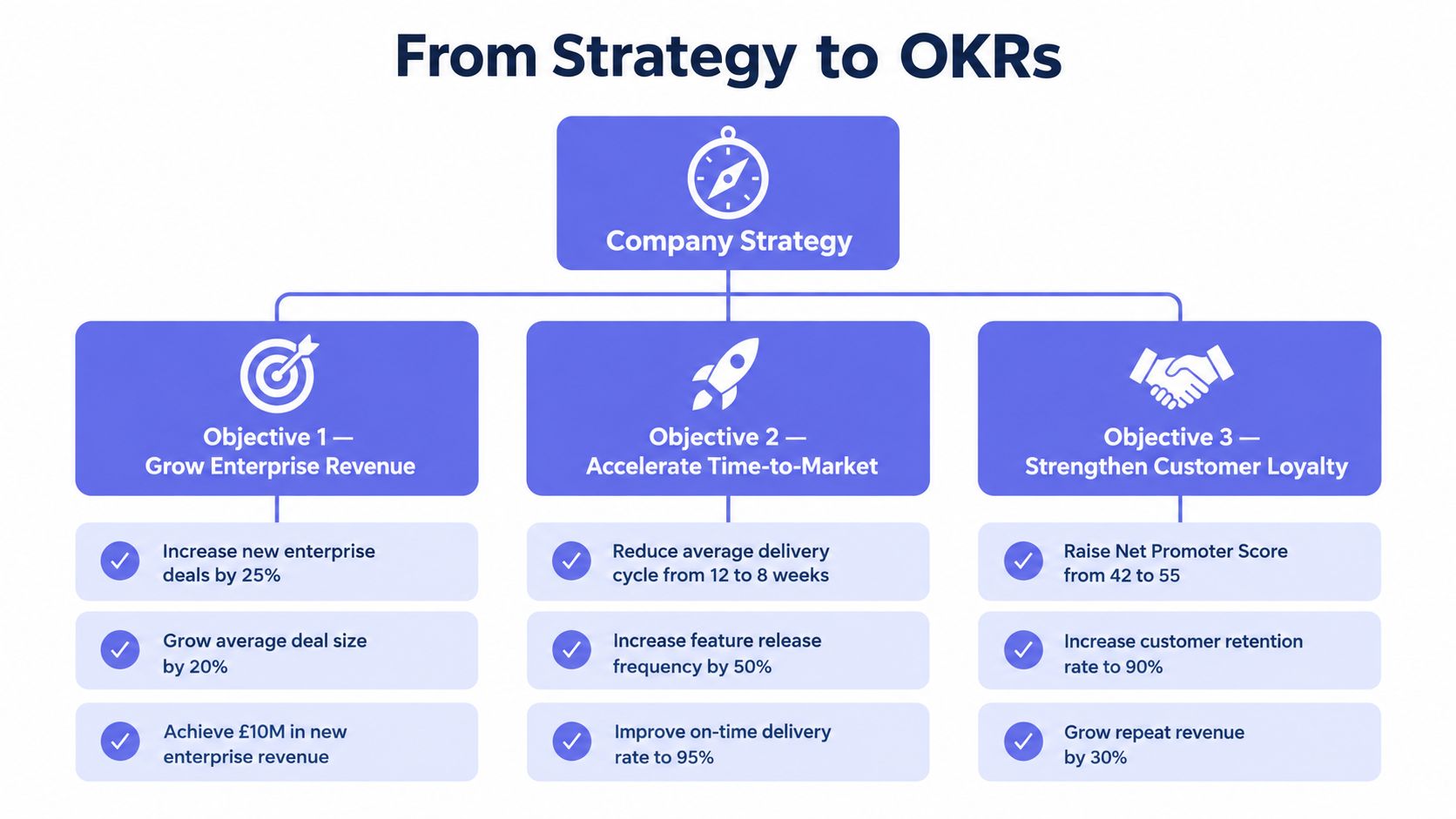
Write objectives around outcomes
Use a sentence that states the direction and the value:
Objective: Make the product credible for enterprise buyers without slowing the core customer experience.
Then define key results that expose progress:
- Adoption: More target enterprise accounts complete the priority workflow.
- Commercial value: The product contributes to qualified enterprise revenue.
- Customer value: Time-to-value improves for the target segment.
- Quality: Critical defects and support escalations decline after release.
- Operational readiness: Sales, service, compliance, and support can deliver the new proposition.
Don't turn every metric into a key result. Choose the small number that proves or disproves the product thesis. If a result can rise while customer value stays flat, it probably measures activity rather than outcome.
UK businesses performed £55.6 billion of R&D in 2024, an increase of £2.4 billion, or 4.5%, from 2023. Software development represented £10.3 billion, or 18.5% of total business R&D, according to the Office for National Statistics business R&D bulletin. That scale makes the distinction urgent. Development effort is not proof that a product direction deserves more investment.
Put the stop decision in the plan
Every objective needs a kill or pivot condition before delivery begins.
For example:
- Continue if target buyers confirm the problem, accept the proposed value, and show behaviour consistent with the business case.
- Pivot if the problem is real but the proposed workflow fails usability or willingness-to-pay tests.
- Stop if the target segment doesn't recognise the problem or the economics cannot support delivery.
- Pause if a regulatory, technical, or operational dependency remains unresolved without a named mitigation and date.
Separate reversible experiments from irreversible commitments. A prototype, pricing test, or customer interview is cheap to change. A major platform investment, hiring plan, or contractual promise is harder to unwind. Demand stronger evidence before the second category.
Create a one-page product OKR sheet with the objective, three to five key results, one accountable owner, explicit non-priorities, assumptions, evidence thresholds, and the next decision date. My OKR examples for product teams show how this can stay practical without turning product planning into a paperwork exercise.
Prioritising Bets and Roadmapping for Outcomes
A roadmap should show how investment will earn the right to continue. It shouldn't promise that every idea will reach production.
I score each product bet against three questions:
- Strategic fit: Does this directly support a stated business choice?
- Evidence strength: What do customers, commercial data, technical tests, and operational checks already prove?
- Capability readiness: Can the organisation deliver and adopt it without ignoring critical dependencies?
The current environment makes weak prioritisation expensive. The 2025 Innovation State of the Nation survey found that 60% of UK businesses changed products or services during the year, up from 56% in 2024, while 49% of innovating firms reported barriers, up from 44%. The leading barriers were lack of bank or equity finance at 74%, uncertain demand at 50%, regulation and standards at 49%, and public funding at 45%, according to the 2025 survey report.
That is not a case for freezing innovation. It is a case for staging commitment.
Product Bet Prioritisation Matrix
| Bet | Strategic Fit | Evidence Strength | Decision |
|---|---|---|---|
| Enterprise workflow improvement | Strong | Customer need validated, operational dependencies open | Fund discovery and set an evidence gate |
| New reporting add-on | Moderate | Sales interest, limited usage evidence | Run a narrow pricing and problem validation test |
| Internal platform rewrite | Unclear | Technical rationale, weak customer connection | Pause until the strategic outcome is explicit |
An outcome roadmap says, “Improve enterprise activation, then choose the workflow that proves it.” A feature roadmap says, “Build permissions, reporting, and admin controls by fixed dates.” The first preserves room to learn. The second encourages teams to defend scope after assumptions change.
Use now, next, later only when each lane has a funding rule:
- Now: Committed capacity, named owner, measurable evidence gate.
- Next: Discovery or feasibility work only, no automatic delivery funding.
- Later: Recorded opportunity, no implied promise to customers or sales.
The guide for makers launching new tools is useful for the practical mechanics of roadmapping. I'd still insist that every roadmap item earns its position through evidence, not enthusiasm.
Gate the investment
At the market gate, test the problem, target customer, willingness to pay, and forecast sales. At the product gate, test usability, feasibility, unit economics, and acceptance criteria. At the launch gate, confirm manufacturing or delivery readiness, quality, support, compliance, and commercial enablement.
A Cambridge Judge Business School benchmark defined a successful product as one that exceeded predicted sales during its first twelve months. In its UK and German manufacturing sample, 8% of products failed quality standards during the first month of production and 1% still failed after production stabilised, as reported in the Cambridge benchmark. Treat that as a benchmark for planning hypercare, not a universal industry rate.
Review forecast accuracy after the first year and feed the variance into the next planning cycle. Launch is an event. Commercial and operational performance determine whether the bet worked. My approach to prioritising with OKRs keeps that decision visible.
Governance Handoffs and Operating Rhythms That Hold
Roadmaps decide what gets funded. Governance decides whether those decisions survive delivery pressure.
Start by making decision rights explicit. The product lead owns customer value and scope. The delivery lead owns the delivery plan and timeline. Finance challenges the economics. Commercial leaders validate the route to market. A single executive sponsor decides whether the initiative continues when evidence conflicts.
Don't create a committee that shares accountability. Name one accountable owner per initiative. Contributors can challenge, advise, and deliver. One person must still make the decision.
Build the handoff around exit criteria
Discovery should not end because the calendar says it has ended. It ends when the team can answer the questions required for delivery:
- Customer case: Who has the problem, and what evidence confirms its importance?
- Product case: What smallest solution could create the intended outcome?
- Technical case: Can the team deliver it with known constraints?
- Commercial case: How will customers find, buy, and adopt it?
- Operational case: Can support, service, compliance, and finance handle the change?
- Decision case: What would make leadership continue, pivot, or stop?
Record unresolved high-severity risks with a mitigation, owner, and date. If the handoff document contains “to be confirmed” without ownership, delivery will inherit the ambiguity.
Run a fixed cadence
I prefer a simple rhythm:
- Weekly product review: The accountable owner reports outcome movement, new evidence, blocked decisions, and risks.
- Monthly investment review: Leaders decide whether each bet continues, changes scope, receives capacity, or stops.
- Quarterly planning: The portfolio is rebalanced against customer evidence, financial constraints, capability, and strategic priorities.
- Performance conversations: Managers discuss the decisions and behaviours producing results, not just whether tasks were completed.
The ONS 2023 Management and Expectations Survey found an average UK management-practice score of 0.55 on a scale from 0 to 1. Seventeen percent of firms with at least 10 employees said they had tested or adopted artificial intelligence, compared with 37% among firms in the top decile of management practices and 3% among firms in the bottom decile, according to the ONS management-practices bulletin.
The point isn't that meetings create adoption. Structured management practices make ownership, progress, and blocked decisions visible. Use this operating rhythm guide to pressure-test whether your reviews lead to decisions or merely produce updates.
Operating rule: A review without a decision, owner, or next date is reporting theatre.
Common Failure Modes and How I Fix Them
Most failed product initiatives don't fail because nobody cared. They fail because the system rewarded continuation, activity, and local success after the original assumptions had weakened.
The UK Innovation Survey reported that 36% of businesses were innovation-active in 2020 to 2022. Nineteen percent were product innovators, 29% introduced new business processes, and only 13% did both, according to the UK Innovation Survey report. Product work can therefore fail outside the product team, especially when sales, service, supply chain, compliance, and support processes aren't ready.
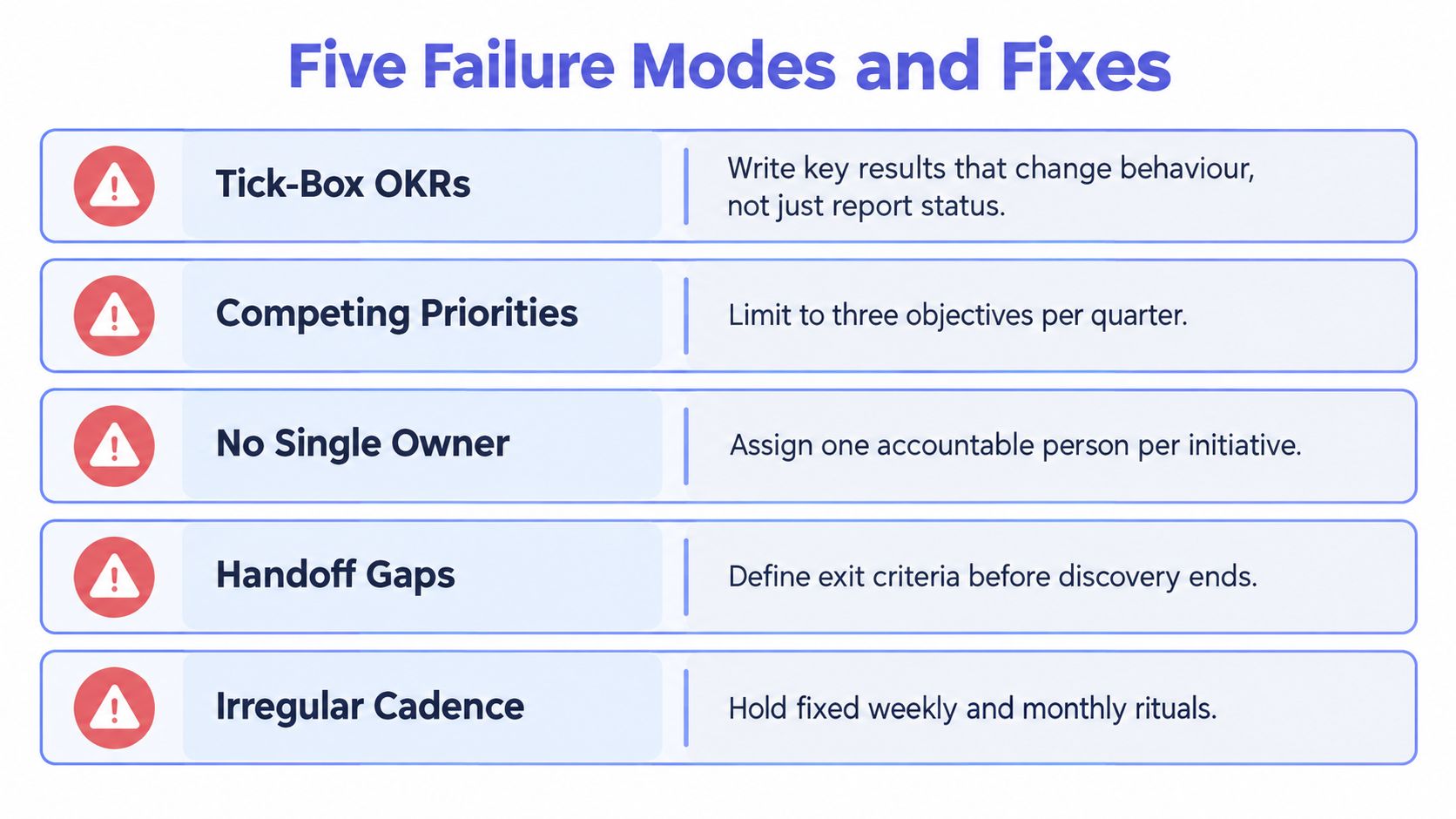
The five patterns I challenge first
Tick-box OKRs. The team writes “deliver the new workflow” as a key result. Symptoms include green status reports and flat customer behaviour. I replace the activity with an outcome, define the baseline, and set a review date that forces evidence.
Competing assumptions. Sales assumes customers will pay for the capability. Engineering assumes the architecture can support it. Operations assumes the launch volume will be small. Nobody records the disagreement. I put the assumptions in one decision log and require each function to attach evidence, an owner, and a date to the risk.
Even funding. Leaders spread capacity across every initiative so nobody feels deprioritised. Everything progresses slowly, and nothing receives enough attention to create traction. I use quarterly kill, pivot, or scale reviews and move capacity towards the bets showing customer and operational evidence.
Handoff gaps. Discovery hands over a concept with no acceptance criteria, support plan, compliance view, or commercial owner. Delivery then discovers the missing work after scope and dates have hardened. I define exit criteria before discovery ends and refuse to call an initiative ready when critical dependencies remain anonymous.
Activity masking weak adoption. The team reports releases, training sessions, and completed tickets while customers ignore the product. I pair delivery measures with adoption, retention, time-to-value, margin, defect escape, and support signals.
Use a decision record, not a status ritual
For every material review, record four things:
- Decision: Continue, pivot, pause, or stop.
- Evidence: What changed since the last review?
- Exposure: Which assumption or risk could invalidate the bet?
- Commitment: Who owns the mitigation, and by what date?
Don't punish a team for stopping a weak bet. Punish a system that makes teams hide weak evidence until the budget is spent. The goal isn't perfect forecasting. It is faster correction.
Making Strategy Stick in Product Delivery
Strategy becomes real when a product team can make a hard trade-off without waiting for an executive rescue.
The chain is straightforward. Leadership chooses a market, customer, problem, and advantage. Product leaders turn those choices into a small set of outcome OKRs. Teams test assumptions before accepting major commitments. Governance moves capacity towards evidence and away from wishful thinking. Operating rhythms expose slippage while leaders can still act.
That is the difference between alignment and agreement. Agreement says the strategy sounds sensible. Alignment means people stop work that doesn't serve it.
A practical 30-day reset
Days 1 to 5: Review the portfolio. List every active product initiative, its accountable owner, strategic outcome, current evidence, and next decision date. Highlight work that has no clear customer or commercial result.
Days 6 to 10: Choose three product objectives. Write the outcomes first. Add key results for adoption, customer value, commercial performance, quality, or operational readiness. Publish the non-priorities.
Days 11 to 20: Run evidence gates on the largest bets. Test demand, willingness to pay, feasibility, quality, and delivery readiness. Separate reversible experiments from irreversible commitments.
Days 21 to 30: Start the cadence. Hold a weekly product review, a monthly investment review, and a quarterly portfolio decision. Keep one decision log. Make unresolved risks visible with named owners and dates.
Use a practical reference such as Genpire product development when you need to think through development work across discovery, delivery, and launch. Then test whether your leadership team can trace every major initiative back to a strategic choice through this product team alignment guide.
Don't ask whether the roadmap is full. Ask whether the organisation is learning fast enough to stop bad bets, strengthen good ones, and fund the outcomes that matter. A product portfolio that ships constantly but cannot show adoption, value, quality, or commercial traction is not executing strategy. It is consuming capacity.
I help leadership teams turn strategy product development into focused OKRs, evidence-based investment decisions, and operating rhythms that hold people accountable for outcomes. If your strategy is clear but delivery still drifts, book a conversation.