
Only 9 of the 108 most complex and strategically significant government projects had sound impact-evaluation plans in place in 2019, according to the National Audit Office. Approval hadn't established how leaders would test whether delivery worked. That's the distinction I care about in the evaluation of strategy. A signed-off plan authorises action. It doesn't prove that action deserves the next investment.
Why Strategy Reviews Rarely Change Decisions
Only 18.4% of respondents in a 2025 survey of 250 UK companies with turnover above £20 million achieved more than 80% of their aspirational growth goals within three years, while only 46% had a clearly measurable value gap, according to Strategy Execution 2025. The same survey identified a talent gap, weak alignment between operations and strategy, and misaligned organisational culture as the leading internal barriers.
Those are operating problems. Another presentation about ambition won't fix them.
The meeting pattern is familiar. The strategy has been signed off. The narrative is still on the wall. Each executive reports progress, but nobody can explain whether delivery is closing the distance between current performance and the destination.
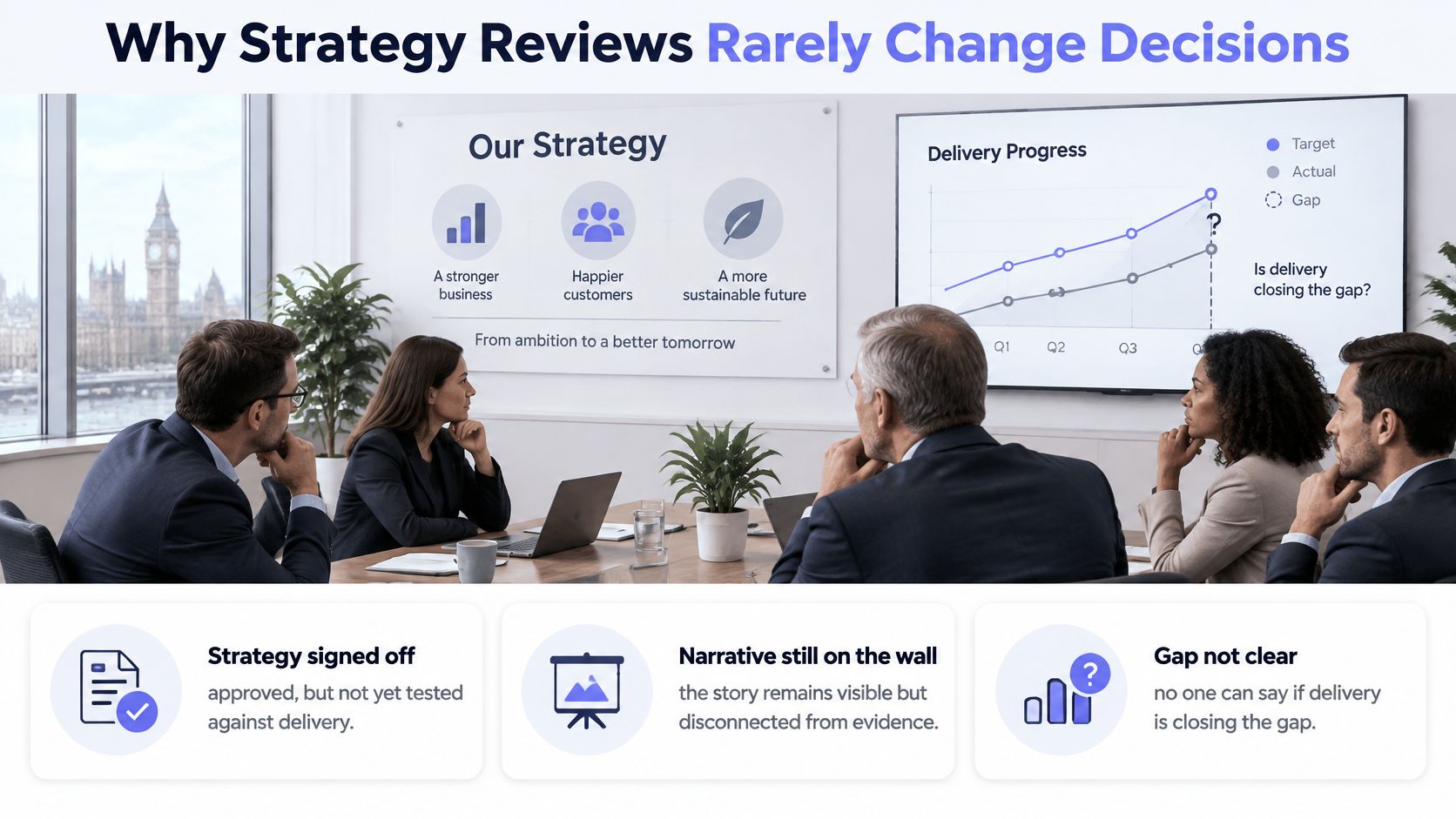
Approval isn't evaluation
I reject a review that treats projects launched as evidence of strategic progress. Red, amber and green can show whether work is on schedule. Without a baseline and an outcome, those colours say nothing about whether the work matters.
Say a leadership team approves an enterprise growth strategy. Sales launches a campaign. Product releases new functionality. Operations completes recruitment. All report green.
Yet enterprise customers still don't buy. Leaders have evidence of expenditure and effort, not evidence that their strategic choice works.
My standard: A strategy review must change a decision, not just update the explanation.
A useful evaluation quantifies the required improvement, assigns an accountable owner and establishes when leaders will continue, adapt or stop. Those decisions must happen while resources can still be redirected.
Make the gap discussable
I want leaders to distinguish an attractive destination from an executable choice. For banking leaders facing that problem, Visbanking's guide to strategy for bank executives provides useful context for examining strategic decisions rather than treating planning as the answer.
The same discipline belongs in quarterly business reviews. Start with the business gap. Ask what changed, what explains the change and what management will do differently.
For a scale-up, the immediate problem may be competing priorities. In an established organisation, it may be slow hand-offs and accountability that dissolves across functions. Neither problem needs a larger reporting pack.
I use a compact review pack, an evaluation design agreed before delivery, an execution-chain test and a targeted response to the failure identified. The purpose is practical: establish whether the strategy is wrong, execution is broken, or nobody made the strategy clear enough to execute.
The Review Pack Leaders Should Demand
Strategy review pack by test
| Test | Evidence that counts | Cadence | Decision it forces |
|---|---|---|---|
| Implementation fidelity | Named owners and the work actually delivered, not initiatives launched | Monthly | Escalate blockers or drop the work |
| Outcome attainment | Baseline, target and actual on one or two primary results | Quarterly | Continue or reset the result |
| Contribution | Movement left after market, price, mix and other initiatives | Quarterly | Scale, redesign or stop |
| Strategic comprehension | Teams state the choices and what was deprioritised | Mid-cycle, around week 6 to 8 | Rebrief or realign priorities |
| Leading indicators | Early signals moving before the lag outcome | Monthly | Change tactics without waiting for the quarter |
| Management system | Few measures, stretch targets, and a response when a gap appears | Quarterly | Fix the operating rhythm |
Read the evidence before the narrative
I ask leadership teams to open this pack before anyone explains performance. The cadences are my recommended operating rhythm, not a claim that every business has identical decision cycles. Bring a review forward when an investment decision can't wait.
Implementation fidelity comes first. Did the agreed work happen, to the agreed standard, under a named owner? If the delivery team couldn't access customer data, resolve the access problem before declaring the strategy ineffective.
Escalate blockers with a decision attached. A request for executive support should state what must change, who can authorise it and which outcome is at risk. Don't rewrite the strategy to disguise an unresolved dependency.
Outcome attainment asks whether the business result moved. Compare like with like. Keep the customer definition, reporting period and measurement method consistent so an apparent improvement isn't just a reporting change.
Resetting a result requires a clear reason. Correct a faulty definition or an assumption that no longer holds. Don't lower a target because delivery became uncomfortable.
Contribution challenges the explanation. Revenue may rise because prices increased, demand recovered or an acquisition added customers. The pack should show the evidence supporting the initiative's contribution and acknowledge what remains uncertain.
For AI-enabled programmes, Applied's discussion of metrics for enterprise AI impact is a useful companion when deciding what business evidence belongs alongside technical performance. Tool usage alone doesn't justify scaling expenditure.
Test understanding and management discipline
Strategic comprehension requires teams to explain choices without reading the leadership slides. I want to hear what they're prioritising and what they've stopped. A fluent repetition of the company narrative isn't enough.
Leading indicators should create an early decision. If customer adoption is weak, leaders should adjust onboarding or support before waiting for the financial result. A measure that arrives early but changes no action is just another reporting burden.
For the management system, I look for useful tension in targets. In the ONS Public Sector Management Practices Survey pilot, 63% of central-government organisations reported setting stretch targets that were fairly difficult to achieve. That's the tension I want in a key result, not an impossible number and not a comfortable one.
A colour status isn't a review pack. It's a prompt to ask for evidence.
Each applicable row should carry baseline, target, actual, confidence, a comparator where available, and management action. Use qualitative evidence where a numerical baseline would be artificial, particularly for comprehension.
My default is one primary outcome per strategic priority. Supporting measures can explain it. Refuse a second slide of activity metrics presented as proof of success.
How to Design Evaluation Before You Execute
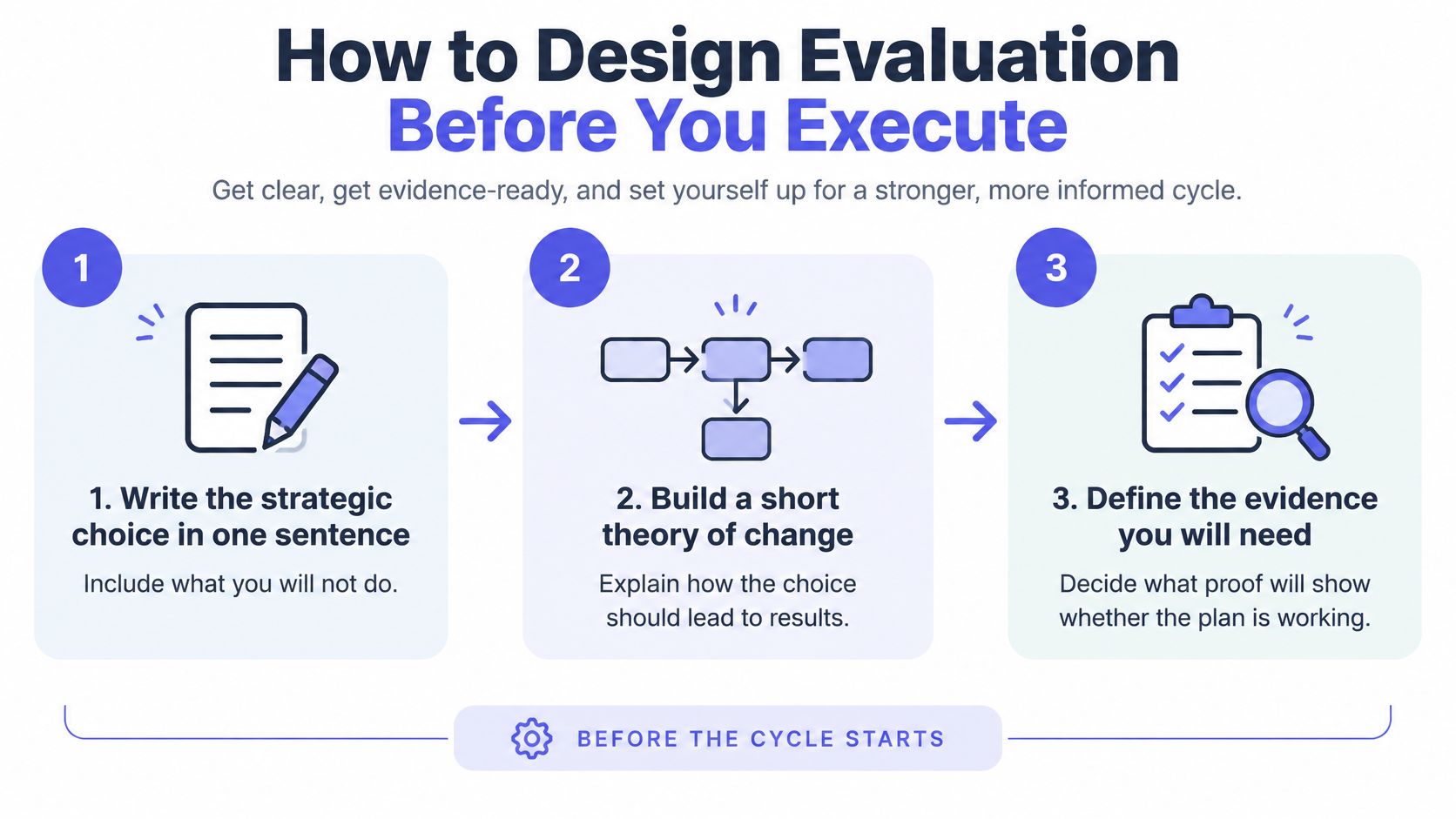
I design evaluation before the delivery cycle starts. Otherwise, leaders end up negotiating what success means after they've seen the result.
The Department for Education's evaluation strategy supports establishing baselines, making causal assumptions explicit and choosing an evaluation design that can test outcomes. I translate that discipline into the following sequence.
Set the rules before progress reporting starts
-
Write the strategic choice in a sentence. Include what the organisation won't do. Without that exclusion, teams can justify almost any existing project as strategically relevant.
-
Build a short theory of change. Connect the objective, the assumption that must hold, the activities, the output, the intermediate outcome and the intended impact. Keep it short enough for someone to challenge the logic.
-
Select the outcome measures and early signals. Name the data owner and collection frequency. If nobody owns the definition, different functions will report different versions of success.
-
Record the baseline now. Establish normal variation and define success before delivery begins. Otherwise, an ordinary fluctuation can become a victory in the next board pack.
-
Agree decision thresholds. Write down what evidence means continue, adapt or stop. Don't leave those judgements to whoever argues most confidently in the meeting.
-
Add a comparison for a high-stakes bet. Use a matched group or a suitable time-series design where feasible. A simple before-and-after comparison is weaker because other changes may explain the result.
-
Separate execution, movement and cause. Ask whether the work happened, whether the metric changed and whether the strategy explains that change. Skipping the distinction encourages leaders to defend delivery instead of examining impact.
-
Put the reviews on the operating calendar. I recommend monthly checks on delivery and early signals, with quarterly examination of outcomes and contribution. Assign preparation and decision ownership, not just meeting attendance.
Make the baseline useful
Consider an illustrative mid-sized software firm aiming to lift net revenue retention from 88% to 100% within three years. Its hypothetical value gap is 12 percentage points.
The strategic choice is to improve retention among larger customers and stop chasing new logos in the smallest segment. That exclusion belongs beside the objective from the start.
In this example, the baseline includes eight quarters of normal variation. A subsequent move to 90% isn't automatically a win. Leaders need to know whether the change exceeds ordinary fluctuation, persists and reflects stronger customer retention rather than a different customer mix.
That's why I distinguish measuring outcomes from counting completed plans or meetings. Activity confirms that people worked. It doesn't confirm that customers benefited.
For an uncertain bet, including AI-enabled change, add learning milestones, adoption quality, confidence and an explicit stop rule. Early evaluation should test whether the team is resolving important uncertainty, not pretend that financial return is already established.
A proxy metric needs scrutiny too. Faster task completion matters only if the organisation can connect it to useful capacity, better service or another strategic result.
Trace Strategy Through the Execution Chain
A disappointing result doesn't automatically mean the strategy was weak. It may mean the people expected to deliver it never understood the choice.
Only 43% of UK employees surveyed said change was clearly communicated within their organisation, according to FGS Global's Navigating Complexity findings. I therefore test strategic understanding as part of evaluation, not as a separate communications exercise.
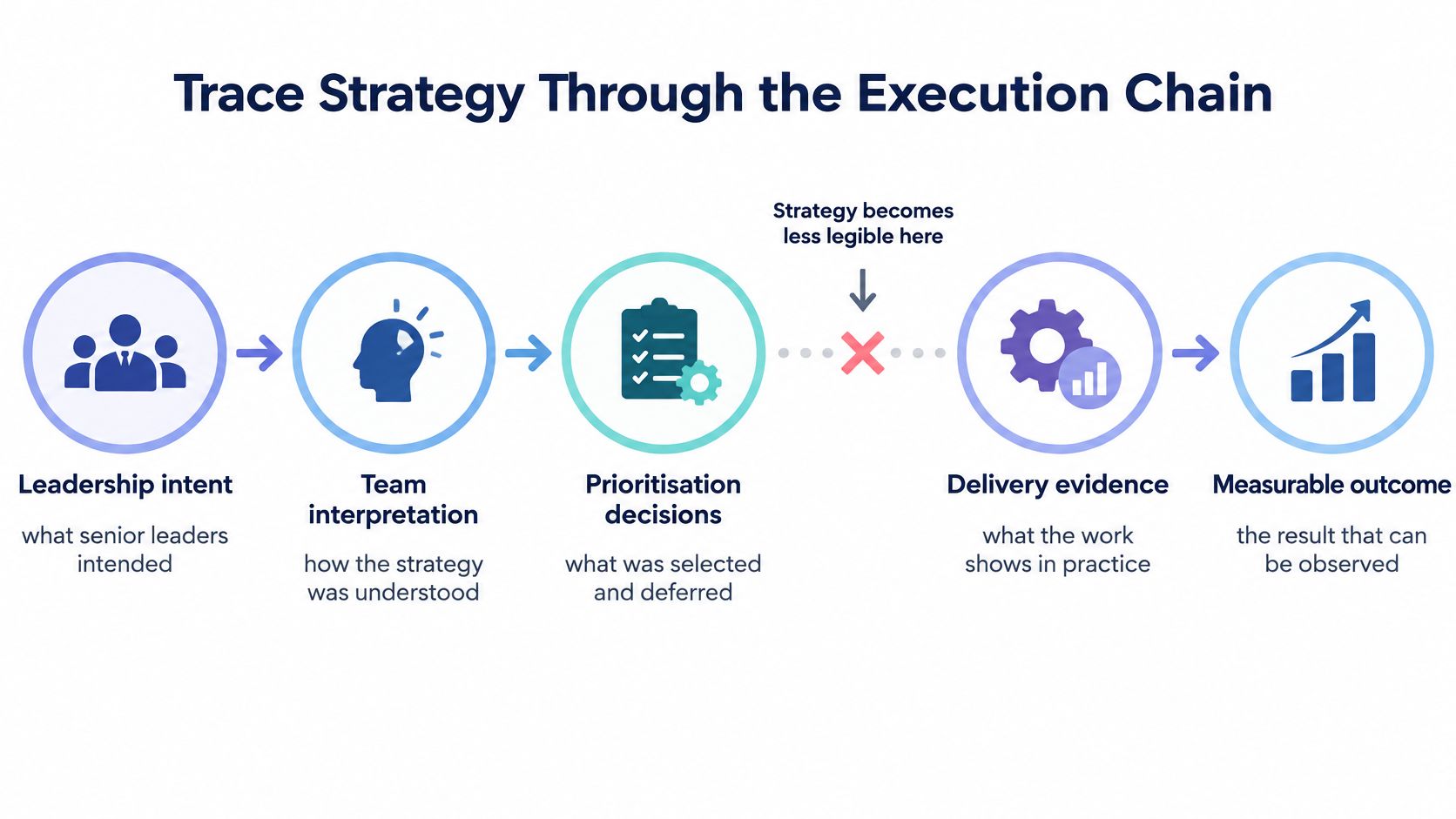
Follow the choice through actual decisions
Take an illustrative scale-up whose leadership chooses to win enterprise accounts in selected regions. The choice sounds clear at the executive meeting. Its meaning changes as it travels.
- Leadership intent. Executives intend to concentrate resources on enterprise buyers with specific needs. They expect larger, more durable customer relationships.
- Team interpretation. Middle managers translate the choice into growing sales. The customer segment and the geographic boundaries disappear.
- Prioritisation decisions. Sales offers discounts to increase volume. Product continues building features for small customers because that backlog already exists.
- Delivery evidence. Campaigns launch and releases ship, but neither demonstrates improved enterprise buying or adoption.
- Measurable outcome. The enterprise result stays flat. Leaders see considerable effort and conclude that the strategy failed.
The problem in this scenario is translation. The company didn't properly test its enterprise strategy because teams kept executing a broader growth agenda.
I wouldn't respond by drafting a new objective. I'd mark the broken hand-off and examine who changed the meaning, which incentives supported that interpretation and what authority managers had to deprioritise existing work.
Ask for proof of understanding
I put these questions to teams away from the executive table:
- Explain the choice. Can a team below the leadership layer state the strategy in its own words?
- Name the trade-off. Can people identify what was deprioritised and show that resources moved?
- Connect current work. Can they explain how this week's decisions should change a key result?
If they can't, that's a translation failure, not yet a verdict on strategic quality. MyCulture.ai's discussion of how to measure progress toward organizational goals is useful context for connecting organisational goals with team-level evidence.
I also test the choices through the Playing to Win framework's Where to Play, How to Win and Capability Focus. Leaders should be able to state the customers and markets they're choosing, the basis on which they expect to win, and the capabilities they'll build.
OKRs provide the bridge at the delivery and outcome end of this chain. The objective preserves the strategic choice. The key results measure the value gap. My distinction between inputs, processes and outputs helps prevent work completed from being mistaken for value created.
I hold that OKRs done well are among the most powerful ways to close the gap between strategy and results. But better wording won't repair an unmade choice.
If a key result can be completed while the business gap stays unchanged, replace the key result.
Close the Gaps the Evidence Exposes
Results flat, activity green is the first pattern I challenge. Leaders may have capable people working hard against measures that reward completion rather than improvement.
The review should identify the fault and prescribe a specific correction. Don't use disappointing performance as permission to replace everything.
Execution gaps and the fix
| What you see | What it usually means | What to change |
|---|---|---|
| Activity green, outcome flat | Key results measure projects, not the value gap | Rewrite results and cut initiatives that do not move them |
| Teams cannot state the choices | The strategy was never made legible | Rebrief trade-offs and retest comprehension mid-cycle |
| Every priority still live | No real strategic choice | Lock three to five priorities and record what stops |
| Metric up, cause unclear | Correlation treated as contribution | Hold scale until other explanations are separated |
| Reviews change nothing | Weak management system around the objectives | Name owners, respond to gaps, and handle missed commitments |
Repair the specific failure
For an illustrative onboarding problem, replace a key result about launching the new flow with a result to raise 90-day activation from 38% to 50%. Then examine each initiative against that intended change.
A redesigned email sequence might contribute. A cosmetic dashboard refresh might not. Cut work that has no credible link to activation rather than adding another project to prove urgency.
When teams can't explain the choices, stop drafting new OKRs. Rebrief the trade-offs using decisions people face. Ask managers to explain which customer requests they'll decline, which backlog items they'll defer and when they should escalate a conflict.
I recommend retesting comprehension around weeks six to eight of the cycle. Don't mistake sending the presentation again for confirming understanding.
When every priority remains active, leadership must make exclusions. I recommend locking three to five priorities and recording what stops. A priority list without released capacity leaves teams negotiating impossible commitments below the leadership table.
Don't scale an unexplained improvement
If the metric rises but the cause remains unclear, hold the proposed spending increase. Segment the result and examine competing explanations before committing more resources.
Say customer revenue improves after a service initiative, but prices also increased. Expanding the initiative immediately would turn an uncertain explanation into a larger financial commitment. Use root cause analysis to test the explanation, not to decorate a decision already made.
The final pattern is more uncomfortable. Owners are named. Measures are reviewed. Yet missed commitments receive no response, dependencies remain unresolved and the same discussion returns at the next meeting.
That's a management-system problem. Check who can make the required decision, whether they make it, and what happens when an agreed action isn't completed.
A UK government evidence annex reports that a 0.1-point increase in the ONS management-practice score was associated with a 9.6% increase in productivity. That's an association, not a promised return from an intervention. I use it as a reason to examine monitoring, targets, incentives and processes around the objectives.
For BBC Studios, after early OKR attempts had stalled, The OKR Hub rebuilt the approach with training, coaching and a cross-business strategy workshop spanning New York and London. The relevant lesson is the nature of the response: repair understanding, capability and alignment rather than assume another set of objectives will solve the problem.
Change the broken link. Don't launch a new framework on top of it.
Decide to Continue Adapt or Stop
- Continue when execution is sound, the primary result is moving from its baseline and the evidence supports the explanation. Protect the conditions that made progress possible.
- Adapt when the strategic choice still holds but a link in execution needs repair. Specify the change and date the next check.
- Stop or pause when the central assumption fails, the opportunity cost becomes unacceptable or another explanation accounts for the apparent gain.
Make the decision consequential
Continue isn't permission to expand automatically. Maintaining an initiative and increasing its investment are different decisions. The evidence needed to preserve a controlled test may be weaker than the evidence needed to scale it across the organisation.
Adapt shouldn't mean restarting the clock without consequence. If leaders rebrief teams, remove a dependency or change a key result, record what they expect that intervention to change. Keep the original evidence visible so a reset doesn't erase accountability.
Stopping requires the same discipline. Distinguish a temporary pause while evidence is collected from a decision to end the initiative. Name what happens to the people, budget and commitments released.
I use decision-making frameworks to make authority and decision criteria explicit. They're useful only when someone has the power to act on the conclusion.
A review that leaves investment, sequencing and priorities untouched is an administrative control, not an evaluation of strategy.
That doesn't mean every meeting must produce dramatic change. A justified decision to continue can be valuable. But leaders must state why they're continuing, what they're committing and what evidence would change their minds.
Close with a decision record
Before the meeting ends, I want each decision captured on a line:
Decision | Evidence | Accountable owner | Action date | Next evidence check
Record unresolved disagreement too. If executives interpret the same evidence differently, name the assumption separating their views and assign someone to test it. Don't hide the disagreement inside an amber status.
The quality test is simple. Can a team leave the meeting knowing what to do differently, what to stop and who will resolve the remaining blocker? If not, the review hasn't finished.
I help leadership teams turn strategy evaluation into an operating rhythm that connects choices, accountability and measurable outcomes. To diagnose where execution is breaking and make reviews drive decisions, book a conversation