
You are halfway through the year. The January plan is still the first slide in the board pack. Product is building one offer, sales is chasing another, and the revenue line has barely moved. Nobody can say which decision stalled it.
That pattern is what I mean by strategy business growth. The ambition is usually fine. The operating system that should turn it into weekly choices is not. I work with start-ups of 1 to 50 people, scale-ups of 51 to 500, and enterprises of 500 or more, and the same break shows up at every size. A sharp strategy loses to a full calendar unless priorities, owners and decisions are explicit.
Diagnose Where Your Growth Strategy Actually Breaks
You sit in the June review. Two departments defend opposing priorities. Both can quote the growth plan. Neither can name what the other team was told to stop. Revenue is flat, and the room treats that as a market problem.
It usually is not. The strategy is the part that survived contact with the quarter. The management system did not.
ONS analysis of UK firms found that 88% of businesses in the top decile for management-practice quality had adopted at least one major technology category, such as AI, cloud computing, robotics or specialised software, compared with 51% in the bottom decile. Read that as an association, not as proof that a new platform creates growth. Firms with stronger management practice were more likely to have adopted at least one major technology category. A better plan, or another piece of software, will not repair weak decision rights.
Before I rewrite a single objective, I check three layers.
Priorities. Is there a ranked list, and an agreed list of work that stops?
Ownership. Does each company result have one name on it?
Decisions. Can anyone say who decides, by when, and where that decision is written down?
Growth breakpoints you can test this week
| Symptom | Likely cause | First check |
|---|---|---|
| Priorities change every month | No ranked list and no agreed stop decisions | Ask five leaders for the top three priorities without notes |
| Department OKRs do not add up | No owner for cross-team results | Map each company goal to one named owner |
| Decisions stall for weeks | No decision rights or decision log | Count open decisions older than 14 days |
| Reviews turn into status updates | No consequence when key results are missed | Check whether a missed result changed a plan last quarter |
| Targets missed and cause unclear | No baseline or leading indicators | Confirm each growth target has a baseline figure |
Practical rule: If five leaders cannot name the same three priorities without notes, you do not have an alignment problem to workshop later. You have one this week.
Founder-led firms hit a particular version of this. The top three priorities live only in the chief executive's head. The team infers them from the last conversation and builds accordingly. Write the three down, even if they feel obvious. If they are not on a page, they are not a system other people can run.
Give the audit half an hour. Ask five leaders, separately, for the top three priorities, with no notes and no preamble. If the lists differ, the breakpoint is alignment, not the quality of the January narrative. A performance diagnostic is the right next step. It tests those three layers before anyone adds a tool.
How to Turn Growth Ambition Into Three Strategic Choices
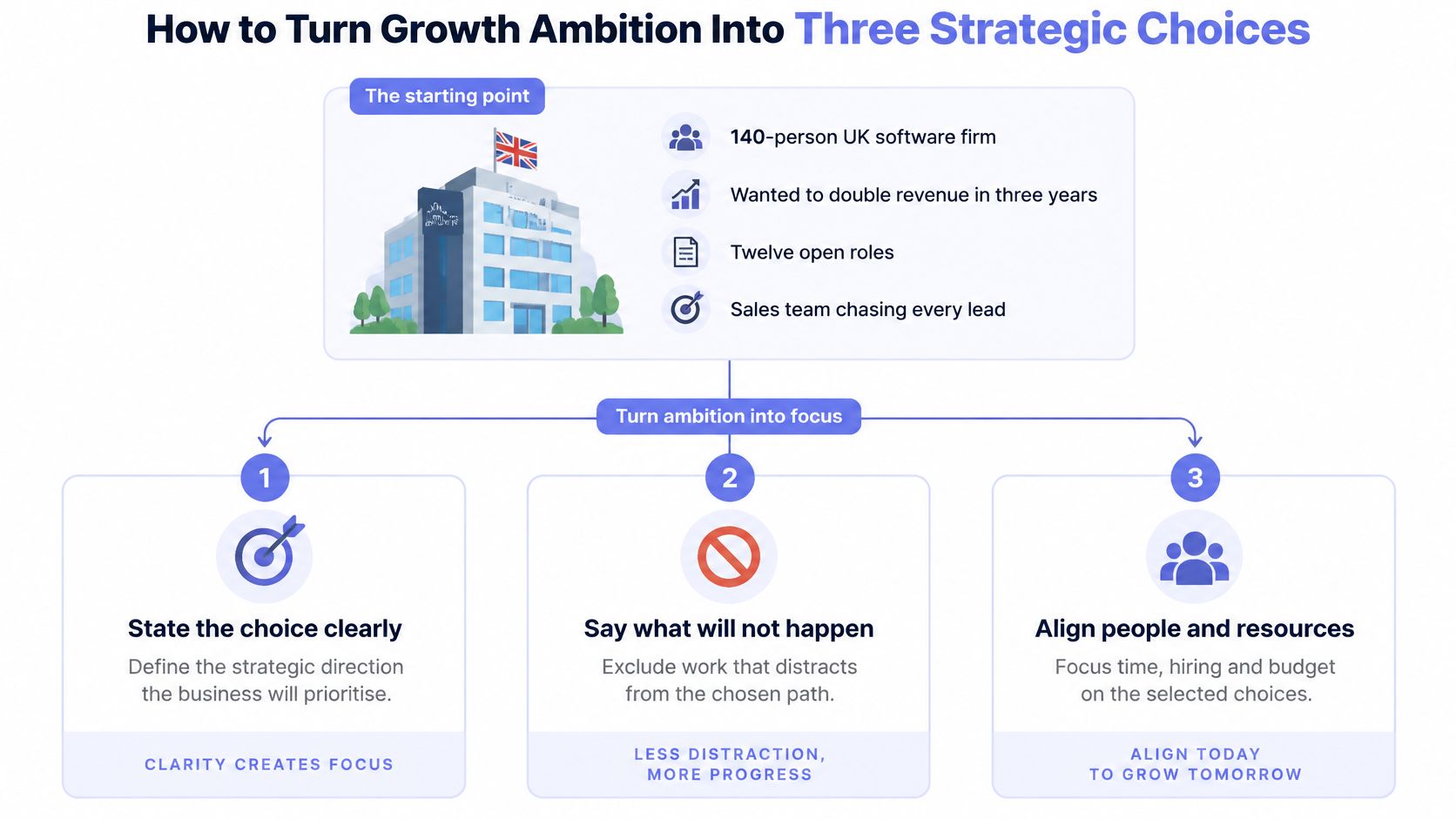
Take a 140-person UK software firm. It wanted to double revenue in three years. It also had twelve open roles, and a sales team that treated every inbound lead as equal. More heads would have raised the coordination load, not the win rate.
The ScaleUp Institute's reporting identifies access to markets as a leading barrier for UK scale-ups, followed by talent and leadership development. Reported skills gaps include AI and cyber skills at 41%, research and technical skills at 34%, general business skills such as finance at 34%, and leadership and strategic direction at 25%. You will not close that list with hiring this year. Growth has to be sequenced.
I use three choices, and the rest of the operating rhythm hangs off them. They come from the Playing to Win framework: Where to Play, How to Win, and Capability Focus.
Five moves, in order
- State the ambition as one number and one date. "£30m ARR by 2028" is usable. "Significant growth" is not. Every later cut refers back to that number.
- List every market, segment and product that could deliver it, then rank them. Include the pet ideas. Ranking is where politics shows up, and that is useful.
- Choose Where to Play. Park or cut any segment that absorbs more than a fifth of effort for under a tenth of pipeline. In the software firm, that meant stopping the long-tail leads the sales team liked because they were easy to book.
- Choose How to Win in one sentence a sales rep could repeat without notes. If the sentence needs a slide, it is not a choice yet. "Win mid-market renewals through a named partner, not direct cold outreach" is the shape you want.
- Set Capability Focus. Name three capabilities to build, buy or borrow this year, and state what you will not hire for. The firm needed partner management, implementation speed and one finance lead. It did not need a second brand team.
A founder often holds two of the three choices in their head and assumes the leadership team has heard them. Write them down anyway. An unwritten Where to Play gets renegotiated in every deal review.
If a department cannot explain its contribution to the ambition in one line, it does not have a priority. It has a backlog.
The trade-off is real, and it should feel uncomfortable. Cutting a segment frees capacity and also removes a story some people were hired to tell. That is the point of making strategic trade-offs explicit before anyone drafts a goal. OKRs then allocate scarce people. They do not pretend you can hire your way out of an unclear bet.
Turn Strategic Choices Into OKRs Leaders Can Track
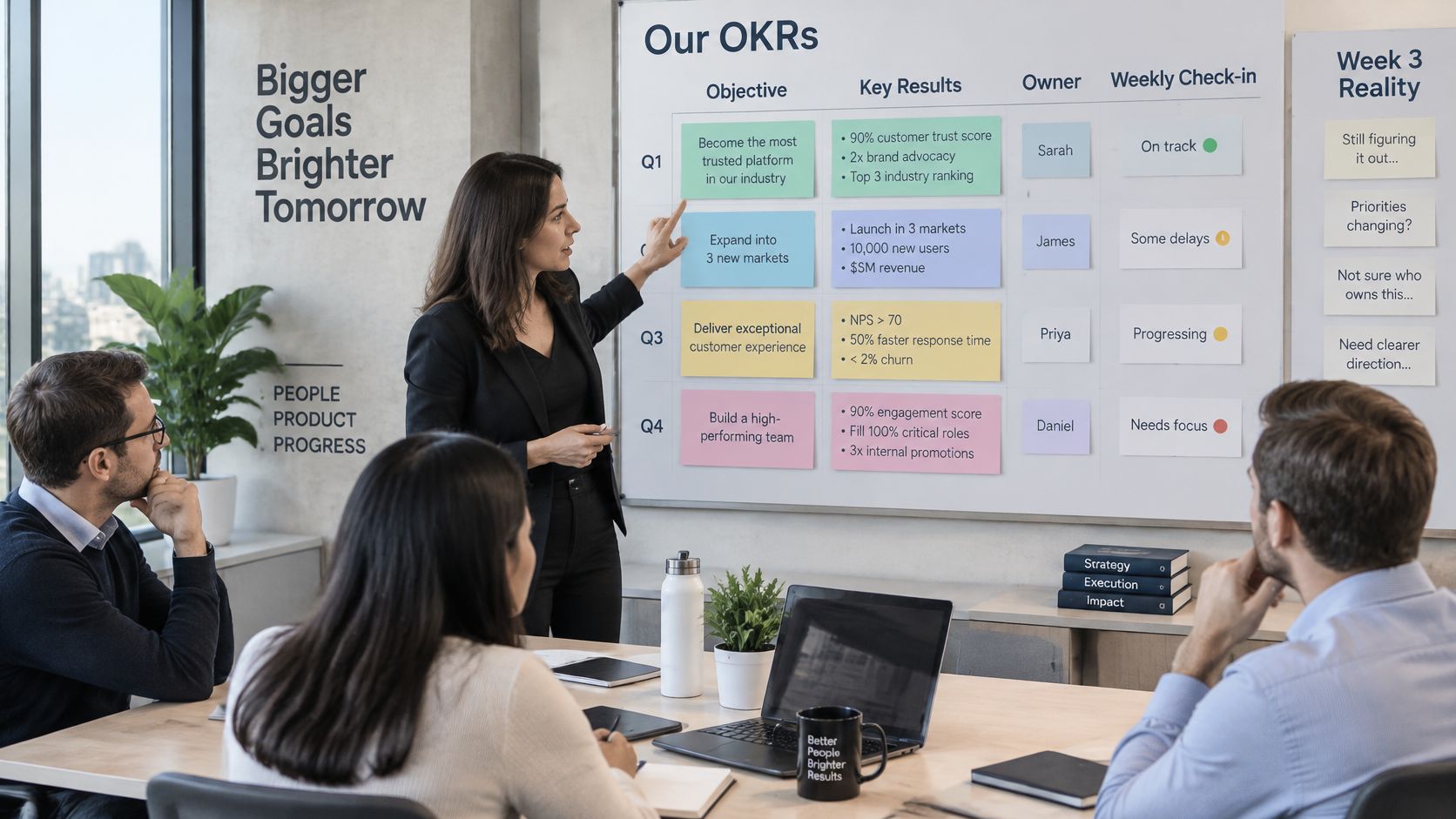
At a strategy offsite last season, the first company objective on the wall was "Improve customer experience". Everyone nodded. By week three nobody could tell whether they were winning, because the line measured a mood, not a result.
That is the assumption I challenge first. A well-written objective is not evidence of a strategy. In the sessions I run, I challenge vague objectives and unmeasurable key results, and I stay with the team until the OKRs can be tracked. Activity dressed up as a key result is the usual failure. "Run a customer programme" can be completed while time to value gets worse.
Vague lines, rewritten
| Vague objective | Measurable objective | Example key result |
|---|---|---|
| Improve customer experience | Cut time to first value for new accounts | Median days from contract signature to first live use falls 30% from baseline by end of Q3 |
| Be more efficient | Reduce cost to serve for SMB accounts | Support cost per active SMB account falls 15% from the Q1 baseline by end of Q3 |
| Expand into Germany | Sign paying German customers through a partner | Three signed contracts and one live partner by end of Q3 |
| Grow sales | Shift pipeline toward the chosen priority segments | Priority-segment share of qualified pipeline rises from the Q1 baseline to 60% by end of Q3 |
Read the last column against this test. Could the team miss this and know it by Friday? If the answer needs a narrative, the key result is still an activity.
Drafting limits that keep the set usable
- Three to five objectives per team. A sixth objective is where focus goes to die. Cut it or park it on the stop list.
- Two to four key results per objective. Each one is an outcome with a baseline and a target, not a task count.
- One trace upward. Each team objective maps to one company key result. If it maps to three, it maps to none.
- One named owner on a shared result. Two teams can contribute. One person answers for the number.
- Name the dependency in the draft. If a key result needs another team's release, write that team's name next to the baseline. Hidden dependencies are how June surprises you.
You should leave the room with three things: agreed company-level objectives, draft key results that already have baselines, and a short list of open questions. Unresolved questions belong in that list, not buried inside a flattering objective. The mechanics of writing measurable outcomes are simple once the choices are sharp. They are impossible while the objective is still a slogan.
Set Governance That Makes Decisions Stick
A product lead misses a key result. The review becomes a search for who slipped. The next week, blockers arrive late, or not at all, because raising one now looks like confessing. Unclear ownership did that. The OKR did not.
CIPD research reported in 2024 found that one quarter of UK employees, an estimated eight million people, had experienced workplace conflict during the previous year. Among those who had, 42% felt exhausted all or most of the time, compared with 18% of employees reporting no conflict. 37% felt under pressure, against 15% in the no-conflict group. Ambiguous ownership and competing priorities feed that friction. Accountability has to be designed so a missed number starts a problem-solving conversation, not a warning.
Who decides what
Not every decision deserves the same room.
- Operational calls, reversible within a week. The team owner decides within five working days. Waiting for an executive is how small calls age into crises.
- Cross-team trade-offs. The quarterly leadership forum decides within ten working days. These are the fights over shared people and shared dates.
- Investments. An executive sponsor brings a written case. No case, no slot. Verbal enthusiasm is not a decision.
- Stop decisions. The chief executive records them in the decision log. Stopping work is the decision people tend to avoid, so it cannot be informal.
A dependency that blocks a key result across two check-ins goes up one level. It does not wait for the quarterly away day. The log should show the date, the owner and the choice that was refused, not only the choice that was made.
Separate accountability for results from punishment for a reasonable miss. A missed key result triggers a why review: baseline, assumption, and what changes in the plan. It does not trigger a performance warning when the team ran the agreed play and the market moved. People hide blockers when those two things are fused.
For Shell NewMotion, a bespoke Strategic Management framework, training across the company and an internal coaching capability kept the programme running after the external consultants left. That is the test I care about. Governance that only works while an outsider is in the room is not governance.
Once the strategic choices are validated, the fourth phase of the work translates them into OKRs, investment priorities and governance cadences. Without that translation, the decision types above stay as a poster. Decision-making frameworks only earn their place when a stalled dependency has somewhere to go before it turns into blame.
Build Execution Rhythms That Survive a Busy Quarter
Launch week can feel decisive. By week six, the remaining forum may be a monthly status meeting where nobody prepares because nothing discussed changes the plan. The OKRs stay in the deck, but drop out of the working week. Growth usually stalls at that point because the management system no longer turns priorities into decisions.
Keep four forums connected. A weekly team check-in clears blockers. A monthly key result review forces reprioritisation. A quarterly business review resets the OKRs and stop list. An annual strategy session sets the year-ahead frame. Skip the monthly or quarterly decision points, and reviews become status theatre.
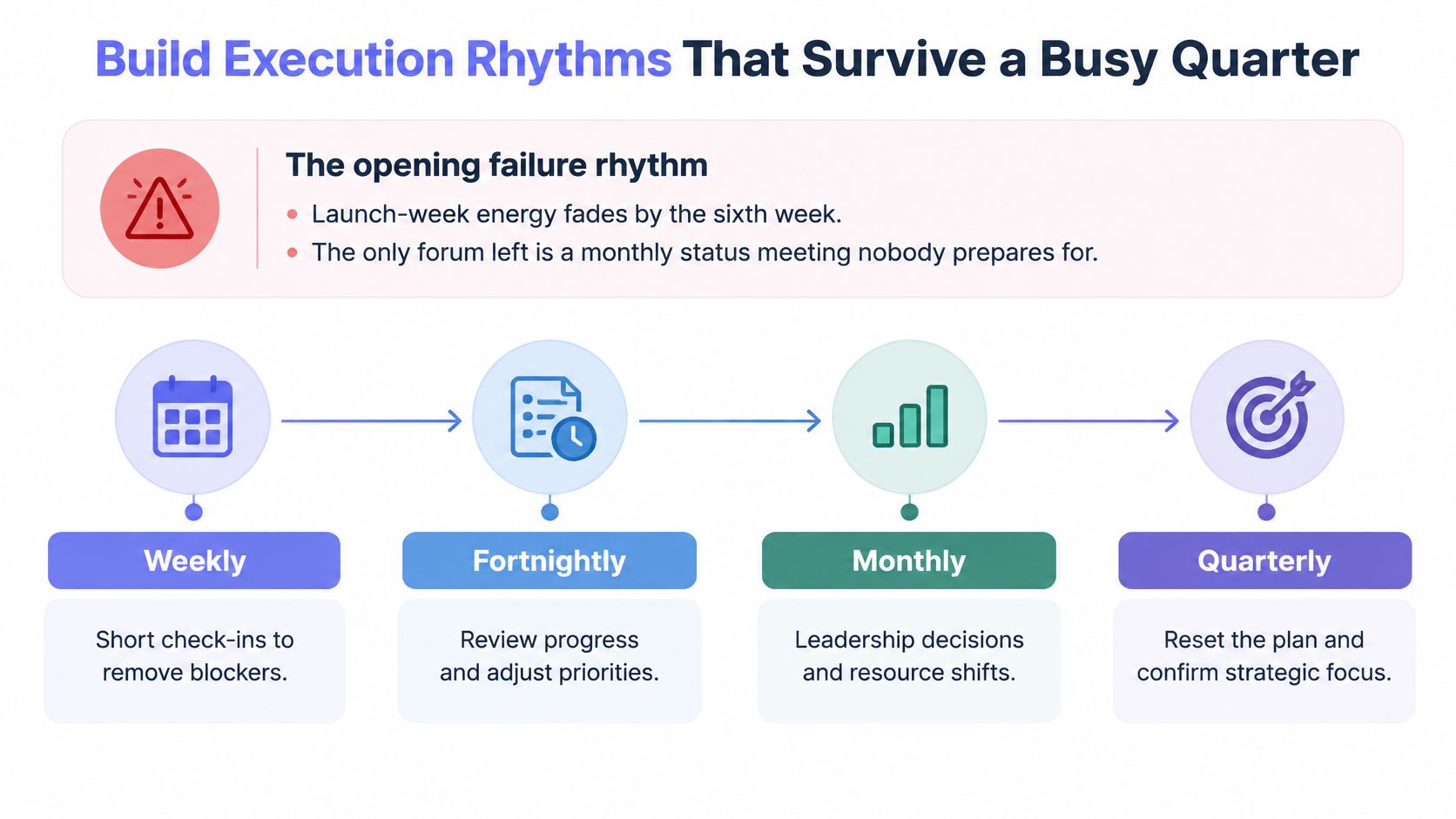
Teams working in six-week sprints may add a fortnightly progress check between weekly and monthly forums. Use it to resolve issues that cannot wait, rather than create another status meeting. A standard quarter is about thirteen weeks, and public holidays can compress the time available. Book the monthly review before calendars fill. If an acquisition or restructure changes the organisation mid-year, reset the cycle instead of carrying pre-deal OKRs into a different structure. A clear operating rhythm makes it easier to see whether the forums are producing action or merely recurring.
Forums, owners and the output that proves they happened
| Forum | Frequency | Owner | Required output |
|---|---|---|---|
| Weekly team check-in | Weekly, 30 minutes | Team lead | Blockers and updated confidence scores |
| Monthly key result review | Monthly, 60 minutes | Executive sponsor | Re-scored key results and one re-prioritisation |
| Quarterly business review | Quarterly, half day | CEO | Next-cycle OKRs and an updated stop list |
| Annual strategy session | Annually, one day or residential | CEO and leadership team | Year-ahead OKR framework and Q1 owners |
Before each check-in, give every key result a confidence score from 1 to 5. A score of 2 or below needs a named action and a date. Otherwise, the score records concern without creating a decision. The meeting should change what someone does, what gets funded, or what work stops.
In the final four weeks of the quarter, freeze new initiatives so teams can finish, review results and make explicit trade-offs. At each quarterly session, revisit the stop list and confirm that stopped work has stopped. The OKR Hub says, based on its client data, that one day is enough to align a leadership team on priorities and draft the next cycle of company OKRs. The business also reports that 94% of its clients run a second OKR cycle. A recurring rhythm helps carry execution beyond the energy of a launch.
UK Government evidence reports an association between a 0.1-point increase in management-practice scores and a 9.6% increase in productivity. The relevant practices include setting targets, reviewing performance and managing people. Regular forums make those practices visible in how work is prioritised and decisions are followed through. Adding headcount without clear reviews and ownership can raise coordination costs faster than output.
The first 90 days of the rhythm
- Days 1 to 30. Put the weekly check-in and monthly review in the diary, with owners. Start confidence scores in week one, while the habit is still easy to establish.
- Days 31 to 60. Run the first monthly review. Re-score every key result, then make one reprioritisation in the room and record the decision.
- Days 61 to 90. Hold the quarterly review. Publish the next-cycle OKRs and updated stop list on the same day.
Check whether confidence scores change week to week, whether open decisions older than 14 days become less common, and whether stopped work is visibly stopped by the next quarterly review. If none of those indicators moves, the meetings are recurring but the operating rhythm is not changing execution.
Confirm Your Starting Point Before You Roll Anything Out
A leadership team can agree on growth targets and still stall because no one owns the choices behind them. Before introducing OKRs, confirm that priorities, trade-offs and decision rights are clear. Otherwise, the system records activity without resolving the conflicts that block execution.
Write down the answers:
- Three priorities, each with one owner. Name the accountable person, not just the function.
- The work the team will stop this quarter. If the list is empty, the trade-offs are still unresolved.
- A baseline for each growth target. Without one, the team cannot track progress.
- The decision log and its owner. A shared inbox does not show which decisions remain open.
- The date of the first monthly review. Book it before the rollout begins.
If two or more answers are missing, settle the strategic choices and examine where execution is breaking before launching company-wide. A scoring tool cannot resolve unclear ownership or competing priorities. It may only make the gaps harder to see.
The OKR Hub offers a free 30-minute consultation to help choose a starting point. It asks where you are, what you have already tried and what you are trying to achieve. That conversation can help clarify whether to begin with strategic choices, OKRs or the operating rhythm.
Ninety days, once you are ready
- Days 1 to 30. Confirm the three strategic choices, draft company-level OKRs with baselines, and schedule the weekly and monthly forums.
- Days 31 to 60. Run the first monthly key result review, rescore each key result, and record cross-team decisions.
- Days 61 to 90. Hold the first quarterly business review, set next-cycle OKRs, and publish the updated stop list.
Use each review to expose stalled decisions, not just report scores. When priorities compete, record the choice, its owner and what the team will stop doing. That is how OKRs become an operating mechanism for growth rather than another layer of planning.