
The strategy was approved in January. The board liked it. By June, everyone's busy, the project list has grown, and the numbers haven't moved.
You ask for an update and get a delivery dashboard. Most projects are green. Nobody can explain why customers still wait too long, margins remain under pressure, or sales conversion hasn't improved. I would start by examining how leaders make decisions, not by rewriting the strategy.
Diagnose the Gap Between Strategy and Delivery
The gap is rarely just a problem with the strategy document. More often, leaders haven't changed the routines that determine what people work on, who resolves conflicts, and what gets stopped.
A strategy can be clear in the boardroom while remaining irrelevant to someone choosing between competing requests. That isn't necessarily a failure of effort. People usually follow the priorities their managers reinforce through meetings, budgets and deadlines.
Look at the work, not just the plan
A 2024 survey of 2,500 UK knowledge workers, reported by HRreview, found that 54% of working time went on busywork, employees spent an average of four hours each week in discussions without a productive outcome, only 52% understood how their work contributed to broader company goals, and just 16% believed teams collaborated effectively across departments.
Those findings describe a recognisable delivery problem: effort without a dependable connection to company outcomes. Adding another reporting requirement won't repair that connection.
I would use a strategy gap analysis to compare the intended outcomes with the work leaders authorise. Ekipa's perspective on turning strategy into execution is a useful companion when the problem extends beyond objectives into business transformation.
Symptoms of a strategy-to-delivery gap
| Symptom | What it usually signals | Diagnostic question |
|---|---|---|
| Priorities change every quarter | No agreed outcome filter for new work | Which outcome did leadership drop to make room for this? |
| Teams cannot name the company goal they serve | Objectives are not cascaded | Can each lead state the company outcome their work moves? |
| Cross-team work stalls in dependencies | No forum resolves trade-offs | Who decides when two teams need the same people? |
| Reviews report status but change nothing | Governance without decision rights | What plan, budget or owner changed after the last review? |
| OKRs are written but never checked | Measures track activity, not outcomes | Which key result moved in the last four weeks? |
| Effort rises while results stay flat | Low-value work is protected | What did leadership stop in the last quarter? |
Treat these as prompts, not verdicts. An unchecked OKR might reflect a poor measure, unavailable evidence or a meeting nobody has authority to act in. Ask what prevents a decision before assigning blame.
Run a ten-minute leadership self-test
Ask each executive to answer without checking a presentation:
- Outcomes: Which three outcomes matter this quarter?
- Ownership: Who owns each one?
- Trade-offs: What did leadership stop last month?
Count how many answers each person can give confidently. Then compare the answers across the room. Agreement matters as much as recall.
If leaders name different outcomes, asking teams to align more closely won't solve the problem. The leadership team has an unresolved choice.
Set Three to Five Outcomes Worth Funding
Outcomes, not projects, are the unit of planning. A project describes something people will deliver. An outcome describes what should become different because they delivered it.
That distinction changes business strategy and planning. Instead of defending a roadmap, a leader must explain which business result deserves investment and why the proposed work is the best route to it.
Make strategic choices before allocating money
The Playing to Win framework has three strategic choices: Where to Play, How to Win and Capability Focus. I would use each as an entry test for the plan:
- Where to Play: Does this outcome strengthen the chosen market, customer group or business arena?
- How to Win: Does it improve the advantage customers should choose the business for?
- Capability Focus: Does it build something the organisation needs to deliver that advantage?
The hierarchy should remain visible when leaders discuss projects.
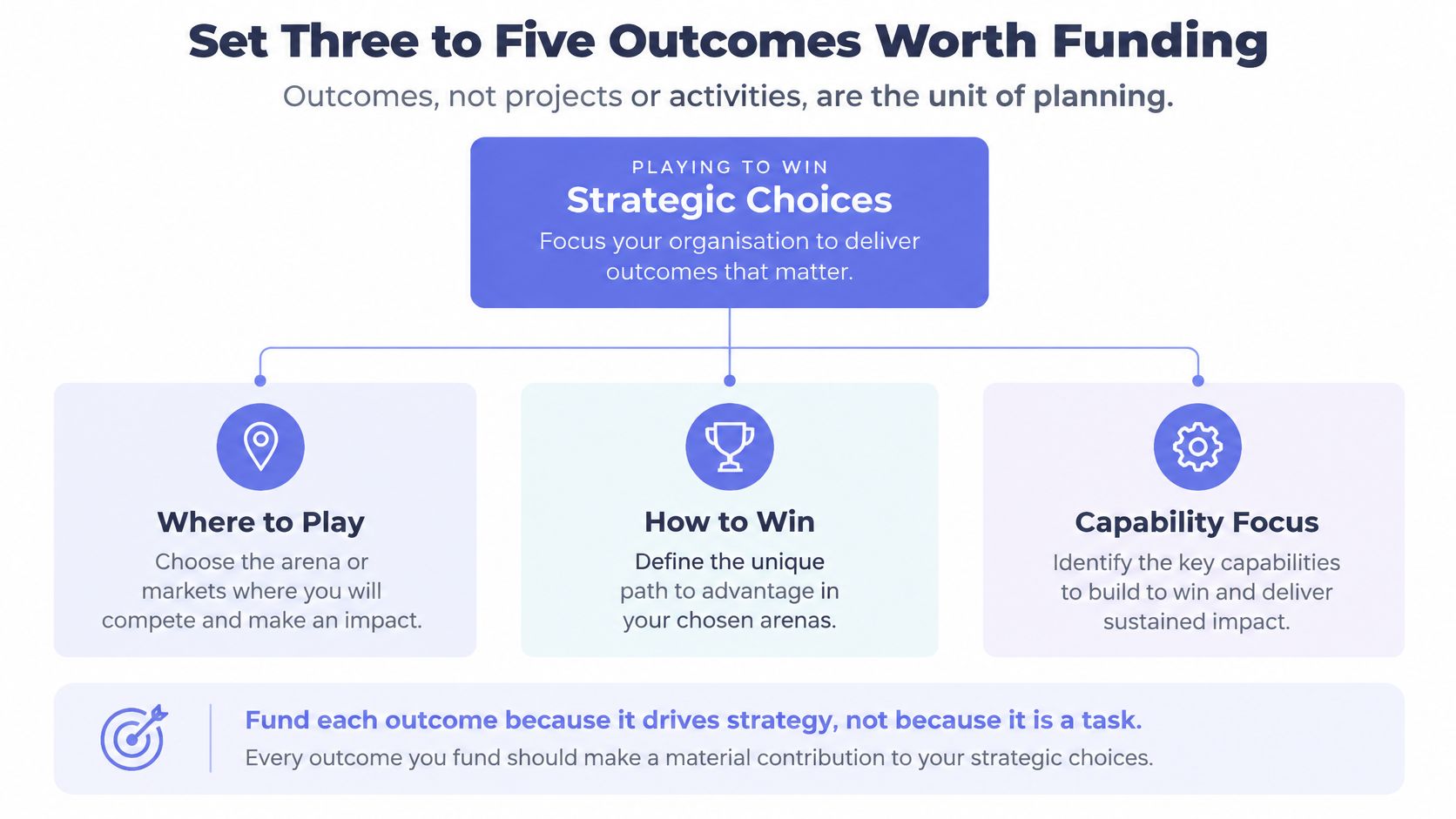
My working rule is three to five enterprise outcomes per quarter, each with one named owner and one measurable result. That's a planning discipline, not a requirement to invent more priorities when fewer would be credible.
Resolve the tension between savings and investment
The Make UK 2024 Executive Survey reported that 48% of manufacturers identified cost control as their main strategy for securing growth, only 12.5% were making digital technology central to their strategies, and half expected productivity to increase over the following year.
Cost pressure and technology investment aren't automatically competing strategies. The problem arises when leaders approve digital projects without deciding which operating result those projects must improve.
Say a manufacturer chooses lower unit cost and shorter cycle time as its near-term outcomes. Automation adoption can sit beneath those outcomes as a leading indicator. Leaders should pause digital projects that don't plausibly move either measure, rather than protecting them because they carry a transformation label.
Service quality also needs a guardrail. Cutting unit cost by creating rework or missed deliveries isn't a successful result.
Apply an initiative filter
Every proposed initiative must answer:
- Contribution: Which chosen outcome will it move, and through what mechanism?
- Accountability: Who owns the result, rather than just the project plan?
- Capacity: Which people, funding and management attention will it consume?
Mandatory operational work still needs resources. Keep it visible rather than disguising every obligation as a strategic priority.
Funding rule: If I can't name what will stop to fund a priority, I wouldn't approve it as an additional commitment.
A shorter portfolio can feel less ambitious. It usually demands harder leadership choices because it removes the option of promising everything.
Write Key Results You Can Measure
I would test each draft key result before discussing its wording. A polished sentence can still conceal a task list.
Use these tests in a monthly review:
- Outcome: Does it measure a change in performance, or only an activity?
- Baseline: Can the team point to a credible starting position?
- Commitment: Is there a target and a date?
- Influence: Could a change in budget, people or approach affect it?
A draft that fails the outcome test belongs in the initiative plan. If leaders can't influence the measure, it may belong on a monitoring dashboard rather than in an OKR.
Replace completion with evidence
For the manufacturing scenario, launch an automation pilot isn't a satisfactory key result. I would write: Reduce cycle time on the two most constrained lines from baseline to the target agreed at planning, by quarter end.
The final version must contain the actual baseline and target. Keep automation adoption beside it as a leading indicator, with its own owner, so leaders can distinguish implementation problems from a weak investment assumption.
Weak and strong key results
| Weak key result | Strong key result | Why it works |
|---|---|---|
| Launch automation pilot | Cycle time on the two most constrained lines reduced from baseline to agreed target by quarter end | Measures the outcome and carries a date |
| Run training sessions | Share of line supervisors using the new standard work rises from the recorded baseline to the agreed target by quarter end | Tests adoption, not attendance |
| Complete the digital roadmap | Automation adoption on priority lines rises from baseline to agreed target by the review date, with an accountable adoption owner | Leading indicator with a named owner |
I would limit each team to two or three key results per outcome. More measures often dilute the conversation.
Agree the calculation and evidence source during planning. A practical approach to measuring outcomes prevents review meetings becoming arguments about definitions. Score progress on verified movement, not on how much work people completed.
Build an Operating Rhythm Around OKRs
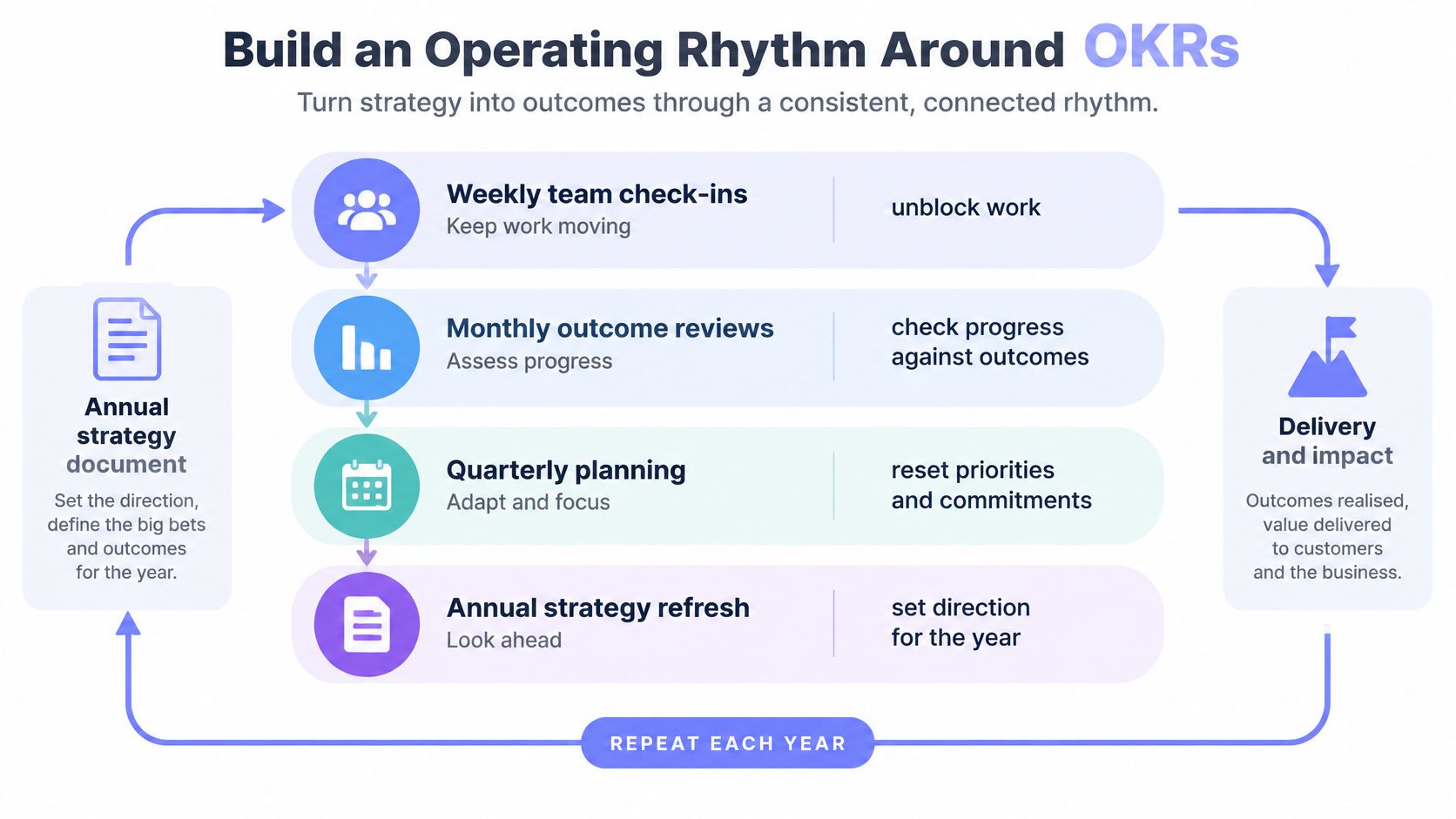
Operating rhythm for OKR execution
| Forum | Frequency | Question it answers | Decision it must make |
|---|---|---|---|
| Team check-in | Weekly | Which key result moved, and what is blocked? | Unblock or reassign the work |
| Outcome review | Monthly | Is the evidence moving the outcome? | Keep, change or stop each initiative |
| Quarterly planning | Quarterly | Which three to five outcomes matter next? | Reset priorities, capacity and owners |
| Strategy review | Annually | Does the strategy still fit the market? | Renew the narrative and year-ahead OKR framework |
I would put these forums around the existing management calendar, not create a parallel OKR bureaucracy. Replace overlapping meetings wherever possible. Keep routine updates in a shared record so meeting time goes to exceptions and decisions.
The cycle needs to connect direction, evidence and intervention.
Separate delivery decisions from outcome decisions
Weekly team check-ins should resolve the immediate obstacle. If a dependency threatens progress, the team either changes the work, assigns someone to resolve it, or escalates a specific decision. Reading every task aloud wastes the forum.
Monthly outcome reviews should test the delivery logic. Is the initiative producing the expected change? If adoption is rising but cycle time isn't improving, leaders need to challenge the intervention rather than congratulate the project team for implementation.
Require a short evidence pack before the review: current measure, confidence in the evidence, explanation of the gap and proposed decision. The owner should arrive with a recommendation, not wait for the room to diagnose everything.
Reset commitments without constantly changing direction
Quarterly planning should reconsider the portfolio against available capacity. Carrying unfinished work forward automatically protects old commitments from scrutiny. Ask whether the remaining work still deserves funding.
The annual strategy review should revisit the assumptions behind the chosen direction. Customer needs, competitive positions and investment requirements belong here. It shouldn't become a detailed negotiation over every team's backlog.
The ONS Management and Expectations Survey found that the UK's average management-practice score rose from 0.51 in 2020 to 0.57 in 2023 on a scale from 0 to 1, and reported a statistically significant relationship between management-practice scores and labour productivity.
That association isn't proof that OKRs cause productivity gains. It supports a more grounded point: visible targets, disciplined reviews and corrective action deserve attention alongside strategic choices.
Did the meeting change resources, sequence or ownership? If nothing required changing, record the evidence for continuing. If nobody could authorise a change, the meeting was reporting, not managing.
A useful operating rhythm makes those decisions predictable. People should know where an issue goes and how it will be resolved.
Put decisions in the calendar
For the next cycle, I would first schedule the planning meeting that confirms commitments, the opening team check-in that tests dependencies, and the outcome review that evaluates the initial evidence. Give each a decision owner and an expected output.
Don't wait until delivery slips to discover that the relevant executives have no shared review date.
Governance, Ownership and Decision Rights
Shared ownership sounds collaborative. It often means nobody can make the decision that matters.
An outcome needs one accountable executive, not a committee. Contributors can be spread across the organisation, but the owner must have authority to move budget and people within agreed boundaries, or obtain a binding decision from someone who does.
Fix the gaps between departments
Consider a scale-up where marketing owns lead volume and sales owns pipeline. Both teams hit their targets, but revenue stalls because neither owns the conversion between an accepted lead and a credible opportunity.
Giving both teams another target won't necessarily help. I would name an executive owner for the shared conversion outcome and define the handoff decisions explicitly.
The agreement should specify:
- Acceptance: Who defines a qualified lead and resolves disputed cases?
- Follow-through: Who can change routing, response expectations and qualification work?
- Resources: Who can redirect campaign spending or sales capacity?
- Escalation: Who settles a conflict that exceeds the outcome owner's authority?
Accountability without those rights turns the owner into a coordinator who must repeatedly ask permission.
Phase 04 of the Strategic Execution Advisory translates validated strategic choices into OKRs, investment priorities and governance cadences. That connection matters because an objective without an investment decision leaves delivery dependent on goodwill.
Record decisions that can be checked
Use a decision log with five fields: decision, owner, evidence used, date and next review date. Classify each decision as continue, change, stop or reallocate.
The entry must describe the consequence. Change approach is too vague. Move implementation support from the secondary rollout to the constrained line, with the operations director accountable gives people something executable.
For finance leaders, Loopfour's governance resources for finance teams provide a useful additional perspective on controls and accountability. I would connect financial approval to the same outcome evidence, rather than maintain separate conversations about spend and delivery.
Governance test: A stop decision should release identifiable capacity. If the people remain committed to the work, leadership hasn't stopped it.
Stopping work is uncomfortable because someone sponsored it and someone else has invested effort. Continuing solely to avoid that discomfort makes the next priority harder to fund.
Keep accountability after launch
The UK Government's business evidence annex points to efficiency guidance recommending benefits realisation throughout a change's full life cycle, supported by accurate and timely information.
Launch approval therefore isn't the end of governance. Keep a benefits owner responsible for checking whether the expected operational improvement appears after implementation.
Before the next quarter starts, agree the owner forum, escalation route and executive sponsor who signs off mid-cycle changes to outcomes. Practical decision-making frameworks should distinguish changes a team can make from changes that alter the company's commitment.
Where Strategy Stalls and How to Rebuild It
The following are hypothetical rebuilds, not client performance claims. They show the operating changes I would recommend when better-written objectives haven't fixed delivery.
The work involves leadership alignment and collaboration, but the output must be more concrete than a productive discussion.

A services firm with disconnected objectives
Before: Each department writes quarterly objectives. Leaders review delivery within functions, but nobody tests whether the combined work improves company outcomes.
Change: Leadership runs a half-day cross-business session to agree three shared priorities. Each gets a single owner and a fixed monthly outcome review. Departmental objectives are retained only where their contribution is clear.
Visible result: A credible first-quarter result would be reviews beginning to change budgets and stop projects that aren't moving the outcome. That demonstrates a functioning management process, not yet proof of improved commercial performance.
The trade-off is a slower start. Leaders must resolve disagreements before teams commit, rather than distribute the conflict through competing plans.
A scale-up with an unowned handoff
Before: Say a 120-person scale-up has three cross-functional priorities. The conversion stage between marketing and sales has no owner, so each department explains the problem through its own measures.
Change: Leadership names one executive owner, documents decision rights for the handoff and adds a weekly check-in on conversion evidence.
Visible result: By quarter end, the governance milestone should be observable: a named owner and both teams reporting against the same metric. Any claim of improved conversion would still require measured evidence.
The compromise is fewer simultaneous improvements while leaders establish a dependable handoff.
Build capability that survives the reset
The named client work provides concrete examples of broader implementation changes. For Shell NewMotion, The OKR Hub designed a bespoke Strategic Management framework, trained the entire company and built an internal coaching capability that sustained the programme.
For BBC Studios, after early OKR attempts had stalled, The OKR Hub rebuilt the approach with training, coaching and a cross-business strategy workshop spanning New York and London.
Neither example reduces the work to objective drafting. I would protect time for leadership decisions, internal capability and cross-business coordination, even when that means starting with fewer priorities.
Plan Commitments Within Real Capacity
Constraints that break commitments and the planning response
| Constraint | Warning sign | Planning response |
|---|---|---|
| Skills gap | Targets assume a capability nobody has | Map the gaps, stage the outcome and fund training as a deliverable |
| Limited decision authority | Teams wait for sign-off on every change | Name decision rights for each outcome before the quarter starts |
| Capacity fully booked | New objectives added without removing work | Set a stop-doing list and cap each team at two outcomes |
| Hidden dependency | A key result depends on another team's backlog | Put the dependency in the plan with a named owner and date |
I would look for these warning signs during the first two weeks of a quarter. Early waiting, repeated approval requests and unassigned specialist work are reasons to intervene, not reasons to demand greater commitment.
Stretch targets become counterproductive when they hide an unfunded capability gap. Asking for ambition doesn't create technical expertise, management attention or available hours.
Make the stop-doing list operational
The stop-doing list is the main capacity tool. Before adding an outcome, name the work that will end, its current owner and the point at which people become available.
For most scale-ups, I would cap each team at two outcomes per quarter. That's a starting recommendation, not a universal benchmark. A team carrying substantial operational demand may need a narrower commitment.
Learning, workflow redesign and internal ownership are strategic deliverables when delivery depends on them. Give them owners and dates, then test whether people can perform the required work rather than only attend training.
Revenue planning needs the same realism. Yalc's guide to improve sales forecast accuracy is a useful companion when leaders need to challenge assumptions behind commercial commitments. A revenue ambition still needs credible selling capacity and functioning handoffs.
Run the capacity check
Use a shared worksheet and make the assumptions visible:
- List the demand. Estimate the hours each proposed outcome needs per week across all contributing teams. Include review, learning and coordination work.
- Compare availability. Add the demand and compare it with hours available after applying the stop-doing list. Protect essential service work and a realistic allowance for interruptions.
- Cut by importance. If demand exceeds capacity, remove the least important outcome, not automatically the most ambitious one.
- Record the choice. Repeat until the numbers fit, then put the cut and released capacity in the decision log.
Use capacity planning methods to expose assumptions, not manufacture certainty. Where estimates are weak, stage the commitment and reassess after the team has tested the work.
Confirm Your Priorities Before the Next Cycle
Business strategy and planning should leave leaders with commitments they can fund and decisions they can enforce. A convincing presentation isn't enough.
I would run this check this week:
- Confirm the outcomes. Agree three to five, each with one named owner and one measurable result.
- Write the stop decision. State which work ends to fund each outcome.
- Inspect the decision log. Did any budget, person or sequence change last month? If not, check whether reviews are managing delivery or merely reporting it.
- Book the review. Put the next outcome review in the calendar before the quarter starts. Name the executive who authorises mid-cycle changes.
Choose the right starting point
My away day engagements start with a 30-minute discovery call to understand the client's strategic context and what a successful session looks like. A free 30-minute consultation also establishes the current position, what's already been tried and the intended result.
For leadership teams preparing for a new OKR cycle, the Strategy Alignment Session runs half a day or a full day. Its outputs are agreed top 3–5 strategic priorities, draft company-level OKRs and a decision log with open questions.
The opening self-test exposes uncertainty. The next-cycle check turns it into decisions.
I help leadership teams connect strategic choices to funded priorities, clear ownership and reviews that change delivery. To work out the right starting point, book a conversation.