
The most popular advice on building a strategic service plan is to clarify the vision, list priorities and produce a roadmap. I would start with a harder question: what will leadership stop funding when services compete for the same people? If the plan can't answer that, clearer wording won't make delivery faster.
Why Most Strategic Service Plans Stall Before the First Review
The plan is rarely the problem. The problem is that nobody uses it after the offsite.
Consider an illustrative leadership team. A 40-slide plan is approved in March. By June, three services need the same two engineers, yet no priority has formally stopped. Each service leader has approval, but nobody has authority to resolve the conflict.
The gap between ambition and results is substantial. Grant Thornton, citing Harvard Business Review and Bain & Company research, reports that 88% of business-transformation initiatives fail to achieve their original ambitions, while only 12% of major change programmes produce lasting results. Those findings concern transformation programmes, not service plans specifically, but they underline why approving an ambition isn't enough.
The management failures behind the document
I would test for these failures before rewriting anything:
- No baseline. Leaders can't prove improvement or detect deterioration because nobody agreed the starting position.
- No sequence or stop list. Teams receive priorities without capacity limits. Every sponsor treats their commitment as urgent.
- Delegated accountability. The programme office tracks delivery while senior leaders stop testing whether the intended outcome remains achievable.
These are management failures, not writing failures. A supplier can deliver a platform. A programme manager can maintain milestones. Neither should inherit the executive's responsibility for the business result.
A service plan becomes useful when it changes a decision, not when leadership approves it.
I use the four dimensions of execution as a way to examine the wider execution problem rather than treating this as a planning-document issue.
The practical controls are straightforward: a component template, a disciplined build process, balanced measures, decision-making checkpoints, a diagnosis of common pitfalls and a funding-readiness check. Together, they connect service ambition to decisions leaders can enforce.
Plan Components at a Glance
I would start with this working template, not a presentation deck. The examples describe an illustrative enterprise software business with renewal, onboarding and support priorities. The amounts, staffing assumptions and thresholds are scenario choices, not industry benchmarks.
Strategic service plan components
| Component | Question it answers | Example | Accountable owner |
|---|---|---|---|
| Strategic outcome | What must be true in 12 months? | Enterprise customers renew because they achieve value without repeated intervention | Sponsoring executive |
| Service baseline | Where are we today, measured how? | CRM renewal records, setup timestamps and support logs establish current performance | Service lead |
| Priority set | Which three to five services get funding this year? | Onboarding redesign, support tiering, self-serve billing | Leadership team |
| Stop list | What is explicitly stopped or reduced? | Bespoke reports for accounts under £10k ARR | Leadership team |
| Leading indicator | What changes first if the plan works? | Share of accounts with setup complete within 7 days | Priority owner |
| Quality guardrail | What must not get worse? | Escalation rate and customer satisfaction score | Quality lead |
| Capacity assumption | How many people and hours does this take? | Two engineers for six weeks, none from support | Delivery lead |
| Review trigger | What makes the team stop or redesign? | Leading indicator flat for two consecutive monthly reviews | Priority owner |
Use every column as a self-audit
Read across each row. Does the example answer the question? Can the named owner obtain the evidence and act on it? A blank cell exposes an unresolved decision. A plan without a measured baseline or accountable owner can't be governed.
The strategic outcome belongs at executive level. The priority owner watches the leading indicator weekly and investigates unexpected movement. Those roles need different conversations: business value at executive level, operational intervention at service level.
The stop list is a component, not an appendix. Leaders usually find it easier to approve new work than withdraw an existing commitment. Recording the withdrawal makes the capacity release explicit.
For technology-heavy services, F1Group's IT roadmapping and governance guidance is a useful companion when connecting service choices with technology dependencies and governance.
My working limit: Keep the decision-making plan to two pages. Put supporting analysis elsewhere.
If that feels impossible, challenge the priority set before shrinking the font. Copy the table into a working document and fill every cell before the next leadership session.
Choosing Metrics That Do Not Reward the Wrong Behaviour
I give every priority at least an outcome, a leading indicator and a quality guardrail. No measure earns trust on its own. Leaders need evidence of value, early movement and protection against harm.
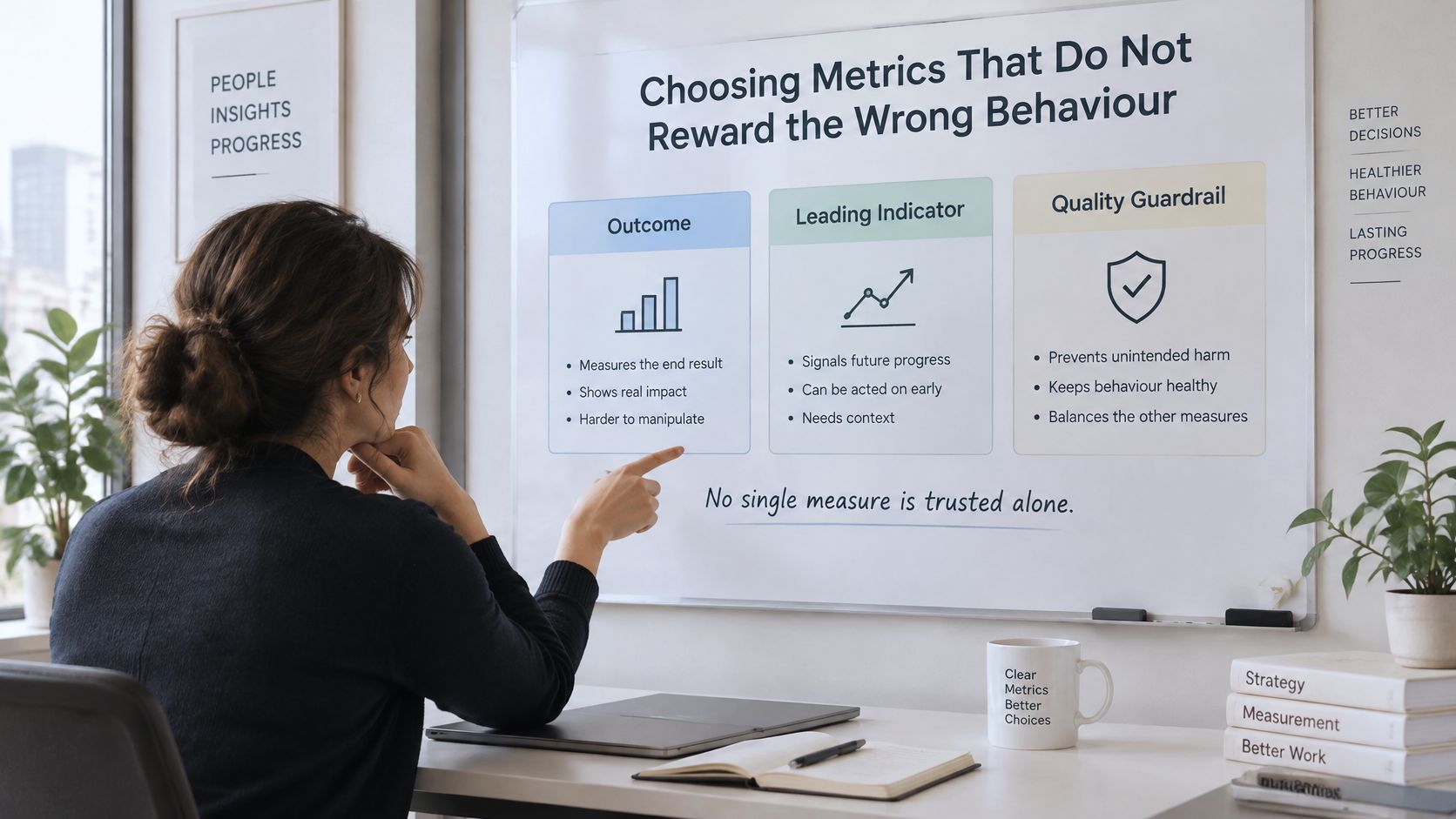
The National Audit Office's Annual Report and Accounts highlights stronger risk analysis, realistic planning, whole-system thinking, resource allocation and transparent reporting. The practical implication is to test consequences across the service, not celebrate an isolated productivity measure.
Metric types and their blind spots
| Measure type | Example measure | What it hides when used alone |
|---|---|---|
| Outcome | Enterprise renewal rate | In this scenario, shows results two quarters late and cannot prove cause |
| Leading indicator | Accounts live within 7 days | Can rise while customers churn later |
| Flow | Median cycle time per case | Speeds up when quality checks are skipped |
| Quality guardrail | Escalation rate and complaint volume | Often ignored until service breaks |
| Adoption | Share of teams using the new process | Use does not show better results |
| Capacity | Hours committed per priority | Says nothing about impact |
| Financial | Cost per transaction | Cuts can shift cost onto customers or other teams |
Treat these as different views of performance, not competing candidates for a single headline KPI. Renewal tells the executive whether customers stayed. Setup completion tests the onboarding hypothesis. Escalations reveal whether apparent speed came at the customer's expense.
Test the mechanism, not just the dashboard
Say a support function launches self-service. Cost per ticket falls because fewer contacts reach an agent. Repeat contacts climb, however, and complaints reach the executive team two quarters later. The financial measure looked positive because the team counted handled tickets without examining unresolved demand.
When evaluating automation, I would use Yellow.ai's AI architecture for automated customer support to inform the design discussion, then separately test resolution quality, handover and repeat demand. Architecture choices don't remove the need for service controls.
Before accepting a metric, ask:
- Influence. Who can change it through a specific operational decision?
- Timing. How long should the intervention take to affect it?
- Gaming. What could someone do to improve the number while worsening the service?
These questions expose measures that look precise but offer little management value. They also distinguish a slow-moving outcome from an intervention that isn't working.
I separate metrics and KPIs from the narrower set of measures needed to judge a strategic intervention. Keep routine health monitoring, but don't crowd the plan with every available dashboard.
If every measure counts inputs, launches or attendance, leadership can report activity without proving impact. The test is whether users achieve a better result without an unacceptable cost elsewhere.
How to Build the Plan in Five Steps
I would build the plan around evidence and choices, then write the summary. Starting with polished objectives encourages people to defend language before testing feasibility.
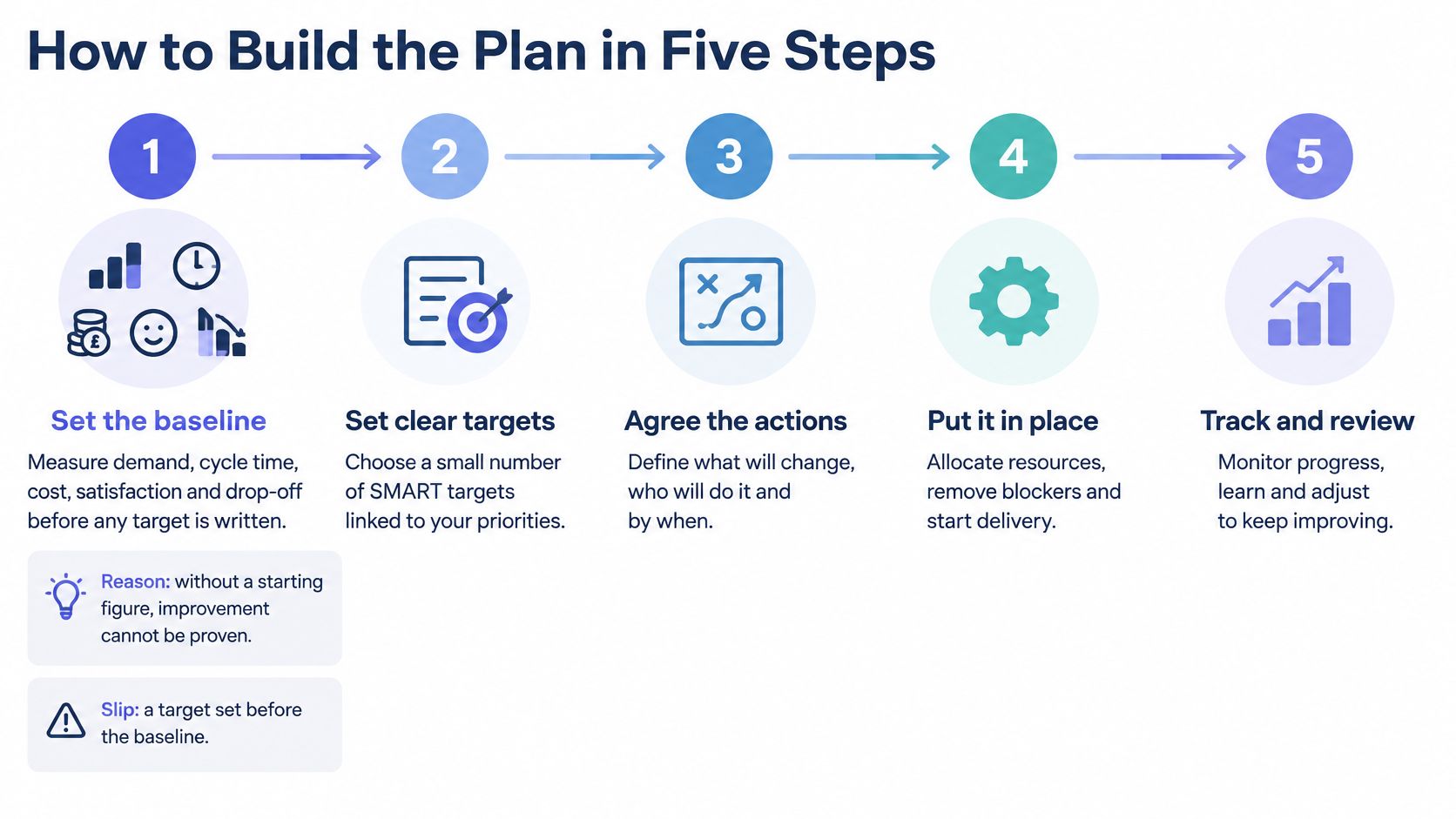
1. Set the baseline
Measure demand, cycle time, cost, satisfaction and drop-off before setting targets. Agree the population, reporting period and calculation method. A service lead should be able to reproduce the baseline from operational records.
The Planning Inspectorate's 2024–27 Strategic Plan records an average of 13,000–14,000 open cases at the end of 2023/24; that year, 62.2% of written-representation cases, 58.4% of hearings and 39.5% of inquiries met the defined timeframes. The plan targets 98% by 2027, using 20 weeks for written representations and 26 weeks for hearings and inquiries, and identifies an estimated 12–15% productivity requirement in high-volume casework areas.
The useful discipline is the connection between starting performance, a dated target and the operational improvement required. It makes the delivery gap visible.
Common slip: setting a target against a number nobody has measured. If records are incomplete, fund baseline discovery before promising improvement.
2. Choose priorities and name what stops
I recommend three to five funded priorities as a working constraint, not an entitlement to fund five. Rank candidates by expected outcome, evidence, delivery effort and dependencies. Then identify the existing commitments that will release capacity.
A list of twelve top priorities isn't a sequence. It leaves teams to negotiate strategy through competing requests.
My approach to prioritising with OKRs starts with those choices rather than scoring every existing project. The Strategy Alignment format is designed for teams that haven't fully locked in their priorities.
3. Write the outcome and early signal
For each priority, state the user or business change and the operational signal expected to move first. Add the guardrail before approving the intervention.
For onboarding, the outcome might concern sustained customer value. The early signal might concern successful setup without assistance. Launching the portal is an activity, even if delivery is difficult.
The reason is causal clarity. Leadership should know what change the intervention is expected to produce, not merely what the delivery team intends to release.
4. Assign ownership and test actual capacity
Choose the owner who controls the main operational lever. Then test the commitment against named people, available hours, specialist skills and business-as-usual obligations.
Don't allocate someone's full nominal capacity while assuming they'll continue handling incidents and customer escalations. Ask functional heads to confirm what work will leave each person's schedule.
Common slip: giving accountability to the most senior person while someone else controls access, staffing or process decisions. Ownership without authority and time is only a title.
5. Set review triggers and dates
Write the decision rule before delivery starts. State which evidence would justify continuation, redesign, pause or withdrawal of funding.
A review date without a possible decision is a reporting appointment.
A flat leading indicator may justify investigation rather than immediate cancellation. A breached quality guardrail may require an immediate pause. Make that distinction explicit.
My final build check is simple: the decision-making plan fits on two pages, and every priority has a number, a name and a date.
Governance Checkpoints and Quarterly OKRs That Keep Trade-offs Visible
A review cadence should move from operational evidence to strategic choice. Monthly checks examine movement. Quarterly reviews decide what continues, pauses or stops. A biannual review tests whether the priority set still fits the plan, while the annual reset confirms direction.
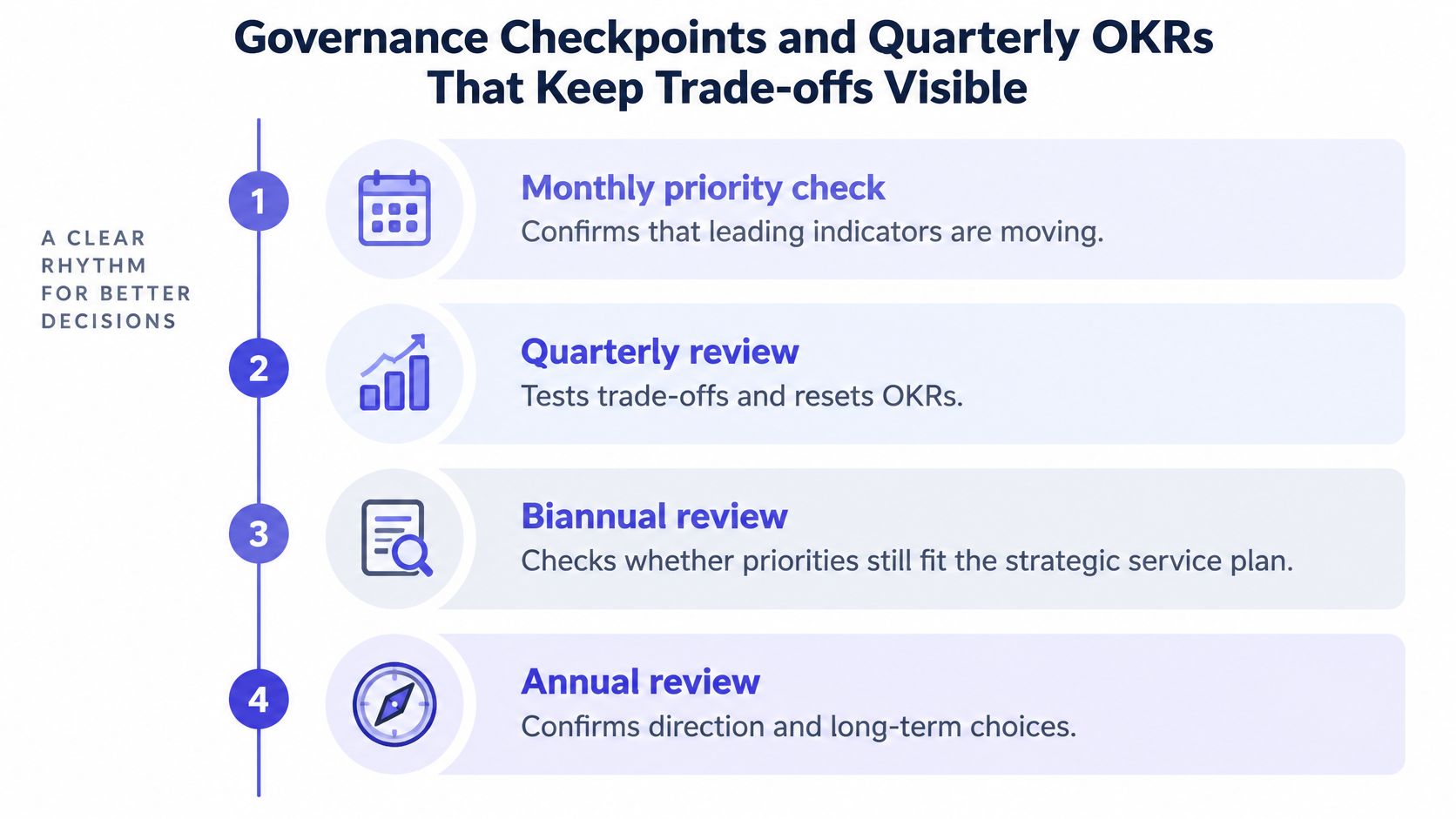
In a survey of 150 digital-transformation leaders at medium and large UK organisations, reported by IT Brief, half said competing internal priorities slowed delivery often or very often. I would therefore review available capacity each quarter rather than carry the original assumption forward.
Governance checkpoints and the decision each must make
| Checkpoint | Cadence | Decision it must make | Attendees |
|---|---|---|---|
| Monthly priority check | Monthly | Are the leading indicators moving? | Priority owners and sponsor |
| Quarterly reprioritisation | Quarterly | Which priorities continue, pause or stop? | Leadership team |
| Cross-team dependency review | Fortnightly | Which blockers need escalation? | Delivery leads |
| Capacity review | Quarterly | Does available capacity still match commitments? | Heads of function |
| Annual strategy reset | Annually | Do the outcomes still reflect the business? | CEO and leadership team |
Translate choices into the quarter
I would organise preparation across three weeks:
- Week one. Turn each validated priority into a company-level objective with two or three key results.
- Week two. Develop team-level drafts showing who owns each contribution and dependency.
- Week three. Confirm the cycle calendar and check-in schedule before the first sprint starts.
Phase 04 of the Strategic Execution Advisory translates validated strategic choices into OKRs, investment priorities and governance cadences. The OKR Kick-off Session provides a concentrated alternative: a full-day session where company OKRs are set and approved, team-level drafts are cascaded, and the cycle calendar and check-in schedule are produced.
An illustrative onboarding OKR
Objective: New enterprise accounts go live without manual rescue.
- Key result one. Setup completion within 7 days rises from 41% to 70% by quarter end, measured from the CRM export every Monday.
- Key result two. Onboarding escalations stay at or below 12 per month as the quality guardrail.
- Key result three. Manual onboarding hours fall from 60 to 35 per week by quarter end.
In this scenario, pausing bespoke reports for accounts under £10k ARR releases the required capacity. Each key result supports the onboarding priority; the objective therefore connects to a real stop decision.
I use quarterly business reviews to make those trade-offs explicit. A key result that can't name its baseline, target and review date isn't ready for the quarter.
Pitfalls That Turn the Plan Into a Document
Vague objectives are the first failure I would challenge. Improve the customer experience sounds reasonable, but leaders can't check it at quarter end without agreeing what improvement means.
For an illustrative onboarding service, replace that ambition with raise completion within 7 days from 41% to 70% by 30 June. The date and figures are scenario targets. They make the commitment testable rather than suggesting a universal benchmark.
Plan symptoms, likely causes and fixes
| Symptom | Likely cause | Fix |
|---|---|---|
| Vague objectives such as improve the customer experience | Outcome not measurable | Rewrite with a baseline, a target and a date |
| Key results that list activities | Output confused with outcome | Replace each activity with a measured change |
| Every priority red by month three | Too many priorities, no stop list | Cut to three and name what stops |
| Owner cannot name the measure | Ownership given by seniority, not control | Reassign to the person who controls the lever |
| Targets met while service worsens | Quality guardrail missing | Add a guardrail and a review trigger |
| Reviews report status but decide nothing | No decision rights at checkpoints | Give each checkpoint one decision to make |
Diagnose the management habit behind the symptom
Don't treat each red status as a separate delivery problem. If several owners cite the same missing specialist, leadership has probably overcommitted shared capacity. Asking each team for a recovery plan won't create another specialist.
Likewise, an owner who can't explain their measure may need a different mandate, not more reporting training. Check whether they control the process, can access the evidence and can secure decisions from dependent teams.
A missing guardrail requires a different response. Investigate who experienced the cost of achieving the target. Faster case closure means little if customers reopen cases or staff transfer difficult work into an unmeasured queue.
Diagnostic question: What decision changed because of the last review?
If nobody can answer, the meeting is probably distributing information rather than governing delivery. Give the chair authority to resolve the relevant trade-off, and record the decision, owner and consequence for funding or scope.
These failures spread through ordinary routines. A vague objective becomes a vague key result, then a recurring update nobody challenges. The plan's job is to govern choices during delivery, not preserve the original intent.
I would finish each review by asking every owner to explain, in one minute, the measure, its current value and the decision they would take if it slipped. An unclear answer exposes drift early.
Confirm Your First Quarter Before You Commit Budget
I would use this readiness check before releasing first-quarter funding:
- Evidence. Every priority has a measured baseline and a named owner.
- Focus. There are no more than five priorities.
- Trade-offs. The stop list contains at least one explicit withdrawal or reduction.
- Capacity. Assumptions match the people available.
- Protection. Every priority has a quality guardrail.
- Governance. The first review dates are in the diary.
Any unticked item means the quarter isn't ready for full delivery funding. If the baseline or stop list is missing, reduce the scope and resolve that gap rather than approve an entire programme.
Separate readiness from purchasing
Buying a service-management platform doesn't resolve ownership or prioritisation. Where Freshservice is under consideration, Freshservice pricing insights from DataLunix can support the commercial assessment, but licensing belongs inside a broader capacity and implementation decision.
I treat resource allocation decisions as commitments to outcomes, not permission to start projects. Fund the quarter when every readiness item is satisfied. Otherwise, close the gap first.
Some clients start with an OKR Maturity Assessment and a single leadership workshop before deciding next steps. Others arrive with a clear brief for a full implementation programme. A discovery call with me is a 30-minute conversation to decide whether the Strategic Execution Advisory fits the leadership team's situation.
I help leadership teams turn strategic service plans into funded priorities, measurable OKRs and reviews that resolve real trade-offs. To discuss the execution controls your plan needs, book a conversation.