
Most advice about metrics and KPIs starts in the wrong place. It tells leaders to add dashboards, define targets and monitor progress. I've seen that approach produce a large amount of reporting without improving a single strategic outcome.
A useful metric isn't valuable because it's easy to collect. It's valuable because it helps a leadership team decide what to do next. In an OKR system, that means connecting a measurable result to a priority, a named owner, a reliable baseline and a management routine that changes when performance moves off course.
The hard work isn't choosing more measures. It's governing a small set of measures well enough that people trust them, understand their trade-offs and use them to allocate attention.
Why Most Dashboards Fail to Improve Delivery
More dashboards don't create better execution. They often create a more convincing view of poor execution.
I regularly see leadership teams reviewing green indicators while product launches slip, customer problems remain unresolved and strategic priorities compete for the same people. The dashboard reports activity. It doesn't explain whether the activity created customer value, commercial progress or operational improvement.
The distinction matters. The ONS analysis of firm-level productivity reported that 70.9% of UK workers in 2022 were employed by firms with labour productivity below the mean. That statistic doesn't prove that activity metrics cause weak productivity. It does show why leaders need outcome measures that connect work to economic value, rather than assuming that more visible effort means better performance.
Activity is easy to count and easy to misuse
Tasks completed, meetings held, tickets closed and hours logged can all be useful diagnostic signals. None is automatically a strategic KPI.
A support team can close more tickets by resolving simple requests quickly while leaving complex customer problems unresolved. A sales team can increase calls while pipeline quality deteriorates. A delivery team can complete more work while defect rates and rework rise.
I use a simple test:
- Outcome connection: What customer, commercial or operational result should this activity influence?
- Decision value: What decision will change if the metric moves?
- Trade-off visibility: Which quality, risk or people measure prevents the team from improving it in a damaging way?
- Ownership: Who can explain the movement and change the intervention?
If nobody can answer those questions, the measure belongs in an operational view, not at the centre of an OKR review.
Audit the dashboard, not just the data
Start by grouping every existing measure into three categories: outcomes, leading indicators and activity signals. Then remove any measure that has no clear relationship with the objective or no credible owner.
This doesn't mean reducing visibility for the sake of a cleaner screen. It means giving each metric a job. A small set of strategically connected measures is usually more useful than a long list of operational outputs, especially when leaders need to make trade-offs quickly.
For teams working across varied audiences, the practical guidance on designing dashboards for community teams is a useful reminder that dashboard design should reflect the decisions users need to make, not the data an organisation happens to possess.
I also look for denominator problems. A conversion rate without a stable definition of the eligible population can create false confidence. A cost measure that excludes a channel or team can make performance appear better than it is. Before debating whether a target is ambitious, confirm that the number means the same thing from one review to the next.
Leaders can use data visibility in execution as a practical audit question. Can the leadership team trace a headline result back to its source, calculation and owner? If not, the dashboard is displaying information, not managing performance.
Designing a Balanced Measurement System
A single metric creates predictable behaviour. Push speed without quality, and people cut corners. Push volume without customer value, and teams optimise throughput. Push revenue without retention or risk controls, and short-term performance can hide long-term damage.
I build measurement systems around three layers. Each layer answers a different management question.
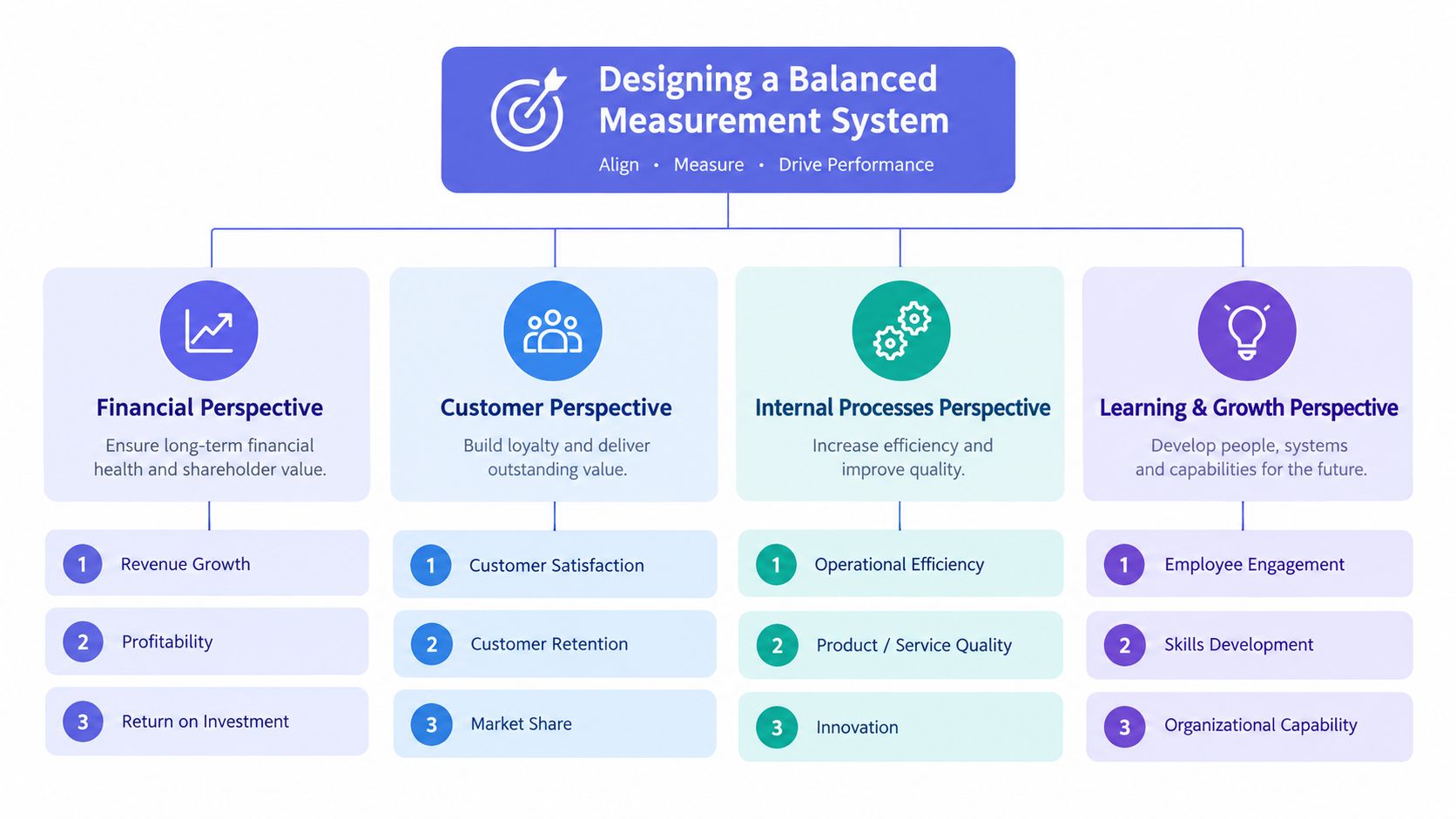
Start with the outcome
The outcome metric defines whether the objective is creating the intended value. Depending on the strategy, that might be successful completion, customer retention, revenue quality, delivery speed or reduced operational failure.
A Key Result should normally have one primary outcome measure. That keeps the conversation focused. If a team has five competing definitions of success, it can explain away almost any result by pointing to the measure that looks strongest.
The outcome needs a baseline and a time boundary. “Improve customer experience” is an intention. “Increase successful completion of the priority journey from the agreed baseline by the end of the quarter” is measurable, provided the organisation has defined successful completion and can defend the data.
Add leading indicators for intervention
Lagging outcomes tell you what happened. Leading indicators help you intervene earlier.
For example, a customer retention objective might use unresolved high-risk issues, adoption of a critical workflow or time to first value as diagnostic signals. These measures don't replace retention. They help the owner understand what may be driving it and where action is possible before the reporting period closes.
I don't accept a leading indicator merely because it moves before the outcome. The team needs a plausible causal connection and a management action attached to it. If the signal changes but nobody knows what to do, it's an interesting observation rather than an execution metric.
Protect performance with health guardrails
Guardrails prevent teams from hitting an outcome through unsustainable effort, poor quality or unacceptable risk. Pair speed with quality. Pair cost reduction with service reliability. Pair delivery ambition with workload and wellbeing checks.
The 2025 CIPD Good Work Index found that only 52% of employees felt paid appropriately for their responsibilities and achievements, while 63% described their mental and physical health as good. Those figures don't establish that a particular KPI damages wellbeing. They do reinforce the need to treat people health as part of performance governance, not as a separate concern that appears only after a crisis.
Useful guardrails include:
- Quality: Defects, rework, complaints or failed acceptance.
- Customer health: Satisfaction, retention risk or unresolved escalation.
- People health: Workload pressure, absence patterns or unwanted attrition.
- Operational risk: Incidents, compliance exceptions or control failures.
I explain the distinction between strategic measures, diagnostic signals and ongoing business measures in more detail through OKR metrics guidance. The practical rule is simple: every pressured objective needs at least one guardrail that makes hidden trade-offs visible.
Operationalising Metrics for Decision Making
A KPI is useful only when it can trigger a decision. If a number changes and the meeting continues unchanged, the organisation isn't operating a measurement system. It's maintaining a report.
The UK Government Digital Service performance framework recommends keeping KPIs few, typically around five, and following a sequence that starts with user needs, establishes a baseline and monitors variance so teams can change operating interventions.
I apply that logic to every Key Result. First, define the outcome and its user or customer relevance. Then document the metric before the reporting period begins. The owner should be able to explain the formula, source, refresh frequency, baseline, target and escalation threshold without relying on an analyst to interpret the number.
Use a controlled metric definition
Freeze the definition for the reporting period. If the denominator changes halfway through a quarter, the trend becomes difficult to interpret and teams can unintentionally manufacture progress.
Exceptions still happen. Record them explicitly. If a source system changes, a channel is excluded or a temporary proxy replaces the intended measure, show that limitation beside the result. Precision without trust is worse than an honest approximation.
| Attribute | Purpose | Failure Mode |
|---|---|---|
| Owner | Names the person accountable for interpretation and action | Everyone assumes someone else will respond |
| Formula | Defines exactly how the measure is calculated | Teams report different versions of the same KPI |
| Data source | Shows where the evidence comes from | Manual or incompatible sources create disputes |
| Refresh frequency | Sets when the measure should be reviewed | Leaders act on stale information |
| Baseline | Establishes the starting position | Targets have no credible context |
| Target | Defines the intended result and time boundary | Teams confuse ambition with achievement |
| Escalation threshold | Specifies when intervention is required | Variance is discussed but not acted upon |
Make review cadence fit the decision
A weekly operating meeting might review leading signals and blockers. A monthly leadership forum can examine outcome movement, cross-functional dependencies and resource decisions. End-period scoring should assess the result and learning. It shouldn't be the first time an owner explains why performance moved.
For operational examples beyond strategy work, a practical guide to operational efficiency for parents illustrates why measures need to connect directly to decisions and constraints. The same principle applies in a scale-up or enterprise. A number that doesn't change prioritisation, resourcing or corrective action has limited management value.
I separate leading and lagging measures visibly. I also ask three questions in every review:
- What changed?
- Why did it change?
- What intervention will change the next result?
If the answer to the third question is “we'll monitor it”, the meeting has stopped short of management.
Managing Execution with Imperfect Data
Bad data is not a minor inconvenience in an OKR review. It changes the conversation from execution to argument.
A 2025 international study of managers found that 47% identified poor data quality as the leading transformation obstacle. Organisations without a clear data strategy achieved a 46.1% target-achievement rate, according to the same source. These findings don't mean that data strategy alone determines target achievement. They do show why leaders should fix measurement confidence before presenting precise results as facts.
Separate the number from your confidence in it
I label each Key Result with a confidence level based on source reliability, completeness, freshness and reconciliation. A high-confidence measure can support a firm decision. A low-confidence measure may still guide investigation, but it shouldn't carry the same weight in performance judgement.
When two systems disagree, I don't average the values to create a comforting middle ground. I identify the definition, timing or denominator causing the conflict, assign an owner and document the resolution. Until then, the review should display both the variance and the limitation.
Temporary proxies have a legitimate role. They must be labelled as proxies, linked to the intended outcome and retired or validated when better evidence becomes available. A proxy becomes dangerous when it quietly turns into the target.
Make data quality part of execution
If a strategic Key Result depends on unreliable data, add a data-quality Key Result alongside it. The measure might concern completeness, freshness, reconciliation or ownership. The exact design depends on the failure, but the principle is consistent. The organisation must treat the measurement system as work that requires delivery, not as a background technical dependency.
I use leading indicators in OKRs to distinguish signals that enable early intervention from outcomes that confirm whether the intervention worked. That distinction also helps teams decide what can be reported with confidence and what still requires investigation.
Practical rule: Never force an owner to defend a precise number that the organisation cannot reproduce. Record the uncertainty, fix the source and make the measurement gap visible in the execution plan.
This approach protects accountability. It doesn't excuse weak performance. It makes the discussion more honest by separating “the result is poor” from “the result is currently untrusted”, which require different interventions.
Embedding Metrics into Operating Rhythms
Publishing targets won't fix slow execution. Teams need repeatable routines for prioritisation, review, escalation and learning.
The ONS management-practices bulletin reported that the average UK management-practice score rose from 0.49 in 2020 to 0.55 in 2023. The improvement was driven by firms below the median adopting basic management routines that connect strategic outcomes to named owners and decision forums.
That evidence supports a practical position. Metrics work when leaders embed them in how decisions are made. They fail when leaders announce them and wait for the quarter-end report.
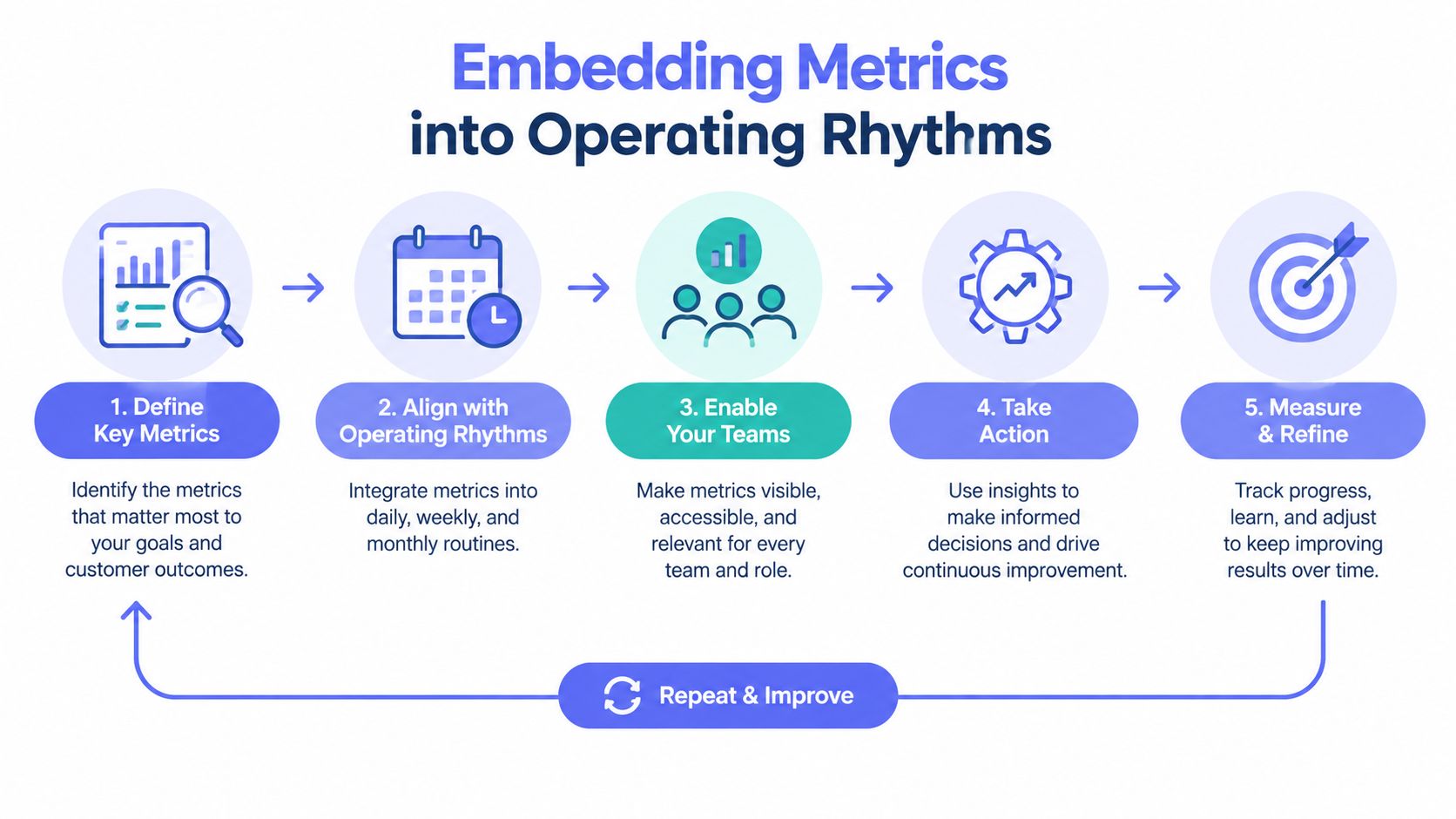
Give each forum a clear job
A good operating rhythm doesn't repeat the same dashboard in every meeting. Each forum answers a different question.
- Team review: What changed this week, and what action can the team take?
- Cross-functional review: Which dependency or decision is slowing delivery?
- Leadership review: Where should attention, capacity or funding move?
- End-period review: What result was achieved, what was learned and what should change?
I keep progress checks separate from scoring. Frequent reviews should help owners recover performance, not create a fear response that encourages them to hide risk. Scoring belongs at the end of the period, after the organisation has given people a fair opportunity to act on the evidence.
Data hygiene matters here. A sudden traffic spike may reflect bots rather than customers, so teams should know how to filter fake Shopify visitor data before using visitor metrics in a commercial decision. The same principle applies to internal systems, where duplicate records, missing events and inconsistent definitions can distort a trend.
Turn variance into action
Every review should end with an intervention, an owner and a date for checking whether the intervention worked. “The KPI is red” is not a management decision. “The owner will change the onboarding sequence, product will remove the identified dependency and the team will review the completion signal at the next operating meeting” is actionable.
I set this expectation explicitly in operating rhythm design. A metric should create a management conversation at the level where delivery takes place. If only the executive team can respond, the measure is too far removed from the work.
Closing the Gap Between Strategy and Delivery
The final test of metrics and KPIs is not dashboard coverage. It's whether the measures help a leadership team close the distance between ambition and delivered value.
Consider a leadership team with a growth objective, a product roadmap and a sales target. Each function reports progress. Product counts releases. Sales reports pipeline. Marketing reports leads. Finance reports revenue. Yet nobody can explain which capability or customer outcome connects the activity to the growth ambition.
That team doesn't need another dashboard. It needs a shared outcome, a defensible baseline, a clear owner and a review process that forces decisions when movement falls short.
Measure the value gap directly
A 2025 survey of 250 UK companies found that only 18.4% achieved more than 80% of their aspirational growth goals within three years, while only 46% had a clearly measurable value gap quantifying the distance to their targets.
The figures don't identify a single cause of weak execution. They do describe the problem I see in many organisations. Leaders state an aspiration, but teams lack agreement on the starting point, the evidence of progress and the intervention required to close the gap.
A useful audit asks:
- Strategic coverage: Do the measures cover the capabilities required to deliver the strategy?
- Outcome integrity: Does each Key Result measure value rather than visible busyness?
- Data confidence: Can the owner reproduce and defend the number?
- Trade-off control: Are quality, customer, people and risk consequences visible?
- Management action: Does variance trigger a decision, not just a discussion?
Long KPI lists often create the illusion of control. A smaller, governed system creates accountability because people know what matters, who owns it and what happens when performance changes.
The execution gap perspective is the one I return to with leadership teams. OKRs are useful when they connect strategic choices to measurable outcomes and operating behaviour. They aren't useful when they become another layer of quarterly paperwork.
I help leadership teams design metrics and KPIs that are trustworthy, balanced and tied to decisions, then embed them into OKR operating rhythms so strategy turns into consistent delivery. If that gap is visible in your organisation, book a conversation.