
Strategy is clear. The board has approved the growth priorities. The leadership team has communicated them. Yet product is chasing one set of outcomes, sales is measured on another, and operations is still treating last quarter's requests as urgent. Meetings fill with updates, but decisions move slowly and accountability remains blurred.
This is the execution problem behind many UK scale-ups and established enterprises. It rarely comes from a lack of effort. It comes from a weak set of objectives, poor connections between organisational levels, and no management rhythm strong enough to turn strategic intent into consistent delivery.
The Execution Gap Most Leaders Ignore
A leadership team can leave an annual planning session with a concise strategy and still create confusion across the business. The chief executive talks about profitable growth. The commercial director pushes pipeline volume. Product prioritises feature delivery. Customer success focuses on reducing escalations. Each priority sounds reasonable in isolation, but nobody can explain which outcomes matter most when resources become constrained.
That confusion becomes expensive. Teams spend time resolving ownership questions, negotiating priorities, and waiting for decisions that should have been made during planning. Leaders then respond by adding more meetings, more dashboards, or more detailed plans. Those tools may improve visibility, but they won't fix the underlying problem if objectives don't connect strategy to day-to-day choices.

Agility needs structure
UK leaders increasingly value agility over long-term planning. Recent UK business research reports that 73% of leaders prioritise agility over long-term planning, while the typical strategic horizon has reduced to 2.08 years. The same source is UK business research on agility and strategic horizons. These conditions make static annual objectives fragile.
The answer isn't to rewrite strategy every time the market changes. That creates churn and teaches teams that objectives are temporary slogans. A better approach keeps the strategic objective stable while allowing the supporting key results, initiatives, and assumptions to be reviewed as evidence changes.
Practical rule: Keep the direction stable, but give teams a controlled way to update the evidence of progress.
An effective set of objectives gives leaders a shared decision filter. It tells teams what to prioritise, what to stop, and which trade-offs require escalation. It also makes misalignment visible before it turns into missed delivery. Leaders looking for a broader treatment of this issue can use this organizational alignment guide as a useful companion resource.
The key shift is from writing aspirations to designing an execution system. A concise objective such as “strengthen retention in strategic accounts” becomes useful only when teams agree on the outcome, the evidence that will demonstrate progress, the accountable owner, and the decisions that follow if performance moves off track. For a practical perspective on diagnosing the wider problem, see this guide to closing the execution gap.
Why Most Objective-Setting Efforts Fall Short
Most objective-setting programmes fail before the first review meeting. Leaders approve goals that sound ambitious, teams translate them into disconnected activities, and managers later assess progress using whatever evidence is easiest to collect. The organisation appears busy, but the set of objectives doesn't create a common view of success.
The UK evidence is stark. Among UK companies with turnover of £20m or more, only 18.4% achieved more than 80% of their aspirational growth goals within three years, while 41.2% failed to achieve 60% or more of their stated targets, according to UK strategy execution research reported by Strategy Management Partners. The figures don't suggest that leaders lack ambition. They suggest that ambition isn't being converted into a reliable delivery mechanism.
Misalignment has several directions
Horizontal misalignment appears between functions operating at the same level. Marketing may optimise qualified demand while sales pursues deal volume and finance protects short-term margin. Each department can hit its own measure while the customer experience deteriorates.
Diagonal misalignment occurs between functions and layers that depend on one another without sharing direct reporting lines. A transformation office may commit to a technology rollout while operational teams lack the capacity or skills to adopt it. Vertical misalignment appears when board priorities fail to translate into meaningful team outcomes.
A UK organisational alignment analysis found that 73% of respondents experienced horizontal misalignment regularly or very often, compared with 58% for diagonal misalignment and 46% for vertical misalignment. The findings are summarised in UK research on alignment and strategy execution. The same analysis reported that respondents estimated more than 30% of their time and energy was spent dealing with misalignment. That time represents an execution tax, not a motivation problem.
| Failure pattern | What leaders usually see | What is actually missing |
|---|---|---|
| Aspirational goals | Strong language in the strategy document | A measurable definition of progress |
| Functional targets | Departments reporting positive activity | Shared outcomes across dependencies |
| Annual objectives | A plan approved once a year | Regular decisions and course correction |
| Individual accountability | Named owners for tasks | Owners with authority and capacity |
| More reporting | Growing dashboards and status packs | A clear response when results move off track |
A traditional management-by-objectives approach can help clarify responsibilities, but it can also reinforce siloed targets when leaders treat objectives as individual contracts. The practical distinction matters. A coherent set of objectives should connect organisational outcomes to team contributions without turning every measure into a narrow performance score. Leaders can compare the approaches in this guide to management by objectives.
Designing a Coherent Set of Objectives
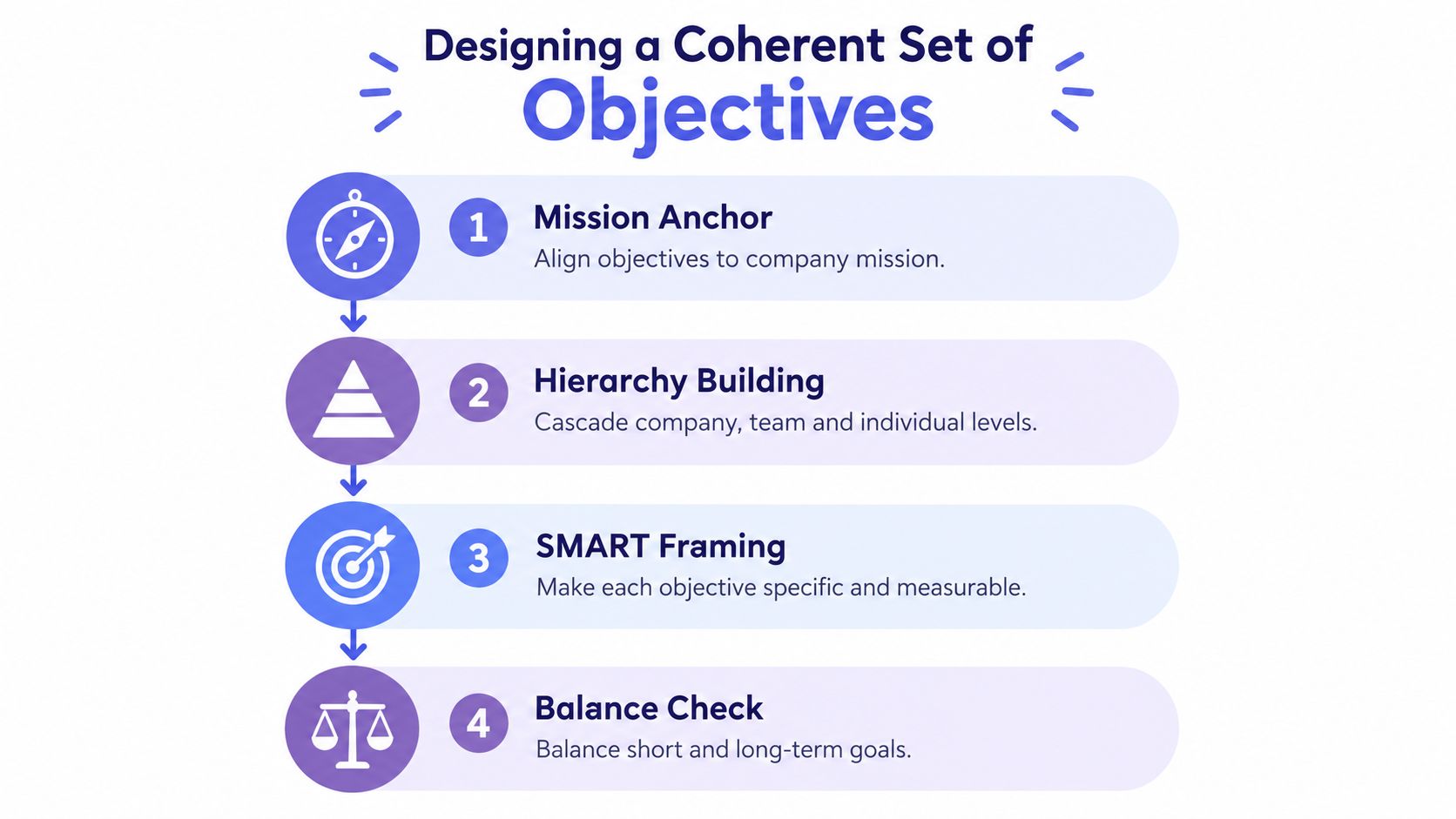
A useful set of objectives is designed as a system, not assembled as a list. Start with the strategic outcomes that matter, then create a visible chain from those outcomes to the work each team can influence.
Start with the decision that matters
First, define the business decision the objective should support. If the leadership team needs to decide whether the company can scale into a new segment, an objective about “improving market presence” is too vague. A stronger formulation might focus on proving demand, building repeatable acquisition, or establishing the capability required to serve that segment.
Next, write the objective as an outcome. Avoid wording that describes a project, an intention, or a general direction. “Launch a partner programme” describes an activity. “Create a repeatable partner channel that contributes to qualified growth” describes a result the organisation can evaluate.
Then create key results that show whether the outcome is becoming real. Each key result should be measurable, owned, and time-bound. It should also be influenced by the team responsible for it. A finance team shouldn't own a customer adoption outcome it can't affect, and a product team shouldn't carry a commercial result without agreed influence over pricing, packaging, or distribution.
Build the hierarchy carefully
The hierarchy should clarify contribution, not force a mechanical cascade. Company objectives describe the outcomes that matter across the organisation. Team objectives explain how a function contributes. Individual priorities should support team delivery without duplicating every organisational measure.
Use this drafting sequence:
- Name the outcome. State the change the organisation needs to create.
- Define evidence. Identify the observable result that would demonstrate progress.
- Assign ownership. Give one accountable owner responsibility for moving the result forward.
- Test dependencies. Ask which teams, systems, capabilities, or decisions the owner needs.
- Remove excess. Delete objectives that don't change prioritisation or resource allocation.
Prioritisation is the discipline most teams avoid. A list feels safe because it includes every important concern. In practice, it gives managers permission to treat everything as important. A smaller set forces trade-offs and makes missed commitments visible.
Capability mapping belongs in the design conversation. If a team is expected to improve forecasting, automate service operations, or enter a regulated market, leaders must check whether the required skills, data, authority, and technology exist. UK strategy execution research found that 50.4% of surveyed firms identified talent and capability gaps as the main barrier to execution, as reported in research on growth ambitions and execution in UK businesses. An objective without capability planning is a demand, not a plan.
For practical guidance on drafting stronger language, use this resource on how to write objectives. The test is simple: can a team explain what will change, how progress will be known, who is accountable, and what decision follows from the result?
Common Anti-Patterns and How to Avoid Them
The fastest way to improve objectives is to inspect what they cause teams to do. If an objective produces activity reports but no meaningful decisions, the wording or operating model needs attention.
Consider a product team told to “improve the onboarding experience”. It may redesign screens, publish help content, and run workshops. Those actions could be useful, but none proves that customers are reaching value more effectively. A better objective would focus on reducing friction in the path to successful adoption, with key results that show whether the customer outcome is improving.
Compare the wording and the behaviour
| Weak pattern | Why it fails | Better test |
|---|---|---|
| “Become the market leader” | It expresses ambition without defining the relevant market or evidence | What specific change would prove stronger competitive position? |
| “Deliver the new platform” | It measures completion, not business value | What capability or customer outcome should the platform enable? |
| “Hold monthly stakeholder meetings” | It treats a management activity as progress | Which decision or outcome should those meetings accelerate? |
| “Increase collaboration” | It gives teams no shared interpretation | Which cross-functional result requires better coordination? |
| Separate functional targets | It encourages local optimisation | Which shared result should multiple teams own together? |
Tasks can sit underneath key results, but they shouldn't replace them. “Complete the migration” is a milestone. “Enable reliable reporting from the new data environment” is closer to an outcome. The distinction matters because teams can complete a task while the intended business benefit remains absent.
Run a pre-approval checklist
Before approving an objective, ask:
- Outcome: Does it describe a meaningful change rather than an activity?
- Evidence: Can the team show progress through an agreed measure?
- Ownership: Does one person have accountability and sufficient authority?
- Alignment: Does it support a higher-level objective without duplicating it?
- Trade-off: Does it make clear what the team won't prioritise?
- Capability: Do the people, data, technology, and budget support delivery?
- Review: Will leaders make a different decision if progress stalls?
One warning sign deserves particular attention. If an objective can be marked complete without anyone outside the team noticing a useful change, it's probably a project milestone rather than a strategic result.
Don't use OKRs to create a second performance bureaucracy. Use them to make choices explicit. A strong objective should help a manager decline low-value work, resolve a dependency, or escalate a decision. If it only creates another field in a software platform, it has failed before the cycle begins.
Embedding Objectives into Operating Rhythm
Writing good objectives doesn't change execution by itself. The organisation needs a cadence that makes progress visible and decisions routine. The most effective approach usually adapts existing meetings rather than creating a separate calendar of OKR ceremonies.
A weekly team check-in should focus on movement, risks, and decisions. It doesn't need a long status recital. Each owner should be able to explain what changed, what is blocked, and what support is needed. Leaders should reserve detailed discussion for results that require intervention.

Match the review to the decision
A monthly leadership review can examine cross-functional dependencies, resource conflicts, and emerging risks. A quarterly business review can test whether the objectives still reflect the strategy and whether the organisation should reallocate capacity. Existing portfolio, product, sales, and people reviews should use the same outcome language where possible.
The review rhythm should distinguish between an objective and its key results. The objective may remain stable while a key result changes because the team has learned something important, the market has shifted, or the original measure no longer captures value. That isn't failure. Uncontrolled changes without a recorded rationale are failure.
A UK public-sector performance framework describes the operating method as a loop of setting expectations, monitoring progress, evaluating results, and taking action to improve performance, as set out in this UK performance management framework. The principle applies in commercial organisations too. Review meetings should lead to action, not merely record performance.
Leadership sponsorship is practical, not ceremonial. Executives need to use the objectives when approving investments, resolving conflicts, and asking for updates. If leaders continue to make decisions through private requests and informal escalations, teams will follow the informal system rather than the documented one.
A useful operating rhythm for objectives connects weekly ownership with periodic strategic review. That connection turns objectives from a planning document into a management system.
Overcoming Adoption Barriers in UK Organisations
Introducing OKRs isn't a software deployment. It changes how leaders prioritise, how managers discuss performance, and how teams expose dependencies. That creates resistance even when people support the underlying goal.
UK adoption evidence identifies financial cost and workforce skills gaps as significant barriers, with 33% citing financial cost and 25% citing workforce skills gaps in one rapid evidence review. The evidence is discussed in this analysis of adoption barriers. Other concerns include uncertainty about benefits, data and privacy, integration difficulty, and regulation.
Treat adoption as a design problem
The wrong response is to mandate a template and expect compliance. People need to understand what will change in their decisions and meetings. They also need training in outcome writing, prioritisation, dependency management, and constructive review conversations.
Start with a contained leadership cycle. Test the language, clarify ownership, and identify where existing performance, planning, HR, and portfolio processes overlap. Then remove duplicated reporting before expanding the approach. Integration matters because teams won't sustain a system that asks them to update several competing sources of truth.
Operational efficiency provides a useful adoption case. One 2026 survey found that 58% of leaders prioritised operational efficiency, according to the same UK adoption research linked above. The practical promise of objectives isn't more administration. It's faster resolution of competing priorities, fewer avoidable escalations, and clearer decisions about where scarce capability should go.
Managers also need permission to surface problems early. If teams believe that reporting a missed key result will damage their standing, they'll protect the number instead of improving the outcome. Leaders should distinguish between honest learning, weak ownership, and persistent neglect. That distinction builds trust without removing accountability.
Turning Strategy into Consistent Delivery
A coherent set of objectives gives strategy somewhere to go. It converts broad intent into a linked chain of outcomes, ownership, evidence, and decisions. The value appears when teams use that chain to choose work, resolve dependencies, and stop activities that no longer support the direction.
The sequence is straightforward, but it demands discipline:
- Diagnose the gap: Identify where priorities become unclear, decisions slow down, or teams optimise locally.
- Design the system: Build focused objectives with measurable key results, accountable owners, and visible dependencies.
- Challenge the wording: Remove task-based measures, vague aspirations, and targets that no team can influence.
- Run the cadence: Review progress frequently enough to act, while protecting objectives from unnecessary churn.
- Support adoption: Train managers, integrate existing processes, and make leadership behaviour consistent with the model.
This approach also complements broader governance work. Technology and transformation leaders may find a practical connection between objective-setting, investment decisions, and IT governance and roadmapping, particularly where delivery depends on shared platforms and constrained technical capacity.
The strongest organisations don't use objectives to create the appearance of control. They use them to make trade-offs visible. They know which outcomes matter, who owns the next move, what evidence will change the decision, and when leaders must intervene. That is how a clear strategy becomes consistent delivery.
If your leadership team recognises slow execution, conflicting priorities, or weak accountability, assess one current strategic priority from outcome to team-level delivery. The gaps you find will show whether you need better wording, stronger governance, or a complete operating-system reset.
The OKR Hub offers OKR consulting, implementation, leadership and team training, and hands-on coaching through its OKR Focus Flow method. Visit The OKR Hub to explore an OKR assessment or discuss how to embed a practical set of objectives into your organisation's operating rhythm.