
Only 18.4% of UK companies surveyed achieved more than 80% of their aspirational growth goals within three years, while 41.2% failed to achieve at least 60% of their stated targets, according to a 2025 survey of 250 UK companies. The problem isn't a shortage of ambition. It's the absence of an operating system that turns ambition into decisions, commitments, evidence and corrective action.
I've watched leadership teams spend weeks refining objectives, then leave them untouched while priorities change, dependencies fail and capable people work hard on disconnected tasks. The answer isn't another planning workshop. It's learning how to work on goals after they've been agreed.
The Gap Between Ambition and Delivery
Writing a goal is easy. Delivering it requires a different discipline.
The same 2025 research found that approximately 63% of respondents were pursuing aspirational growth, while only 16.4% described their ambitions as transformative. Those figures tell me that leaders generally know how to express ambition. The failure happens later, when strategic intent must survive competing priorities, unclear ownership and operational friction.
A goal sitting in an annual plan isn't being managed. It's being stored.
Why annual objectives stop working
Most organisations treat goals as a communication exercise. Executives announce the priorities, departments translate them into plans, and teams return to their existing workload. By the time leaders review progress, the business has accumulated months of activity but little reliable evidence that the intended outcome is closer.
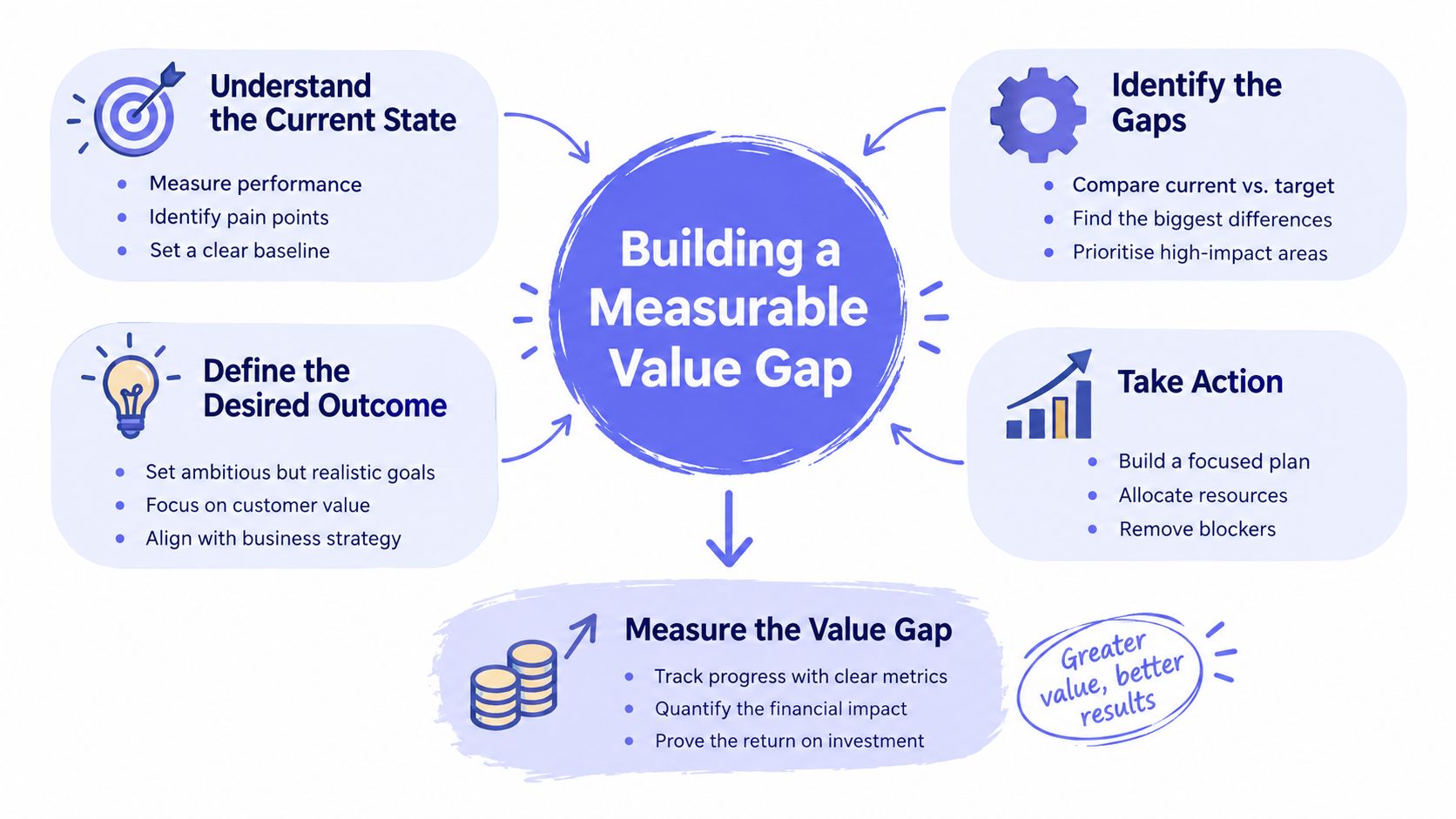
The research found that only 46% of companies had a clearly measurable value gap, the distance between current performance and the desired future state. Without that distance, a leadership team can't tell whether it's advancing, standing still or moving in the wrong direction.
Practical rule: If a goal can't change a decision in the next operating meeting, it isn't yet part of the operating system.
I distinguish between setting goals and working on goals. Setting goals defines direction. Working on goals creates a repeatable mechanism for checking evidence, resolving blockers, reallocating resources and stopping work that no longer supports the outcome.
That mechanism matters because internal execution barriers are predictable. The same survey identified talent gaps, weak alignment between operations and strategy, and misaligned organisational culture as leading obstacles. None of those problems is solved by writing a more elegant objective.
The shift leaders need to make
A commercial director might own a growth objective, but delivery could depend on product capacity, marketing quality, pricing decisions and customer-support readiness. If those dependencies aren't visible, the commercial director carries accountability without control.
I recommend treating every material objective as a live management conversation:
- What outcome are we pursuing?
- What is true today?
- What evidence will prove movement?
- Who can make the next decision?
- What will happen if progress stalls?
For practical advice on turning intentions into follow-through, the Acheloa Wellness goal-setting guide is a useful complementary resource. It reinforces the point that commitment needs structure, not good intentions.
Leaders who want to examine the broader problem can also read my analysis of closing the execution gap. The central lesson is simple: strategy doesn't fail because nobody understood the ambition. It fails because nobody built the routines required to keep delivery connected to it.
Building a Measurable Value Gap
A goal must show the distance between reality and intent. Without a baseline, target and time period, it's just a preference expressed with confidence.
I use a simple structure:
Current state → desired outcome → required change → deadline
“Improve customer retention” is not enough. A usable objective identifies the current retention position, the intended result, the period for achieving it and the evidence that will confirm whether the change occurred.
Start with the baseline
Leaders often resist baselines because the current number may expose uncomfortable performance. That's precisely why the baseline matters. A team can't manage a problem it has avoided measuring.
UK productivity evidence shows why this discipline matters. Productivity growth averaged approximately 0.4% per year after the 2008 financial crisis, and in 2022, 67.7% of UK firms had labour productivity below the national mean of approximately £53,000 per worker, according to UK productivity evidence summarised by BI WORLDWIDE.
Those figures don't prove that goals create productivity gains. They do show why leaders need stronger management routines. If performance is weak, the organisation must identify where work slows, which decisions are delayed and which resources are misallocated.
Use these questions to define the value gap:
- What result matters commercially? Revenue, margin, cycle time, customer retention or another outcome.
- What is the verified baseline? Use an agreed source and date. Don't let every function use a different version of reality.
- What target represents meaningful progress? The target must be demanding enough to matter and specific enough to test.
- By when must the change happen? A goal without a time boundary invites indefinite activity.
- What will count as evidence? Name the report, customer behaviour, financial measure or operational result that will confirm progress.
Separate activity from advancement
Teams often report completed tasks because tasks are easier to count than outcomes. A product team may celebrate released features while adoption remains unchanged. A transformation office may report workshops completed while decision times remain slow.
That's why I ask for two views of every important goal. The first shows the outcome. The second shows the leading evidence that should indicate whether the outcome is likely to arrive. Neither replaces the other.
A measurable outcome might state that a service will reduce customer waiting time by a defined amount within a defined period. Supporting evidence might include completed process changes, unresolved dependencies and customer usage. The leadership team can then distinguish productive activity from motion that merely looks busy.
The practical guidance in how to write measurable outcomes follows this same principle. Precision isn't bureaucracy. It's what makes intervention possible before a missed target becomes an accepted fact.
The Weekly Rhythm and Implementation Intentions
Strategy usually breaks in the space between meetings.
A leadership team agrees that customer retention matters. The product lead knows it matters. The service director knows it matters. Then Monday arrives, urgent work takes over and nobody has a defined action tied to a recurring moment.
The fix is to convert the goal into an implementation intention. This specifies when, where and how the next action will happen.
When the Monday product review starts, the product lead will confirm the highest-risk dependency, assign an owner and record a due date.
That commitment is stronger than “prioritise customer retention” because somebody can observe whether the trigger occurred and whether the action was completed.
Design the weekly execution check
A useful weekly review is short and operational. It shouldn't become a status-reading exercise where every owner repeats a dashboard line.
I structure it around four questions:
- What changed in the evidence?
- Which blocker now threatens the outcome?
- What decision or dependency needs an owner?
- What will be completed before the next review?
The meeting should end with named actions, dates and escalation routes. If the same blocker appears repeatedly, the leadership team must address the system causing it. Re-recording the blocker each week is not governance. It's avoidance.
For teams that need to sharpen their commercial operating cadence, this practical guide to a weekly revenue meeting offers useful ideas for keeping discussion focused on decisions and follow-through.
Use triggers instead of vague promises
UK Behavioural Insights Team evidence found that specific commitments linked to daily routines produced about a five-percentage-point increase in benefit off-flow rates, described as a large effect in that policy context, as reported in the Behavioural Insights evidence.
The lesson applies directly to leadership execution. A trigger creates a reliable connection between an operating event and a visible behaviour.
Use this sequence:
- State the desired result.
- Identify the recurring situation that should trigger action.
- Define one observable behaviour.
- Record the owner and completion evidence.
- Review whether the trigger occurred.
Keep the commitment narrow. “Improve delivery discipline” is too broad. “When a dependency is marked high risk, the programme lead will assign an owner before the meeting closes” is testable.
The weekly review handles immediate execution. A monthly or quarterly outcome review asks a different question: does this goal still represent the right strategic choice? My guidance on weekly check-ins separates those two conversations so teams don't confuse activity management with strategic judgement.
Governance and the Discipline to Stop
A goal system that only celebrates continuation is badly designed.
Senior leaders need an agreed way to stop, reset or escalate work when the evidence turns against it. Otherwise, every project becomes permanent because somebody has already invested time, budget or reputation.
A survey of 700 senior leaders reported that UK large businesses lose an estimated £67 billion a year on transformation and AI initiatives that fail to deliver. Only 30% said stopping an underperforming programme was a normal part of organisational practice, according to the reported transformation research.
Replace sponsorship with accountability
A named sponsor isn't enough. Accountability needs four visible components:
| Governance element | What leaders should define |
|---|---|
| Owner | One person accountable for the outcome, not a committee |
| Evidence | The measures that show progress or deterioration |
| Cadence | The meeting where the evidence will be reviewed |
| Intervention rule | The threshold for escalation, reset or closure |
This structure prevents a common failure. A programme remains active because everyone agrees it is strategically important, even though no one can show that it is producing the intended result.
I don't recommend killing work at the first sign of difficulty. Difficult work often needs a better assumption, a different dependency or additional capability. The mistake is allowing uncertainty to replace a decision.
Make stopping a normal management action
Leadership teams should define intervention thresholds before they become emotionally attached to a programme. For example, an objective might require a reset if a critical dependency remains unresolved through a specified review cycle, or if evidence shows that the expected customer or commercial behaviour isn't changing.
The exact threshold depends on the work. The principle doesn't.
A programme isn't protected by the money already spent on it. It earns continuation by producing evidence that the intended value remains achievable.
This is why governance should focus on outcomes rather than process compliance. A project can meet every reporting requirement and still be failing. Conversely, a team may need to change its plan while remaining firmly accountable for the result.
My practical guidance on governance frameworks focuses on making those decisions explicit. The aim isn't more paperwork. It's earlier intervention, clearer trade-offs and fewer initiatives surviving solely because nobody wants to admit that the original assumption was wrong.
Aligning Commercial Targets with Purpose
Leaders can't force commitment by attaching the word “purpose” to a commercial target.
Employees judge the quality of work through more than promotion, status or financial reward. Deloitte's 2025 survey of 814 UK Gen Z and Millennial respondents found that work-life balance led as a career goal for 18% of Gen Z and 20% of Millennials, while purpose was cited as important by 88% of Gen Z and 92% of Millennials, according to Deloitte's UK findings.
Those preferences don't remove commercial accountability. They change how leaders need to design contribution.
Separate the outcome from the preference
A company may need to improve delivery reliability. An employee may value autonomy, manageable workload or meaningful customer impact. The leadership task is to connect those realities without pretending they are identical.
For example, the commercial outcome could require a more reliable product release process. A team contribution goal might focus on reducing late dependency discovery and improving decision visibility. The working agreement could protect focused build time, define collaboration windows and establish response expectations for urgent decisions.
The contribution goal remains commercially necessary. The working conditions make effective contribution more realistic.
Make purpose concrete
Purpose becomes empty when leaders use it as emotional decoration. Employees need to see who benefits from the work, what problem the organisation is solving and how their contribution affects that result.
Ask each team member:
- Which business outcome can you influence directly?
- Which part of that outcome gives your work meaning?
- What working condition helps you deliver consistently?
- What trade-off are you willing to make when priorities conflict?
The answers shouldn't produce vague personal objectives disconnected from strategy. They should improve the quality of the agreement between the organisation and the individual.
I also separate development goals from delivery goals. Learning a new skill may support future capability, but it shouldn't be disguised as a current business outcome. Clear distinctions protect trust. Employees know which commitments serve today's results and which investments prepare them for greater responsibility later.
When leaders recognise different definitions of progress, they get stronger commitment without diluting standards. People don't need every goal to be personally exciting. They do need to understand the value of the outcome, the limits of the commitment and the conditions in which good work can happen.
Moving From Theory to Transformation
A leadership team I worked with had no shortage of strategy. It had a growth ambition, a transformation portfolio and a familiar collection of quarterly reports. Its problem was simpler and harder: different functions were acting on different interpretations of the priority.
Product was protecting roadmap delivery. Sales was chasing near-term opportunities. Operations was managing service pressure. Nobody lacked effort. The organisation lacked a shared mechanism for deciding what mattered when those pressures collided.
The answer was not to add another layer of objectives. The team clarified the few outcomes that mattered, assigned accountable owners, mapped dependencies and changed its reviews. Weekly conversations focused on blockers and decisions. Outcome reviews tested whether the work still supported the strategy. Leaders stopped treating missed targets as a reporting issue and started treating them as a reason to intervene.
Build the operating system around the outcome
Working on goals means making strategy visible in ordinary management behaviour:
- Leaders choose what will not be prioritised.
- Owners bring evidence, not reassurance.
- Teams surface dependencies before deadlines fail.
- Managers connect individual contribution to business outcomes.
- Governance forums decide whether to continue, change or stop work.
That is the practical meaning of implementation of strategy. Strategy becomes real when it changes what people discuss, what they measure and what they do next.
I use OKRs as a way to create this connection, not as a documentation exercise. A useful OKR system gives teams a shared outcome, measurable evidence and a cadence for resolving the conditions that stand between intent and delivery. The OKR Hub is one option for organisations that need support designing objectives, clarifying dependencies and embedding evidence-based reviews into their operating rhythm.
The leaders who deliver consistently don't wait for certainty. They create enough visibility to make better decisions early. They accept that goals will need to be tested, adjusted and sometimes closed. Above all, they refuse to confuse a completed plan with completed execution.
I help leadership teams turn strategic priorities into measurable goals, practical operating rhythms and clear accountability, so working on goals becomes part of how the business runs rather than another planning exercise. If execution is drifting, book a conversation.