
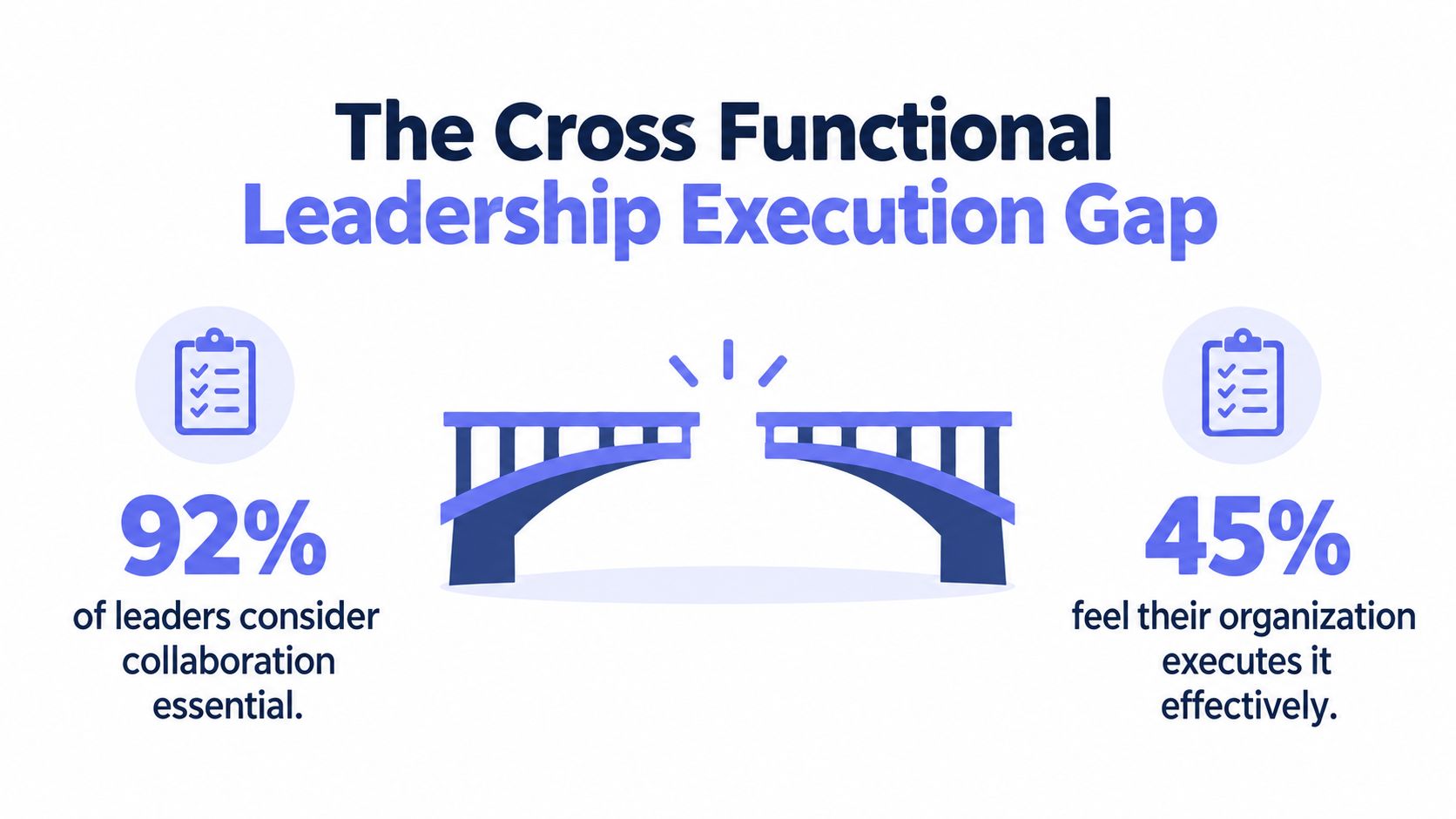
Cross-functional leadership is a structured operating system, not a personality trait or a communication exercise. In a 2025 UK survey, 92% of leaders said collaboration was essential, yet only 12% rated the current state of collaboration as good or excellent. That gap is where strategy gets lost.
The popular advice is predictable: communicate more, build stronger relationships, schedule better meetings and invest in collaboration software. Those actions can help, but they don't solve the core problem. Teams struggle because nobody knows who makes the final decision, functions measure different outcomes, and no operating rhythm forces dependencies into view.
I've seen this pattern repeatedly. Sales wants speed. Product wants focus. Operations wants control. Finance wants predictability. Every function can be performing well against its own targets while the organisation misses the strategic outcome.
Cross-functional leadership fixes that problem by creating a system for shared execution. It defines ownership, decision rights, metrics, review routines and escalation rules. The aim isn't more collaboration. It's reliable delivery across organisational boundaries.
The Cross Functional Leadership Execution Gap
Good leadership doesn't automatically produce good collaboration. The evidence is clear. A 2025 survey of 145 leaders across UK public, private, education and not-for-profit sectors found that 92% considered collaboration essential to economic growth, yet only 12% rated the current state of collaboration as good or excellent. You can read the findings in the UK cross-sector collaboration survey.
That contrast exposes a serious execution problem. Leaders agree that collaboration matters, but agreement doesn't tell a product manager who can reject a sales commitment. It doesn't tell operations whether a customer deadline outranks a process improvement. It doesn't tell finance how to resolve a capacity dispute. Good intentions can't settle competing priorities.
Collaboration needs infrastructure
Most organisations treat cross-functional leadership as a soft skill. They look for leaders who are empathetic, persuasive and good at bringing people together. Those qualities matter, but they don't create accountability.
A cross-functional leader needs to build four operating components:
- A shared outcome: Everyone understands the business result that matters.
- Decision rights: People know who decides, who contributes and who must be informed.
- Aligned measures: Functions don't receive rewards for behaviour that damages the shared result.
- A review rhythm: Leaders identify stalled dependencies before they become delivery failures.
Without those components, collaboration turns into theatre. People attend workshops, exchange updates and leave with the same unresolved trade-offs.
The UK cross-functional collaboration research found that 73% of UK people professionals reported working collaboratively across business functions to meet organisational needs. That makes cross-functional work a mainstream operating requirement, not an optional management style.
My view: If collaboration depends on unusually generous people, it isn't a system. It's luck.
Leaders should therefore diagnose the execution mechanism, not just the quality of communication. Ask where decisions wait, which metrics conflict and which outcomes lack a named owner. The execution gap guide is useful for turning those questions into a practical leadership conversation.
Why Cross Functional Collaboration Fails
Cross-functional work usually breaks in three places. The symptoms look like poor communication, but the underlying failures are more specific: ambiguous decision rights, incompatible operating rhythms and conflicting metrics.
Research examining 10 cross-functional teams from six major UK employers found that bringing people from different functions together doesn't automatically create effective integration. The value depends on how the team is led and how people combine expertise and make decisions across departmental boundaries. The Institute for Employment Studies research supports a practical conclusion: a team isn't integrated because its members sit in the same meeting.
Decision rights disappear
Suppose a company wants to improve customer onboarding. Sales owns the commercial relationship. Product controls configuration choices. Operations manages implementation. Customer success sees adoption problems first.
If nobody owns the final trade-off, the group seeks consensus. Consensus sounds collaborative, but it often means waiting for every function to agree. A minor decision becomes a leadership escalation. The customer waits while internal teams protect their positions.
Rhythms pull teams apart
Functions often work to different clocks. Sales reviews pipeline pressure frequently. Product plans delivery in larger cycles. Operations manages capacity and risk. Finance monitors forecasts and variance. Without a shared review rhythm, each function discovers a dependency at a different point.
That creates avoidable friction. Sales promises a date before operations confirms capacity. Product changes a workflow after enablement materials are prepared. Finance challenges a forecast after the delivery plan has already hardened.
Metrics reward local optimisation
A team will usually follow the measure attached to its performance conversation. If sales is rewarded for signed revenue, product for release volume and operations for cost control, each group can behave rationally while damaging the customer outcome.
The fix isn't to remove functional measures. It is to add a shared outcome that forces leaders to manage the trade-offs together. For practical guidance on rebuilding connections between teams, how to connect your whole team provides a useful perspective alongside the more formal operating mechanisms discussed here.
Don't start by adding another collaboration platform. Start by mapping the decisions, dependencies and measures that currently slow execution. The silo-breaking guide offers a useful way to identify where functional optimisation is blocking strategic delivery.
Establishing Decision Rights Across Functions
The first question in a cross-functional initiative should be simple: who owns the outcome and who has authority to make the trade-offs?
Many leaders skip that question because they assume seniority, goodwill or group discussion will resolve ambiguity. It won't. If several functions share a result but report through separate lines, the final decision must be designed rather than inferred.
A 2025 survey of 300 UK HR, L&D, DEI and C-suite leaders found that only 44% of organisations reported that their strategies included defined leadership roles and responsibilities, with just 38% placing accountability with a C-suite or executive leader. The findings are available in the Onvero leadership accountability whitepaper.

Start with the outcome
Write the cross-functional objective in business terms. “Improve onboarding” is too vague. “Reduce the effort required for new customers to reach first value” gives functions a result they can interpret and measure together.
Then appoint one accountable outcome owner. That person doesn't complete every task. They own the result, coordinate contributions and make the call when priorities conflict. If every function has equal ownership, nobody owns the final decision.
Separate contribution from authority
Use RACI, RAPID or a similar decision matrix. The framework matters less than the discipline of making roles explicit.
| Role | Practical question |
|---|---|
| Accountable | Who makes the final call and owns the result? |
| Responsible | Who completes the work? |
| Consulted | Whose expertise must shape the decision? |
| Informed | Who needs visibility after the decision? |
For a product launch, marketing may be consulted on timing and positioning. Product may own what gets built. Operations may approve readiness against defined service requirements. Finance may be informed about the commercial impact. Those distinctions stop every discussion becoming a committee meeting.
Give the owner usable authority
An accountable owner needs boundaries, not unlimited power. Define which trade-offs they can resolve, which decisions require executive escalation and how quickly an unresolved dispute must move upward.
Document the decision in a shared log. Record the owner, contributors, deadline, rationale and expected impact. The decision-making frameworks guide provides further practical direction on turning responsibility into authority.
Practical rule: Consultation should improve a decision. It shouldn't create a veto for every participant.
Review the matrix when the work changes. New dependencies, customer risks or regulatory constraints may alter who needs to contribute. A static RACI document won't rescue a live initiative unless leaders use it during real trade-offs.
Building Operating Rhythms That Drive Alignment
Clear decision rights won't help if leaders only inspect progress during quarterly reviews. By then, a dependency may have become a missed commitment, a rework cycle or a customer problem.
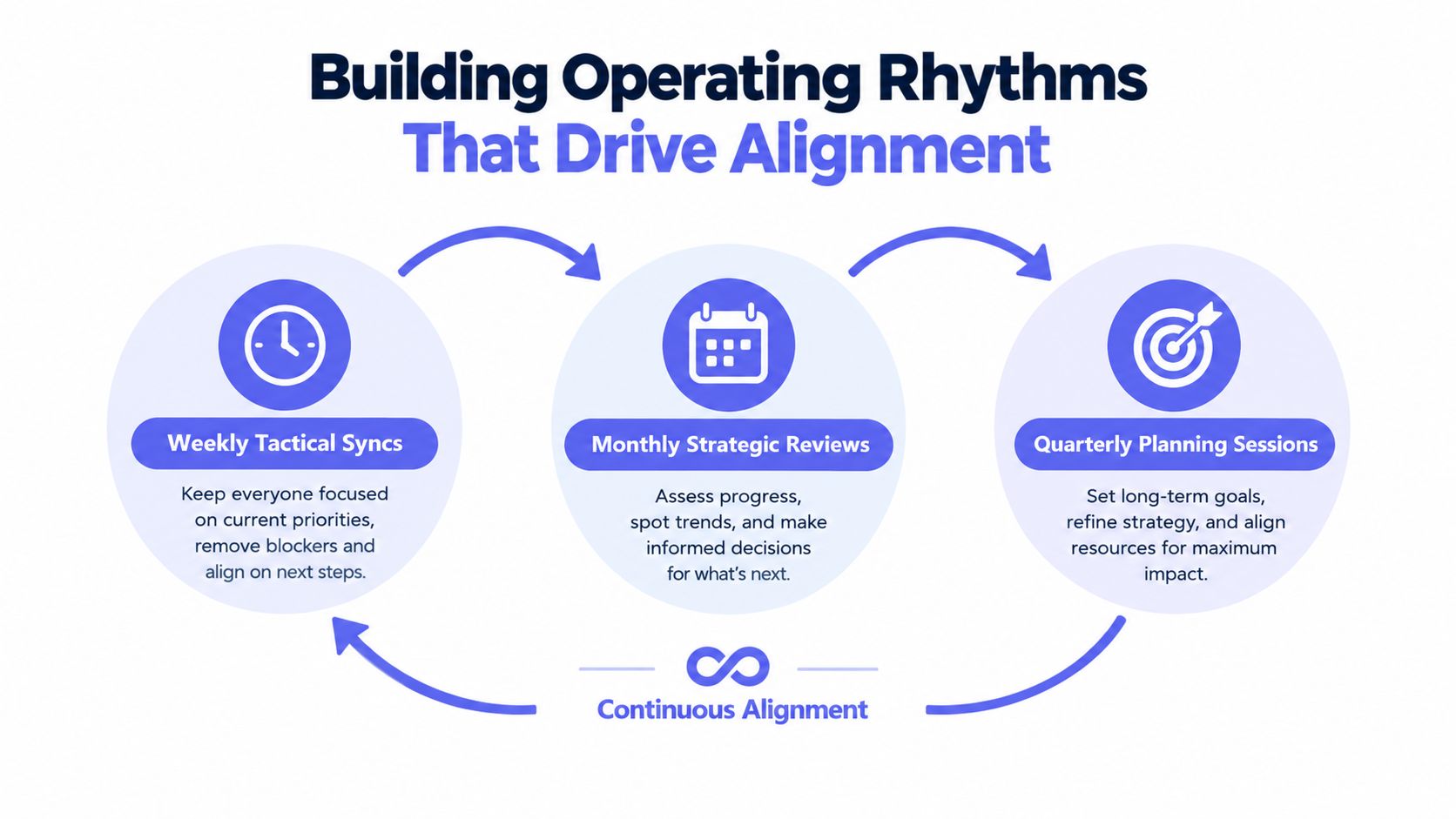
Cross-functional leadership needs a repeatable operating rhythm. Each forum should have a defined purpose and produce a tangible output. If a meeting can't remove a blocker, make a decision or change a commitment, it probably doesn't deserve a place in the calendar.
Use three connected forums
A practical rhythm separates immediate coordination from strategic review and planning.
- Weekly tactical syncs: Review dependencies, decisions needed and risks to key results. Keep status updates in the dashboard.
- Monthly strategic reviews: Examine whether the shared outcomes still support strategy. Reallocate capacity when evidence shows that priorities have changed.
- Quarterly planning sessions: Set the next group of outcomes, confirm contribution boundaries and remove objectives that no longer matter.
The weekly meeting should be short and operational. Each issue should end with a documented owner, decision, deadline and expected impact. Don't allow the group to hide behind phrases such as “we'll align offline”.
Cascade outcomes, not task lists
A strategy should flow into a small set of shared objectives. Each function then defines measurable contributions that support those objectives.
For example, a customer onboarding objective might require a sales contribution around expectation setting, a product contribution around configuration effort and an operations contribution around implementation lead time. The functions retain their specialist work, but the shared outcome reveals where one team's progress depends on another's.
A practical cross-functional leadership method should establish recurring coordination routines and measure delivery, decision quality, conflict resolution and stakeholder confidence. It should also use a 6 to 8 week pilot to baseline cycle time, rework, escalations and dependency delays, then compare those measures with post-pilot results. The method and pilot recommendation are set out in the Exeter research on inter-team leadership.
Protect the rhythm under pressure
The first meeting leaders cancel when work gets difficult is often the meeting that would expose the difficulty. That reverses the priority. Dependency reviews matter most when delivery pressure rises.
The operating rhythm guidance shows how to connect reviews to governance rather than treating them as optional status sessions. Keep the cadence stable, change the agenda when the business problem changes and insist on visible evidence.
Resolving Conflict and Coaching for Collaboration
Conflict isn't the failure of a cross-functional team. Unresolved conflict is.
Sales may argue for a customer commitment that product considers unsafe. Operations may reject a launch date that commercial leaders consider urgent. Finance may challenge investment that technology leaders see as necessary. These disagreements contain useful information about risk, capacity and value. Leaders damage execution when they suppress the disagreement or allow it to become personal.
A UK leadership-team report found that only 40% of leaders rated their organisation's leadership quality highly, while just 23% of employees expressed confidence in leaders' ability to handle changing workplace and workforce demands. The report also attributes up to 70% of employee engagement to leadership quality. See the UK leadership teams report.
Coach the argument, not the personality
When two functions disagree, ask each leader to state:
- The outcome they are protecting.
- The evidence behind their position.
- The risk they believe the other option creates.
- The decision they recommend.
- The time by which the decision must be made.
This structure moves the conversation from “my function versus yours” to “which trade-off best serves the shared outcome?” It also gives quieter experts a clear route into the discussion.
Psychological safety doesn't mean removing challenge. It means people can raise a material risk without being punished for making the issue visible. I expect leaders to challenge assumptions directly, then commit once the accountable owner decides.
Make decisions stick
Once the decision is made, leaders must stop relitigating it in separate functional meetings. Record the rationale and communicate what changes for each team. If new evidence appears, reopen the decision through the agreed escalation route, not through informal resistance.
Use retrospectives after major initiatives. Keep them blameless but not vague. Ask which decision arrived late, which dependency stayed hidden and which operating rule should change next time.
Strong teams don't avoid disagreement. They resolve it before it becomes expensive.
Coaching should reinforce observable behaviours. Recognise leaders who surface trade-offs early, involve the right experts and close decisions clearly. Correct leaders who use consultation to delay, escalate every minor dispute or protect a functional target at the expense of the shared result.
Measuring Cross Functional Leadership Effectiveness
Meeting attendance is not evidence of alignment. Neither is activity in a collaboration tool. Those measures show effort, not whether teams are delivering the strategy.
Measure the operating system at three levels.
Delivery outcomes
Track whether shared work moves with fewer preventable delays. Useful indicators include cycle time, rework, escalations, dependency delays and completion against agreed commitments. Establish a baseline before changing the leadership process, then compare results after the pilot.
Decision quality and speed
Record how long important decisions remain open. Review whether the right expertise was involved, whether the decision matched the agreed outcome and whether teams acted on it. A fast bad decision creates rework. A thoughtful decision that arrives too late also fails.
Confidence and behaviour
Ask stakeholders whether they understand ownership, trust the review process and believe cross-functional risks will be resolved. Use recurring pulse questions rather than a single survey. For a more structured perspective on leadership behaviour, multi-rater feedback for HR teams can complement delivery data.
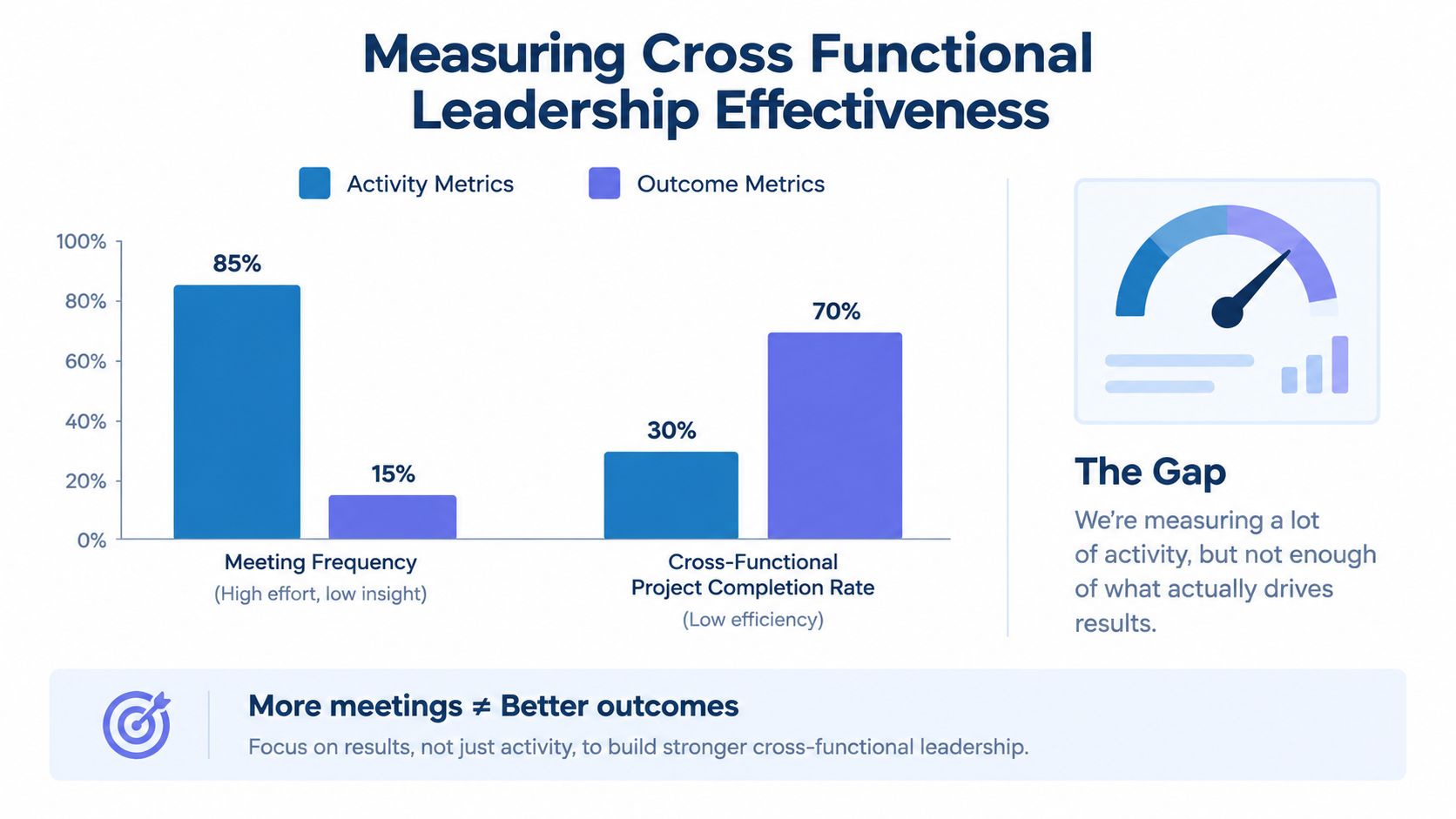
Research on leadership in inter-team contexts found that 64% of reviewed studies used quantitative methods, but 87% of those quantitative studies were cross-sectional. That means leaders should avoid judging effectiveness from one-off snapshots. Track the same measures over time, alongside qualitative evidence from the people doing the work.
| Measure | What it reveals |
|---|---|
| Decision latency | Where authority or information is stuck |
| Unresolved dependencies | Which teams need intervention |
| Rework | Whether decisions or hand-offs are producing avoidable work |
| Stakeholder confidence | Whether the system feels dependable to participants |
The outcomes measurement guide offers a practical way to connect these indicators to OKRs. Don't reward teams for holding more meetings. Reward them for making better decisions and delivering shared outcomes.
From Strategy to Execution with Cross Functional Leadership
A leadership team can spend months refining a strategy and still leave every function to interpret it alone. Sales converts it into a revenue push. Product converts it into a roadmap. Operations converts it into a capacity plan. Finance converts it into a cost challenge. The strategy remains clear at the top, but execution fragments below it.
I work with leadership teams to find the point where that fragmentation begins. Sometimes the problem is an objective with no accountable owner. Sometimes it's a review rhythm that only reports history. Sometimes each function has a sensible metric that collectively drives the wrong behaviour.
The practical response is to design the system around the outcome. Define the shared objective. Name the decision owner. Map dependencies. Align the measures. Create a review cadence that forces trade-offs into the open. Then test the system against live work rather than discussing collaboration as an abstract capability.
OKRs are useful here because they connect strategic intent to measurable contributions. They don't solve accountability automatically. Poorly designed OKRs can create another layer of reporting. Well-designed OKRs make ownership, dependencies and progress visible enough for leaders to intervene before execution stalls.
I don't see cross-functional leadership as a softer version of management. It is an execution discipline. When teams remain misaligned despite a clear strategy, the issue is often not motivation or talent. It's the operating system surrounding the work.
I help leadership teams clarify decision rights, align cross-functional OKRs and build operating rhythms that turn strategy into dependable execution. If that gap is slowing delivery, book a conversation.