
Your leadership dashboard is green, but the launch date has moved again. Sales is waiting for onboarding. Onboarding is waiting for Product. Everyone can explain their own progress, yet nobody can explain who should have resolved the gap. I'd start there, not with another team-building exercise.
Why Capable Teams Still Miss Their Targets
The launch slipped six weeks. In this composite illustration, a 120-person scale-up had capable Product, Sales and Operations teams. Each hit its own OKRs. Nobody owned the handover between Product and onboarding.
Product considered the release complete when the feature shipped. Sales considered its job done when customers signed. Operations hadn't agreed the readiness criteria for bringing those customers live. The company missed the result while departments celebrated their contributions.
I treat that as a recognisable operating failure, not bad luck. Local targets encouraged local completion. Leaders never made the connection between those targets someone's explicit responsibility.
Cooperation isn't enough
Synergy in teams means their combined output exceeds what each would deliver alone. It shows up as faster decisions, fewer missed handoffs and stronger shared results. People can cooperate politely while still pulling in different directions.
The practical barriers are substantial. Research reported by Workplace Insight found that three-quarters of UK workers couldn't contact the right people when needed, while 72% lacked access to required information in real time.
Willingness won't remove those obstacles. Leaders need to specify where information lives, who makes decisions and what happens when a dependency threatens a business outcome. That's the practical work of breaking down silos, rather than asking departments to communicate more.
A successful departmental scorecard isn't evidence of successful company execution.
I assess observable behaviours, operating structures, shared OKRs and targeted interventions. Each needs a measure that shows whether delivery improved. Otherwise, leaders can mistake a fuller calendar for better coordination.
The first diagnosis doesn't require a survey. Choose a missed cross-team result and reconstruct the handoffs. Find the moment when someone needed a decision, information or acceptance from another team and didn't get it.
Before changing anything, answer two questions:
- Where did the last cross-team result slip? Identify the actual handoff, not the department eventually blamed.
- Who owned that handoff? Name the person accountable for securing agreement and resolving the gap.
What Synergy Looks Like in Daily Execution
Cooperation is teams being civil. Synergy is teams producing more together than apart.
I look for behaviour, not descriptions of culture. A leader saying that collaboration is strong tells me little. A team showing how it resolved a contested priority tells me much more.
Seven behaviours that show synergy, and what they look like
| Behaviour | Healthy signal | Warning sign |
|---|---|---|
| Shared outcome ownership | One named owner for each cross-team result | Two teams claim the result, or nobody does |
| Explicit dependencies | Each handoff logged with an owner and a date | Blockers raised in status meetings, then forgotten |
| Decision speed | Cross-team calls made in the meeting where they are raised | Decisions wait for the next all-hands or escalate by default |
| Information flow | Teams find current status without asking | The same question is asked twice in one week |
| Honest challenge | Teams flag risk with a confidence score | Every update is green until the final weeks of the cycle |
| Trade-offs | Teams drop lower-value work to free capacity | Every team adds work and none removes any |
| Escalation | Blockers reach a decision-maker within an agreed time | Problems first surface in the quarterly review |
Watch what happens under pressure
The warning signs are concrete. Product and Operations both claim ownership of activation, but each assumes the other will resolve an exception. A blocker appears in successive status meetings without a named decision-maker. A release choice waits for an all-hands because nobody knows who can authorise it.
Information flow fails just as visibly. Sales asks whether a customer can go live, receives an answer privately, and another salesperson asks again. Where customer messages cross departments, a shared inbox from Convot is one practical resource for keeping the conversation accessible. It still needs an explicit assignment rule.
Other failures appear in planning. Team leads accept another urgent project without removing anything. They report green because admitting uncertainty feels like admitting poor performance. The executive sponsor hears about the problem only when the delivery date is already lost.
These aren't personality diagnoses. They're observable gaps between what leaders expect and what people do.
Score evidence, not confidence
I recommend a simple diagnostic scale from 1 to 5 for each behaviour. Treat 1 as absent, 3 as inconsistent and 5 as reliably demonstrated under pressure. These are assessment anchors, not industry benchmarks.
Ask each team lead to support the score with a recent example. A written escalation policy doesn't earn a high score if people bypass it. Equally, a difficult disagreement can demonstrate healthy challenge if someone resolved it without suppressing the risk.
Keep the scoring focused on working relationships between teams. A department may manage its internal tasks well while repeatedly disappointing downstream colleagues.
Then compare rows across teams. Find the behaviour where teams score lowest. That's where the first intervention goes, not the row that feels most uncomfortable to discuss.
Structures That Turn Collaboration Into Delivery
More teamworking doesn't guarantee more authority. Oxford research using British workplace relations data found that the share of employees working in teams rose from 47% in 1992 to 59% in 2006, while the share working in teams with greater autonomy fell from 21% to 14% over the same period.
That distinction matters. Leaders can add team structures while keeping the decisions elsewhere. People then spend more time coordinating work they still can't control.

Give each structure a job
I use the following as a starting design. The cadences and escalation windows are operating recommendations to adapt, not universal standards.
Five structures that make cross-team work deliverable
| Structure | Purpose | Cadence | Owner |
|---|---|---|---|
| Dependency register | Shows every cross-team handoff with its owner and date | Live, reviewed weekly | Delivery or programme lead |
| Cross-team decision forum | Settles trade-offs with authority to act | Weekly, with urgent decisions handled between meetings | Chief of Staff or COO |
| Shared-outcome review | Tests progress on shared key results against plan | Monthly | Executive sponsor with team leads |
| Team KR check-in | Surfaces local risk and confidence early | Weekly, 15 minutes | Team lead |
| Escalation rule | Sends blockers to a decision-maker within an agreed time | Triggered when a blocker ages past five working days | Forum chair |
A dependency register can live in Jira, Asana or a shared spreadsheet. The tool matters less than the acceptance criteria. Record what the receiving team needs, who accepts it and the date it becomes necessary.
The decision forum needs people who can commit capacity and settle priorities. Don't fill it with representatives who must take every question back to someone else. That creates another handoff.
For each agenda item, require a decision statement, available options and a recommendation. Record the decision and its consequences for other work. Practical dependency management means managing those commitments, not maintaining a list of vaguely connected projects.
Authority before governance
My test is direct:
Decision-right test: Can this team make the trade-off on work it's accountable for without escalating?
Some choices rightly remain with executives, especially where regulatory exposure or major investment is involved. Make those boundaries explicit. Don't leave teams to discover them after committing to delivery.
Jan Kutschera's guide to improve team performance with engineered systems is a useful companion when considering routines rather than relying on individual effort.
Match the structure to organisational size. In a hypothetical 40-person company, I'd start with the register and decision forum, not a review board. Combine reviews where the same people hold the necessary authority.
If a team fails the decision-right test, give it the appropriate authority first. Then build the structure around it.
Shared OKRs That Force Cross-Team Work
Consider a composite fintech illustration, not a named client. Six leaders bring six conflicting priorities into planning. They leave with three company OKRs everyone signs, but no team can act on.
The wording sounds strategic. The commitments remain departmental. Each leader writes a separate objective, and nobody translates the company outcome into an accountable cross-team result.
I wouldn't solve that by cascading more objectives. I'd change how leaders define the shared commitment.
Apply the owner-and-contributors test
A shared key result needs one accountable owner, at least two named contributing teams and a measure expressed in business terms. Ownership means securing the result across boundaries, not doing everyone's work.
| Illustrative wording | What it makes possible |
|---|---|
| Improve onboarding | Teams can choose unrelated improvements and still claim progress |
| Cut time-to-first-payment from nine days to three | Teams must agree what changes the customer's elapsed time |
The second row is an illustrative target, not a reported business result. Assign it to the Head of Onboarding, with Product, Compliance and Operations as contributors.
Product might remove an avoidable workflow step. Compliance might redesign exception handling without weakening controls. Operations might change how it allocates cases. Their contributions differ, but the business measure stays common.
The owner must also establish measurement boundaries. Define when the clock starts, when it stops and which customer population is included. Otherwise, teams can improve their local measure without improving the customer experience.
Resolve disagreement in the room
I recommend setting shared OKRs in a facilitated executive session, not assembling them through email. Leaders need to challenge resource assumptions while the people making those commitments are present.
The OKR Hub's business figures show that teams adopt OKRs 3× faster when the executive team sets OKRs together in a facilitated session rather than asynchronously. 82% of leadership teams say they leave its facilitated sessions with clearer strategic alignment than before.
Those figures don't replace the hard decisions. A session still needs to settle competing priorities, contribution boundaries and what stops when capacity is insufficient.
I'd make cross-functional alignment tangible by asking each contributing leader to explain the commitment in their own words. Agreement on a slide isn't enough if their interpretations differ.
- The owner explains the result. What business change must happen?
- Contributors explain their commitments. What will they change, and what do they need?
- The sponsor resolves the conflict. Which priority wins when commitments compete?
If a team can't name the shared key result it contributes to, the OKR isn't shared in practice.
Measures That Prove Synergy and Vanity Metrics to Drop
In the Office for National Statistics' 2023 Management and Expectations Survey, KPI use was the lowest-scoring management practice, at 0.42 on a scale from 0 to 1. That highlights a practical weakness: leaders need a consistent way to distinguish useful activity from progress.
I measure the consequences of collaboration. Did someone make the decision? Did the receiving team get what it needed? Did the business result move?
Build a small execution scorecard
The thresholds below are starting points to calibrate after one cycle, not universal standards. Use them to trigger investigation, not automatic judgement.
Six measures of cross-team synergy
| Measure | What it reveals | How to calculate | Review trigger |
|---|---|---|---|
| Decision latency | Speed of cross-team decisions | Median working days from raised to decided | Above 10 working days for two cycles |
| Dependency failure rate | Share of handoffs missed | Missed handoffs divided by total handoffs | Above 20% in any cycle |
| Rework rate | Work redone through unclear ownership | Items reopened divided by items closed | Rising for two cycles running |
| Shared key result pace | Whether shared outcomes are moving | Share of shared key results on pace at mid-cycle | Under half on pace at mid-cycle |
| Confidence accuracy | Whether teams predict delivery honestly | Team confidence scores compared with actual outcomes | Scores consistently above outcomes |
| Escalation time | How long blockers wait for a decision | Working days from first flag to decision-maker involvement | Over five working days |
Define the events before collecting the numbers. A handoff is missed when the receiving team doesn't get the agreed deliverable by the agreed date. A decision isn't complete if someone records approval but leaves an essential condition unresolved.
Rework needs particular care. Reopened items can reflect useful learning rather than poor coordination. Tag the reason so leaders can isolate work repeated because ownership, requirements or acceptance criteria were unclear.
Confidence accuracy also requires interpretation. Don't treat a confidence score as mathematically equivalent to percentage completion. Compare stated expectations with eventual delivery and look for persistent optimism or concealed uncertainty.
Good metrics and KPIs make a decision easier. If a measure changes but nobody knows what action to consider, refine the definition or remove it.
Drop measures that reward appearances
- Number of cross-team meetings. More meetings can mean more unresolved work. Track the decisions and commitments produced, not attendance.
- Team closeness scores. These can inform wellbeing and relationships, but they don't establish delivery effectiveness.
- Share of OKRs marked green. Without evidence and realistic confidence, green status can reward late disclosure.
A UK workforce study reported by Vodafone found that 47% of employees blamed too many meetings for preventing productivity. Treat meeting time as a cost to justify, not proof of synergy.
A useful review changes a decision, a commitment or the allocation of capacity. A status recital doesn't.
Keep diagnostic measures separate from individual performance rewards. Otherwise, people have a reason to delay logging blockers, redefine missed handoffs or avoid reopening defective work. I want an honest picture of execution, not a cleaner-looking dashboard.
How to Launch Synergy Controls in the Next Cycle
Use the six measures to anchor the changes. Confidence reporting needs a delivery comparison, and an overdue-dependency review needs a reliable handoff record. Without those foundations, leaders are collecting opinions again.
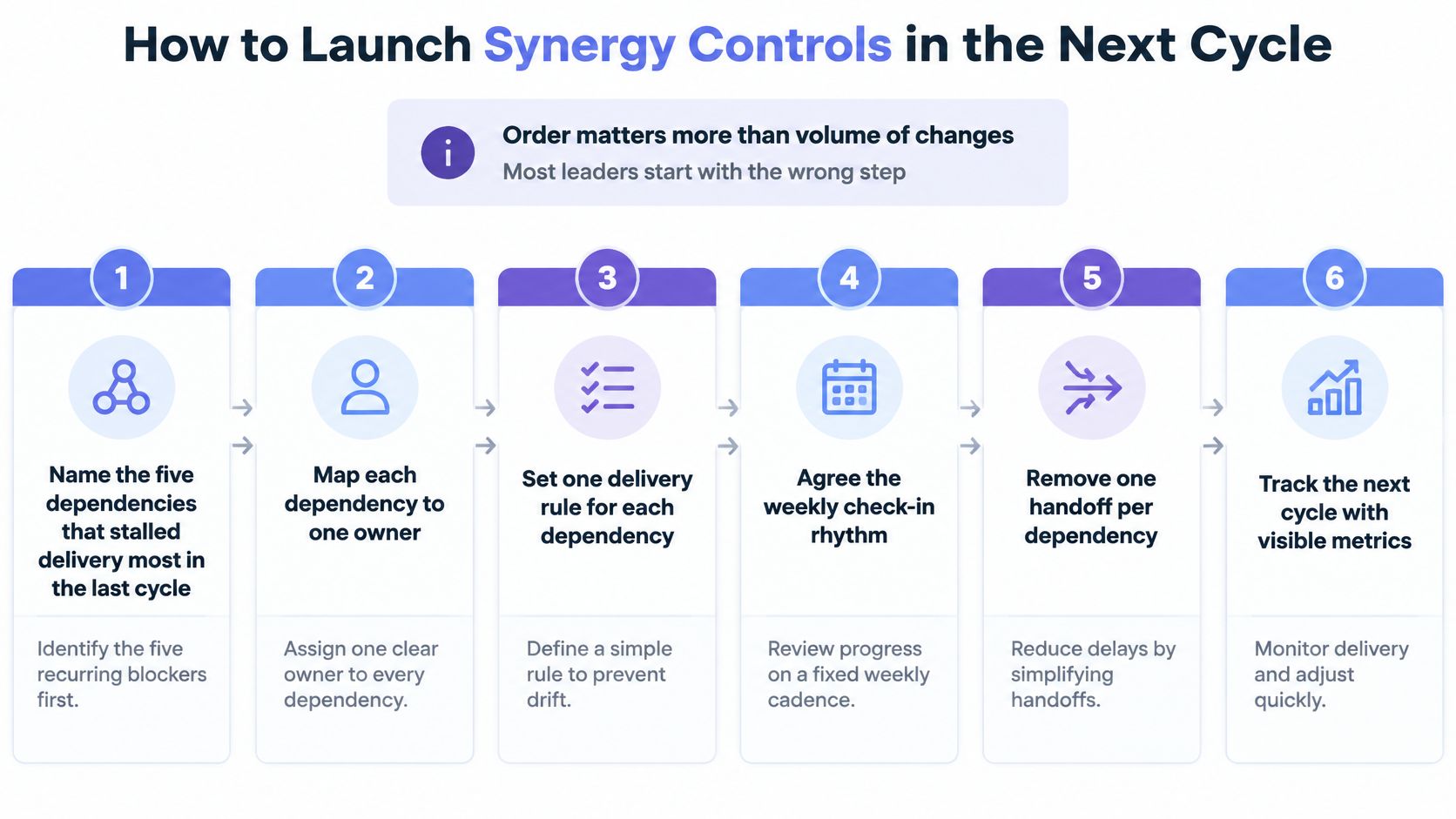
Order matters more than the volume of changes. I'd start with the delivery failures, not a new meeting calendar. Most leaders reverse that order and add reviews before deciding what those reviews must resolve.
Start with a bounded operating experiment
The timing, counts and scoring below are my recommended starting design. Adjust them to the risk and pace of the organisation.
-
Name the five dependencies that stalled delivery most in the last cycle. Use the handoff log or delivery review and describe the missing commitment precisely. This keeps attention on actual constraints rather than the most vocal department's frustrations.
-
Assign each dependency one owner and one deadline. The owner must secure acceptance from the receiving team, not merely send the work. This removes the ambiguity between producing something and completing the handoff.
-
Put every open cross-team decision on the forum agenda. Close it in the meeting or within 48 hours, with a named decision-maker responsible for any missing evidence. This prevents discussion from becoming a substitute for resolution.
-
Log a confidence score from 1 to 5 and one unresolved risk beside every key result in each update. If no material risk is identified, record that explicitly rather than inventing one. This gives leaders an early signal to investigate before a missed commitment becomes unavoidable.
-
Make dissent part of planning. Ask each team to state the assumption it is least sure of before the cycle starts. This gives people permission to challenge the plan before they feel obliged to defend it.
-
At week four, count dependencies still open past their deadline and fix the worst one before adding new work. Choose the dependency with the greatest consequence for the shared business result. This tests whether leaders will remove a constraint rather than just note it again.
Make candour safe and useful
A Workplace Options and IIRSM report describes a survey covering leaders and managers from more than 5,000 organisations, in which 93% agreed or strongly agreed that psychological safety is associated with employee wellbeing, productivity and innovation.
That's a reported association, not proof that introducing a confidence score improves performance. The practical requirement is leadership behaviour. If someone reports a risk and receives blame, the reporting routine becomes theatre.
I'd ask the sponsor to respond with a decision: accept the risk, change the plan, secure evidence or assign corrective action. Record the response beside the issue. People need to see that candour produces useful action.
Keep the experiment narrow. Don't launch a new governance framework alongside it. Establish whether these controls help people resolve the chosen dependencies, then retain only what improves execution.
Confirm Your Synergy Baseline Before the Next Cycle
This week, score each team against the seven behaviours and pull the six measures for the last cycle. Mark missing records as unknown. Don't reconstruct a reassuring baseline from memory.
I'd use a leadership alignment assessment to structure the discussion, then test every conclusion against a delivery example. Agreement among executives isn't enough if team leads describe a different operating reality.
Choose the intervention from the evidence
Apply these diagnostic rules as starting decisions, not external benchmarks:
- If two or more teams show the same behavioural warning sign, treat the problem as structural. Start with the dependency register and decision forum before rewriting the OKRs.
- If shared ownership is the weakness, rewrite the affected key results using the owner-and-contributors test. Don't ask everyone to become jointly accountable.
- If decision latency exceeds 10 working days or dependency failure exceeds 20%, fix the escalation rule first. Check that the person receiving an escalation is able to resolve it.
Hold a two-hour baseline review with the leadership team present. Ask each team lead to defend their scores with an example for every behaviour. Mark any score without an example as unverified.
The output should be a specific intervention, an accountable executive and an observable change. Avoid a broad commitment to improve collaboration. Nobody can reliably implement that.
Test whether capability improves
Review the baseline again at week four of the next cycle. Compare the evidence, including whether receiving teams consider handoffs complete. Don't declare success because the new routine happened on schedule.
At The OKR Hub, I combine training and consulting because training without implementation support rarely sticks, while consulting without capability-building leaves teams dependent. The leadership team should become better at diagnosing and correcting these problems itself.
I help leadership teams close the gap between strategy and execution, from diagnosing the operating rhythm to building shared OKRs teams can deliver. To establish where your execution system needs to change, book a conversation.