
You left the away day with three agreed priorities. Everyone nodded. Someone photographed the flipchart. Six weeks later, your team is still asking which project wins when capacity runs short, and two functions are funding work that pulls in opposite directions.
That's not a commitment problem. It's a measurement problem. Consensus in a room tells you leaders can agree on words. It doesn't tell you whether managers translated those words into team priorities, whether non-managers understand the trade-offs, or whether money moved.
A good leadership alignment assessment tests shared understanding below the top team, not just agreement inside it. The gap can be stark. In the UK Institute of Internal Communication's 2026 IC Index, based on 5,000 UK employees, 87% of senior leaders believed organisational strategy had been clearly communicated, compared with only 57% of non-managers. If you only survey the top team, you'll miss exactly where execution breaks.
I treat weak scores as operating system problems before I treat them as communication problems. Send another town hall invite if you want. It won't fix unclear decision rights, incompatible planning rhythms or a budget that contradicts the strategy.
Five Dimensions That Show Whether Alignment Is Real
Say your leadership team agreed three priorities at an away day in March. By June, the operations director is funding a fourth initiative nobody discussed. Sales calls it essential. Product calls it a distraction. Nobody's lying. They're interpreting the same strategy through different pressures, measures and incentives.
That's why I don't score alignment as one feeling. I test five dimensions, each with evidence you can inspect. This kind of discipline sits alongside the wider four dimensions of execution, but it answers a narrower question. Do leaders, managers and teams make compatible choices when priorities compete?
The Five Dimensions
Five dimensions of leadership alignment
| Dimension | Question it answers | Evidence to collect | Healthy signal |
|---|---|---|---|
| Shared priorities | Do leaders name the same top three priorities? | Written priority lists from each leader | Identical lists, same wording |
| Shared understanding | Can managers and non-managers explain the priorities? | Survey by level and function | Spread under 15 points on every item |
| Decision consistency | Do trade-offs match the stated priorities? | Scenario answers and the decision log | Competing requests resolved the same way by every leader |
| Resource alignment | Does capacity follow the priorities? | Budget and headcount by priority | Top priorities hold the people and money they claim |
| Measured accountability | Does each priority have a measure, owner and review? | Dashboards, review records and escalation logs | Every priority has a baseline, target, owner and review slot |
Don't average these away. A team can score well on shared priorities and still fail on resources. That pattern is common, and it's useful. It tells you the strategy conversation worked, but the investment rules didn't change.
The 2025 Oxford Strategic Alignment Survey, based on 400 responses, found that 91% of respondents agreed or strongly agreed that strategic alignment was important, but only 56% agreed or strongly agreed that their own enterprise was strategically aligned. That 35-percentage-point gap is the point. Valuing alignment isn't evidence you've got it.
Agreement in a room is not evidence. Compatible decisions, funded capacity and reviewed measures are.
What This Assessment Does Not Do
It doesn't replace a strategy review. If the strategy itself is vague, crowded or untestable, fix that first. It also doesn't score individuals. The moment people think you're ranking leaders, you'll get polished answers and lose the diagnostic value.
Run the first test this week. Ask three leaders, separately and in writing, to list their top three priorities. Then compare the lists word for word. If the wording differs, don't smooth it over. Different wording usually means different scope, different success criteria and different work getting funded. That five minute exercise will tell you whether you need the full assessment. A full assessment is often needed.
Sample Questions for Leaders, Managers and Teams
Bad questions produce reassuring data. Ask leaders whether they communicate well and most will say yes. Ask teams whether strategy is clear and many will nod because they've seen the deck. Neither answer tells you whether people can make the same decision under pressure.
Use questions that force a choice, name a trade-off or reveal an owner. Keep them short. People give straight answers when a survey takes minutes, not half an hour. Confidentiality matters too, because psychological safety affects whether managers admit they're unclear rather than guess what you want to hear.
Questions for Leaders
- Name your top three: What are your top three priorities this quarter, in order?
- Name the stop: Which one would you stop first if capacity fell, and why?
- Point to a no: What did you decline last month because it conflicted with a priority?
- Name the owner: For each priority, who owns the outcome and who can change the plan?
That third question does heavy lifting. If a leader can't name anything they've declined, the priorities aren't constraining behaviour. They're decoration.
Questions for Managers
Managers translate intent into team backlogs, rosters, pipelines and delivery plans. If that layer is shaky, strategy loses momentum. Ask them to explain, in their own words, what their team is working on and which company priority it supports. Then ask who decides when two requests conflict, and how they know.
Add two observable checks. Can the manager show team priorities that trace to a company priority? Can they point to a recent progress conversation where a trade-off was reinforced, not just a status update given?
The stakes here are real. CMI's UK research, based on more than 4,500 workers, found that 82% of managers entering management roles had received no formal management and leadership training. That doesn't make managers the problem. It makes unsupported translation a predictable risk.
Questions for Non-Managers
Keep this set plain. What is the company trying to achieve this year, in one sentence? What do you do each week that moves it? When your work conflicts with another team's work, what happens next?
Don't grade the one sentence for polish. Grade it for accuracy. If ten people give ten different versions, you don't have shared understanding. You have ten local strategies.
One Scenario for Every Level
Give everyone the same scenario. Two initiatives compete for the same engineering team. One protects retention for existing customers. The other supports a new market launch. Which gets capacity? What evidence would change your answer? Who has authority to decide?
Compare the answers by level and function. Alignment shows up when people choose the same initiative, cite similar evidence and name the same decision maker. Misalignment shows up when each function picks its own work and calls it strategic.
Then run an evidence review. Take recent executive decisions, portfolio changes and meeting agendas. Tag each item as consistent, ambiguous or conflicting with the stated strategy. If the survey says leaders are aligned but the last month's decisions say otherwise, believe the decisions.
How to Run the Assessment in Four Steps
Keep the method boring. The value comes from identical wording, clean segmentation and evidence you can revisit next cycle. A clever survey that changes every quarter gives you activity, not learning.
If you're building the survey yourself, a simple tool where you can customize quizzes and forms is enough for a first pass. You don't need an enterprise platform to ask twelve good questions and segment the answers properly.
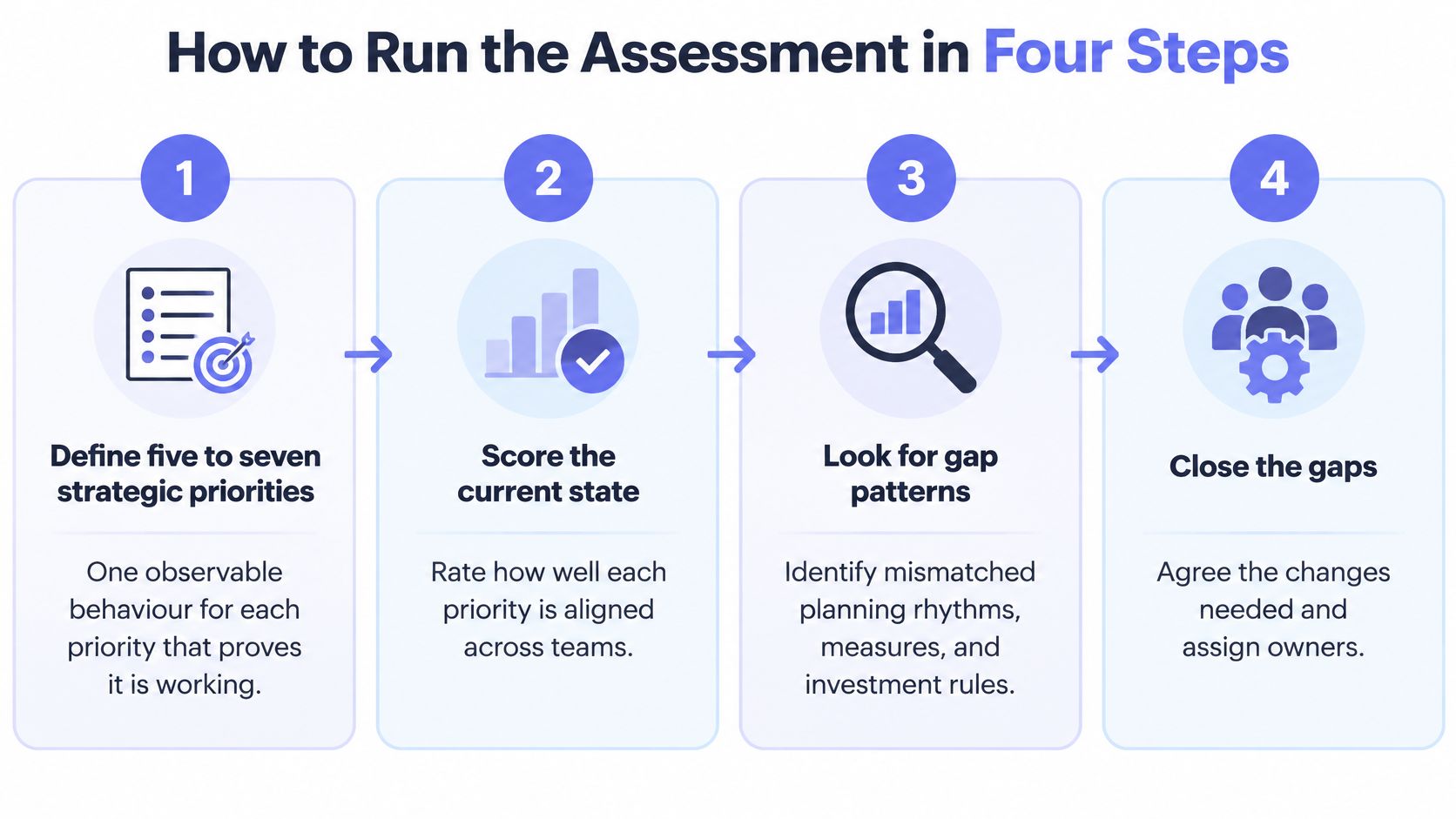
The Four Steps
-
Define five to seven strategic priorities. For each one, write one observable behaviour that proves it's working. I like behaviours with a cost attached, such as a team dropping a project to free capacity for the priority. If nothing stops, starts or moves, the behaviour is too soft. The usual slip is writing aspirations instead of behaviours, which makes scoring an argument about intent.
-
Survey leaders, managers and non-managers with identical items. Cover strategic clarity, belief in the strategy, personal contribution and decision rights. Keep the wording fixed so you can re-test later. The slip I see most often is giving senior leaders a richer survey and everyone else a shorter one. You then can't compare levels, which defeats the purpose.
-
Segment by level and function, then calculate the spread. For each item, subtract non-manager agreement from senior leader agreement. That number is your alignment spread. Apply an anonymity rule. Report any group with fewer than five respondents combined with the next level up, so results in small teams can't be traced to individuals.
-
Validate the largest gaps with evidence. Interview a small sample, then check governance forums, prioritisation calls and resource decisions. You're testing whether the survey pattern matches how the business runs. A focused goal alignment workshop works well at this point, because leaders have to confront specific gaps rather than debate alignment in the abstract.
What to Report
Don't produce one composite alignment score. Report three separate survey measures, understanding, belief and role-level action, alongside the five dimension scores. A composite hides the exact failure you need to fix. High understanding with low belief needs a different intervention from high belief with weak role-level action.
The Institute of Internal Communication's 2024 IC Index, covering 4,000 UK workers, found that just under seven in ten said their organisation had been clear about its strategy, but only 56% believed the strategy was right for success. Those are different problems. Clarity without belief won't survive the first hard trade-off.
Practical rule: Treat any spread above 15 percentage points as a priority gap, then validate it before you announce a fix.
Finish with a one page output. List the largest gaps, the evidence behind each one and the operating change you'll make first. If your output runs to thirty pages, nobody will own it. If it fits on one page, you can review it in the next operating meeting and hold someone accountable for movement.
Re-test after one operating cycle using the same wording. If you reword the items, you can't tell whether alignment improved or the survey got easier.
Scoring Each Dimension and Choosing Your Next Step
A leadership team can agree on priorities in the room while managers and teams still interpret them differently. Score each dimension using observable evidence, then use the results to choose a specific next step. The scores are diagnostic prompts, not proof that the organisation is aligned.
Use 1, 3 or 5 points for each dimension. This scale makes the distinction between weak, partial and strong evidence explicit, rather than letting a comfortable middle score conceal a gap. Report all five scores separately before adding them as a summary band out of 25. The total is a useful overview, but it can conceal the dimension most likely to disrupt execution. A structured gap analysis can help identify which weak dimension to address first.
Scoring Rubric for Leadership Alignment
| Dimension | 1 point | 3 points | 5 points |
|---|---|---|---|
| Shared priorities | Leaders name different top priorities | Same list, worded differently | Same three priorities named in every interview, in writing |
| Shared understanding | Spread above 15 points on most items | Spread under 15 points on most items | Spread under 15 points on every item |
| Decision consistency | Competing initiatives get contradictory calls | Calls match priorities only when pressed | Calls match priorities in the scenario test and the evidence review |
| Resource alignment | Top priority has no dedicated capacity | Some capacity follows priorities | Top three priorities hold most of the budget and headcount they claim |
| Measured accountability | Priorities have no named measure or owner | Measures exist but reviews are irregular | Every priority has a measure, baseline, target, owner and review cadence |
Score evidence, not confidence. If leaders describe decision-making as consistent but the decision log shows contradictory calls, score decision consistency as 1. If managers say they understand the priorities but cannot explain the trade-offs, shared understanding does not earn a 5. Strong agreement at the top is not enough if people below the leadership team cannot explain how the strategy guides their choices.
How to Read the Bands
- 20 to 25, aligned in practice: Keep the existing cadence. Address any remaining spread on an individual item, then re-test after one operating cycle with the same wording. A high band is not a reason to start a programme without a defined need.
- 13 to 19, aligned in parts: Choose the two weakest dimensions. Assign an owner to each and check both again before the next planning round. Trying to improve all five at once can leave every gap unresolved.
- 5 to 12, operating system problem: Pause the rollout and audit the OKR framework before writing new objectives. Better wording cannot compensate for missing owners, unfunded priorities or inconsistent decisions.
Consider a scale-up where every leader names the same three priorities in writing. That is 5 for shared priorities. On shared understanding, most items have a spread under 15 points, but the response to “I can explain our trade-offs” has a 22-point spread. That earns 3, not 5. The pattern points to agreement among leaders that has not yet translated consistently beyond the top team. Managers need clear team-level priorities and decision guidance before another strategy cascade.
Why Accountability Needs Building
Accountability requires more than naming an owner. ONS data on UK management practices reports average scores of 0.49 in 2020 and 0.55 in 2023, with a median of 0.60. The scale runs from 0, meaning no implementation of structured management practices, to 1, meaning full implementation. These figures describe management practices, not alignment in a specific organisation. They reinforce why routine target setting, review and intervention should be checked rather than assumed.
Set a baseline before you agree a target. Without a baseline, there is no clear starting point for assessing progress. Give each measure an owner, and define what action follows a review. Otherwise, a dashboard can show status without prompting a decision, while blocked work remains blocked.
The free OKR Maturity Assessment identifies gaps in OKR understanding across a leadership team. Some clients start with the assessment and a single leadership workshop before deciding next steps; others arrive with a clear brief for a full implementation programme. Choose the starting point that fits the team's needs rather than assuming every low score calls for the same intervention.
Finish by taking the weakest dimension and naming its first practical fix. Write that fix as one objective with two key results, a baseline for each key result and one owner. Keep it within the operating rhythm the team already uses, so progress can be reviewed without adding a new committee.
Reading Gap Patterns and Closing Them
Apparent misalignment is often a systems problem. Leaders may agree on the destination, then run incompatible planning rhythms, measures or investment rules. One function plans quarterly. Another commits annually. A third reallocates people weekly based on whoever shouts loudest. The strategy hasn't failed. The management system gives people contradictory instructions.
That distinction changes the fix. You don't solve a cadence problem with a better slide deck. You solve it by changing who decides, what gets funded, which measure counts and when progress gets reviewed. At that point cross-functional alignment stops being a value statement and becomes an operating choice.

Gap patterns, likely causes and first fixes
| Gap pattern | Likely cause | First fix |
|---|---|---|
| Leaders agree, managers do not | Translation breaks between leadership layers | Cascade the top three priorities into team goals within one cycle |
| Strong on priorities, weak on trade-offs | Decision rights are unclear | Write down who decides on each top priority and what evidence changes the call |
| Strategy clear, budget unchanged | Resource rules contradict priorities | Reallocate capacity to the top priority and stop one competing initiative |
| Many dashboards, few owners | Management system gap | Give each measure one owner, a baseline and a fixed review slot |
| Scores fall after a reorganisation | Governance not re-set | Re-run the decision log and confirm escalation routes |
A Scenario You'll Recognise
Say a scale-up's executive team agrees customer retention is critical. Sales tracks new logos and expansion bookings. Customer success tracks a separate retention measure with a different definition and a different reporting period. Product prioritises features for prospects because that's where the loudest revenue pressure sits.
Another town hall won't close that gap. People already know retention matters. The fix is one shared retention measure, one owner and one review slot where conflicts get resolved. Turn it into an OKR. Set an objective to lift customer retention, add the shared retention outcome as a key result with a baseline, name the owner and fix the monthly review slot. Now leaders have to confront trade-offs with the same number in front of them.
McKinsey's 2025 survey of operational leadership and management systems found that the UK had weaker management systems than both the United States and Germany across daily metrics and steering, planning, and continuous improvement. I read that as a warning against blaming individuals too quickly. Weak systems make capable leaders look misaligned.
Reassess Against Behaviour, Not Sentiment
Re-run the same survey wording after one operating cycle. Track leading indicators alongside outcomes, because scores can improve while behaviour stays stuck. Watch duplicated work, priority reversals, unresolved dependencies and escalation volume. If those don't fall, alignment isn't turning into execution yet.
Turn each first fix into one OKR with one objective, two or three key results with baselines and a named owner. Don't create an OKR for every observation in the assessment. Pick the gap that's blocking delivery now and make the change visible in the next cycle.
A gap is closed when a decision has changed, not just when a score has improved.
Hold that line. If capacity moved, an initiative stopped, an owner intervened earlier or two functions settled a conflict using the agreed rule, you've got progress. If people sound more positive in the next survey, keep digging.
I help leadership teams turn assessment results like these into clear priorities, explicit trade-offs and OKRs with owners, baselines and a review rhythm that holds under pressure, so if your scores point to an operating system problem rather than a messaging problem, book a conversation.