
Your product team has just locked a launch date. Marketing hears about it seven days before customers do. Finance finds out when the spend is already committed.
Nobody intended to hide anything. Each team communicated inside its own channel, with its own assumptions. I treat that pattern as an information architecture problem, not a people problem. Cross functional communication fails when nobody can answer three questions fast: who owns the decision, where is it recorded, and how does another team retrieve the context without interrupting someone?
Fix those three questions and execution speeds up. Leave them vague and adding meetings only adds noise.
Where Cross-Functional Communication Breaks Down
A product launch has a confirmed date in the sprint review, a provisional date in the marketing brief and an old scope in Finance's budget. Each team works from a record that looks current. The conflict surfaces when contracts are signed.
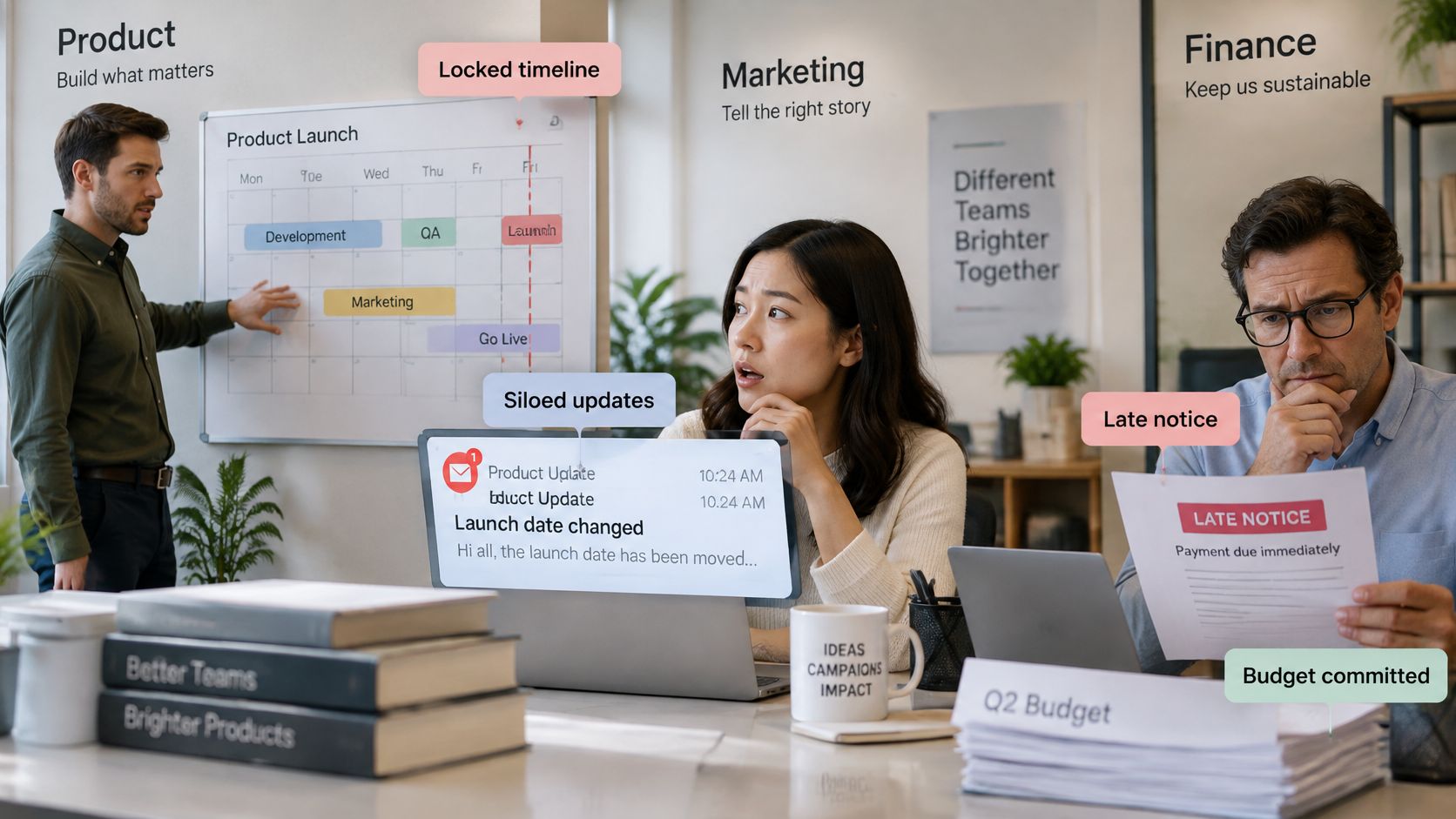
Four signals of a structural problem
Decisions stall when no one can identify who has approval rights. Computer Weekly's report on a September 2024 survey of 2,190 knowledge workers says almost half of respondents reported that deciding how to progress business objectives can take up to three hours. A decision without a named owner often becomes a queue.
Priorities drift when functions keep different versions of the team's top priorities. People Insight's UK cross-sector benchmark found that only 54% of employees believe communication between different teams is good. Practical team habits can help, as described in Zemith's guide to better team communication, but shared records and clear decision ownership address the underlying coordination problem.
Information hunting fills the gaps: colleagues send messages, make calls or book meetings to find context that should be retrievable. Rework follows when requirements change late or never reach the teams doing the work. In 2025, 31% of UK knowledge workers said poor communication caused project delays or failures, according to Lucid's Work Acceleration Survey, reported by Workplace Wellbeing. Delivery absorbs the cost.
| Signal | What it looks like | UK evidence |
|---|---|---|
| Decisions stall | Work waits for a sign-off with no clear owner | Almost half of respondents say it can take up to three hours to decide how to progress business objectives |
| Priorities drift | Teams hold different top priorities | Only 54% of employees believe communication between teams is good |
| Information hunting | Staff chase colleagues or book meetings to find context | Employees report spending time searching for information |
| Rework | Finished work is redone after requirements change | Late or unclear requirements can force teams to redo work |
Run a ten-minute test: pull the cross-team decisions from last month. Check whether each has a named owner, a recorded date and a visible reason. If any are missing, fix the record and retrieval path before adding channels or meetings. The structural causes of silos between teams often persist because goodwill cannot resolve competing deadlines or make an unrecorded decision easy to find.
Where Cross-Functional Work Pays Off
More functions in every phase doesn't produce better outcomes. It often produces slower decisions, diluted accountability and objections that arrive after the work is nearly finished.
Research on UK and German manufacturing plants published via Aston University found the optimal UK combination, cross-functional working in product design and development plus product marketing, but not in new-product identification or production engineering, increased innovation success by 29.5%. Integration pays where technical, commercial and customer knowledge must meet. Specialist ownership pays where speed and depth matter more.
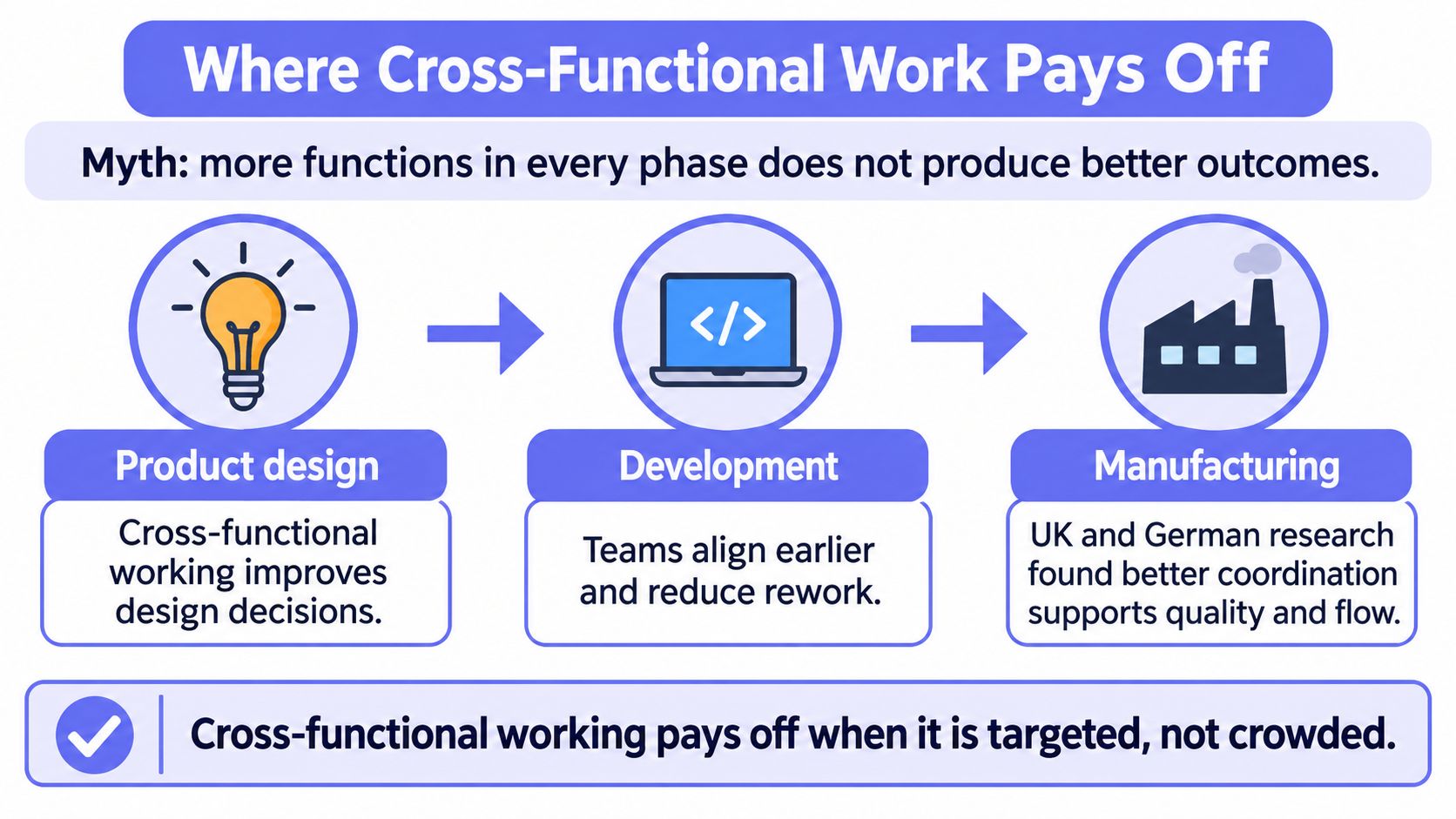
Place collaboration at the right interfaces
- Map where knowledge must integrate. List each stage and mark where one function's decision changes another function's work. Those junctions need joint input, not every stage by default.
- Keep single-function ownership where speed is critical. Let specialists move without a committee when the trade-off sits inside their expertise. I would rather have one accountable expert than five partial owners.
- Define each handoff explicitly. State required inputs, decision criteria and acceptance conditions before work passes across. A handoff without acceptance conditions is just a transfer of ambiguity.
- Assign one accountable owner per stage. Use a RACI or decision-rights matrix so contributors know whether they decide, approve, contribute or need informing.
- Hold interface reviews only at predefined gates. Short reviews at agreed points catch conflicts early. Continuous check-ins between gates interrupt the people doing the work.
Take a SaaS launch. The design to marketing handoff needs a signed positioning brief, agreed customer problem, proof points and launch claim limits. Engineering estimates, by contrast, stay with the engineering lead. Marketing needs the date and confidence level, not a vote on technical sequencing.
Cross-functional working pays off when it's targeted, not crowded.
I track stage-level measures, not a generic collaboration score:
- Design to validation time: days from design decision to market validation.
- Late requirement changes: number of requirement changes after development begins.
- First-pass approval rate: share of handoffs accepted without return.
- Misunderstood requirements: defects or rework traced to unclear requirements.
If first-pass approval rises and late changes fall, communication is improving where it counts.
Aligning Objectives Across Functions
Misalignment usually starts innocently. Marketing commits to pipeline. Product commits to a launch date. Finance commits to margin. Each objective looks sensible alone, and nobody owns the links between them.
I fix that by writing shared key results for outcomes no single function can deliver. OKRs help here not as a framework exercise, but as a way to turn dependencies into owned, scored commitments.
Build the dependency into the objective
- Pick the few company objectives that need multiple functions. I start with two or three, not a long list that dilutes attention.
- Write one measurable key result per contributing function. Each key result gets a single named owner, even when several people contribute.
- Add a dependency line. State which function's output another key result relies on, and by when.
- Check dependencies against the decision record. Every open item needs an owner and a date, otherwise it's a hope.
- Score outcomes, not activity. Meetings held and assets produced don't prove progress toward the shared result.
Say a scale-up wants to double enterprise revenue in two quarters. Sales owns qualified enterprise deals. Product owns onboarding time under five days. Finance owns approval of new pricing by week four. The logic is connected: sales can't close credibly if pricing is unapproved, and onboarding capacity limits how much new revenue the business can absorb.
When pricing approval slips, the sales key result turns amber that week. The dependency escalates immediately instead of surfacing at quarter end, when recovery options have narrowed. That's the difference between visibility and theatre. I cover the leadership conversation behind this in my guidance on stakeholder alignment across functions.
I track two measures. First, the share of key results with a named cross-functional dependency. Second, the number of days a dependency stays off track. A long amber period tells me leaders are seeing the problem but not resolving the trade-off.
Decision Contracts and Shared Records
A pricing decision sits in a chat thread, its assumptions live in a spreadsheet, and the owner is unclear. By the time another team needs the context, someone has to interrupt a colleague or schedule a meeting to reconstruct it. That is an information architecture problem: teams need to know who owns a decision, where its record lives and how to retrieve it.
A shared record makes the decision usable beyond the meeting where it was made. Set a minimum standard for every cross-functional initiative:
Build a one-page communication contract
- State the decision and scope in one sentence. For example: choose which two pricing tiers to test next quarter. If the sentence contains several decisions, separate them.
- Name the functions whose input is required. Specify who must contribute before the decision closes, so consultation does not arrive as a late objection.
- Assign one decision owner. List contributors separately, and identify who owns follow-up actions once the decision is made.
- Record where the decision will be made. Give the forum a clear purpose: what it can decide, not just what it will discuss.
- Review three recent decisions monthly. Check whether the right functions contributed in time and whether the record captures the reasoning.
A CIPD report on cross-functional collaboration identifies shared understanding, transparency, information sharing, expertise exchange and collaboration across organisational boundaries as enablers. It also cites a UK survey in which 73% of people professionals said they worked collaboratively across business functions to meet organisational needs. Collaboration needs a record that makes its decisions and context retrievable.
Keep one canonical record for each initiative, covering the outcome, accountable owner, decision date, assumptions, dependencies and escalation route. A document management platform can support that discipline, but the rule matters more than the tool: if it isn't in the record, it isn't decided.
| Field | What to write | Example entry |
|---|---|---|
| Decision owner | One person accountable for the outcome | Head of Operations approves the supplier change |
| Contributors | Functions consulted before the decision closes | Finance, Product and Customer Success |
| Response time | Expected turnaround for input | Two working days for a finance review |
| Canonical source | Where the live decision and status are kept | Shared decision log, not email threads |
| Escalation trigger | Condition that moves an issue up a level | Dependency unresolved after one sprint |
| Meeting purpose | What the forum must decide | Choose between two pricing options, not share updates |
Measure flow weekly
- Decision-cycle time: days from issue raised to decision recorded.
- Named owner rate: percentage of decisions with a named owner.
- Information rework: work redone because information was missing or conflicting.
- Aged dependencies: unresolved cross-functional dependencies older than the agreed threshold.
A searchable record can reduce the need to ask colleagues for context. Test retrieval directly: can a new starter find the last three decisions and their owners within five minutes, without messaging anyone? Consistent decision-making frameworks for leaders help teams apply the same criteria when recording the reasoning.
Rituals That Replace Status Meetings
Status can be written down. Decisions need the right people in one room, with the trade-off stated clearly. I therefore replace general updates with a small set of rituals, each with a cadence, a narrow purpose and a visible output.
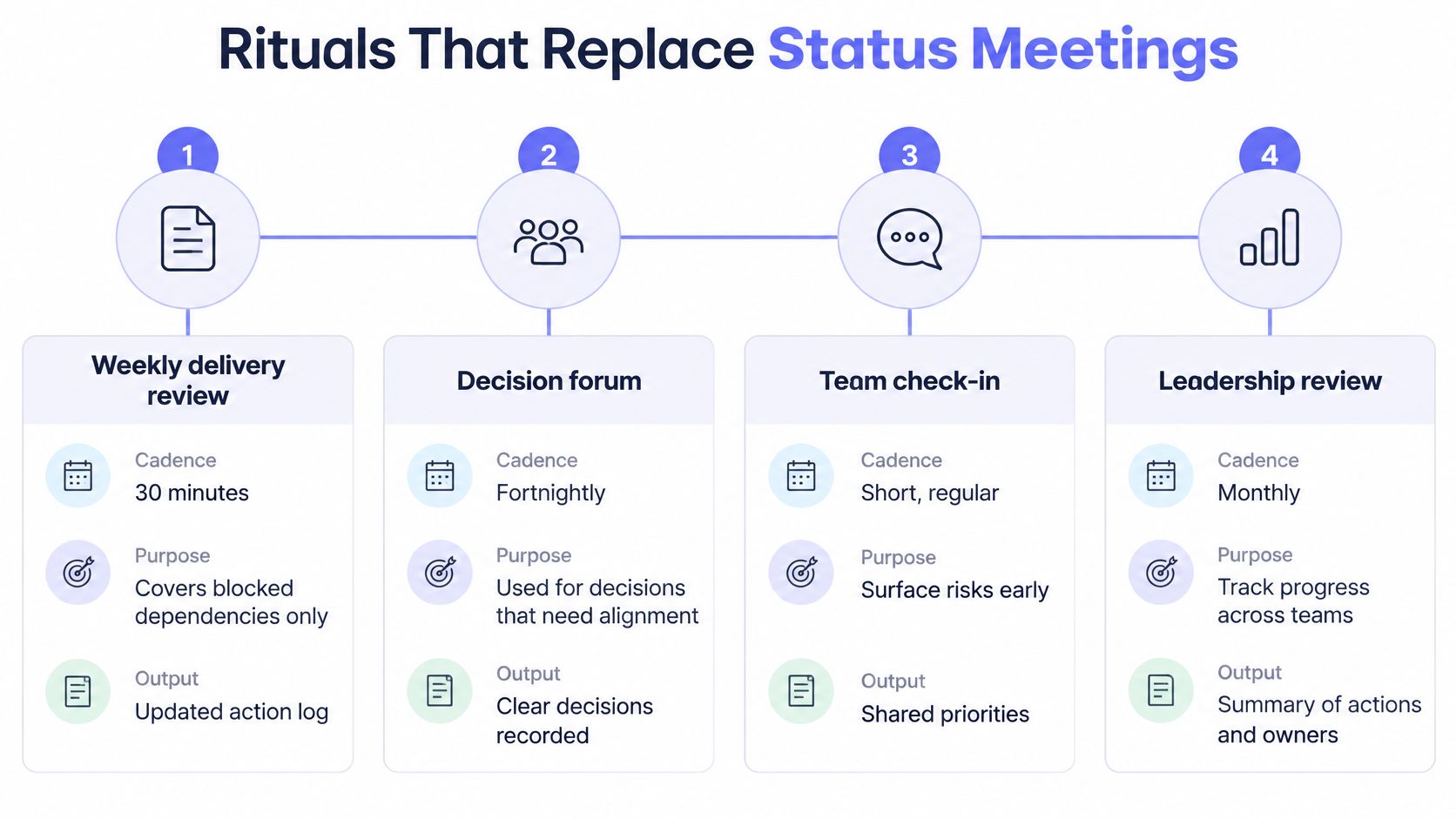
Five rituals with distinct jobs
- Weekly delivery review, 30 minutes. Cover blocked dependencies only. The output is an updated action log with an owner and date for each blocker, not a tour of everything in progress.
- Decision forum, fortnightly. Use it for cross-team trade-offs. Send a written pre-read 24 hours ahead and record the decision before the meeting closes, including who owns follow-up.
- Objective check-in, fortnightly. Score progress on shared key results and name the function behind each stalled one. Keep the conversation on outcomes and dependencies, not activity lists.
- Mid-cycle review at weeks six to eight. Test whether objectives still match what's happening. Adjust priorities while there's still time to act, rather than explaining variance at the end.
- Quarterly reprioritisation. Retire one objective before adding another. Without a retirement rule, every new priority taxes the old ones.
The decision forum is the replacement. It forces a choice between options, with contributors identified in advance. A status meeting lets everyone report progress while the unresolved dependency survives another week.
Group size matters. For groups larger than 16 participants, I recommend splitting into parallel streams so people speak and decide. Teams also adopt OKRs 3× faster when the exec team sets OKRs together in a facilitated session rather than asynchronously, which is why I protect live time for alignment and trade-offs, then move status into writing. I set out cadence options in my guidance on meeting cadence for execution rhythm.
Starting move: Cancel one status meeting this week. Replace it with a written update plus a decision forum, then judge the change by decisions closed, not by how busy calendars look.
Escalation Paths and Rules for Hybrid Teams
A remote analyst flags a pricing assumption in writing. The decision owner does not respond, the launch date approaches, and the analyst cannot tell whether the issue is being considered or ignored. Hybrid teams need escalation routes that make ownership, deadlines and decision records visible without relying on corridor conversations.
The Office for National Statistics analysis of hybrid working in Great Britain reports that 28% of working adults in Great Britain worked hybrid between January and March 2025. When people work across locations, context must be findable in a shared record, not passed on informally.
Ask who is least likely to contest the decision
Check who may not see the decision in time, have enough context to interpret it, or feel able to challenge it. Remote staff, newer employees, specialists and less influential functions can receive context late. A local agreement can still exclude a function whose work depends on the outcome.
| Level | Trigger | Owner | Response time |
|---|---|---|---|
| Level 1 | Blocked for under two working days | Dependency owner | Same working day |
| Level 2 | Blocked beyond two working days, or changes a shared objective | Pair of functional leads | Within two working days |
| Level 3 | Trade-off between two or more objectives | Executive sponsor | Next decision forum |
| Level 4 | Strategic conflict or shift in resources | Leadership team | Next quarterly reprioritisation |
Make the route usable without adding more meetings:
- Set written and live-work rules: record context and routine updates in writing; reserve live discussion for issues that need a decision.
- Rotate who speaks first: avoid letting seniority or location determine whose interpretation sets the frame.
- Publish a decision summary within one working day: name the owner, rationale and next action.
- Provide a route for dissent: let people challenge the decision without needing approval from the most senior person.
For the pricing assumption, the decision record should name the owner and response deadline. If the owner does not respond within two working days, move the item to the next escalation level and record the change. Escalation procedures for cross-team decisions should make the next owner and response time clear. If using the route depends on knowing the right person, the route does not exist.
Pick One Handoff to Fix This Quarter
Choose the single handoff that caused the most rework or delay last quarter. Don't launch a company-wide communication programme. Fix one interface, prove it works, then extend the pattern.
- Pull the last ten decisions that crossed that handoff and count how many had a named owner and a recorded date.
- Draft a communication contract for that handoff using the six fields in the contract table.
- Start the shared record and run it for one full cycle without parallel email decisions.
- Track the four weekly measures and review them at weeks six to eight.
- Decide whether to extend the pattern to the next handoff based on flow, not enthusiasm.
Assign one named owner to keep the fix running. Unowned fixes drift back within weeks. I combine training and consulting in my work because training without implementation support rarely sticks and consulting without capability-building leaves teams dependent.
I help leadership teams turn cross functional communication into clear owners, shared objectives, decision records and escalation routes that speed up execution. If that is the problem in front of you, book a conversation.