
The strategy slide is still on the screen. Everyone agrees with it. Then the delivery updates start: a dependency hasn't moved, the commercial team needs another decision, and the transformation lead wants more capacity. The quarter is slipping, but nobody can name the work that should stop.
When the Strategy Is Clear and Delivery Is Not
I'd start that leadership meeting with a harder question than whether the plan is on track: which result matters enough to displace something else? If nobody can answer, the problem isn't the wording of the strategy. It's the absence of an operating decision.
Consider a scale-up preparing for growth. Sales wants faster onboarding. Product wants platform improvements. Operations wants fewer exceptions. Each team has a defensible plan, but the same people appear in every dependency.
Everyone is busy. Decisions wait. When the result slips, each leader can explain their contribution without accepting responsibility for the whole outcome.
Ambition needs a measured gap
A March 2025 survey of UK strategy execution covered 250 companies with turnover above £20 million. Only 18.4% achieved more than 80% of their aspirational growth goals within three years, just 46% had a clearly measurable value gap, and 59.6% treated execution as a core discipline.
That contrast matters. A formal process doesn't guarantee that leaders understand the distance between current performance and ambition. I want that gap visible before anyone adds another initiative.
A clear strategy isn't an executable commitment until leaders agree what takes precedence when capacity runs out.
Sometimes the constraint is leadership capacity rather than effort. If technology decisions repeatedly stall delivery, MR2 Solutions' resource to compare fractional and full-time CTOs provides a relevant staffing comparison. I'd treat that as a decision about authority and availability, not a substitute for prioritisation.
OKRs must change the decisions
My approach to closing the execution gap starts with the choices leaders make after agreeing the strategy. OKRs earn their place when they change those choices.
- Priority: Which outcome gets scarce capacity?
- Evidence: What would demonstrate progress?
- Ownership: Who must act when delivery slips?
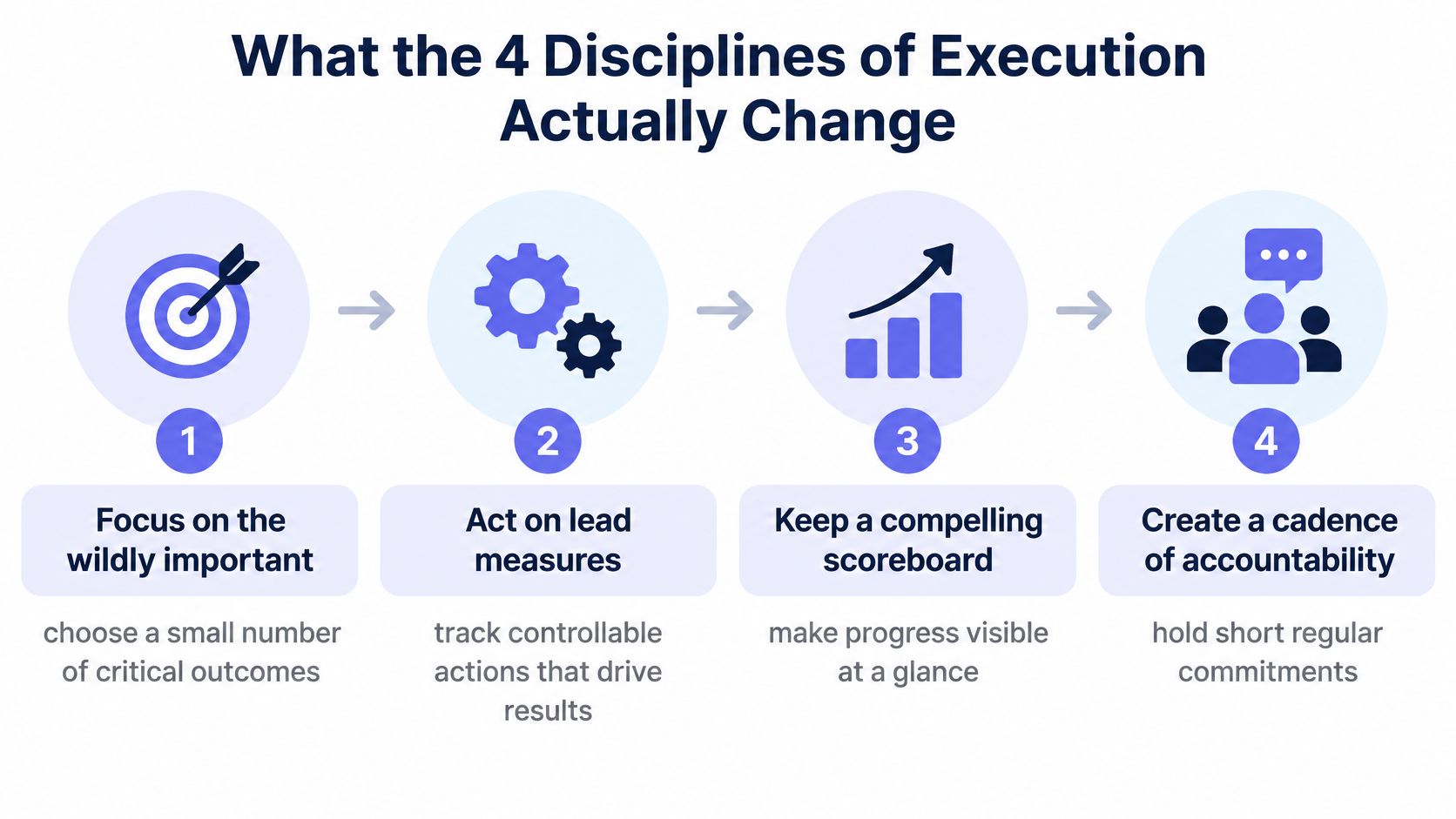
I use the 4 Disciplines of Execution to connect those choices. The practical test is whether leaders can focus a wildly important goal, identify useful lead measures, trust the scoreboard and hold a conversation that produces ownership.
What the 4 Disciplines of Execution Actually Change
I treat the disciplines as connected management mechanisms, not a motivational programme. Think of a delivery control panel: a destination, signals that help steer, a shared view of progress and a fixed conversation about corrective action.
Focus and influence
Focus on the wildly important means choosing the outcome that deserves protected attention alongside normal operations. On Monday, a leader should be able to see what has priority and what must wait. Skip this discipline and every team can claim strategic importance without making a trade-off.
The choice must be specific enough to challenge. Improving customer onboarding is a direction. Reducing the delay between contract signature and usable service identifies a result that people can investigate and influence.
Act on lead measures shifts attention towards actions or conditions the team can change before the final result arrives. On Monday, the team should know which behaviour it intends to improve and why it expects that behaviour to affect the outcome.
I treat that relationship as a hypothesis, not a certainty. If the action improves but the result doesn't respond, I want the team to question the measure rather than celebrate activity.
Visibility and follow-through
Keep a compelling scoreboard means making the current position understandable without a presentation. A leader should see the intended result, the relevant signals and the gap. Without that visibility, people can mistake confident commentary for evidence.
Create a cadence of accountability means returning to commitments consistently. On Monday, people should know when they'll review what happened and who can resolve a constraint. Without that conversation, even a useful scoreboard becomes passive reporting.
The ONS analysis of UK management practices gives relevant context. Among firms with 10 or more employees, the average management-practice score rose from 0.49 in 2020 to 0.55 in 2023. A 0.1-point increase was associated with 9.6% higher labour productivity, across practices covering continuous improvement, KPIs, target-setting and employment management.
That's evidence of an association with structured management, not proof that 4DX causes those gains. My conclusion is narrower: execution deserves management infrastructure.
A wildly important goal without an owner, a measure, a review and an escalation route is still an aspiration. Announcing it more forcefully won't supply the missing controls.
How Each Discipline Maps to OKR Practice
A polished OKR document can conceal weak execution. The objective sounds strategic. The Key Results contain numbers. Yet the initiatives remain unchanged, nobody has released capacity, and the review arrives after the opportunity to intervene.
I use the disciplines to inspect those weaknesses, rather than adding another layer of terminology to the OKR framework.
From 4DX discipline to OKR move
| Discipline | OKR move | Failure it stops | Proof to demand |
|---|---|---|---|
| Focus on the wildly important | Limit enterprise objectives to outcomes that must move now | Every initiative being treated as urgent | An explicit deferred-work list and capacity decisions |
| Act on lead measures | Separate influenceable signals from outcome Key Results | Task completion being presented as strategic progress | A credible relationship between the action and the intended result |
| Keep a compelling scoreboard | Show baseline, target, current position and risk | Long status narratives hiding deterioration | Consistent definitions and current evidence |
| Create a cadence of accountability | Assign an accountable owner to each Key Result | Shared responsibility becoming nobody's responsibility | An owner able to explain the gap and secure a decision |
The important distinction is between the result that proves progress and the work intended to produce it. I don't want a Key Result that merely says a customer onboarding workshop happened. I want evidence that customers reach usable service sooner, with the workshop treated as a possible intervention.
A lead measure might track whether implementation prerequisites are validated before handover. That's useful only if the team can influence it and test its relevance to onboarding delay. It shouldn't replace the outcome measure.
Demand infrastructure, not intent
The CIPD report on improving UK management capability cites UK manufacturing evidence showing 38% higher average productivity among organisations in the top half for structured management practices than those in the bottom half. It also identifies performance reviews, managing underperformance, training and promotion among practices strongly correlated with productivity.
I read that as support for repeatable management infrastructure, not a promise that rewriting objectives will improve productivity. Leaders need to make the new operating choices observable.
- For a vague objective: I ask what business condition will be different.
- For an activity-based Key Result: I ask what evidence would show the activity worked.
- For an overloaded portfolio: I ask which commitment loses capacity.
- For an unowned result: I ask who has authority to resolve the next obstacle.
Those questions expose whether OKRs influence management or merely describe it. I'd rather see an imperfectly worded objective supported by real trade-offs than an elegant objective attached to an untouched project list.
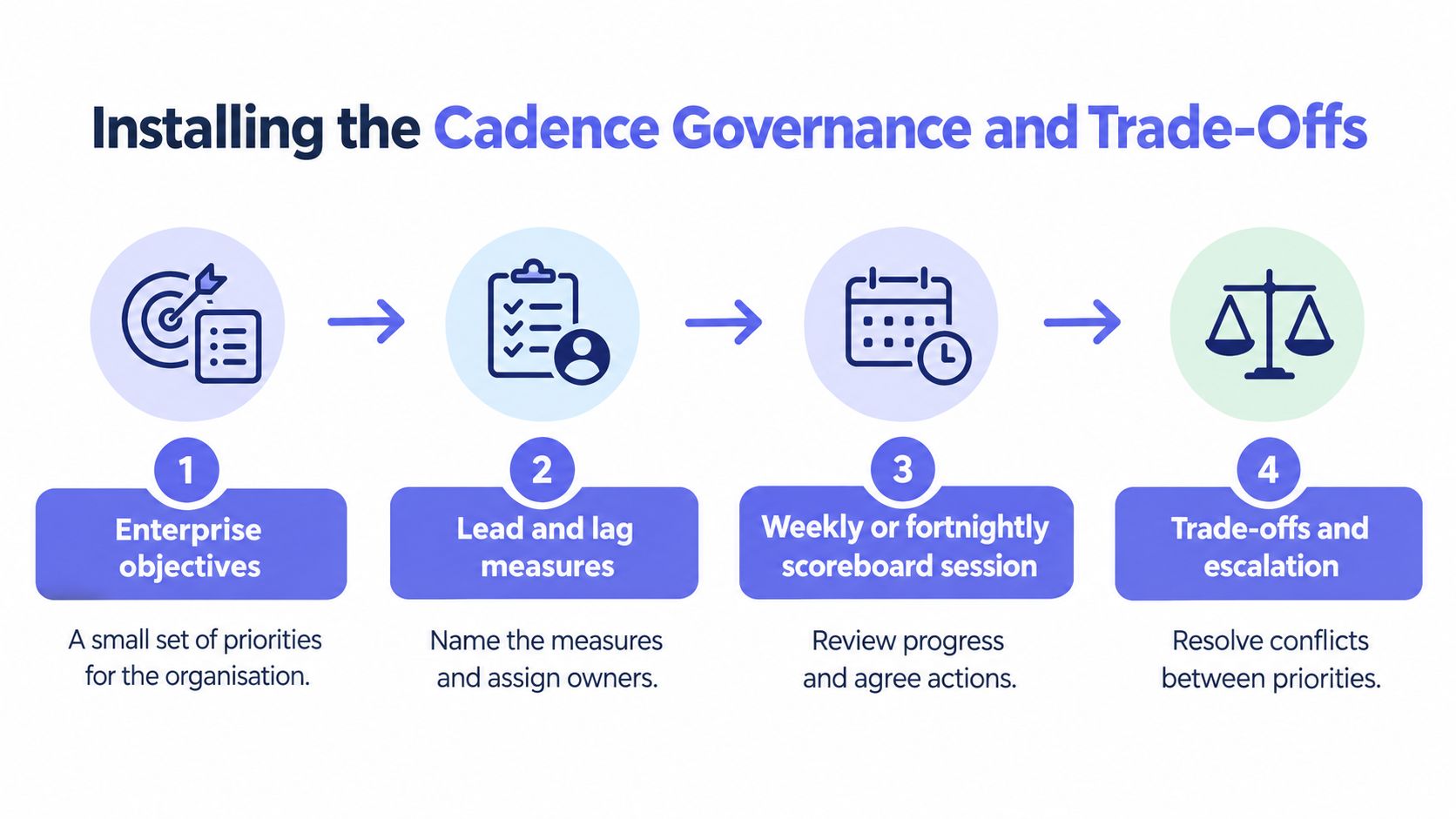
Installing the Cadence Governance and Trade-Offs
I install the review before launching the OKRs. If leaders can't agree where decisions will happen, they aren't ready to ask teams for more commitments.
The starting design is practical: a small set of enterprise objectives, owned lead and lag measures, a weekly or fortnightly scoreboard session and a quarterly reset. I fit that into the existing operating rhythm, replacing redundant reporting rather than adding another meeting.
Make the session a decision point
The scoreboard must be current before the conversation starts. I don't use leadership time to collect updates that owners could have provided beforehand.
- What moved: Identify the material change in the measure, not every completed task.
- What's blocked: Name the dependency, decision or capacity constraint.
- What happens next: Record the commitment, owner and completion evidence.
- What gives way: Resolve any conflict with another priority.
A red or amber measure should trigger a pre-agreed if-then action. For example, if onboarding prerequisites remain unresolved at the agreed checkpoint, then the implementation owner brings the dependency to the operational decision-maker before accepting another handover.
In a workplace study discussed in a Leeds Beckett review of training transfer, employees using implementation intentions gave the trained response about seven times out of ten, compared with about four times out of ten without them. I wouldn't assume that result transfers unchanged to an executive review. I'd pilot the routine and examine completed commitments and recovery from exceptions, not attendance.
Practical rule: An exception needs a decision rule, not another colour-coded explanation.
At the quarterly reset, I ask whether the strategic gap closed, whether the interventions helped and whether the outcome still deserves priority. Unfinished work doesn't automatically earn another quarter.
Build capability into the installation
I use OKR Focus Flow to diagnose why delivery is inconsistent, design the objectives and governance, deploy them into existing management routines, and build internal capability. The final part matters: leaders and facilitators must be able to run the system without depending on me.
That differs from writing OKRs in a workshop and hoping management behaviour changes. For smaller organisations dealing with process friction, the MyOfficeOps resource on how to improve operational efficiency for small businesses is a useful companion to the governance conversation.
A chief of staff can audit the installation against a short checklist:
- Owner: Someone accepts accountability and has access to decisions.
- Visible measure: The evidence is defined and available.
- Review frequency: The interval allows intervention.
- Escalation route: Blocked work has somewhere to go.
Missing any of those is a design defect, not a reason to demand more commitment from the team.
Execution Choices in Situations Leaders Recognise
Consider a transformation director reviewing a crowded portfolio. Every sponsor has a reasonable case. The same integration specialists support several programmes, and each project reports its dependency as somebody else's problem.
This is an illustrative situation, not a claimed client result. The choice I'd put to the director is whether to preserve every start date or protect the outcomes that matter most.

Protect the constrained work
Research involving 150 UK digital transformation leaders found that more than half said most or all projects ran late. One-third identified implementation and integration as the main stall point, compared with 17% citing strategy and planning and 15% budget approval; almost one-third had six to ten projects underway, while half said competing priorities slowed work often or very often, according to IT Brief's report on UK transformation delivery.
I'd make the integration bottleneck explicit. Leaders would choose the outcome that needs that capacity now, defer competing work and accept the consequences with sponsors.
The OKR review would then examine whether the chosen business result is moving. It wouldn't become a tour of every project. That's the practical difference between prioritising with OKRs and attaching objectives to an unchanged portfolio.
Escalate while intervention is possible
Now consider an enterprise programme with unresolved acceptance criteria. The delivery owner keeps the status amber because the final deadline hasn't been missed. The sponsor sees a manageable warning, while the team waits for a decision it can't make.
Evidence submitted to Parliament on government major projects reported that approximately one in eight projects missed budget and around one in six missed time, although only 6% were judged wholly unsuccessful. A programme can retain an overall success label while delivering late or over budget.
In this illustrative programme, I'd assign the delivery owner responsibility for tracking unresolved acceptance decisions. The lead signal would be the age and consequence of those decisions, not just the final milestone date.
- Owner action: Surface the unresolved acceptance decision before it threatens delivery.
- Sponsor action: Decide scope, sequencing or capacity at the agreed checkpoint.
- Portfolio action: Make the effect on other commitments visible.
The trade-off is early discomfort versus late surprise. I'd choose the uncomfortable decision while leaders still have options.
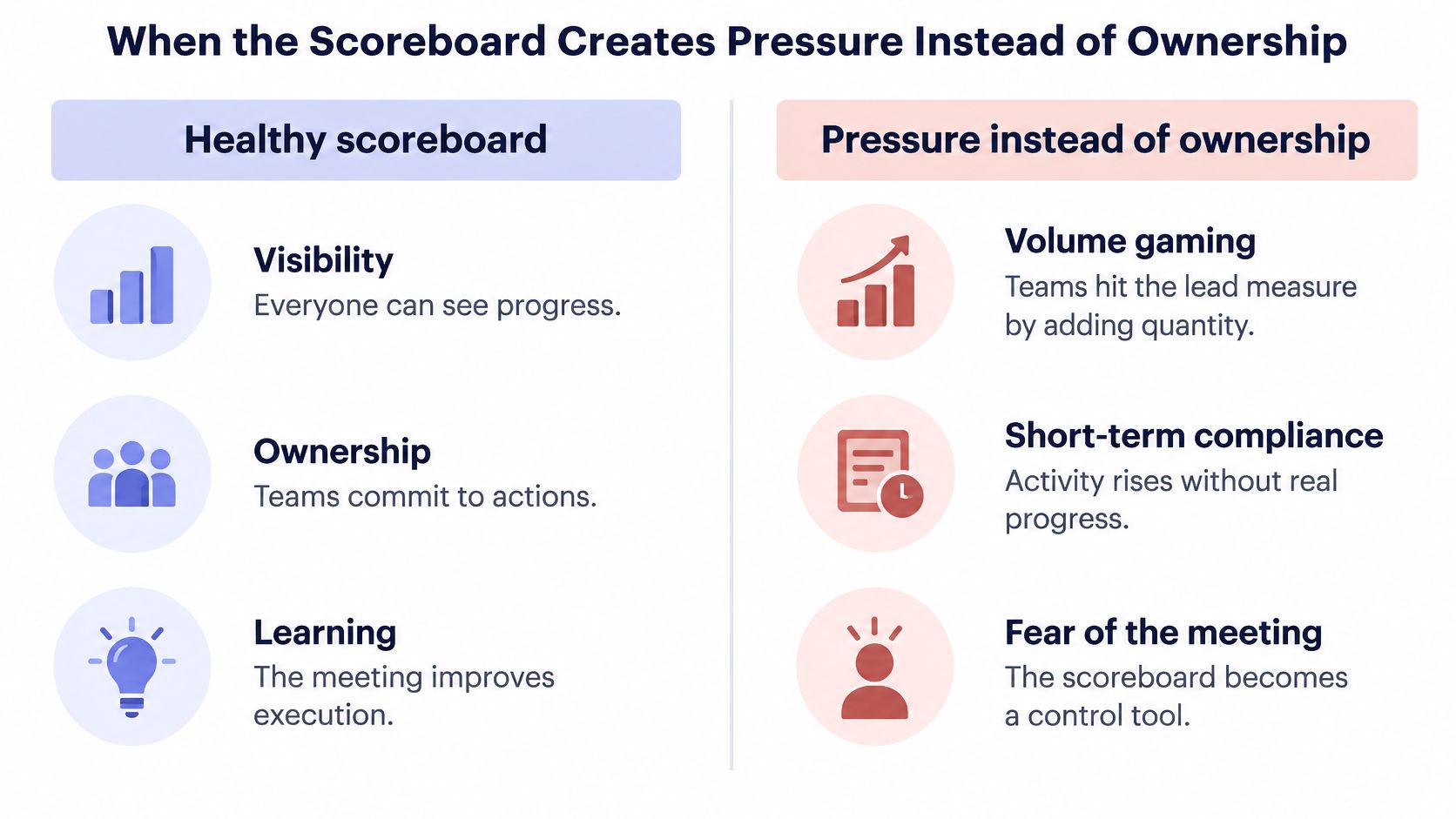
When the Scoreboard Creates Pressure Instead of Ownership
A busy cadence can conceal poor management. A sales team can increase conversations without improving opportunity quality. A product team can complete experiments that teach little. Both can arrive at the meeting with a better-looking lead measure and an unchanged business result.
My test is direct: does the cadence help people exercise judgement, or does it teach them to avoid scrutiny? That's the distinction I use when discussing ownership and accountability.
Protect quality and judgement
I pair each lead measure with safeguards:
- Quality guardrail: Track validated experiments alongside defects or customer outcomes. For commercial teams, define a qualified conversation rather than rewarding raw volume.
- Employee-impact signal: Ask whether commitments require sustained overtime, rework or avoidable interruptions.
- Blocked-work path: Give teams a route to secure decisions and challenge unrealistic dependencies.
Weekly commitments should record learning and dependencies, not only promises. An owner who disproves an assumption has contributed something useful, even if the original intervention stops.
A national survey reported by Nottingham Trent University covered more than 4,000 UK workers and found engagement rose by 3 percentage points to 65%, while inequalities persisted. That isn't evidence of an OKR effect. It's a reminder not to assume employees experience management practices uniformly, particularly across hybrid teams.
For the monitoring design itself, digna's discussion of effective organizational monitoring systems is a relevant reference. My recommendation is to make the business question and intended response explicit before collecting another measure.
Govern changed assumptions openly
AI adoption and operational redesign can change the relationship between effort and results. The ONS research on AI in UK businesses provides context for that changing environment. I wouldn't defend a manual activity measure after automation has made it irrelevant.
I use a clear change-control distinction:
- Preserve: The outcome and assumptions still hold, but execution needs correction.
- Re-baseline: A material assumption changed. Record the original baseline, revised measure, reason and approval.
- Stop: The outcome no longer justifies the capacity or conflicts with a higher strategic priority.
Changing a commitment transparently is governance. Quietly changing the target to erase a miss is avoidance.
I'd keep the strategic goal stable where possible and revise the intervention when evidence warrants it. Accountability means explaining that decision, not protecting the original plan indefinitely.
What I Help Leadership Teams Put in Place
I hold leadership teams to a practical standard. They should be able to identify the outcomes that deserve attention, show the gap against an explicit baseline and explain what action follows when evidence deteriorates. Missed commitments need open handling, without turning every miss into a judgement about motivation.
The people closest to the work need a voice in that system. Leaders can hold the intended result steady while teams shape the initiatives, challenge assumptions and identify better ways to deliver.
Use the knowledge already available
A Cardiff University study of productivity at work found that 71% of employees had taken the initiative to improve processes, products or services more than once. 18% identified changes that would make them a great deal more productive, while 13% said their suggestions had contributed greatly to efficiency; stronger improvement was linked with autonomy, supportive management, meaningful appraisals and having views heard.
My conclusion is that leaders shouldn't confuse accountability with prescribing every action. The review needs enough structure to expose a gap and enough openness for employees to explain what would fix it.
- Leaders own the trade-offs: Decide which outcomes justify scarce capacity.
- Teams shape the intervention: Use their knowledge of customers, processes and constraints.
- Owners make evidence visible: Explain results, learning and decisions without hiding behind activity.
That's the standard I'd apply before scaling the system. More participating teams won't repair unclear authority or weak measures.
I help leadership teams fix the gap between a clear strategy and inconsistent delivery by embedding OKRs into focus, measures, governance and the operating rhythm. To discuss putting that system in place, book a conversation