
A leadership team leaves a strategy meeting with a polished SWOT slide and a shared sense of agreement. A week later, priorities are blurred, delivery is still slow, and nobody can say who owns the weaknesses the team identified. The problem isn't the four-box framework. It's treating the workshop as the work.
A useful team SWOT analysis is a quarterly operating diagnostic. It tests assumptions against evidence, makes trade-offs explicit and gives the team a direct route from strategic choices to OKRs. Without those disciplines, the team gets a tidy inventory of opinions. With them, it gets a clearer view of what to change next.
Why Most Team SWOTs End Up on a Shelf
A SWOT can fill four boxes and leave the team exactly where it started. Leaders gather observations, the facilitator records them, and the finished slide gets mistaken for progress. Without evidence or a clear decision to guide the discussion, participants cannot tell which points are accurate, important or within the team's control.
The failure often begins with a vague question: “What are our strengths and weaknesses?” That prompt invites a sprawling discussion of culture, market conditions, hiring, product quality and leadership. Each subject may matter, but without a decision to focus the exercise, the team has no sound way to separate useful signals from background noise.
At the University of Warwick, a steering committee's strategy awayday identified 81 items across the four quadrants. The group scored them on a 1–5 scale and kept 53 priorities after filtering out lower-scoring issues. The study describes SWOT as an iterative part of planning, rather than a one-off workshop (Warwick SWOT analysis study). The committee's exact process matters less than the discipline it shows: collect ideas, assess them, then make choices.
Practical rule: If an item has no evidence, owner or decision attached, it isn't a priority yet.
That discipline matters when misalignment or slow execution is already affecting the team. Agreement in the room can hide different interpretations of strategy. A useful SWOT makes those differences visible, then connects the choices to ownership and a review rhythm. Treat it as a quarterly operating diagnostic, not a workshop deliverable: the test is whether it changes what the team decides and tracks. Without that follow-through, a polished slide remains an inventory of opinions.
Prepare the Team SWOT Before the Workshop
The facilitator's first job isn't to open a blank slide. It's to define what the team needs to decide. Pick a real strategic question, such as whether to enter a market, improve delivery predictability or prepare a product for a new customer segment. Set a clear time horizon, typically the coming quarter, so participants know which evidence and trade-offs matter.
Then separate internal factors from external factors. Strengths and weaknesses describe capabilities and constraints inside the organisation. Opportunities and threats describe conditions outside it. Customer demand, regulation and competitor behaviour belong in the external quadrants. The team can respond to those conditions, but it can't claim to control them.
Ask each participant to submit evidence before the meeting. Pull delivery measures, customer feedback, sales information, hiring signals, decision logs and recurring incident themes. Keep the pre-work focused on the chosen decision. “We collaborate well” is an opinion until the team can connect it to something observable, such as handoff quality, decision delays or stakeholder feedback.
Use anonymous individual input as well as prepared evidence. Seniority affects what people say in a room, especially when the weakness being discussed reflects leadership decisions. Anonymous responses give quieter contributors a route to raise concerns without making a public challenge their first move.
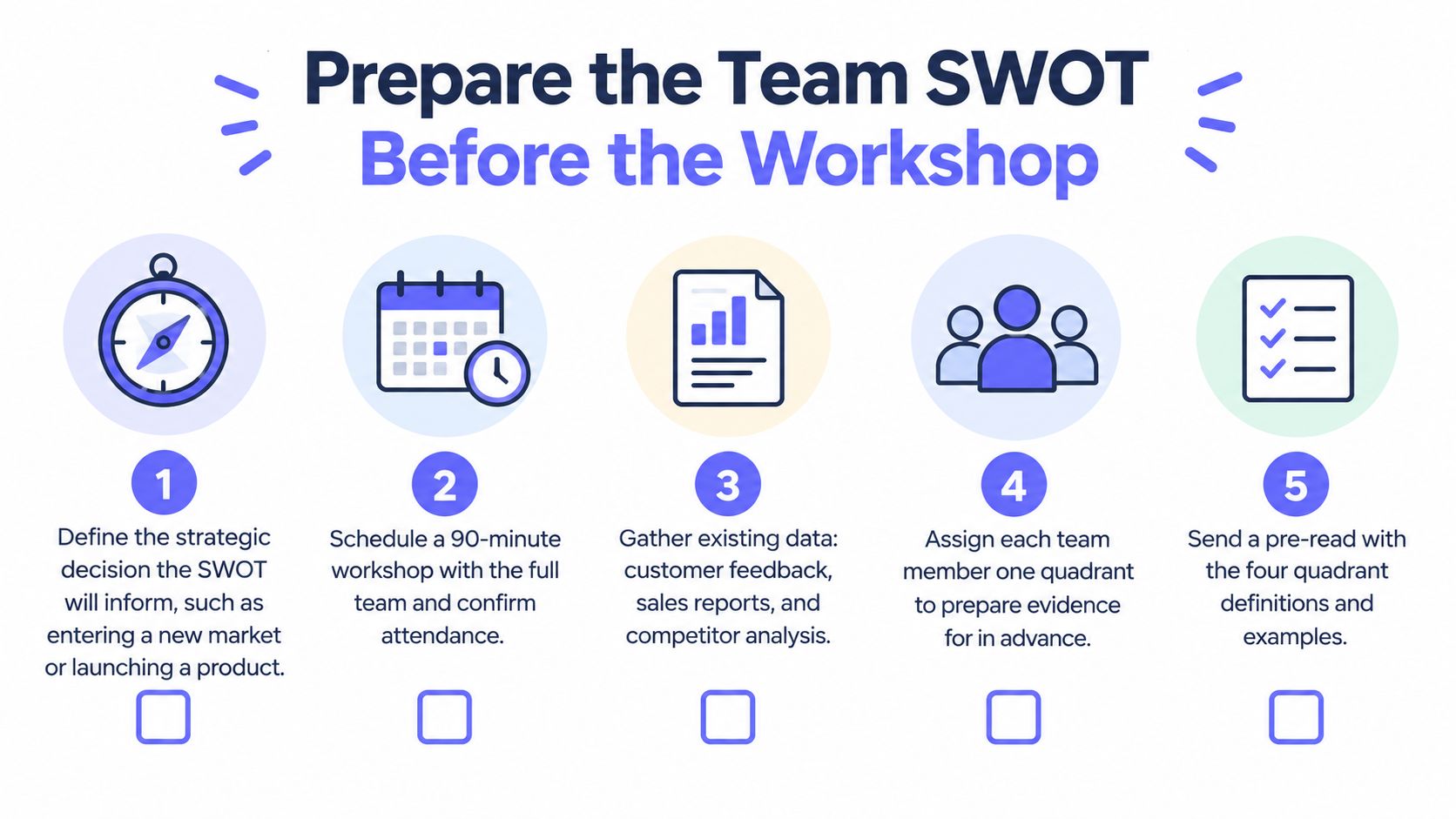
Make the pre-work concrete
- Decision: State the strategic question the SWOT must inform.
- Evidence: Gather relevant internal performance data and external market or customer signals.
- Individual input: Ask each person for evidence-backed observations, including anonymously submitted concerns.
- Quadrants: Send concise definitions so external conditions don't get mislabelled as internal strengths or weaknesses.
- Participants: Include people who see different parts of delivery, not just the most senior voices.
A Chief of Staff can coordinate the pre-read and make sure the evidence is available in one place. Invite representatives from the functions that will need to act on the findings. Cross-functional coverage is more useful than seniority alone, because execution problems often sit between teams. For help shaping the session itself, compare practical workshop formats and agendas and choose a format that suits the decision, not just the calendar.
Run the Facilitated Session in Four Movements
A good session has a clear arc. The facilitator frames a decision, gathers specific evidence, tests the items and leaves the team with a shortlist. The discussion shouldn't be a tour of the four boxes with everybody taking turns to read sticky notes.

Frame the decision
Open by restating the choice the SWOT will inform. For a scale-up weighing a new market, that might be whether the team can support expansion without making current delivery less reliable. This gives people a way to judge relevance. If an observation doesn't affect the decision, record it elsewhere rather than letting it dominate the session.
Capture and challenge
Ask people to write independently before discussing the items. Group similar points, then test broad statements. If someone says “sales and product work well together,” ask what evidence supports that view and where the handoffs still fail. Don't correct the first answer for them. The purpose is to make the claim precise enough to assess.
Disagreements can expose useful distinctions. If customer churn is rising, is that a weakness in the team's retention capability or an external threat caused by changing customer needs? Ask what the team can influence and what evidence would change its view. The right category matters less than the clarity of the response.
Score, select and assign
Have participants score the strongest items individually before comparing results. This reduces the chance that the first confident speaker sets the group's view. When scores differ, ask what evidence each person used. The facilitator should challenge weak claims and make uncertainty visible, not force a false consensus.
Before anyone leaves, confirm which items deserve action, who owns each next step and when the team will review progress. A discussion of decision methods can also benefit from a broader look at MyPerfectStay's decision frameworks. For leadership teams working through conflicting interpretations of strategy, a focused goal alignment workshop can help turn the discussion into shared direction.
The session succeeds when the team can explain why it selected its priorities and what it will do about them. An emailed slide without those decisions is just documentation.
Score and Prioritise Without Arguing in Circles
A long list is not a strategy. Prioritisation should separate items that warrant action from observations worth keeping on file. Score each item against three questions: How much could it affect a decision? How much influence does the team have? How quickly could action or inaction change the outcome?
Choose a method that fits the stakes and the team's experience. A simple scale beats a model that creates false precision. As in the Warwick example above, a 1–5 significance scale can help the group apply explicit criteria and reduce a sprawling list to a workable set.
| Approach | Best for | Time needed | Watch out for |
|---|---|---|---|
| Simple 1–5 confidence scale | Teams that need a quick, shared view of item importance | Low | Confidence can be mistaken for evidence. Ask participants to explain their score. |
| Impact/effort matrix | Teams comparing actions they could take | Moderate | An external threat may have high impact but little direct team control. Don't discard it just because action is difficult. |
| Weighted scoring model | Complex choices where several criteria carry different importance | Higher | Too many criteria create scoring theatre. Use weights only when they change the decision. |
Keep the shortlist small enough to act on. A catalogue of priorities is a sign the team has avoided making choices. An item with high impact but no owner in the room calls for a different response from a task the team can deliver. It may expose a governance, resource or decision-rights gap that needs escalation.
Set a clear rule for resolving close scores before the discussion starts. Ask participants to name the evidence behind each rating, then focus debate on the items where the ranking would change the team's decision. This keeps the exercise tied to action rather than giving everyone another round to defend their preferred issue.
For practical guidance on making trade-offs, see prioritising with OKRs. The aim is to agree what gets attention, what waits and who has authority to resolve issues the team cannot own.
Turn the SWOT Shortlist Into Team OKRs
A shortlist only matters if it changes what the team does next quarter. Don't write an OKR for every SWOT item. That creates a crowded set of commitments and weakens focus. Instead, look for a few connected priorities that can shape an objective and a small set of measurable results.
Use the quadrant to guide the response. A weakness should lead to a measurable signal of improvement. A strength should become a repeatable practice the team can rely on. An opportunity should become an experiment with a clear outcome. A threat should prompt a contingency, including a trigger that tells the team when to act.
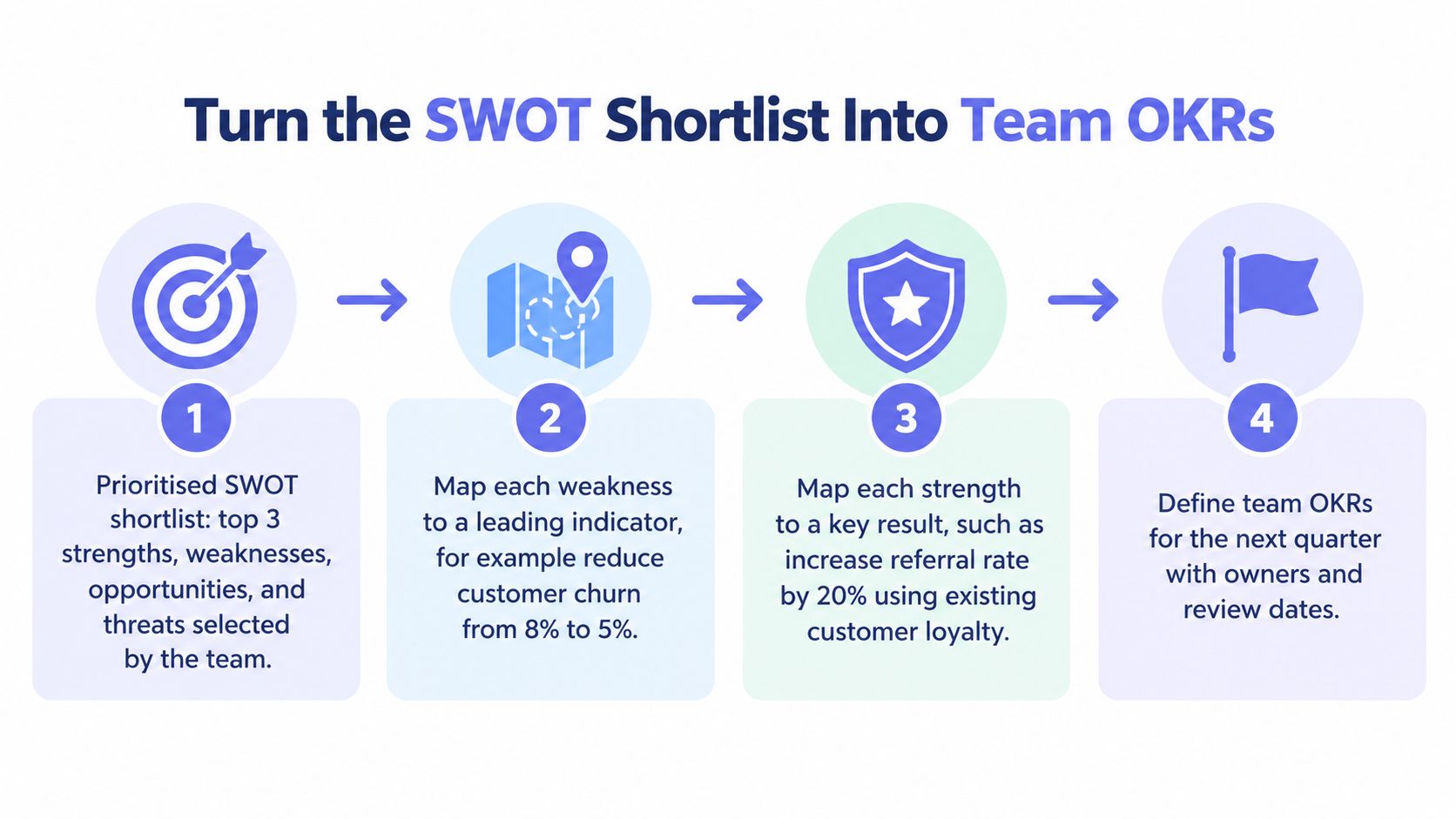
Convert findings into measurable commitments
Consider a team whose SWOT identifies three priorities: delivery forecasts are unreliable, customer feedback reaches product teams quickly, and a regulatory change may affect the roadmap. The first item is a weakness. The second is a strength. The third is an external threat.
A useful OKR response could combine the delivery and customer-feedback findings into one objective: Make product delivery more dependable and responsive to customer needs. Its key results could track delivery forecast reliability and whether customer feedback is acted on in planning. The team should use its existing baseline rather than inventing a target before it knows its current performance.
The regulatory threat may need a separate contingency rather than a standalone OKR. Name the accountable owner, identify the change that would trigger a response, and agree how quickly the roadmap will be reviewed if that trigger occurs. A risk with no trigger is just a concern. A trigger without an owner is an unassigned decision.
Set owners, measures and review dates when the OKRs are drafted. The person accountable for a result needs authority and access to the information required to influence it. If delivery depends on another function, name the dependency and agree how it will be handled.
The connection between the SWOT and the OKRs should stay visible. The team should be able to trace each objective back to a strategic issue, not just a workshop note. For practical guidance on shaping measurable commitments, use how to write OKRs. If the team needs a shared activity to build working relationships before tackling difficult issues, browse these 2026 team building challenge ideas, then bring the conversation back to the delivery problem at hand.
Surface Truth When People Do Not Feel Safe
A positive atmosphere doesn't guarantee an honest SWOT. People may stay silent because they fear consequences, disagree with the most senior person or assume that raising a problem won't change anything. Uniformly high ratings and vague agreement can be warning signs, not proof that the team is healthy.
Psychological safety affects whether people will share concerns that matter to delivery and risk. British Safety Council research cited in the verified reporting found that 65% of workers believed a lack of psychological safety contributed to workplace safety risks, and 71% of managers shared that concern (British Safety Council on psychological safety). Separate UK civil service evidence found that 61% of 5,121 surveyed civil servants said a return-to-office mandate made no difference to team collaboration, while 24% believed it improved collaboration (CIPD flexible working report). Presence and a pleasant meeting are not substitutes for candour.
Give disagreement a route into the room
Start with anonymous pre-work and individual scoring before the group discussion. Then ask the facilitator to test claims that depend on hierarchy. “We have strong ownership” is worth probing. Who makes the decision? Who takes responsibility when a dependency fails? What evidence would show that ownership is working?
Compare what people say with behaviour the team can observe. Missed handoffs, repeated escalations and unpredictable delivery may contradict a confident statement about alignment. Invite frontline and cross-functional perspectives, especially when senior leaders are describing processes they don't directly operate.
Silence is information. Treat it as a prompt to change the process, not as agreement.
If participants aren't comfortable disagreeing in the room, use written responses or a neutral facilitator rather than asking them to take a public risk. The discussion of psychological safety is relevant here because candour is an operating condition for sound diagnosis. The aim isn't to label a team as safe or unsafe. It's to make sure the evidence can challenge the most comfortable story.
Make the SWOT a Quarterly Operating Input
Keep the shortlist in the team's operating rhythm. Review it alongside OKR progress so leaders can see whether a weakness is blocking delivery, a strength remains reliable or an external threat has changed the decision. Refresh the diagnosis when a key capability changes, the market shifts or an OKR misses its intended result. Don't wait for an annual planning cycle to admit that the assumptions no longer hold.
Accountability needs more than a name beside an action. UK research found that 65% of respondents lacked trust in senior management's accountability practices, while approximately 60% viewed existing mechanisms as unfair (UK workplace accountability research). Give each priority a clear owner, a measurable outcome, a review date and an escalation route. Use quarterly business reviews to test whether the work is changing execution, not just producing updates. The historical role of SWOT in UK higher education planning also shows why analysis needs to connect to governance and action (research on strategic planning in English higher education).
I'm Mike Horwath, and I help leadership teams turn SWOT findings into clear priorities, accountable OKRs and operating rhythms that address misalignment and slow execution. If you're ready to make your team's strategy more actionable, book a conversation.