
The marketing plan was agreed in January. By the next quarterly review, the same three priorities are back on the agenda. Sales quotes one pipeline number. Marketing quotes another. Finance asks which figure supports the forecast. Nobody can explain who owns the gap.
The strategies rarely fail because the idea lacks merit. They fail because nobody has converted the idea into a measurable outcome, a named owner, and a review rhythm. That distinction matters in a market where UK digital advertising expenditure reached £35.5 billion in 2024, growing 13% year on year, while UK GDP grew 1.1% over the same period, according to the IAB UK digital advertising market report.
I rank these growth strategies in marketing by how well they survive contact with execution. Each one includes the practical move, the trade-off, the outcomes to measure, and the OKR rhythm needed to keep delivery honest. The list is designed for scale-ups and enterprise teams where priorities cross marketing, sales, product, finance, and operations.
A strategy without an owner and a measurable key result is a wish.
I'm not interested in tactics that look impressive in a planning document and disappear by the next review. I'm interested in strategies leadership teams can fund, measure, challenge, and stop when the evidence changes. For broader context, compare this approach with these proven revenue growth strategies.
1. Product-Led Growth with Clear Execution Metrics
Product-Led Growth works when users reach value before a salesperson has to explain every feature. Figma, Slack, and Notion each show the basic pattern. A useful product attracts users, collaboration or usage spreads, and paid adoption follows when customers need more capability, control, or scale.
The model itself isn't the advantage. Clarity about user behaviour is. Teams often say they're product-led while product measures feature adoption, marketing measures sign-ups, and finance waits for paid conversion. Those measures can all rise while the business still struggles to create durable revenue.
Start with the behaviour that proves value. It might be a first meaningful action, a completed workflow, or a repeated collaboration event. Then connect that behaviour to activation, conversion, and retention. I'd give each stage a clear owner rather than handing “growth” to everyone and therefore nobody.
Turn usage into accountable outcomes
A practical PLG OKR could focus on reducing friction between first interaction and meaningful value. The key results should cover activation quality, time-to-value, free-to-paid movement, and retention depth. Avoid treating raw registrations as success. A large pool of inactive users creates work, not growth.
The operating rhythm should include a weekly review between product and growth. They should inspect funnel movement, user feedback, experiment results, and blockers. If activation improves but retention doesn't, the team must investigate the product experience rather than celebrate an incomplete win.

I'd also separate ownership for new-user activation, free-to-paid conversion, and retention. Those responsibilities depend on one another, but they aren't identical. My guidance on OKR examples for product teams shows how to connect product work to measurable behaviour rather than feature delivery.
2. Account-Based Marketing with Aligned Sales Execution
ABM treats a high-value account as a market of one. That sounds focused, but many ABM programmes still behave like ordinary campaigns with better graphics. Marketing builds account plans. Sales ignores them. Both teams later claim engagement as evidence of progress.
The first decision is whether the target account list is winnable. A smaller list with a credible reason to win is better than a long list selected because the logos look attractive. Every account needs a business hypothesis, a buying committee map, a relevant commercial problem, and a next action.
Make sales and marketing share the result
I'd create one shared objective, not separate marketing and sales objectives. It could centre on qualified pipeline from target accounts, progression of priority opportunities, or closed revenue. The result must be owned jointly, while individual actions remain visible.
Sales needs to know what marketing is doing for each account. Marketing needs direct feedback on stakeholder response, objections, and deal movement. A weekly meeting is usually necessary for complex selling. Asynchronous updates often conceal the exact problems that need discussion.
Practical rule: If the ABM dashboard can't show account engagement alongside pipeline movement and deal probability, it's a campaign report, not a growth system.
The execution plan should define messages by stakeholder role, the content sequence, the sales action, and the evidence required to move an account forward. Track pipeline velocity and opportunity quality, not just meetings or content downloads. My guidance on OKR examples for sales teams is relevant because ABM only works when both functions accept the same commercial outcome.
3. Community-Driven Growth with Structured Engagement OKRs
Community can become a powerful acquisition, retention, and advocacy channel. It can also become an expensive calendar of events with no commercial purpose. The difference is accountability.
Figma's community of designers, plugins, and shared resources shows how users can create value for one another. Stripe's developer communities and events deepen technical engagement. Notion's user communities share templates and use cases that help customers solve problems without waiting for formal support.
I'd start by defining the job the community must do. Is it helping new users activate? Is it reducing support pressure? Is it generating referrals? Is it giving product teams better insight into unmet needs? “Build an engaged community” is too vague to guide investment.
Measure community health and influence
A useful OKR can combine active participation, meaningful engagement, sentiment, and influence on retention or expansion. The first three show whether the community is healthy. The final measure tests whether it matters to the business.
Identify influential members early, but don't turn every advocate into an unpaid employee. Give them access, recognition, and a route to provide feedback. Then show the product team what changed because of that feedback. Members stay engaged when they can see their contribution affecting the product.
Recurring events help, but frequency alone proves nothing. A small event that solves a real customer problem may matter more than a large event that produces applause and no follow-through. Review community signals weekly, then connect them to customer success and product decisions.

I use a community of practice as a useful comparison. A community becomes durable when members have a shared purpose, a repeatable interaction pattern, and visible value. The failure mode is clear: activity rises while advocacy, retention, and product insight remain unchanged.
4. Content Marketing as a Demand Generation System
Content marketing fails when publishing becomes the objective. A team can produce polished articles, webinars, guides, and social posts while sales sees no improvement in buyer quality. The problem usually sits in the connection between audience, buying stage, distribution, and commercial action.
HubSpot built authority through educational resources. Databox uses data storytelling to create interest beyond its product features. Intercom has consistently connected product and business content to the problems its audience is trying to solve. The lesson isn't to copy their publishing volume. It's to build a system that helps a defined buyer make a better decision.
Build content around buying work
Map content to buyer stages and roles. A practitioner may need implementation guidance. A finance leader may need a business case. An executive may need evidence that the problem deserves investment. One generic article rarely serves all three.
A content OKR should connect reach to qualified action. Useful measures include organic discovery, conversion to a relevant next step, qualified leads, and pipeline influenced. Page views and social shares can help diagnose distribution, but they shouldn't decide whether the strategy continues.
Repurposing improves the economics. One research project can become a guide, webinar, sales deck, email sequence, and social series. That only works when the central argument stays consistent and each format has a clear job.
Editorial ownership matters too. Assign an owner for the audience problem, an owner for subject-matter accuracy, and an owner for distribution. Review performance on a regular cadence. Stop topics that attract the wrong audience, even when traffic looks strong.
For a broader view of building repeatable programmes, see these scalable content marketing strategies. My test is simple: can a sales leader explain which content helped a qualified buyer progress, and can marketing show what happened next?
5. Strategic Partnerships and Channel Partnerships for Market Expansion
Partnerships promise borrowed distribution. They rarely deliver it automatically. A partner may like your product, attend a launch meeting, and still send no customers because its sales incentives, priorities, or customer needs don't align with yours.
Stripe and Shopify demonstrate the strength of a genuine product relationship. Salesforce's AppExchange model gives partners distribution while expanding the platform's use cases. Slack's integrations with enterprise software vendors helped it become part of wider workflows. These partnerships work because the commercial and customer value reinforce each other.
I'd qualify a potential partner through three questions:
- Customer fit: Do its customers have a problem your product solves now?
- Commercial fit: Can both sides explain how the relationship creates value?
- Execution fit: Does each side have a named person who can deliver the work?
Treat the relationship as a channel
A shared OKR should include partner launches, partner-sourced pipeline, revenue contribution, or adoption of the integrated solution. Track partner-originated opportunities separately so the business can see whether the channel is creating genuine demand.
Keep the commercial model simple. Complex commission rules create arguments before the first deal. Assign a partnership manager, establish early weekly meetings, and document decisions. The owner must have authority to resolve small issues without sending every question into executive review.
The failure mode is predictable. A partnership produces logos, announcements, and integration work, but no qualified pipeline. Set a stop condition before launch. If the partner can't provide access to the intended audience or commit the required delivery capacity, redirect the investment.
6. Vertical-Specific Marketing and Go-to-Market Differentiation
Generic positioning often sounds safe because it avoids excluding anyone. It also gives buyers little reason to choose you. Vertical-specific marketing works by changing the commercial conversation around the customer's industry, operating pressures, language, risk, and buying process.
Stripe's work across ecommerce, SaaS, and marketplaces illustrates the point. Each vertical can require different integrations, proof, and implementation guidance. HubSpot expanded from a broad platform proposition by developing stronger relevance for specific customer groups. Figma's focus on designers created depth that a general collaboration message would have weakened.
I'd choose a vertical using evidence of customer density, strategic fit, delivery capability, and margin potential. Interest alone isn't a strategy. If the product, sales process, and service model can't support the segment, better messaging won't rescue it.
Change the operating model, not just the copy
A serious vertical play needs a product voice, a sales owner, and marketing support that understand the industry. The team should build role-specific messaging, relevant content, credible proof, and a route to customer feedback.
Set a vertical OKR around a business position, not publishing activity. Possible results include awareness among a defined buying group, closed customers, qualified pipeline, and customer proof that can support future sales. The numbers must come from the business plan rather than a generic benchmark.
Industry bodies, specialist consultants, and respected practitioners can add credibility. But association alone isn't proof. The team still needs to show that its solution changes an outcome buyers care about.
The trade-off is focus. Choosing a vertical means deprioritising some opportunities. I'd rather see a leadership team win decisively in a defensible segment than spread resources across several markets where nobody owns the message or delivery.
7. Pricing and Packaging Optimisation as a Growth Lever
Pricing is often treated as a finance decision that marketing communicates after the fact. That creates avoidable friction. Price and packaging affect who enters the funnel, what customers understand, how sales positions value, and whether existing users can expand.
Slack, Figma, and Stripe each illustrate different routes to monetisation, from usage and collaboration patterns to models that align payment with customer activity. The point isn't to copy any one model. The point is to test whether the commercial structure reflects how customers receive value.
I'd begin with customer research and willingness-to-pay evidence. Ask what problem the buyer is paying to solve, which outcomes matter, and where the current offer creates confusion. Then test a limited number of packaging changes with clear safeguards.
Protect both conversion and value
A pricing OKR should balance buyer conversion, revenue per customer, customer quality, and segment movement. A lower entry price may increase sign-ups but attract customers who never reach value. A higher price may improve economics while narrowing demand. Leadership needs to decide which trade-off the business can accept.
Packaging tiers should reflect meaningful differences in customer value. Artificial feature gates create resentment and make sales harder. Clear limits based on users, usage, control, or support can be easier to understand when they match the buyer's operating reality.
Review pricing with product, sales, customer success, and finance. Monitor movement between tiers and listen to churn reasons. The failure mode is a launch that increases short-term conversion while damaging retention or gross margin. Stop or revise the test when downstream quality worsens.
8. Performance Marketing and CAC Optimisation Through Attribution
Performance marketing is attractive because it promises measurable efficiency. It becomes dangerous when teams optimise the metric closest to the advert and ignore what happens after the lead enters the business.
A channel can produce a low cost per lead while creating poor-fit opportunities. Another can appear expensive because it influences several touchpoints before a high-quality customer converts. The leadership problem is not finding one perfect attribution model. It's making the model useful enough to allocate resources and honest enough to show uncertainty.
Connect campaign data to customer economics
Use multiple views of the journey, including first-touch, last-touch, position-based, and time-decay analysis where the data supports it. Then compare channel performance through customer acquisition cost, payback, lifetime value, retention, and profitability.
I'd set the objective around efficient customer acquisition, not lead volume. Key results should include qualified pipeline, customer quality, payback, and revenue contribution. The owner must be able to change bids, audiences, creative, landing pages, or spend without waiting for a quarterly meeting.
Holdout groups can help test incrementality for major acquisition investments. Some customers would have converted without the campaign. If the team can't distinguish assisted activity from additional demand, it should describe the result cautiously.
Use customer cohorts to test the quality of acquisition over time. A low-cost customer who churns quickly isn't efficient. My practical guidance on marketing OKRs focuses on connecting buyer behaviour and pipeline quality to retention and revenue rather than rewarding activity alone.
9. Customer Success and Retention as a Growth Multiplier
Acquisition gets attention because it looks like growth. Retention decides whether that growth stays. When customer success sits in a support silo, marketing and sales can keep filling a leaking bucket.
HubSpot built onboarding, education, and success into its operating model. Salesforce treats customer outcomes as part of its strategic advantage. Intercom connects support, automation, and customer engagement so successful customers have more reasons to remain active. The common pattern is clear. Customer success belongs in the growth plan.
Start with the adoption journey. Define the actions, milestones, and time-to-value signals that indicate a customer is becoming successful. Then create health scoring that combines product usage, support signals, relationship strength, commercial status, and customer feedback.
Make expansion a managed motion
A retention OKR should cover renewal quality, customer health, adoption, and expansion. Sales shouldn't receive an expansion opportunity only because an account manager has a good feeling. Create playbooks around observable usage, emerging needs, and evidence of value.
Review at-risk accounts weekly, but don't turn the meeting into a list of red statuses. Assign a next action, owner, deadline, and escalation route for each material risk. Product teams should see recurring friction themes and decide which deserve roadmap attention.
Track expansion separately from new business. This shows whether customers are increasing their value, remaining flat, or shrinking. The failure mode is celebrating gross bookings while the existing customer base contracts.
I use OKR examples for customer success to help teams connect customer outcomes to measurable retention and expansion work. The important shift is managerial. Success isn't a service promise. It's an owned commercial outcome.
10. Data-Driven Growth Experimentation and Rapid Iteration
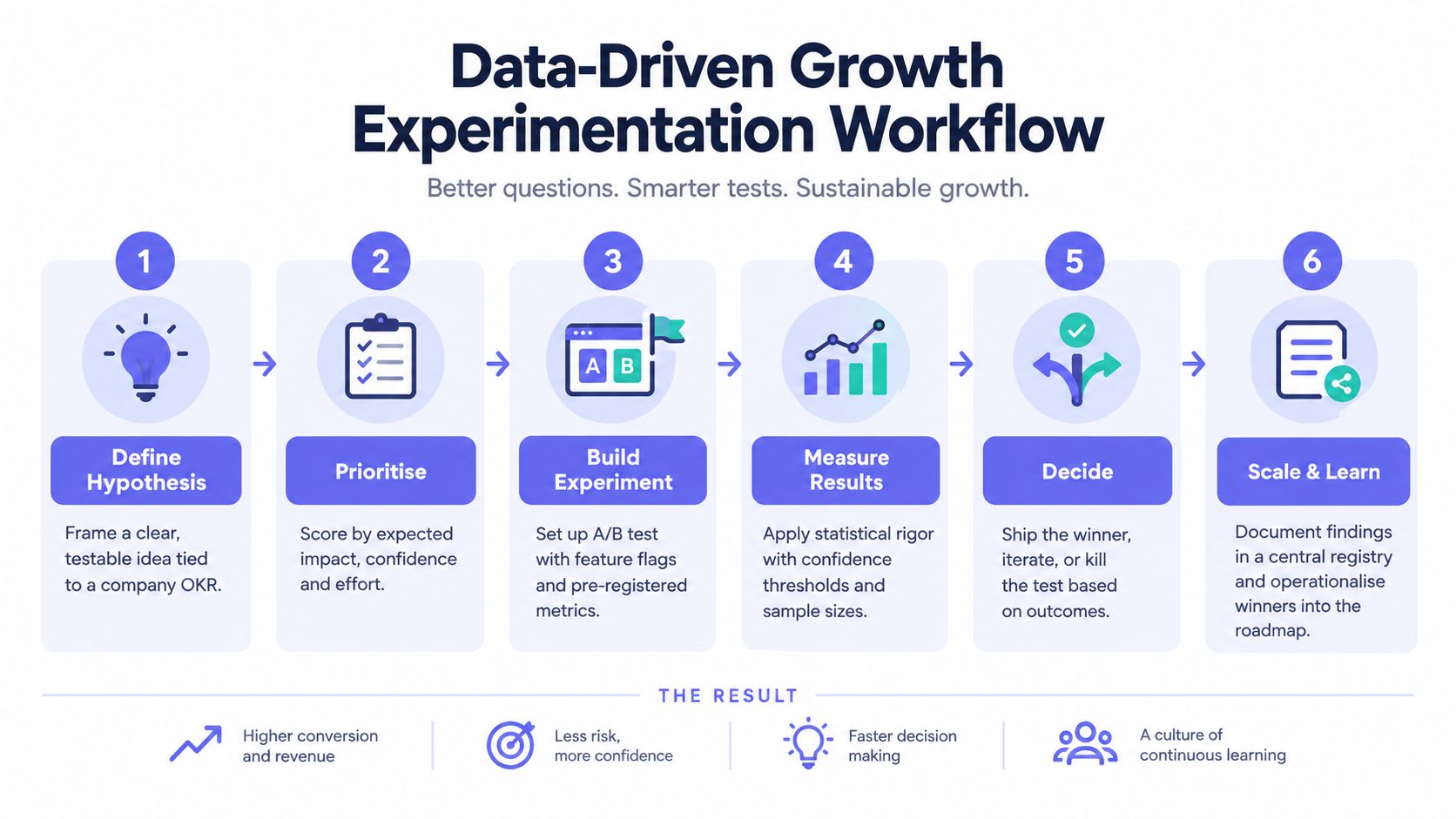
Experimentation is valuable when it replaces opinion with evidence. It becomes theatre when teams run tests without a clear hypothesis, choose success metrics after seeing the result, or optimise a local measure that doesn't move the company objective.
Booking.com, Netflix, and Amazon are well-known examples of companies that use experimentation across product and customer experiences. Their lesson for a smaller team isn't to imitate their scale. It's to create a disciplined way to choose tests, learn, and turn a winning result into delivery.
I'd start with the constraint. Is conversion weak because the offer is unclear? Is activation slow because onboarding creates friction? Is paid growth expensive because customer quality varies by channel? A test should answer a decision the business needs to make.
Make learning part of the operating system
Prioritise experiments by expected impact, confidence, and effort. Pre-register the hypothesis, success measure, decision threshold, and required evidence before launch. For important acquisition or spend decisions, use holdouts or incrementality tests where practical.
Log the learning centrally. A result that doesn't change a decision isn't much of a result. When a test wins, assign someone to translate it into a scaling plan, product change, campaign update, or sales playbook.
The weekly rhythm should review live tests, completed tests, blocked tests, and decisions made. Connect hypotheses to company OKRs so the team doesn't mistake more activity for progress. A useful North Star metric strategy can help maintain that connection, provided the metric reflects customer value rather than easy-to-inflate engagement.
The failure mode is a busy experimentation backlog with no organisational learning. Stop tests that no longer answer an important question. Keep the evidence that prevents the same debate returning next quarter.
10-Point Growth Strategy Comparison
| Strategy | Implementation complexity | Resource requirements | Expected outcomes | Ideal use cases | Key advantages |
|---|---|---|---|---|---|
| Product-Led Growth (PLG) with Clear Execution Metrics | Medium–High, product, analytics and onboarding work required | Product development, analytics, UX, support; upfront investment | Lower CAC, scalable self-serve adoption, improved retention/expansion | SaaS products with clear activation moments and freemium potential | Scales without proportional sales; fast user-driven feedback loops |
| Account-Based Marketing (ABM) with Aligned Sales Execution | High, intensive personalization and coordination | Sales + marketing time, account research, customised content | Higher ACV, more predictable enterprise pipeline | Enterprise B2B targeting a finite list of high-value accounts | Deep alignment between sales and marketing; higher deal value |
| Community-Driven Growth with Structured Engagement OKRs | Medium, ongoing moderation and program management | Community manager(s), events budget, content and moderation | Lower long-term CAC, improved retention, referral growth | Products with passionate user bases (developers, designers) | Authentic advocacy, stronger retention and product insights |
| Content Marketing as a Demand Generation System | Medium, requires editorial process and SEO discipline | Content creators, SEO, distribution budget, analytics | Inbound leads, compounding organic traffic, brand authority | Thought leadership, top-of-funnel demand generation for B2B/B2C | Compounding traffic, sales enablement, long-term lead source |
| Strategic & Channel Partnerships for Market Expansion | High, legal, commercial and operational coordination | Partnership managers, legal, co-marketing spend, integration effort | Faster market reach, new revenue channels, credibility gain | New geographies, vertical expansion, complementary product ecosystems | Leverages partner distribution and credibility for quicker scale |
| Vertical-Specific Marketing & GTM Differentiation | Medium–High, deep industry knowledge and tailored assets | Vertical teams, specialised content, sales playbooks, case studies | Higher conversion and pricing power within chosen verticals | Regulated industries or sectors with distinct pain points | Stronger resonance with buyers; shorter sales cycles |
| Pricing & Packaging Optimisation as a Growth Lever | Medium, requires hypothesis testing and billing changes | Finance, product, analytics, billing/engineering support | Improved ARPU, better segment capture, expansion revenue | SaaS and usage-sensitive products seeking monetisation lift | Direct, measurable revenue impact without new acquisition spend |
| Performance Marketing & CAC Optimisation Through Attribution | Medium, analytics and attribution setup needed | Ad spend, analytics stack, optimisation team, testing budget | Measurable CAC, faster ROI visibility, dynamic budget allocation | Scalable user acquisition and conversion-driven campaigns | ROI-focused spend; quick feedback and scalable channels |
| Customer Success & Retention as a Growth Multiplier | Medium, scalable playbooks but labour-intensive | Success managers, onboarding resources, health-scoring tools | Higher NRR, lower churn, expansion from existing customers | Subscription businesses where retention drives unit economics | Expansion-driven growth; cheaper revenue via existing base |
| Data-Driven Growth Experimentation & Rapid Iteration | High, robust instrumentation and statistical rigor required | Experimentation platform, engineers, analysts, feature flags | Repeatable high-impact learnings, evidence-based optimisation | Funnel optimisation, product feature validation, growth teams | Converts opinions into evidence; de-risks major bets |
What to Run First on Monday
I'd start with the constraint, not the tactic. If sales and marketing disagree about pipeline, choose ABM or performance marketing only after agreeing what counts as qualified pipeline and who owns the number. If customers leave before reaching value, start with Product-Led Growth and customer success. If the business has attention but weak differentiation, choose content, community, or a vertical strategy. If delivery is slow, don't add another channel. Fix the operating rhythm first.
Pick two strategies that match the biggest constraint. Don't launch all ten. That creates a portfolio of activity without a portfolio of accountable outcomes.
For each strategy, write one objective and three key results. The objective should describe the business change, not the activity. The key results should show customer behaviour, pipeline quality, retention, revenue contribution, or another outcome leadership can act on. Name one owner. Shared contribution is useful, but shared ownership often means nobody can be challenged when delivery slips.
Put a weekly review slot in the calendar. Keep it focused on four questions:
- What changed: Which customer, commercial, or operational result moved?
- What is blocked: Which dependency needs a leadership decision?
- What did we learn: Which assumption is now weaker or stronger?
- What will stop: Which activity no longer deserves scarce capacity?
A strong operating rhythm also exposes trade-offs. A team can't expand into several verticals, build a community, increase content production, and redesign packaging without affecting delivery capacity. Leadership must choose what not to do. That decision is part of the strategy, not an admission of failure.
The wider UK market reinforces the need for discipline. Search represented 47% of UK digital advertising investment in 2024, reaching approximately £16.6 billion, while video display expenditure reached £8.3 billion after growing 20%, according to IAB UK. More available investment and more available channels don't remove the need for prioritisation. They increase it.
The IPA Bellwether Report found that the net balance of companies increasing total marketing budgets rose from +9.4% in the first quarter to +15.9% in the second quarter of 2024, with marketing budgets remaining positive for 13 consecutive quarters. The IPA report also shows why leaders should combine routes to market rather than assume paid digital acquisition can carry the whole plan. Events, direct marketing, sales promotion, and major media support different parts of the customer journey.
I help scale-up and enterprise leadership teams turn marketing growth priorities into owned outcomes, measurable OKRs, and operating rhythms that improve delivery. If the same priorities keep returning without enough progress, book a conversation.