
The usual advice on strategy management software is to compare features, check integrations and book demonstrations. I'd reverse that order. First establish how leaders make decisions, who owns outcomes and whether teams will maintain the information those decisions need. Otherwise, you're buying a more expensive place to store unresolved management problems.
My recommendation is to weight governance and adoption above feature breadth. A polished dashboard won't resolve competing priorities. An integration won't make an executive act on a blocked dependency. The right purchase supports a credible operating rhythm, rather than asking the organisation to invent one after signing.
Choose the Software Category Before the Feature List
Comparing feature lists before agreeing the category wastes evaluation time. A portfolio tool and an OKR-native platform may both display objectives, but they support different management decisions. One starts with funded investments. The other starts with outcomes and a recurring execution cycle.
I'd establish the dominant planning model before inviting vendors. Does leadership manage through quarterly OKRs, a strategy map and scorecard, or investment gates? That answer matters more than the number of dashboard widgets.
Strategy software categories compared
These are buying categories, not absolute product boundaries. Individual platforms can span several, but their underlying design still affects setup effort and everyday use.
| Category | Built for | Strongest at | Weakest at | Typical buyer |
|---|---|---|---|---|
| OKR-native platform | Teams running OKRs as the core quarterly cycle | Cadence, check-ins, objective scoring | Portfolio and budget links | Scale-ups and OKR owners |
| Strategy execution suite | Organisations linking strategy maps, initiatives and KPIs | Strategy maps, balanced scorecards | Heavy setup and slower adoption | Enterprise strategy offices |
| Portfolio management tool | Investment-led organisations with funded projects | Resource and budget control | Weak on outcomes and team-level goals | PMOs and transformation teams |
| Work management with goal add-ons | Teams already working in Jira, Asana or monday.com | Low adoption friction | Shallow goal logic and thin governance | Product and operations teams |
| BI or dashboard layer | Organisations with strong data teams and reporting needs | Reporting flexibility | No accountability workflow | Analytics-led functions |
Consider a hypothetical 220-person scale-up. Objectives sit in Google Sheets. A chief of staff assembles the board pack by hand each month. Leadership already agrees priorities, but team updates arrive inconsistently and dependencies disappear between reviews.
I'd shortlist an OKR-native platform first. That organisation needs clear ownership, lightweight updates and cross-functional visibility, not the configuration burden of a suite designed around a hypothetical 2,000-person group. A strategy execution suite becomes credible only if scorecards, organisational complexity or formal planning requirements justify it.
Match the category to the operating problem
For a product-led business working in Jira, I'd compare an OKR-native platform with field-level Jira synchronisation against the existing work management tool's goal functionality. The critical trade-off is between stronger outcome management and entering the same progress twice.
For a transformation programme with budget gates, I'd favour a portfolio tool with an OKR layer. Finance needs investment control, while sponsors need evidence of benefits. The danger is declaring success because projects finished, even when customer retention, operating cost or service performance hasn't improved.
A BI layer can be sufficient when ownership and review routines already work. It's a poor substitute when nobody knows who must respond to a deteriorating measure.
The wider adoption picture supports caution. The Office for National Statistics' technology adoption analysis found that 88% of firms in the highest management-practice decile had adopted at least one advanced technology, compared with 51% in the lowest decile in 2023. That association doesn't establish causation, but it challenges the idea that procurement and management capability are separate issues.
Practical rule: If objectives already fail in spreadsheets because leaders don't review them, keep the tooling and fix the management system first.
An effective OKR framework connects strategic choices to measurable results and decisions. The OKR Rollout Blueprint is a step-by-step plan for an organisation's first rollout, covering leadership alignment through to team-level adoption. That sequence matters more than migrating every existing field.
Keep specialist requirements separate, too. If secure product delivery is a strategic priority, engineering may need to find continuous threat modeling tools through DevArmor's guide. Strategy software should track the outcome and accountable owner, not replace the specialist security workflow.
Ask the narrowing question: is your strategy set in cycles, in a scorecard, or in a portfolio of investments? Leave with two categories to compare, not a long list of superficially similar products.
Evaluation Criteria That Decide the Shortlist
I'd score vendors against the work people must perform, rather than the capabilities a salesperson chooses to demonstrate. A platform that owners avoid produces unreliable information. Its reporting sophistication then becomes irrelevant.
The UK Innovation Diffusion and Adoption Survey executive summary identified leadership and management as an adoption enabler for 41% of surveyed businesses, alongside evidence that technology works for 40%. Buyers need proof of operational fit, not reassurance that implementation support is available.
Evaluation criteria with the question to ask and the red flag
Use the same questions with every vendor. Record demonstrated behaviour separately from promised functionality.
| Criterion | Question to ask in the demo | Red flag |
|---|---|---|
| Integration depth | Which systems sync natively, in which direction, and how often? | Integration only through paid custom services |
| Governance and decision rights | Can approval rights cover targets, changes and closures? | Only admin and user roles, no decision rights |
| Audit trail | Can a full change history be exported with timestamps? | History overwritten on every edit |
| Cadence support | Can check-ins and reviews be scheduled and tracked by team? | Reminders are manual and unrecorded |
| Adoption design | Can an owner update an objective in under five minutes, on mobile or inside Teams or Slack? | Updates need full browser logins and long forms |
| Data residency and security | Where is UK data stored, and which SSO and user provisioning options exist? | Vague answers on UK GDPR |
| Reporting on risk | Can leaders see overdue and abandoned objectives by layer? | Only colour-coded status dashboards |
| Vendor viability | Who provides support in year two, and what is the exit route? | Support depends on a single implementation partner |
My recommended scoring method is 1 to 5 for each criterion, with adoption and governance carrying 40% combined. Those are purchasing weights, not industry benchmarks. Adjust the remaining allocation to the business problem, but don't allow attractive integrations to compensate for an unusable workflow.
Keep a separate list of critical requirements. A weighted average mustn't conceal a failed security requirement or an inability to export essential records. Price the implementation, ongoing administration and exit work alongside the licence.
Make the demonstration do real work
Ask each vendor to build your top three objectives live, then add a key result linked to a real data source. Have an objective owner perform the update while a sponsor reviews a proposed change. That exposes friction across roles.
A weak answer redirects the test towards roadmap commitments or a partner-managed workaround. Neither is automatically disqualifying, but both need a named delivery owner, an agreed scope and acceptance evidence before purchase.
A demonstration on the vendor's sample data proves that the demonstration works. It doesn't prove that your rollout will.
I'd also ask for an export during the session. A vendor that can show a compelling dashboard but can't produce usable underlying records creates a dependency you should understand before signing.
Integration Depth Where Enterprise Rollouts Break
Integration is a question of ownership before it's a question of connectors. Which system controls each field? Who investigates a mismatch? What happens when a source stops updating?
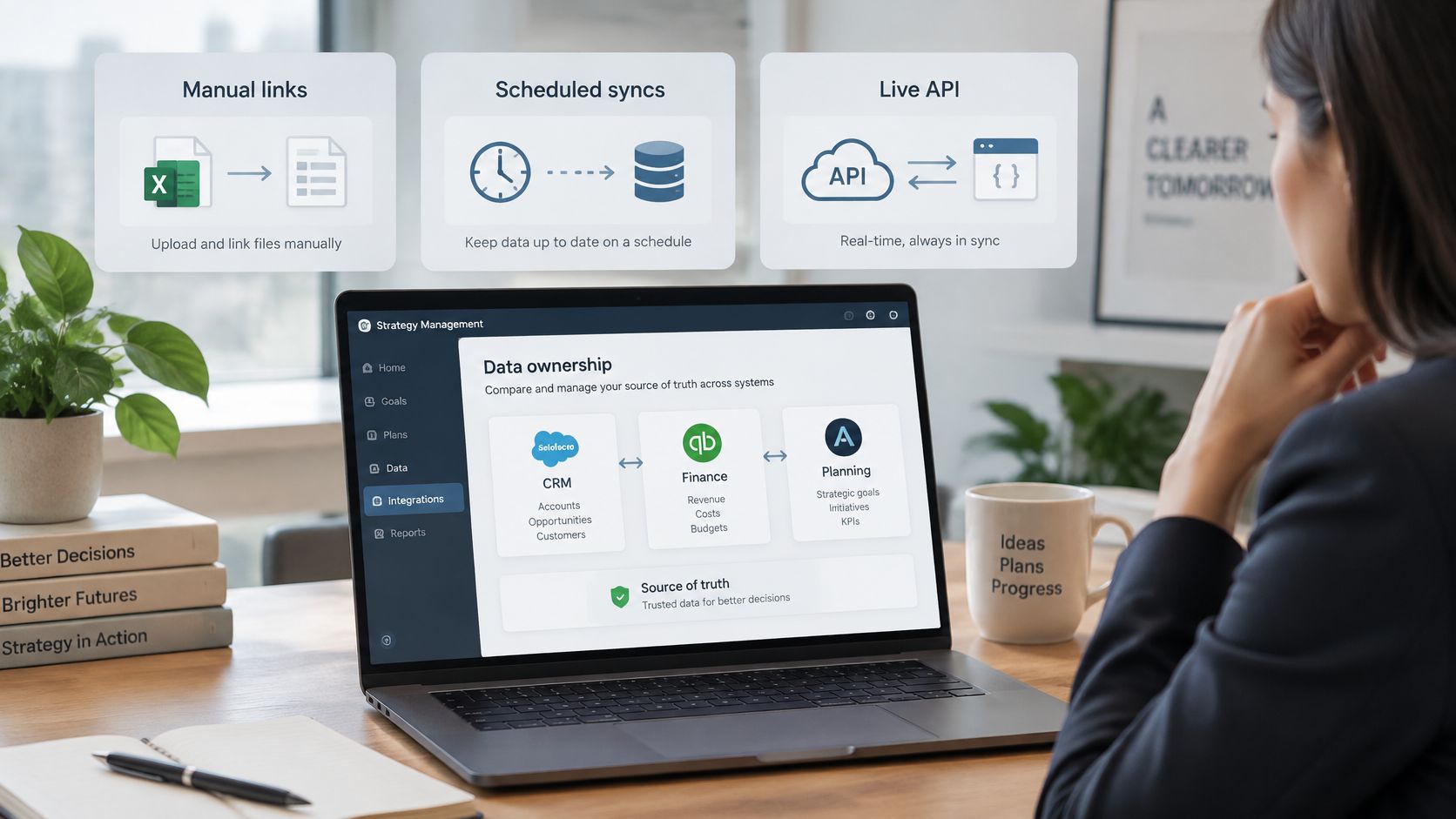
Consider a hypothetical 300-person scale-up. Engineering tracks delivery in Jira, sales bookings sit in Salesforce, and the CFO maintains the revenue model in Excel. Connecting all three doesn't automatically produce a trustworthy strategic picture.
Distinguish access from synchronisation
A manual link directs someone to evidence. A scheduled sync copies selected fields at agreed intervals. A live API connection can support frequent or event-driven updates, but its actual behaviour still needs testing.
For this scale-up, a bookings key result could become stale within a week if the import runs monthly and nobody owns the field. The objective might show a recent comment beside an old number. Leaders need separate timestamps for the latest narrative update and the latest successful data refresh.
I'd test three failure patterns explicitly:
- Competing editors: Both applications allow changes to the same target without a defined master.
- One-way assumptions: A connector imports delivery progress, but users expect changes to flow back.
- False freshness: The dashboard looks current while its underlying value comes from last month.
Good systems integration also distinguishes activity from results. Completed Jira milestones can explain progress, but they shouldn't automatically become evidence of increased customer adoption or improved margin.
Identity belongs in this design. Test single sign-on and automated user provisioning with the actual identity provider. A leaver should lose access on their last day, not three weeks later because an administrator missed a separate account.
Integration map for the 300-person scale-up
This hypothetical map deliberately exposes the bookings failure rather than presenting every connection as healthy.
| Data field | Source of truth | Sync type | Owner | Refresh |
|---|---|---|---|---|
| Engineering milestones | Jira | Live API | Head of Engineering | Real time |
| Bookings | Salesforce | Scheduled sync | Unassigned | Monthly |
| Revenue forecast | Excel model | Manual upload | CFO | Monthly |
The bookings row isn't ready for deployment. Assign a revenue operations owner and set a refresh interval appropriate to the decision cycle. Keep the finance upload manual if judgement is integral to the forecast, but label its reporting period clearly.
My required working artefact is this map, extended with field definitions, failure alerts and reconciliation rules. A connector catalogue isn't an integration design.
Governance, Permissions and Audit Trails That Hold Up
Governance gets vague when vendors demonstrate visibility but avoid authority. Seeing an objective isn't the same as being entitled to change it. Being accountable for delivery doesn't necessarily grant permission to redefine success.
The ONS management-practices methodology treats continuous improvement, KPI use, targets and employment practices as connected management dimensions. I'd apply that same discipline here: targets, reviews and corrective actions must function together.
Make authority explicit
Start with who sets company-level objectives. The CEO and strategy office should publish an agreed baseline, not leave competing drafts circulating across functions.
Then establish who can change a target mid-cycle, who can close or cancel an objective, and who approves linked team objectives. Finally, define who can see which information. Commercially sensitive targets may need different access from shared delivery dependencies.
Say an owner lowers a target in week six of a hypothetical quarterly cycle. At the quarter review, the sponsor remembers the original commitment while the dashboard displays the revised one. Without a preserved baseline, leaders debate recollections instead of performance.
Governance test: A legitimate change should remain possible. A silent rewrite of the commitment shouldn't.
Role-based permissions should work by business unit and responsibility, not just through global administrator and ordinary user accounts. Lock baselines once the cycle starts, while allowing approved changes through a recorded workflow.
Preserve the decision record
Require timestamped histories of target changes, owner changes and status edits. The export should show the previous value, replacement value, person responsible and approval rationale. That gives the board, internal audit or a regulator a usable record where needed.
For UK GDPR diligence, involve the privacy and security leads in reviewing processing terms, data location and access logs. Don't treat a statement about UK hosting as a complete compliance assessment.
I'd translate governance frameworks into testable software actions rather than leaving them in policy documents.
Governance matrix for the software demo
| Decision | Role | Enforcing feature |
|---|---|---|
| Set company-level objectives | CEO and strategy office | Locked baseline at cycle start |
| Change a target mid-cycle | Objective owner with sponsor approval | Timestamped change request with approval |
| Close or cancel an objective | Executive sponsor | Closure requires reason and approver |
| Approve cascaded team objectives | Function head | Approval workflow before publish |
| See what | Business unit leaders and board | Role-based permissions by unit |
Have the vendor demonstrate both an authorised action and a blocked action for every row. Permissions that exist only in the implementation presentation don't count.
Adoption Risks Behind Stalled Strategy Software
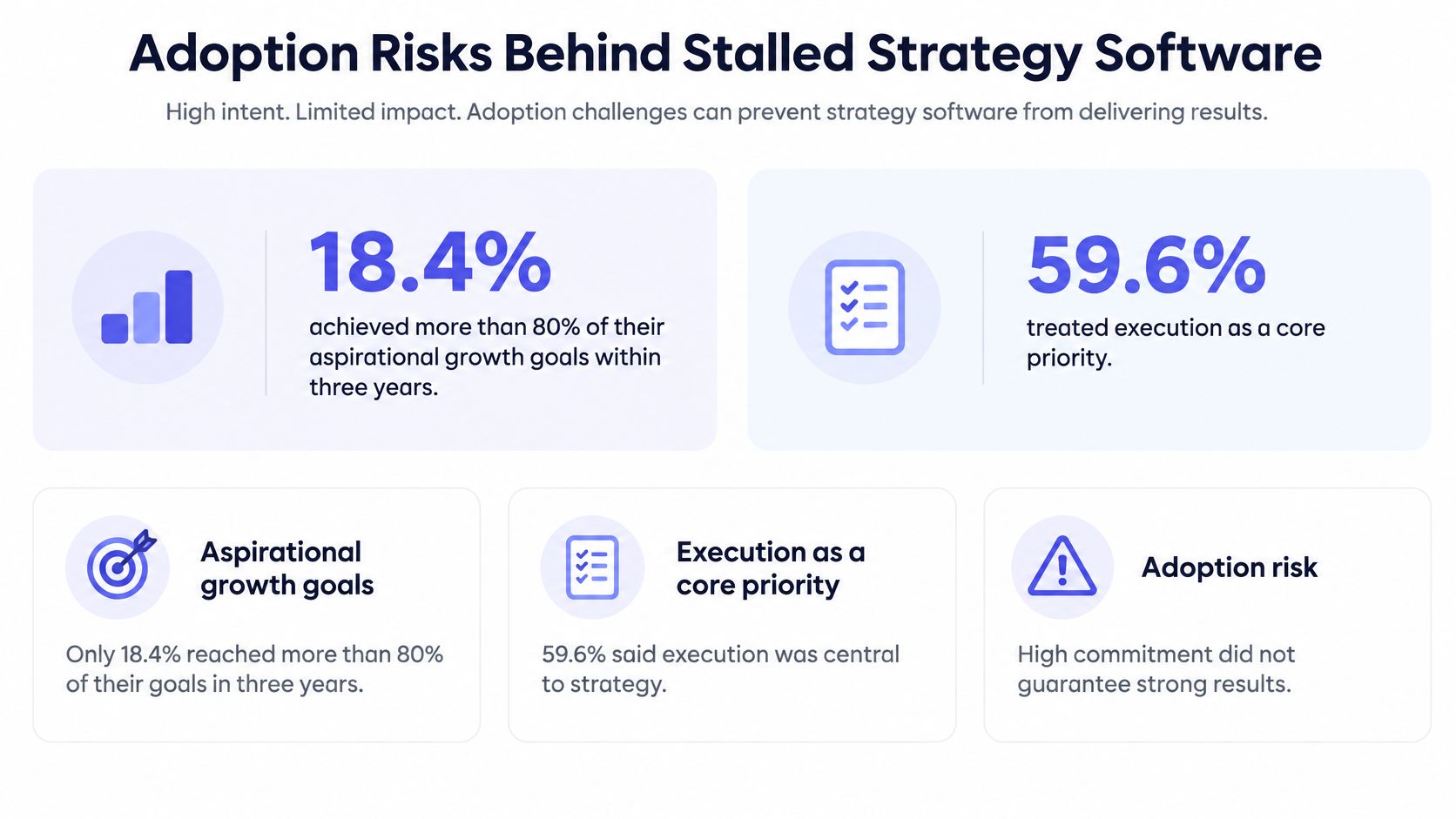
Only 18.4% of large UK businesses achieved more than 80% of their aspirational growth goals within three years, according to Strategy Management Partners' 2025 survey of 250 UK companies with turnover above £20 million, reported by FM magazine. The survey's key findings also state that 59.6% treated execution as a core discipline.
Declaring execution important isn't the same as delivering it. Software makes that distinction visible only when people provide honest evidence and leaders respond constructively.
Design against avoidance
I'd address these adoption barriers before configuring reminders:
- Compliance clicks: Owners complete fields to clear a notification. Require a current result, supporting evidence and a clear statement of any decision needed.
- Overload: Leaders put every departmental commitment into the same cycle. Separate strategic change from routine operations and make explicit choices about capacity.
- Surveillance: Sponsors use transparency to assign blame. Owners then conceal uncertainty until recovery becomes difficult. Review assumptions and blockers, not just the person attached to a red indicator.
Training needs its own budget. Henley Business School's 2025 survey of 4,640 UK full-time workers found that 60% would be more likely to use AI if properly shown how, while KPMG found that 27% had AI education or training despite 65% intentionally using AI for work, as described alongside the UK AI adoption research. These are AI findings, not strategy-platform adoption rates, but they reinforce the need to distinguish access from capability.
For Shell NewMotion, the engagement delivered by The OKR Hub included a bespoke Strategic Management framework, training for the entire company and an internal coaching capability that sustained the programme. The relevant lesson is the investment in internal capability, not the launch.
Measure useful participation
My recommended design is a weekly update taking under five minutes, followed by a monthly review focused on decisions. Teach owners what sufficient evidence looks like. Teach sponsors how to resolve dependencies, stop work and adjust priorities.
From day 30, track active coverage by organisational layer, the percentage of objectives updated on schedule, and the share linked to a strategic theme. These are recommended rollout measures, not universal performance benchmarks. Logins alone won't tell you whether teams are executing better.
Run a Pilot Before You Sign the Contract
I'd make a bounded pilot a condition of the buying process. Agree on its scope, data handling, support, and exit terms before loading information. Don't let a trial turn into an organisation-wide deployment.
Before starting, use the OKR Maturity Assessment to judge whether the current management system can absorb a new tool. It and the OKR Rollout Blueprint are free tools used by hundreds of teams. The OKR rollout plan provides a useful basis for sequencing the work.
Use a bounded test
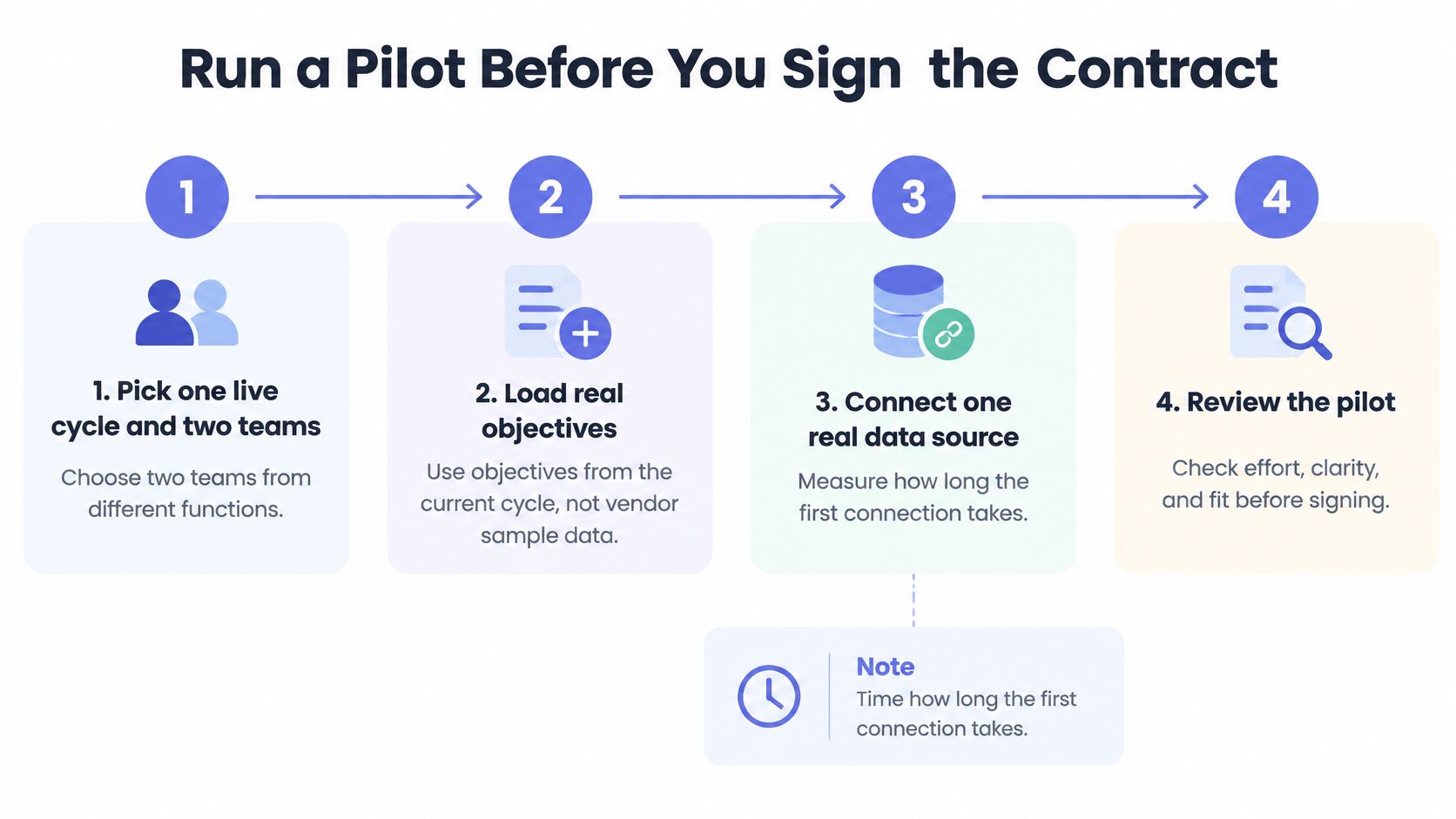
My recommended procedure puts real work ahead of configuration polish:
-
Pick one live cycle and two teams from different functions. Choose teams with a genuine dependency, such as product and sales. A friendly team working alone won't expose cross-functional friction.
-
Load current objectives. Include an uncertain result, a blocked dependency and an objective that may need cancellation. Don't clean away the difficult cases to make the pilot look successful.
-
Connect one real data source. Time how long the first accurate number takes to appear. Include validation and reconciliation, not just the moment a connector reports success.
-
Run two check-ins. Record each owner's update time and any help required. Watch the actual workflow rather than relying on a satisfaction survey.
-
Review after 60 days. Measure active coverage by layer, scheduled-update completion and strategic-theme linkage. Add the share of objectives with a named decision owner, then inspect whether unresolved issues reached someone authorised to act.
-
Score the evidence. Test the vendor against the integration map and governance matrix. Record gaps, remediation owners and ongoing administrative effort before making the commercial decision.
Set stop conditions before enthusiasm takes over
I'd pause the pilot if the first real update takes longer than ten minutes, or if half the owners skip the first check-in. These are proposed intervention thresholds, not published benchmarks. Diagnose whether the cause is workflow friction, poor enablement or unclear leadership expectations before continuing.
Finish with one of three decisions. Sign when the evidence supports operational fit. Extend the pilot when a specific, bounded uncertainty remains. Fix the rollout first when priorities, decision rights or participation are still unresolved.
I help leadership teams choose strategy management software that fits how they need to execute, then establish the governance, OKRs and adoption routines that make it useful. To discuss your selection or a stalled rollout, book a conversation.