
Your leadership team agreed three priorities at the offsite, booked a training calendar, and went back to full diaries. Six months on, the same argument is in the same meeting. Sales is still chasing volume. Operations is still protecting quality. The capability goal has a slide and no owner.
The strategies of development that move a business are tied to a decision, not a course code. A funded plan can still leave Monday's trade-off untouched. People finish the course and return to the inbox that trained them.
I treat a development strategy as a deliberate plan to change what people know, how they decide, and how work gets delivered, with named owners and measures. Capability sticks only when routines, decision rights and outcomes change with it.
Three questions follow. Which strategy fits the problem you have. How you diagnose the gap before you spend. How you connect development to results you can see. You should leave with a shortlist, a diagnostic you can run this week, and one first move.
Why Development Strategies Stall Before They Reach Teams
The offsite felt decisive. Three priorities, a training calendar, a shared nod. Then the quarter ran, and each function walked back into its own version of the plan.
Four symptoms tell me the strategy never reached the teams.
- Priorities differ between functions. Ask three directors what the company will stop, and you get three answers.
- Nobody owns the capability goal. Learning books the sessions. No executive owns the decision the skill is meant to change.
- Delivery slows once the training ends. The new behaviour has no slot in the week, so the old habit wins by default.
- OKRs have become a quarterly ritual. Teams file updates. They don't use the review to choose, stop, or escalate.
Most development strategies fail because they treat capability as a project separate from delivery. You can complete every module and still make Monday's trade-off the old way.
A working development strategy names what must change in knowledge, judgement and delivery, then puts an owner and a measure on each change. Without that, you have a calendar, not a plan.
The OKR Hub starts with the strategy execution problem and works downstream from there. I use the same order. Fix the decision that is stuck before you buy more content. When priorities look agreed at the top and fracture underneath, you are usually facing the adoption barriers that appear once OKRs leave the leadership pack.
If the same disagreement returns after the course, the course was never the constraint.
I would not commission another programme until those four symptoms are named in writing. The choices below only help once you know which failure you are looking at.
Diagnose the Execution Gap Before You Develop Anyone
Start from the symptom that is hurting delivery, not from the training catalogue. Pick the row that matches this month's pain, then test the first response before you design a programme.
| Symptom | Likely capability gap | First response |
|---|---|---|
| Teams hit every milestone but customer outcomes do not move | Objectives measure activity, not outcomes | Rewrite key results around a measurable change in results |
| Leaders agree priorities but teams describe different ones | Strategy not translated into team-level choices | Run a strategy translation session on the top five priorities |
| Quarterly reviews turn into status reports | Managers lack the skill to challenge progress | Coach managers to run confidence reviews |
| Blockers surface only at the end of the cycle | No escalation routine or unclear decision rights | Set a weekly escalation rule with named owners |
| New tools or platforms are underused | Management practice has not changed around them | Pair the tool with a defined operating routine |
A second test before you spend
The symptom tells you where to look. It doesn't tell you whether change can succeed. Research from the Association for Project Management identified six conditions that were critical to successful change delivery in UK public-sector organisations. Four concerned capability: strong and consistent leadership, a coherent vision and clear goals, disciplined planning with realistic timelines, and sufficient investment across the full change lifecycle. Two concerned accountability: engaging stakeholders early and throughout the change, and benefits that remain sustainable after the project ends. When one or more of these conditions was absent, change largely resulted in failure.
Score each condition together as red, amber or green. Red means the condition is missing. Amber means it exists on a slide and not in the week. Green means you can point to a person, a date and a behaviour.
Say a scale-up of around 120 people, an illustrative composite rather than a named client, ran this check before a growth push. The vision was green. Planning was red, because the timeline assumed capacity the teams didn't have. A skills course on top of that plan would have produced busy people and the same miss.
Key results earn their place when they measure adoption, usage, service quality or realised benefits, rather than a project marked complete. A performance diagnostic is worth running only if it forces that split.
A red score is a stop, not a prompt to train harder.
Fix the red condition before you add development activity. If the plan assumes people you don't have, cut the scope or add capacity. Then develop the skill the remaining work needs.
Five Development Strategies and When Each One Fits
Choose from the gap you diagnosed, not from what is fashionable this year. Most firms need two or three strategies of development running together. Sequence still matters. The usual mistake is starting with the most visible option, a course, before decision rights and priorities are clear.
| Strategy | Best for | Typical owner | First visible signal |
|---|---|---|---|
| Leadership development | Leaders who must change how they make trade-offs | CEO or executive sponsor | Faster, clearer decisions in leadership meetings |
| Team capability building | Teams without a shared method for setting and tracking goals | Team lead with HR or L&D support | Objectives written to a common standard across the team |
| OKR capability building | Organisations rolling out or repairing OKRs | Strategy or transformation lead | Fewer vague key results at the next quarterly review |
| Manager coaching | Managers who tell teams what to do rather than helping them decide | Senior managers | Blockers raised early instead of at the end of the cycle |
| Strategy translation sessions | Leadership teams with a clear strategy but inconsistent local priorities | Chief of Staff or strategy lead | Team priorities that trace back to three to five company priorities |
How to read each row
Leadership development is the right start when the same disagreement keeps returning in the executive team. The skill is the trade-off, not the slide. If you want formats that force a real decision, advanced professional development activities for leaders are a useful scan beyond a single workshop.
Team capability building fits when people can agree the priority and still can't write a measurable goal. Give them one standard. The team lead owns it. HR or L&D supports, rather than running the goal.
OKR capability building is for a rollout or a repair. Judge it by fewer vague key results at the next review, not by attendance. Peer learning works when managers score each other's live objectives, not a fictional case.
Manager coaching is the move when managers still hand down tasks. You'll know it's working when blockers appear in week two, not in the closing pack.
Strategy translation sessions suit a clear company strategy and messy local lists. They overlap with OKR capability building. Translation clarifies the choices. The OKR routine is what tracks them after the room empties.
The rule that keeps this honest
A development strategy needs an owner with authority over the decisions it affects. A learning lead can't own a priority the chief product officer won't drop.
If you run two or three strategies at once, keep this order. Diagnose first. Run strategy translation. Install the capability routine. Only then add training volume.
For a scale-up heading into a hiring wave or a funding round, protect decision speed first. Growth multiplies the number of calls a team must make without a clear owner. Train the decision, then hire into it.
Building Capability Inside the Flow of Work
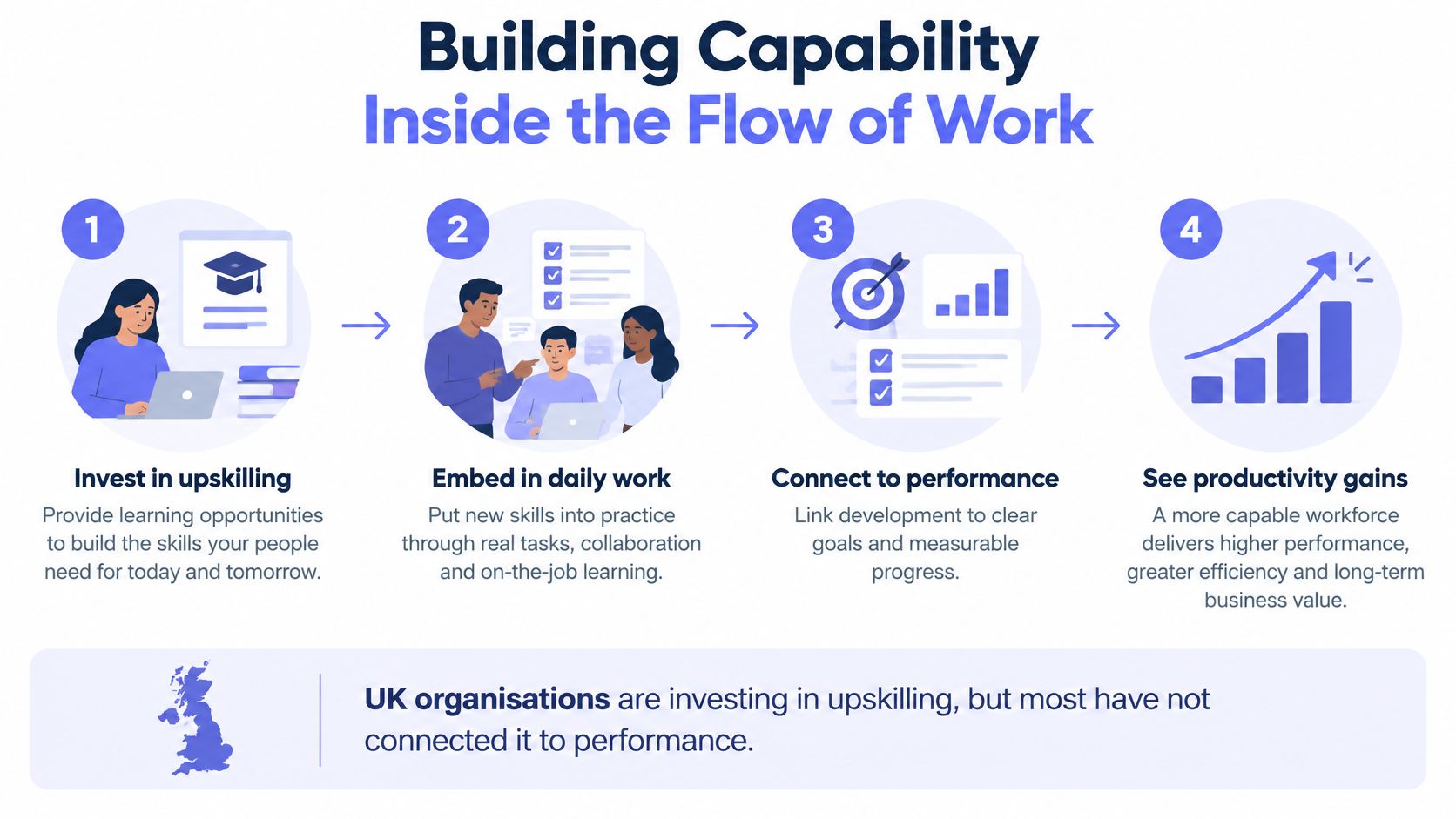
UK organisations are spending on upskilling and still leaving learning beside the work. A 2026 UK workforce study from Adecco found that 54% of organisations were piloting or implementing upskilling opportunities, but only 29% described continuous learning as embedded in culture and leadership, and just 2% had fully integrated learning into performance frameworks and linked it to business outcomes. In that study, UK L&D respondents identified coaching, feedback and performance conversations as the leading leadership priority, with 86% selecting core people-management skills.
More courses won't close that gap. You need a named place to practise, a manager who reinforces it, and a business result that proves it.
The pattern is a short flow, not a longer catalogue.
A practice loop on live work
- Name the live delivery problem. A product team facing a launch doesn't need a generic goal-writing class. It needs key results that would tell the team the launch is on track.
- Define the skill that problem requires. Here, the skill is writing a result a customer or a metric can confirm, not a task list with a date on it.
- Name the manager who will coach it. That person reviews the draft in the next weekly priority meeting. Leadership delegation tips from Acheloa Wellness are a useful reminder that the manager's job is to hand over the decision, not to rewrite the goal in private.
- Schedule the practice inside the work. The session ends with a draft the team will use on Monday, on the launch they already own.
- Agree the outcome that proves progress. For this team, that is a key result the leadership review can score without a narrative attached.
I build those sessions on four stages: Connection, Concept, Concrete Practice and Conclusion. Connection ties the idea to this week's problem. Concept stays short. Concrete practice means they apply it to real work before they leave. Conclusion names who checks it, and when.
The OKR Hub combines training and consulting because training without implementation support rarely sticks, and consulting without capability building leaves teams dependent. I hold the same line. A deck that leaves with the adviser is not a capability.
Treat the objective as the place the skill gets used. Priority reviews should surface the gap. The manager coaches against the live blocker. Governance tracks the outcome and whether the behaviour showed up. Knowledge transfer fails when the only record is the slide deck and the manager never has to use the method on a real call.
Ask this every quarter. Where did this skill get used, and who noticed?
Making Strategy Clear Enough to Guide Daily Decisions
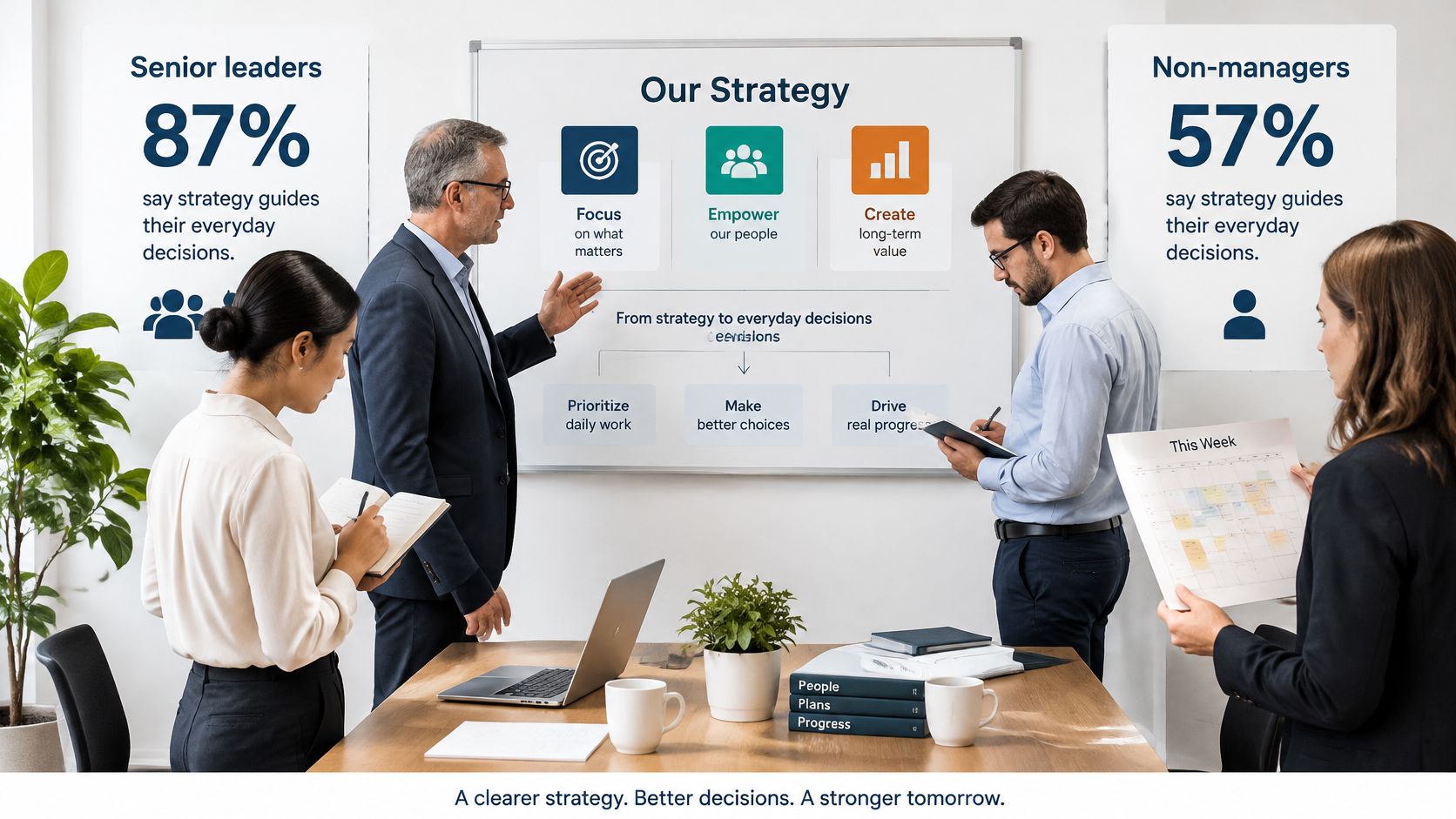
Leaders are sure the strategy landed. The people who must use it are not. In the 2026 IC Index, 87% of senior leaders believed organisational strategy had been clearly communicated, compared with only 57% of non-managers. Belief that the strategy was the right one fell from 80% among senior leaders to 44% among non-managers, while 52% of UK employees reported a restructure in the previous 12 months and only 42% felt their organisation was good at helping employees adapt.
Communication volume is not alignment. Another all-hands won't close that gap between the top table and everyone else.
A comprehension test that takes an hour
Ask three non-managers from different functions to explain three things. The top company priority. The trade-off it implies. One thing they would stop this week. Compare the answers in the room and mark every place they diverge.
Do this in a planning conversation, not an engagement survey. A survey tells you people felt informed. This test tells you whether Monday's decision would match.
The translation layer
Turn three to five strategic priorities into team-level priorities, explicit decision boundaries, and observable outcomes. A boundary is the sentence that says the team will not do something, even if a customer asks. An outcome is a number or a behaviour you can see inside the quarter.
Restructures make this urgent. Broadcast updates multiply, and each function writes its own reading of the plan. Autonomy at work only helps when the boundary is written down. Otherwise each team invents its own version of freedom.
If capacity fell by a quarter, which priority would you stop first, and who would be told?
Write the answer before the next planning cycle. If the leadership team can't agree the stop, the strategy isn't clear enough to guide a daily decision.
How Management Practice Decides Whether Development Pays Off
The return on a new tool depends on the management around it. UK evidence in the government's innovation strategy papers shows firms combining ICT adoption with strong management practices achieved approximately a 20% productivity improvement, compared with only 2% among firms adopting ICT alongside weak practices. Separate UK evidence in that analysis associates small improvements in management practice with productivity increases of up to 10%.
That is the chain I ask a leadership team to test. Stronger management practice enables better use of the tool or skill. Better use improves execution and output. Fund technology, capability and strategy as three projects, and you will get three status reports and the weaker result.
The split is easier to see as a map than as a slogan.
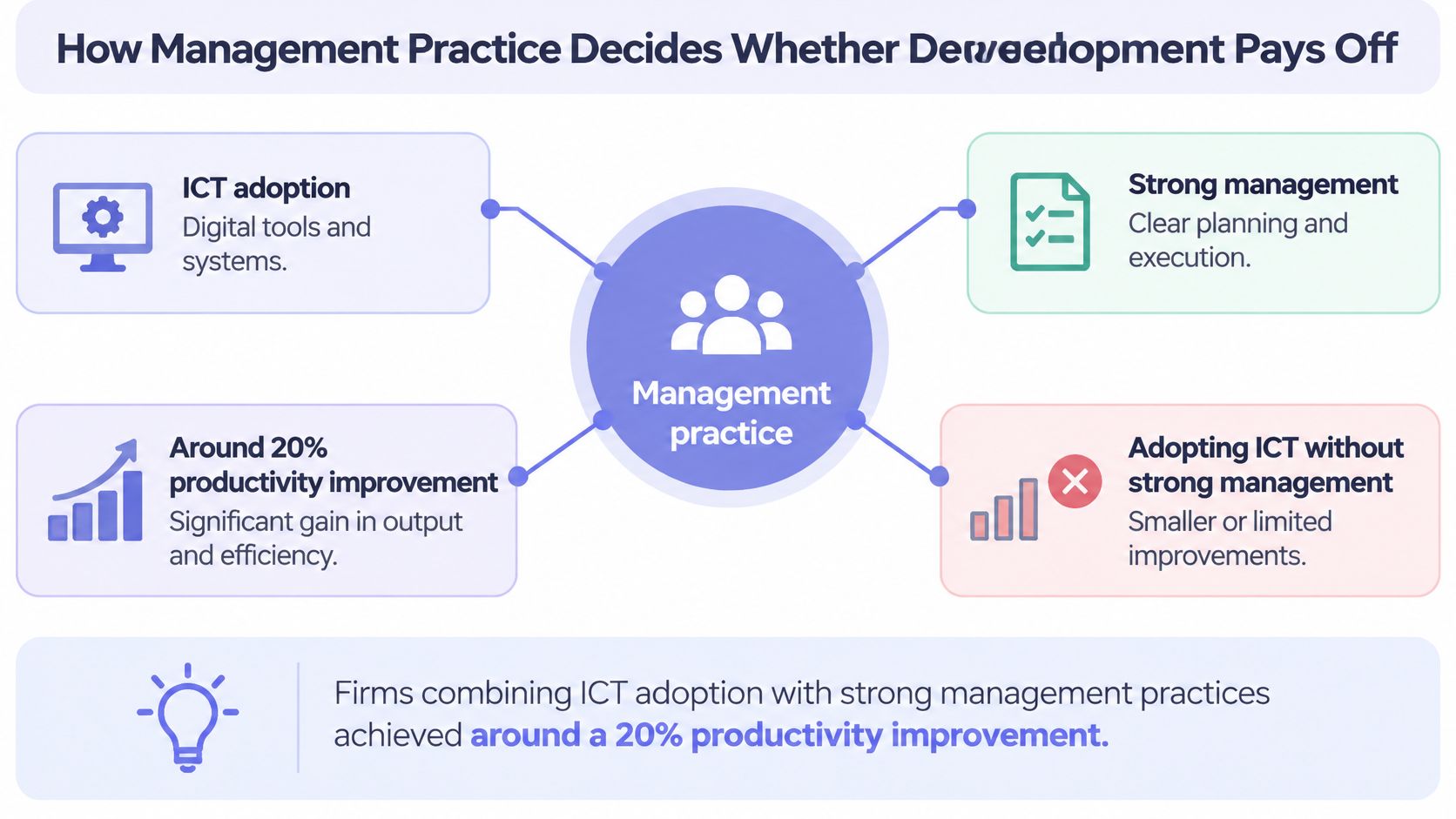
Design them as one operating system. It needs clear ownership, measurable outcomes, regular performance reviews, and fast escalation when delivery is stuck.
What the objective is allowed to say
"Implement a new platform" and "train managers" describe activity. A key result has to describe an operating effect, such as cycle time, forecast accuracy or adoption quality. The review then asks whether a weak result comes from skills, process design, decision rights or the tool. The figures in the middle column are example targets a team would set, not a benchmark to copy.
| Weak objective | Stronger key result | Review question |
|---|---|---|
| Implement a new platform | Core process cycle time falls from 12 to 5 days by quarter end | Is the cause skills, process design, decision rights or the tool? |
| Train managers | 80 percent of blockers are raised within one week by teams whose managers run weekly escalations | Are managers using the skill on live work? |
| Roll out a forecasting tool | Forecast accuracy reaches 90 percent for two consecutive months | Who owns the forecast and the variance review? |
What internal ownership looks like
Take a 150-person services firm, an illustrative composite and not a named client. It rolls out a planning tool. Managers keep the weekly decision in email threads. The key result tracks planning cycle time. The review shows the cause is unclear decision rights, not the software. The fix is a named decision owner and a weekly escalation rule.
For Shell NewMotion, The OKR Hub designed a bespoke Strategic Management framework, trained the entire company and built an internal coaching capability that sustained the programme. The lesson is plain. If the routine has no internal owner, the capability fades when external support leaves.
A pulse score can distract you. Mojolin's employee engagement statistics help you see whether people feel connected to the work, but a high score doesn't prove the decision right has changed. I would rather see cycle time move.
Build the internal owner before you scale the rollout. Otherwise you have rented a result.
Choose Your First Development Move This Quarter
Start with one outcome, one owner, and a review that looks at decisions.
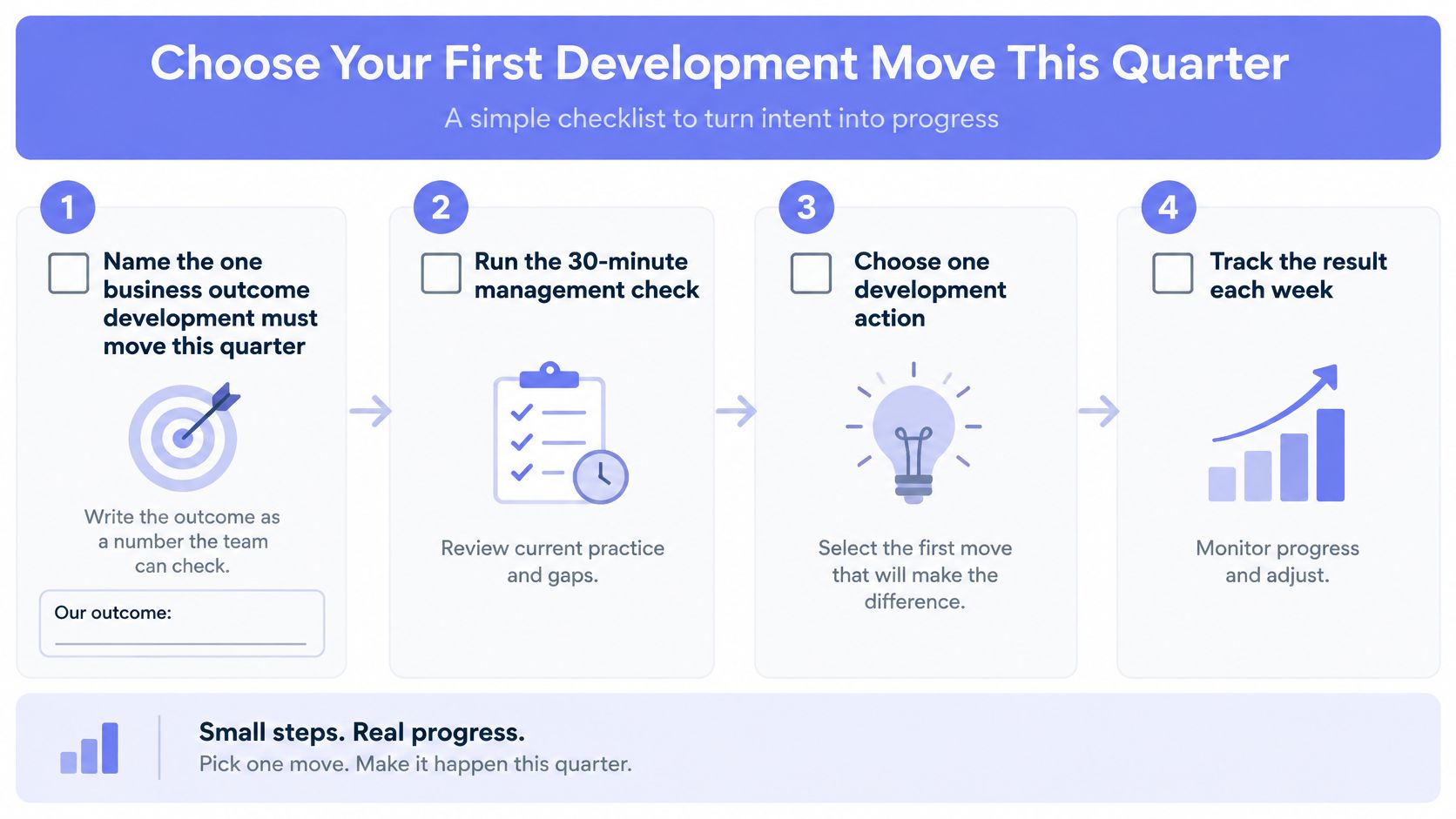
- Name the business outcome development must move this quarter. Write it as a number the team can check: cycle time, escalation rate or a customer result.
- Run the symptom table and the six-condition check in one sitting, and score each condition red, amber or green. Keep the scoring with the leadership team.
- Pick one strategy from the comparison and give it an owner with authority over the decisions it affects. If two strategies tempt you, sequence them. Do not start both in the same week.
- Set two key results that measure operating change. Decision cycle time and the share of blockers raised inside the week tell you more than "training completed".
- Schedule a 90-day review where each team shows a changed decision, not a register of attendance.
Clarity, architecture, momentum
The OKR Hub's approach runs in three phases: Clarity, Architecture and Momentum. The same shape works for a first quarter move.
Clarity comes first. You confirm the problem with the diagnostic, and any red condition is fixed before the routine is designed. The output is a shared statement of what is broken and what will change first.
Architecture is how decision rights, reviews and measures will work. Some clients start with an OKR Maturity Assessment and a single leadership workshop before deciding next steps; others arrive with a clear brief for a full implementation programme. Either path should leave an internal owner who can run the cadence.
Momentum is the habit after the first review. The 90-day check starts that phase. It does not close the project. If the review shows the same bottleneck, fix the architecture before adding more training.
I help leadership teams turn a development strategy into execution they can govern, with owners, routines and capability that show up in delivery rather than in a course register. If you want to pressure-test the first move, book a conversation.