
The popular advice is simple: build a full-featured dashboard, populate it with balanced measures, and execution will improve. I've seen that approach fail repeatedly. Leadership teams rarely suffer from a shortage of metrics. They suffer from unclear priorities, slow decisions, weak ownership, and activity that looks productive but doesn't move a strategic outcome.
A Balanced Scorecard and OKRs solve different problems. The scorecard monitors the stable health of the organisation across financial, customer, process, and capability dimensions. OKRs focus attention on the specific changes required to close the most important gaps. Used together, they create a stronger operating rhythm than either framework used as a substitute for the other.
| Decision question | Balanced Scorecard | OKRs |
|---|---|---|
| What does it monitor? | Ongoing organisational health | A defined change priority |
| Typical time horizon | Stable, long-term performance | Time-bound execution cycle |
| Main value | Shows trade-offs and performance patterns | Converts priorities into owned outcomes |
| Best use | Governance, resource allocation, early warning | Focus, alignment, and delivery |
| Main risk | Becoming a reporting catalogue | Becoming a task list |
| Relationship | Baseline and diagnostic system | Change layer that moves the baseline |
Why Most Scorecards Fail at Driving Execution
More metrics rarely create more control. They often create more places for weak execution to hide.
A 2025 survey of 500 UK business decision-makers found that teams lose an average of eight hours per week to busy work, equivalent to approximately 10 working weeks annually, while more than half still use busyness as their primary productivity measure. The research is reported in Smartsheet's End of Busy research report.
That finding changes how a scorecard should be assessed. Project volume, meetings attended, tickets closed, and documents produced can all rise while customer, financial, or operational results remain unchanged. A measure that rewards visible activity may reinforce the behaviour leadership is trying to reduce.
A department can meet every activity target and still miss the strategy.
Activity is not execution quality
Consider a transformation programme with a full delivery pipeline. Every workstream reports green status, and the steering pack contains dozens of measures. Decisions remain stuck between functions, dependencies go unresolved, and customers see no meaningful improvement.
Measurement design, not effort, is usually the bottleneck. Activity answers, “What did people do?” Execution quality asks, “What changed because they did it?”
A useful scorecard connects work to outcomes such as:
- Customer value: Has service reliability, retention, satisfaction, or adoption improved?
- Flow: Are decisions and valuable work moving faster through the organisation?
- Quality: Are defects, rework, complaints, or avoidable escalations falling?
- Capacity: Has the organisation released time for higher-value work?
- Enterprise effect: Has the activity improved the strategic result rather than only a departmental number?
Practical rule: Every measure should inform a decision, have an accountable owner, and expose a behaviour it might accidentally encourage.
A metric with no associated decision belongs in an information pack, not an executive scorecard. If nobody can act when it changes, it provides display value rather than accountability.
The test I use with leadership teams
I ask four questions about every proposed measure:
- What decision will this measure change?
- Who can act when the result moves off course?
- How quickly does the data arrive?
- What low-value behaviour could this measure create?
The final question catches design flaws that polished dashboards conceal. A target for completed initiatives can encourage teams to split work into smaller pieces. A utilisation target can discourage time for strategic thinking. An output target can increase volume while reducing quality.
A scorecard can then become a tick-box exercise. Leaders review the dashboard, acknowledge the colours, and return to the same unresolved priorities.
The score balanced scorecard approach I favour uses fewer, more consequential measures. It separates stable organisational health from active change. The scorecard shows where the organisation stands. OKRs define the specific changes leaders will make to close the most important gaps. Understanding why scorecards fail is the first step. The structural difference between BSC and OKRs determines how that insight becomes action.
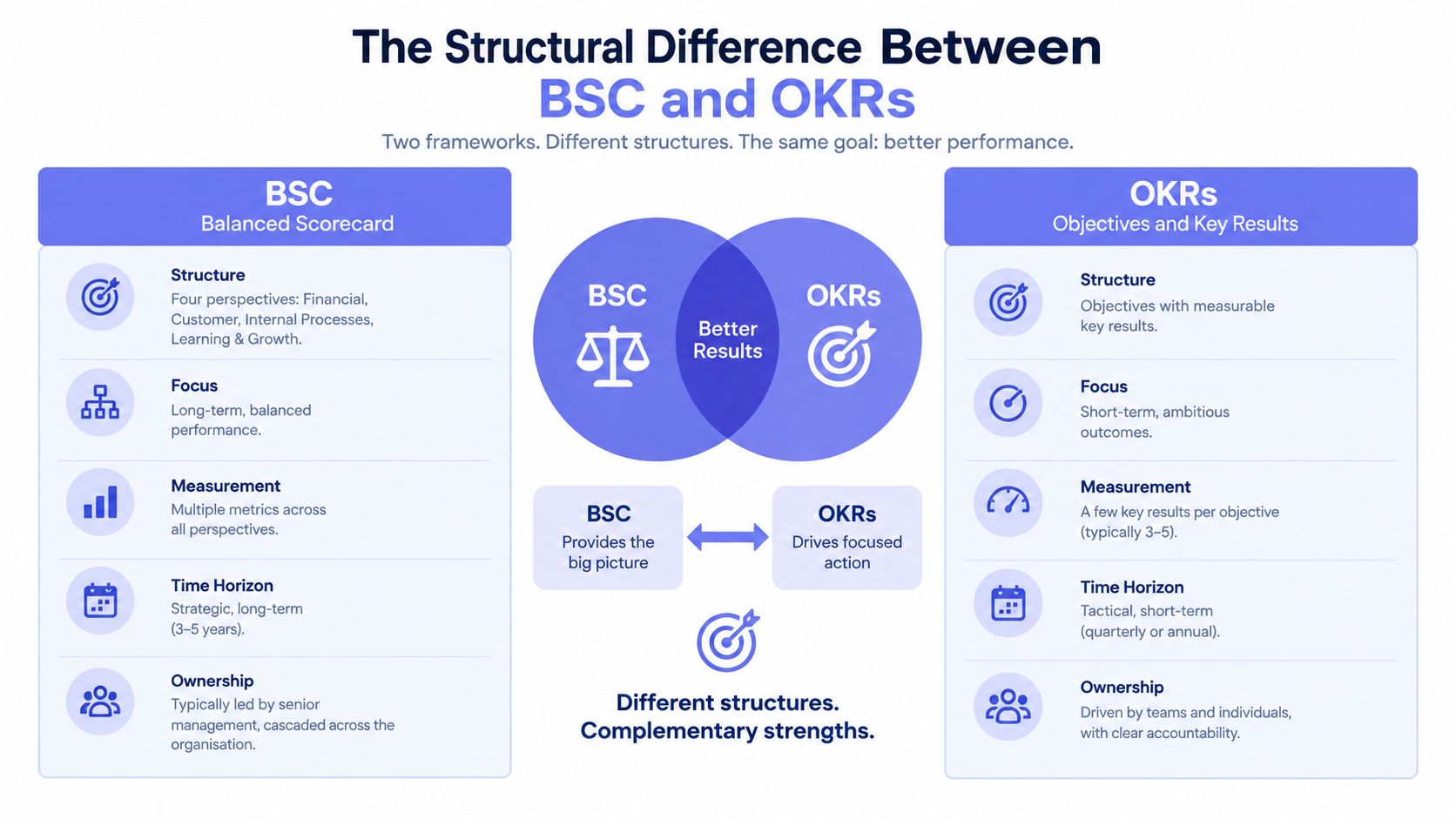
The Structural Difference Between BSC and OKRs
A Balanced Scorecard measures strategic health. OKRs organise focused change. Using both gives leaders a stable view of organisational performance and a mechanism for closing specific execution gaps.
The scorecard traditionally balances financial performance with customer outcomes, internal processes, and learning or organisational capability. UK public-sector adaptations apply the same logic in a different setting. The Public Sector Scorecard combines service-user, strategic, financial, and sustainability outcomes with enabling dimensions such as processes, capability, behaviour, and organisational factors, as described by the Public Sector Scorecard framework.
That structure makes cause and effect visible. Capability and behaviour should influence process performance. Process performance should contribute to service and strategic outcomes. Without those links, leaders are left with unrelated KPIs and little guidance on where intervention will matter.
Different jobs, different failure modes
A scorecard helps leaders assess whether the business is financially healthy, customers receive the intended value, critical processes remain reliable, and the organisation can deliver its strategy. It also brings trade-offs into executive discussions.
OKRs focus the operating cycle on a narrower set of decisions:
- Which strategic gap matters most in this cycle?
- What outcome must change?
- Who owns the result?
- What evidence will show progress?
- Which work should stop or lose priority?
A scorecard measure usually remains relevant across cycles. An OKR is temporary by design. After the outcome improves, the organisation can sustain it through the scorecard or select another gap for focused action.
Treating OKRs as routine KPIs creates predictable problems. Teams report business-as-usual numbers as key results, managers inspect activity instead of outcomes, and people optimise for target completion rather than strategic movement.
A scorecard also has limits. It can expose a worsening metric, but it does not create the focused commitment, ownership, or short review loop required to reverse the trend.
Leaders comparing performance management frameworks should match the system to the operating problem. Guidance on how to implement OKRs in Fluidwave illustrates the execution layer. Software and terminology are secondary. The discipline lies in connecting each objective to observable results and decisions.
A scorecard tells me where the system is healthy or under strain. An OKR tells me what I'm changing before the next review.
Comparing Performance Systems for Scale-ups
Scale-ups often try to use one framework for every management need. That creates tension. The board wants confidence that the business is controlled. Functional leaders need visibility of operational risk. Teams need a short list of priorities they can influence.
A Balanced Scorecard is stronger for the first two needs. OKRs are stronger for the third.
The right answer depends on the type of work, not on which framework is currently fashionable.
BSC vs OKRs Decision Matrix
| Criteria | Balanced Scorecard | OKRs |
|---|---|---|
| Primary purpose | Maintain a balanced view of strategic performance | Drive a small number of material changes |
| Cadence | Regular governance review, with measures that remain stable | Planning, check-ins, and review within a defined cycle |
| Ownership | Often assigned to executives or functional owners | Assigned to the people or teams responsible for changing the outcome |
| Alignment mechanic | Strategy map and linked perspectives | Shared objectives, visible dependencies, and aligned results |
| Time horizon | Long-term direction and organisational health | Near-term execution against a strategic priority |
| Best for | Board reporting, investment choices, risk, and operating health | Transformation, growth bets, capability shifts, and cross-functional delivery |
| Measures | Lagging outcomes plus leading health indicators | Results that demonstrate movement towards an objective |
| Main failure mode | Too many measures, weak decisions, retrospective reporting | Too many objectives, vague results, or activity disguised as outcomes |
| Leadership question | What is happening across the system? | What must change next, and who will move it? |
| Team experience | A stable view of performance expectations | A focused commitment with explicit trade-offs |
A scale-up with weak cash control, unstable service delivery, and unclear ownership needs a scorecard baseline before it launches a large OKR programme. Otherwise, leaders may pursue ambitious changes without understanding the operational constraints.
A scale-up with stable health but stalled growth needs the opposite emphasis. Its scorecard may already show the problem. The immediate need is a small set of OKRs that changes the customer proposition, sales motion, product adoption, or delivery model.
Choose by decision pressure
Use the Balanced Scorecard when the leadership team needs to compare competing investments. UK central-government procurement guidance provides a clear example. For relevant works, infrastructure, and capital-investment procurements above £10 million, departments are expected to use a project-specific scorecard that balances cost with quality, supply-chain impact, employment and skills, environmental sustainability, health and safety, and outcome benefits. The UK Government's procurement policy note shows how the framework can shape a decision before delivery begins.
Use OKRs when a known gap requires coordinated action. For example, if customer retention is weakening because onboarding depends on several disconnected teams, an OKR can align product, sales, service, and operations around a defined outcome. The scorecard keeps the wider health measures visible. The OKR concentrates effort on the intervention.
I don't recommend cascading every scorecard measure into an OKR. That turns a strategy system into a bureaucracy. Select the few gaps where leadership is willing to make trade-offs, assign owners, and inspect progress frequently.
Designing a Scorecard That Informs Real Decisions
A useful scorecard begins with decisions, not data availability.
PwC's UK finance-function benchmarking describes leading companies as developing intelligent metrics embedded in the organisation, with balanced scorecards combining financial and non-financial information. Its model assesses finance performance through business insight, efficiency, and compliance or control, including measures such as systems complexity, time to close or report, accountability, risk management, and culture. See the PwC finance benchmarking report for the source framework.
That combination matters. A falling margin is a lagging signal. Longer delivery cycles, unreliable forecasts, reporting delays, and control exceptions may explain why it is falling.
Build measures around choices
I use five design moves.
-
Start with strategic outcomes. Define what the organisation must achieve for customers, finances, operations, and capability. Don't start by listing every number already available.
-
Map the causal logic. Show how capability affects process performance, how process performance affects customer value, and how customer value contributes to financial or mission outcomes.
-
Pair lagging and leading indicators. Financial results tell leaders what happened. Delivery-cycle time, forecast reliability, capacity released, and risk exceptions can show what is likely to happen next.
-
Name the decision owner. If a measure deteriorates, someone must have the authority to change priorities, funding, capacity, or process design.
-
Retire measures deliberately. Remove a metric when it no longer informs a decision or starts rewarding activity that conflicts with enterprise outcomes.
The same discipline applies to commercial reporting. A recurring-revenue business may need a stable view of acquisition, retention, expansion, and service health. Guidance on tracking subscription revenue metrics can help finance and commercial teams clarify the measures they monitor, but the leadership scorecard still needs to show what decisions those measures support.
Keep departmental optimisation in check
Functional dashboards are useful until they create local success and enterprise failure. Sales can maximise bookings that create delivery strain. Product can increase releases while support quality falls. Operations can improve utilisation by reducing the capacity needed for improvement work.
I prevent this by requiring every departmental measure to connect to an enterprise outcome. The owner must explain the trade-off. If the measure improves while the linked customer, financial, or process result worsens, the leadership team should question the measure, not congratulate the department.
A scorecard should also record data latency and confidence. A measure updated quarterly cannot support a weekly intervention. A manually assembled number may need a different level of scrutiny from an automated operational measure.
For a practical approach to decision-making frameworks, I recommend documenting the decision, owner, evidence, review cadence, and consequence for every critical measure. That turns reporting into governance.
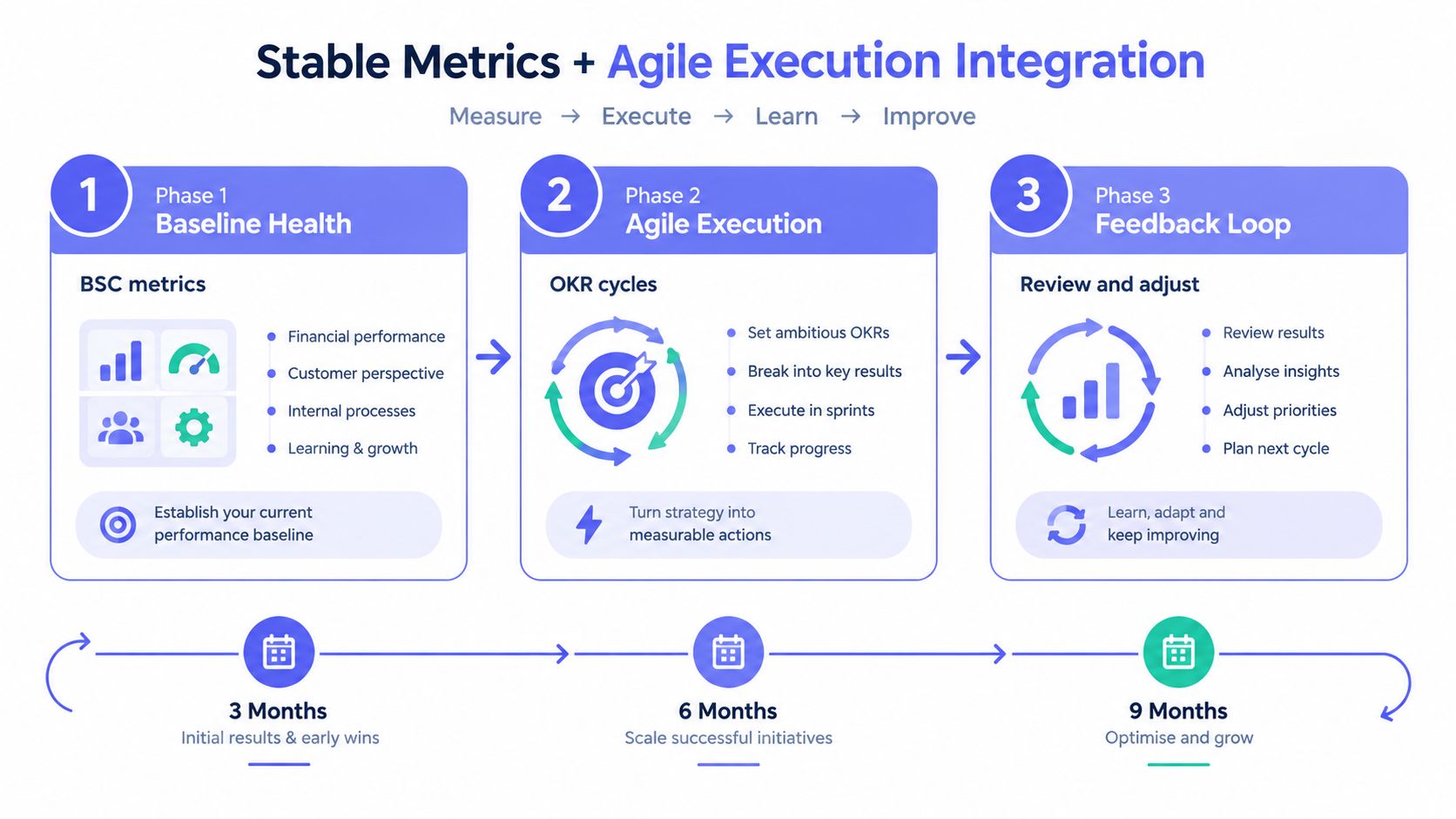
Integrating Stable Metrics with Agile Execution
The integration is straightforward in principle, but leaders often skip the critical bridge between a scorecard result and an OKR.
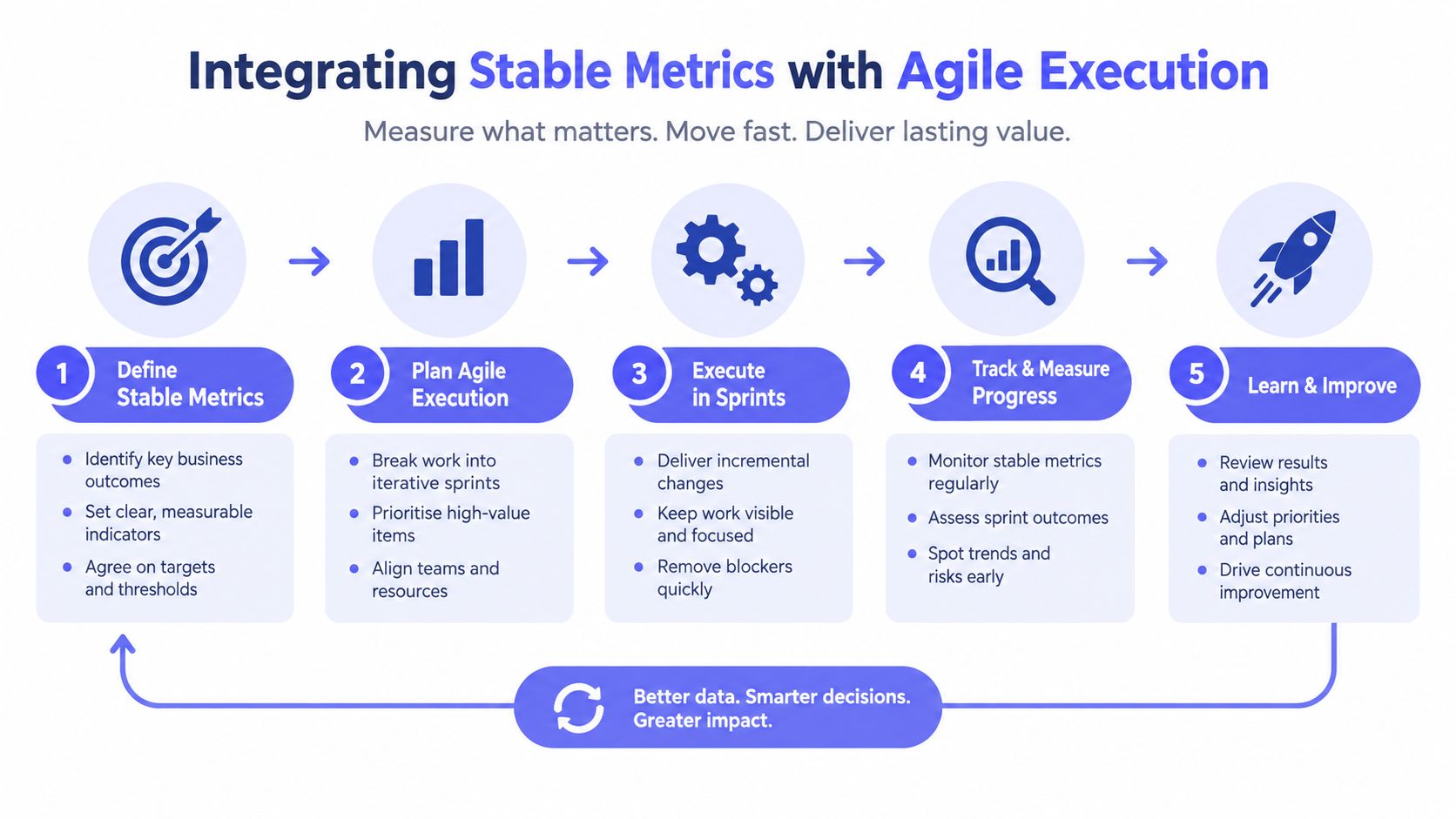
The scorecard identifies the gap. The OKR defines the change. The operating rhythm checks whether the change is moving the gap without damaging another part of the system.
Use a clear conversion process
I use this sequence with leadership teams:
- Select the critical gap: Choose a measure that requires intervention, not every measure that is below target.
- Diagnose the cause: Separate symptoms from constraints such as process friction, capability, dependencies, data quality, or unclear decision rights.
- Define the change objective: State what must be different for customers, colleagues, or the business.
- Set observable key results: Use evidence of changed performance, not a list of activities completed.
- Assign ownership and review dates: Name the accountable leader and establish when the team will inspect progress and change course.
Suppose the scorecard shows that customer onboarding is unreliable. An activity-based OKR might promise to redesign several workflows and deliver training. A stronger OKR would focus on the customer outcome, then use the workflow and training work as interventions only if they contribute to that result.
leading indicators become useful here. They help the team detect whether an intervention is working before the final scorecard outcome moves. The team can monitor time to first value, unresolved dependencies, hand-off quality, or decision latency while keeping the customer outcome as the test of success.
Protect the scorecard from quarterly noise
Not every OKR should change the scorecard. Some commitments build capability or test a new approach. Others address a temporary constraint. The leadership team should decide which results belong in stable governance and which remain within the change cycle.
The board may need a consistent view of commercial health, customer outcomes, operational reliability, and capability. Teams may need permission to experiment within those boundaries. Combining the two gives leaders both control and adaptability.
The review conversation should therefore ask two questions:
- Did the OKR deliver the intended change?
- Did the underlying scorecard measure improve without creating unacceptable damage elsewhere?
If the answer to the first is yes and the second is no, the intervention may have optimised a local result. If the answer to the first is no, leaders should investigate the assumption, capacity, capability, or dependency before blaming execution.
Closing the Gap Between Ambition and Delivery
A missed target is evidence to examine, not proof of poor individual performance.
Research involving leaders from UK companies with turnover above £20 million found that only 18.4% achieved more than 80% of their aspirational growth goals within three years, while 41.2% failed to achieve at least 60%. The same study found that 50.4% identified talent and capability gaps as the main barrier to strategy delivery, according to FM Magazine's coverage of the UK strategy execution study. A fuller discussion of the issue appears in this guide to closing the execution gap.
Performance reviews should therefore test the conditions around delivery. A team may miss an OKR because it lacks the skills, capacity, authority, data, or cooperation needed to complete the work. A scorecard that treats every miss as an appraisal problem conceals those constraints and produces weaker decisions.
Separate diagnosis from judgement
Keep diagnostic measures separate from individual ratings wherever possible. Review the following questions:
- Capability: Does the team have the expertise required?
- Capacity: Was the workload realistic alongside business-as-usual commitments?
- Governance: Were decisions made at the right level and speed?
- Dependencies: Did another team control a critical input?
- Fairness: Did workload, opportunity, or support differ materially across groups?
- Assumptions: Did the original strategy remain valid?
This approach preserves accountability while making it more accurate. A leader should own the response when a dependency remains unresolved. An executive should own a funding decision that leaves a team without the capability to deliver. A team should own execution within the conditions it can reasonably control.
The UK government's Balanced Scorecard guidance applies the same logic to procurement. Critical success factors should inform decisions where they matter, with evidence suited to the programme stage, rather than operate as a universal checklist. See the Balanced Scorecard FAQs from the UK Government.
Operational handovers expose another execution risk. The move from experimentation to dependable delivery often fails through unclear ownership, insufficient readiness, or weak operating discipline. Loresson's guide to production handover offers a useful reference for examining that transition.
The scorecard should show the organisation's stable health. OKRs should mobilise the specific changes needed to improve it. Neither replaces clear decisions, capable people, or honest trade-offs. Connect both through an operating rhythm that turns priorities into accountable delivery. book a conversation