
The MBO appraisal form was signed in January. The targets went into a folder. By March, the leadership team has changed priorities, a critical dependency has slipped, and nobody has reopened the document. Everyone's busy, but nobody can explain whether the business is getting closer to its strategic goals.
I wouldn't start by rewriting those objectives. I'd examine who reviews progress, who can change commitments, and who decides when teams compete for the same people. Mgt by objective stalls when managers treat objectives as appraisal records rather than tools for running the business. Moving to OKRs only helps if those management routines change too.
Mgt by Objective and OKRs Side by Side
MBO versus OKRs on the criteria that matter in execution
| Dimension | Management by Objective | OKRs |
|---|---|---|
| Core question | What did each person deliver? | Which outcome must change, and how will the business know? |
| Review cycle | Usually annual, reviewed at appraisal | Quarterly objectives with weekly or fortnightly check-ins |
| Measurement | Targets, often activity or output based | Outcome-based key results with numeric targets |
| Link to pay | Often tied directly to rating and reward | Usually separated from reward calibration |
| Ownership | Manager sets, individual delivers | Shared and cross-functional, visible across the company |
| Typical failure | Targets gamed, drift from strategy | Vague objectives, ritual scoring, no review rhythm |
| Best fit | Stable roles with routine, measurable work | Changing priorities, cross-team delivery, scale-ups |
I use this comparison as a design choice, not a claim that every organisation applies either approach identically. MBO can include frequent reviews and collaborative objective-setting. OKRs can become another annual paperwork exercise if leaders neglect them.
The useful distinction is the question managers bring into the room. An individual delivery question supports accountability for an established role. An outcome question tests whether the combined work of several teams is producing the strategic change the business needs.
Keep the discipline and change the rhythm
The UK's experience of objective-based management is strongly visible in public-sector reforms after 1979, when target-setting became more systematic through New Public Management. The Institute for Government's account of public-service targets describes the emphasis on measurable objectives, professional management and accountability, alongside the risk that poorly designed targets distort behaviour.
That history matters because I wouldn't discard clear targets or individual responsibility. For stable work with predictable demand and clear ownership, those disciplines remain useful. The problem starts when a fixed personal commitment survives after the business conditions behind it have changed.
Consider a scale-up entering a new market. Sales, product, operations and finance all influence whether customers can buy and use the service profitably. Separate personal targets won't resolve disagreements about launch readiness or shared capacity.
An OKR framework built around execution gives leaders a way to organise that shared outcome. It doesn't remove the need for individual accountability. I still want a named person responsible for moving each result and escalating obstacles.
Practical test: Pick a current objective. Does it name an outcome, a single accountable owner and a review date? If it fails two of those three checks, I'd treat it as an appraisal target, not a management tool.
The difference isn't the form. It's whether managers use the objective to make decisions while there's still time to influence delivery.
Agree What Good Performance Means Before You Cascade
91% of employees considered their organisations high-performing, compared with 79% of leaders, in UK and Ireland survey findings. The same research reported that 41% of leaders expected their organisation to be high-performing in 2025, against 66% of employees, a forward-looking expectation at the time of the survey, not a confirmed outcome (FM magazine's analysis of performance perceptions).
I'd resolve that kind of disagreement before cascading objectives. A team can meet its targets while its chief executive considers the quarter disappointing. Both judgements can be internally consistent if they rely on different definitions of success.
A green dashboard can hide the wrong result
Consider a hypothetical scale-up whose marketing team meets its lead target. The marketing director reports success. At the board meeting, the CEO asks why the qualified pipeline hasn't improved and why sales conversion remains weak.
Marketing has measured contact volume. The CEO has judged commercial contribution. Nobody agreed whether the target represented an output or evidence of a business outcome.
I wouldn't fix this by adding another dashboard. I'd settle the disagreement about what the existing measures are supposed to prove. Where commercial performance is central, Stewart Accounting Services' guidance to align your KPIs with profitability goals provides a useful reference point for that discussion.
Run the definition check before setting targets
-
Collect independent answers. Ask executives, managers and two or three team members to write separately what good performance would look like in six months. Don't start with a workshop where everyone copies the most senior person's language.
-
Classify the answers. Separate activity, output, outcome and impact. Running campaigns is activity. Generating leads is output. Improving qualified conversion is an outcome. Profitable growth is the broader impact those changes should support.
-
Expose conflicts and assign a decider. If sales wants more leads while marketing wants tighter qualification, name who settles the trade-off. Leaving both commitments intact doesn't create alignment.
-
Agree the evidence in advance. Define the measure, baseline, reporting source and conditions that would demonstrate success. My guidance on writing measurable outcomes develops that distinction between completing work and changing performance.
I'd also test the proposed measures against an awkward result. Could the team hit the target while making the customer experience worse or increasing unprofitable demand? If so, the definition needs a guardrail.
The aim isn't consensus on wording. It's agreement on what evidence counts and who decides when definitions clash.
Why Clear Objectives Still Fail in Execution
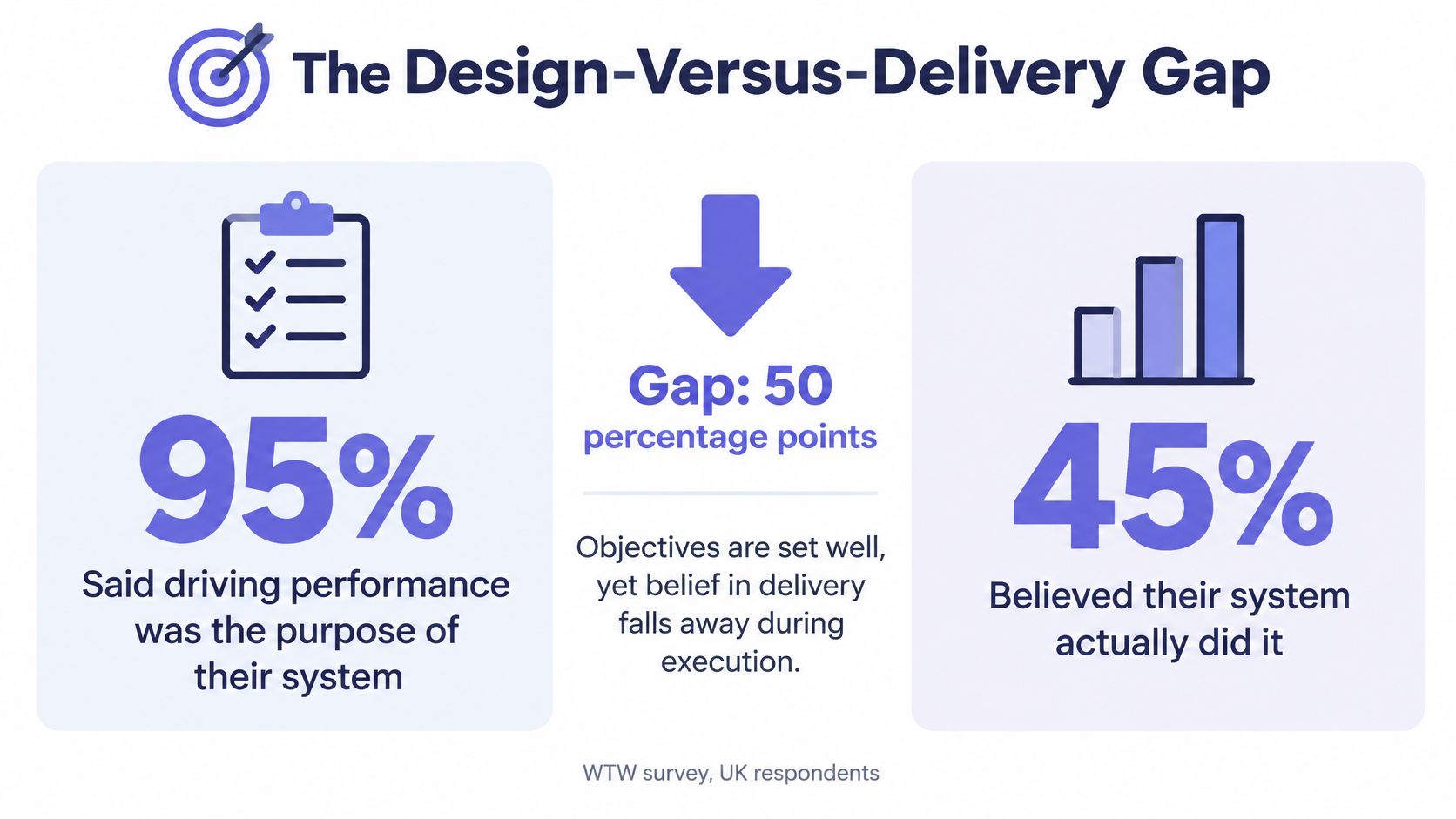
In WTW's survey, 95% of UK respondents said driving organisational performance was a key objective of performance management, but only 45% believed their programme achieved it. That's a 50-percentage-point gap between purpose and perceived delivery (WTW's UK performance-management findings).
I read that as a reason to inspect the management system, not merely improve the wording of objectives. Leaders can approve a convincing cascade while leaving managers without the authority or meeting discipline to resolve delivery problems.
Connect the work without creating a reporting hierarchy
I connect organisational outcomes, team deliverables and individual contribution explicitly. At each level, the record needs a measurable result, an accountable owner, a review cadence and documented dependencies.
That doesn't mean copying the corporate objective into everyone's appraisal. The organisation may need customers to reach value sooner. A product team might address activation friction, while an operations team changes onboarding support. Individual contributions should explain who does the necessary work, not pretend each person independently controls the whole result.
Dependencies need more than a team name in a spreadsheet. I want to know what must arrive, when it's needed, and who can resolve a disagreement about its priority.
Consider a hypothetical product launch. The payments team moves a dependency back by two sprints because a regulatory commitment takes precedence. The product manager misses her launch objective and faces a poor rating.
The delivery miss is real. The judgement about her performance is not yet justified. I'd first establish when she knew, whether she escalated, what alternatives she proposed, and who authorised the competing commitment.
A missed objective is a signal to diagnose, not a verdict on the person.
Diagnose the cause before choosing the response
Missed objective causes and the right first response
| Cause | First response | Who decides |
|---|---|---|
| Priority changed | Reset the key result and reallocate capacity | Leadership team |
| Dependency slipped | Escalate to the owning team's lead within one week | Both team leads |
| Capacity lost | Cut scope or defer the lowest-ranked objective | Objective owner and sponsor |
| Capability gap | Agree a coaching or training plan with dates | Manager and individual |
| Genuine underperformance | Hold a direct conversation and set a support plan | Manager with HR |
These are operating rules I recommend, not a substitute for judgement. A dependency problem can coexist with weak escalation. A capacity problem can reveal that a manager accepted commitments without checking availability.
Record both issues separately. Otherwise, leaders either blame an employee for a structural problem or excuse avoidable behaviour because the wider situation was difficult.
Make the weekly review a decision meeting
I recommend a 20-minute weekly check across the team's key results, with evidence updated beforehand. Discuss changes in the measure, confidence in delivery, blockers and decisions required. Don't let each owner recite completed tasks.
Flag variance in the week it becomes visible. Give each unresolved issue a decision owner and a deadline. If the team can't settle it within its authority, escalate a clear choice, including what each option would delay or stop.
The evidence supports looking beyond objective-setting alone. In the CIPD Good Work Index 2023, based on a UK-wide survey of 5,000 employees, 48% reported specific job objectives and 28% experienced systematic performance management. Among those with systematic management, 89% said they achieved their job objectives and fulfilled requirements, compared with 76% among those with none (CIPD's performance-management analysis).
Those are reported associations, not proof that introducing a weekly meeting causes better performance. My practical conclusion is narrower: objectives deserve monitoring, feedback and follow-through, not just approval.
For closing the execution gap, the essential output is a recorded decision. A colour change on a dashboard isn't enough.
My routing rule is straightforward. Capability gaps and genuine underperformance go into a performance conversation. Priority, dependency and capacity failures go to leadership as trade-offs. Managers remain responsible for feedback throughout, but they shouldn't use appraisal to settle decisions leaders avoided.
How to Migrate From MBO to OKRs in Six Steps
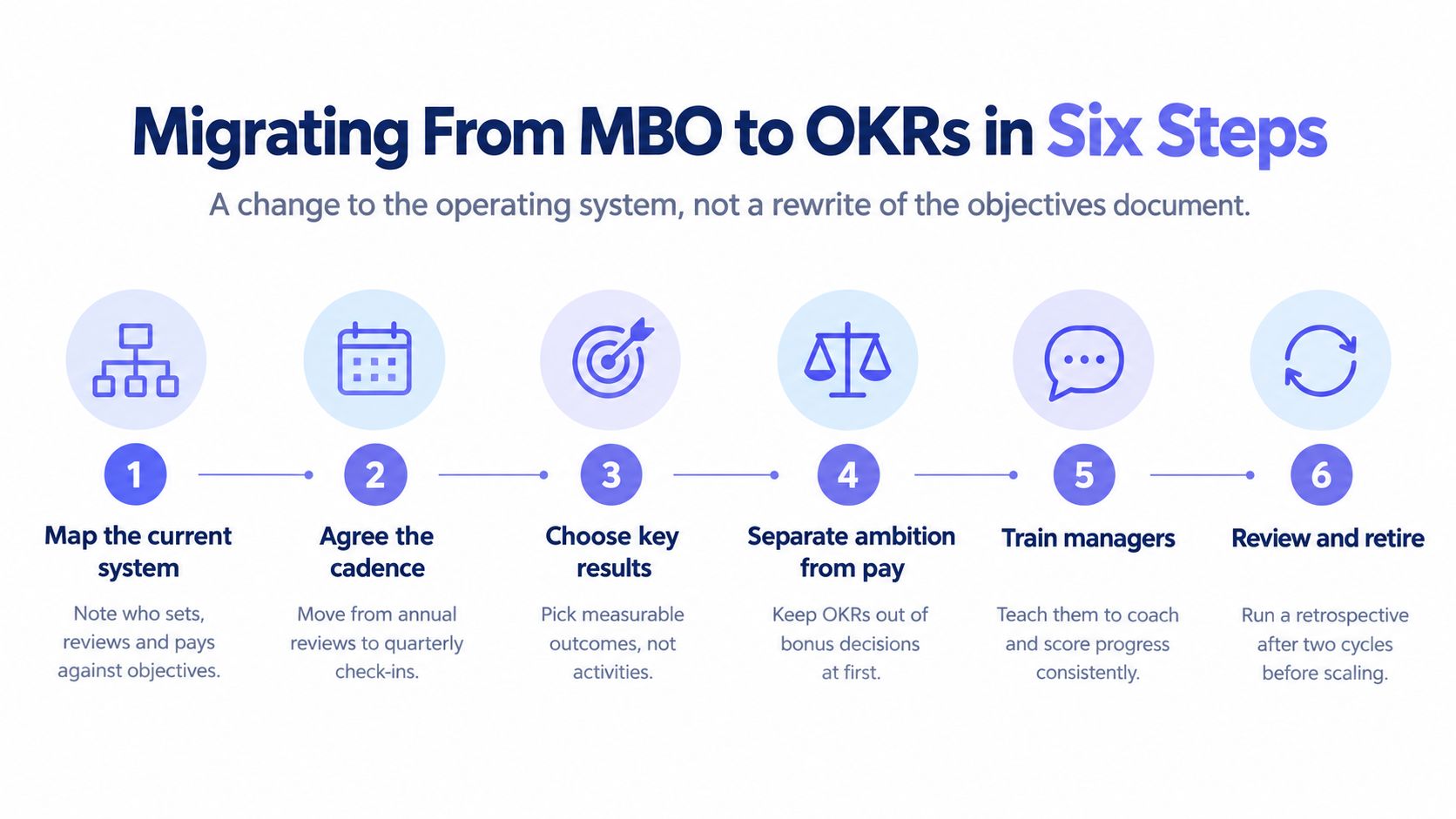
A team can rewrite every target and still stall if nobody can resolve competing demands or change the plan. Treat migration as a change to management routines and decision rights. The link between commitments, resources and timely decisions matters more than a new label.
The UK's Public Service Agreements, introduced as part of the 1998 spending review, linked objectives, targets and measures to three-year spending settlements. The World Bank's account of UK performance management offers a useful lesson: connect objectives to resources, and don't let process milestones replace outcomes.
Design the change around actual decisions
Consider a hypothetical 140-person scale-up with 22 MBO objectives. The figures are illustrative, not a client case or reported result. The migration should reveal where decisions stall, who can make them, and how teams will manage trade-offs.
-
Map the current system. Set aside two to three weeks as an initial planning assumption, then adjust for what the review uncovers. Trace who sets priorities, reviews delivery, approves changes and makes reward decisions. Check which objectives depend on the same specialists. A process map that captures formal steps but misses stalled decisions won't help.
-
Define the value gap. Record the baseline, desired state, deadline and measure of progress. A 2025 survey of 250 leaders at UK companies with turnover above £20 million and international operations found that only 46% had a clearly measurable gap, while only 18.4% achieved more than 80% of aspirational growth goals within three years (FM magazine's report on growth and execution). For the scale-up, distinguish the growth ambition from the specific customer or commercial change required. If no one can measure the movement, the ambition is not ready to guide execution.
-
Convert targets into outcomes. Start with no more than three objectives per team and two to four key results per objective. These are design recommendations, not universal benchmarks. Replace an activity, such as launching onboarding material, with evidence that customers can use the product successfully. Changing the label on an activity count does not make it an outcome.
Establish ownership before expanding adoption
-
Name an accountable owner for each key result. Shared delivery still needs one person to track evidence and raise issues. In the example, record the payments dependency beside the customer outcome it supports. The owner needs a clear route to escalate; accountability does not give them control over every contributing team.
-
Set the cadence and separate reward decisions. Schedule weekly check-ins and a quarterly review, while handling reward calibration separately. Managers should examine evidence, coach owners and distinguish delivery risks from poor performance. Combining progress reviews with bonus judgments can discourage people from raising uncertainty.
-
Pilot before retiring old targets. Begin with one or two teams while appraisal continues. Retire overlapping MBO targets only after the review rhythm has held for two cycles. State which commitments govern delivery during the pilot, so employees aren't left to reconcile conflicting systems themselves.
Migration safeguard: Don't keep duplicate target systems indefinitely. Give the pilot an exit decision, a named owner and clear evidence for whether it should expand.
For the hypothetical scale-up, the intended outcome is fewer objectives, named owners and recorded decisions after the pilot. Rewritten targets alone don't demonstrate success. A phased implementation approach gives leaders a chance to check whether managers are using the new routines before extending them across the organisation.
Cut Competing Priorities Before They Cut Delivery
Consider another hypothetical business: a 300-person company running fourteen initiatives. Every sponsor can explain the strategic fit. None can name what should stop to make room for their work.
I wouldn't ask those sponsors for better presentations. I'd ask the leadership team to rank the commitments against available capacity. Strategic relevance is necessary, but it doesn't establish that the organisation can deliver everything simultaneously.

Put the stop list beside the priorities
My rule is that a new priority must displace an existing commitment or reach leadership as an explicit trade-off. A team shouldn't absorb the conflict just because both sponsors call their work urgent.
At the start of the cycle, I'd require a stop list. It should identify work that will slow or stop if capacity becomes constrained, along with the consequences of that choice.
- Stop or slow. Name the initiative or scope that will give way, rather than promising a vague efficiency improvement.
- Protect. Identify obligations that cannot be displaced, including essential operational or regulatory work.
- Decide. Name the executive authorised to approve the change and communicate it to affected teams.
The objective cap and mapping questions from the migration process make this conversation easier. They don't replace it. Leaders still have to disappoint a sponsor and explain why another outcome takes precedence.
Make continuation an earned decision
I'd run a quarterly kill review in which each sponsor must show evidence of progress against the relevant key result. An initiative without progress must justify continued investment, change its approach or lose its place.
That isn't an automatic punishment for a difficult quarter. A strategically important experiment may produce useful evidence without reaching its target. I'd examine what leadership has learned and whether the next commitment is justified, rather than rewarding optimistic status reports.
In the hypothetical company, leadership might reduce the portfolio to four initiatives, each with an owner, a measure and a review date. Fewer stalled projects would be an outcome to verify, not a result I'd assume from cutting the list.
Capacity is only released when someone stops assigning the work, not when someone removes it from a presentation.
The practical work of managing competing priorities happens in that governance meeting. A template can expose the choices. Only leaders can make them and defend them afterwards.
Confirm Your Migration Path Before the Next Cycle
I'd judge readiness for OKRs by the decisions leadership can make, not by whether the objectives look polished. A business can have measurable targets and still lack a workable way to resolve conflict.
Before the next cycle, I'd put these questions to the leadership team:
- Outcome clarity. Which important outcome isn't moving, and has leadership expressed it as a measurable gap?
- Decision authority. Who settles the trade-off when competing objectives need the same people?
- Operating commitment. Will the weekly review rhythm continue through the next two quarters, rather than disappear after launch?
- Shared standards. Can each team describe good performance in terms the CEO would accept?
Diagnose before rewriting
If an answer is missing, I'd pause migration at that point. Don't compensate for an unresolved decision by adding detail to the template. A more precise commitment won't help if nobody has authority to resolve the conflict behind it.
The practical next step is a diagnostic of the current MBO system. Examine the value gap, differences in performance expectations, decision rights and how managers currently handle missed commitments. Use recent delivery problems as evidence, rather than relying only on descriptions of how the process should work.
That diagnostic should identify what to retain, what to change and what must be tested during the pilot. Stable operational targets may remain entirely appropriate. Cross-functional strategic outcomes may need a different management approach.
The migration succeeds when leaders make better delivery decisions, not when everyone adopts new terminology.
I help leadership teams and transformation leads fix the gap between strategy and execution by building OKRs into operating rhythm, governance and team-level decisions. To establish the right migration path for your business, book a conversation.